
























Text version of this issue
Merry Christmas, Happy Hanukkah, and Goodwill to All.
The Manufactured Housing Review readers made this the best year in the magazine’s history. Readership is up and we received more publication submissions from more authors than ever. Our editorial team excelled at finding information timely and pertinent to Manufactured Home Community Owners, Managers and Manufactured Home Retailers across the country.
May you enjoy the love this life has to offer this holiday season and unlike Rudolph above, forgive all those who trespassed against you. It’s the season of family, friends, and taking stock in what we accomplished and endured during the year.
Sweet Pit Bull
And no, he can’t live in the Park!
Don’t Bring a Knife to a Gun Fight
Knights in armor were the gold standard of warfare from about 1300 to about 1600. And then suddenly they fell from prominence due to the invention of the cannon. Virtually overnight, a calvary of splendid knights in armor could be annihilated by a single cannon that cost very little to build. It was a seismic shift and not just a temporary fad. Today, the only place where you’ll find a suit of armor is in a museum.
And that’s pretty much the same thing that’s happening right now in commercial real estate. Only instead of the advent of the cannon you have the combination of technology and Covid. Here’s the breakdown of who the players are and what their survivability looks like:
Office Buildings
This is probably the most hopeless sector in commercial real estate. Nobody needs office space anymore nor will they ever need it again. The reasons are numerous including the advent of remote work and the technology revolution, but also include the end of the “knowledge worker” at the hands of AI. The nationwide office vacancy rate is around 50% and still going down. I would imagine that probably every major office building is worth less than its mortgage. This sector is more like a knight in armor getting hit by napalm than just a mere cannon ball.
Retail Centers
While not much better than office buildings, the American retail industry at least still has a small future in housing those businesses that can’t just sell their wares on the internet (such as grocery stores and Dollar General). But let’s face it, the number of retail stores that are closing is phenomenal and only going to get worse. We’ve all been in giant shopping malls that are 50% vacant. So to invest in this niche you have to either be nuts or think you have the answer to filling all that vacant space (which
nobody has figured out yet). This sector has all the future of a knight in armor running full blast into a tank.
Hotels
Business travel is done and so are conventions. The only future that the lodging industry has is the normal consumer looking for a personal vacation. That means while a hotel on Maui might still hit its budget all those giant hotels in urban centers are as good as dead. The national occupancy rate of the lodging industry is 66%. That’s not going to even remotely cover the values that the mortgages were placed on years ago. So this sector has survivability in limited locations but if you’re talking big hotel towers in major cities then you’re just another knight facing a cannon.
Self-Storage
The surprise loser in the commercial real estate industry, the self-storage facility was once touted as being recession-proof yet now is already failing without the advent of the next recession. Nationwide self-storage is nothing more than a story of declining rents and occupancy with no upturn in sight. The industry massively overbuilt during the past few years, but more importantly there’s absolutely no restriction on supply – even office, retail and lodging have barriers based on zoning and cost. You always could build a self-storage on any corner or parcel as cheap a $7,000 per unit and – as most smart investors declared at the time – when there’s infinite, cheap supply there’s no value at all. This sector is becoming a knight vs. hypersonic missile and the shrapnel field is going to be vast.
Industrial
Your survivability in this sector is going to be based on how old your building is and who the tenant is. There’s been a lot of turnover from obsolete buildings that no longer have the desired ceiling height for modern warehousing or are simply in the wrong product line and location for the businesses in America that are still doing well. The pending recession should fire a cannon ball into the crowd and, as they say, “when the tide goes out you find out who’s been swimming naked”.
Apartments
Now we move into the first of the only two commercial real estate sectors that have survivability. Apartments are like a knight in armor where the iron plate is 10’ thick. It can take a direct hit by a cannon ball and it simply bounces off. The reason? It’s called “necessity investing” and it is based on the premise that what works in bad times are only those sectors based on basic human needs that will never reduce in demand. Of all the categories so far, this is the first one that has the power to succeed in good times and bad. The only issues with apartments are 1) the issue of how much higher rents can go, as they currently stand at around $2,000 per month and 2) the inherent, large capital needs to keep giant structures in good repair.
Mobile Home Parks
Last, but not least, on the list is the lowly “trailer park” which turns out to be the strongest of all the sectors when it comes to surviving the modern cannon ball. Just like the apartment sector, mobile home parks are all about “necessity investing” as they are the Dollar General of housing. But more importantly the lot rents nationwide are insanely cheap (around $300 per month) and could double or triple and still be cheap – which is not an option that apartments share. Additionally – and unlike each and every sector shown above – you have not been able to build new mobile home parks since the 1970s. This cap on the supply maintains extremely favorable supply/demand metrics and creates another medieval reference which is what Warren Buffett calls the “moat”: the barrier to competition that protects your investment. And finally, mobile home parks are by definition “parking lots” and have very low capital needs.
Conclusion
The commercial real estate sector is a big mess. Only two niches will emerge untouched: 1) apartments and 2) mobile home parks. Of these two, I prefer the “trailer park” as it has some unique competitive advantages. But as long as I’m not in office, retail, lodging, self-storage or industrial I’m happy. The carnage coming up for the other niches will make the worst medieval battlefield look good. Who would have ever thought that this is how the commercial real estate industry would end up? I’m sure the knights on the battlefield when that first cannon went off were equally shocked.
Frank Rolfe has been a manufactured home community owner for almost three decades, and currently ranks as part of one of the ten largest community owners in the United States, with more than 16,000 lots in 20 states in the Great Plains and Midwest. His books and courses on community acquisitions and management are the top-selling ones in the industry. To learn more about Frank’s views on the manufactured home community industry visit www.MobileHomeUniversity.com.
What is an Estoppel Certificate
Estoppel Certificate Basics
To understand the basics of estoppel certificates, look no further. With this solution, you will dive into the definition, legal significance, and purpose of estoppel certificates or letters. Knowing these sub-sections will equip you with a foundational understanding of this important legal document.
Definition of Estoppel Certificate
An Estoppel Certificate is a document that verifies specific lease terms between different parties. This certificate outlines the tenant’s current responsibilities and verifies the landlord’s promises as well. It serves as evidence of the lease’s validity and assures future parties about the present status of an agreement. By signing an estoppel certificate, a tenant agrees to accept all obligations required under their lease.
Moreover, this legal document certifies that no changes have been made in the lease without prior consent from all involved parties. The landlords must provide estoppel certificates when selling or refinancing their property to demonstrate tenants’ rights and obligations. Conversely, tenants can request for one before terminating their occupancy to guarantee that they have met their obligations satisfactorily.
It’s crucial to ensure that all necessary information is included in an Estoppel Certificate as it might be legally binding on both ends upon signing it. Each party should review the document before signing it because they will back up its clauses during any dispute or litigation later.
Don’t take chances with your lease agreements; requesting or providing Estoppel Certificates ensures transparency and avoids misunderstandings, further leading to smooth transactions.
Put simply, an estoppel certificate is like a truth serum for buildings, revealing any hidden skeletons (or leaky roofs) in the landlord’s closet.
Legal Significance of Estoppel Certificate
The Estoppel Certificate holds significant legal implications in a real estate transaction. It is a document provided by a landlord or property manager to an interested party, outlining the terms and conditions of an existing lease. The following table shows the information included in an Estoppel Certificate:
Column 1 Column 2
Tenancy Dates Start & End date of the Lease
Rental Amount The current rent being paid and when it’s due
Deposit Information
The amount held as deposit, current status, and any claims made against it
Lease Status and Terms & Conditions
The lease’s current status and any changes that may have been made along with other relevant information.
It acts as a binding agreement between the parties involved and can be used in court proceedings. It protects tenants from false claims made against them for breaches they haven’t committed. Moreover, it provides landlords with detailed information about their tenant’s lease, such as terms of occupancy, rental payments, deposits, etc.
To ensure the validity of an estoppel certificate, one must request a copy from their landlord or property manager before closing any real estate deal. They should also compare the information provided in the certificate to that stated in their lease. Lastly, misrepresenting facts on an estoppel certificate can lead to severe legal consequences.
Think of the estoppel certificate as the law’s version of a relationship status on Facebook: it’s complicated.
Purpose of Estoppel Certificate
The Estoppel Certificate serves as a legal document that verifies the rights and obligations of parties in a real estate transaction. It is necessary to ensure all parties are aware of their responsibilities before signing the agreement. The certificate confirms whether there is any breach or violation of an existing lease, pending litigation, or if any party owes financial obligations.
When requesting an Estoppel Certificate, it is essential to provide clear instructions as to what information should be included and request it from the right source. Additionally, ensure that the certificate has been reviewed and signed by all relevant parties before finalizing any real estate transaction.
It is important to note that Estoppel Certificates expire and may have limited effectiveness over time. Therefore, it is
necessary to obtain an updated version for renewal or when there are significant changes in the real estate arrangement.
To avoid confusion or disputes, parties should make every effort to cooperate and communicate clearly during this process. By doing so, both sides will have a clear understanding of their commitments, thereby minimizing the likelihood of misunderstandings that could lead to costly legal proceedings.
Obtaining an accurate and up-to-date Estoppel Certificate can save both parties valuable time and resources in negotiating new leases or transferring ownership of commercial property. Ready to spill the tea? An estoppel certificate will spill all the details about a property, leaving no room for surprises.
Information Included in an Estoppel Certificate
To provide necessary information about an estoppel certificate, focus on the section “Information Included in an Estoppel Certificate” with its sub-sections, including Property Information, Lease Information, Rent Payments and Other Charges, Security Deposits, Tenant Improvements, Lease Expiration Date, and Other Provisions. These sub-sections help to provide a clear understanding of the necessary information that should be included in an estoppel certificate, which can benefit both tenants and landlords.
Property Information
When an estoppel certificate is prepared, important property information must be included. This could consist of current rent rates, lease terms and more. Property details about current agreements, ownership, legal restrictions, and utilities also need to be in place. Additionally, any pending lawsuits or claims against the property should also be listed. Ensuring that all pertinent facts are included can help avoid future disputes between parties.
It’s vital to remember that providing only accurate information on an estoppel certificate is crucial because it can have a significant impact on the outcome of a transaction. Failing to detail relevant data could lead to problems down the line for both parties.
Pro Tip: All parties should give sufficient thought to preparing a comprehensive statement of material facts for an estoppel certificate before requesting it from each other.
Lease information? More like, lease-n’t forget to read the fine print and have a lawyer on speed dial.
Lease Information
Lease Terms Explanation
In an Estoppel Certificate, Lease Terms Explanation includes information about the lease agreement between the tenant and the landlord. It covers details such as lease commencement date, termination date, renewal options, rent amount, late fees and security deposit details.
Additional Details
It may also include clauses related to subleasing or assignment of lease rights. This section provides a clear understanding of the terms of the existing lease agreement to potential buyers or creditors.
Pro Tip
Paying close attention to lease terms information in an estoppel certificate will avoid any legal disputes in future transactions involving buyers or lenders.
Don’t be surprised if your rent payments start feeling like a form of punishment – just be grateful your landlord isn’t charging you extra for air.
Rent Payments and Other Charges
Rent Obligations and Additional Costs Information to be included in an Estoppel Certificate
Rent obligations and additional costs may play a significant role in the leasing process and can affect the property’s value. Here are some essential details that must be included in an Estoppel Certificate:
• The total amount of rent owed by the tenant, including any outstanding obligations;
• Any late fees or penalties imposed on missed or late payments;
• Security deposit amounts held by the landlord;
• Any amounts paid towards utilities, taxes or insurance;
• Any current or future reductions in rent due to lease negotiations, concessions, extensions or renewals;
• An itemization of any other charges that may have been imposed on the leaseholder, including attorneys’ fees, maintenance costs and administration fees.
It’s important to note that these terms can vary depending on local regulations and specific contract conditions. Failing to provide detailed information about these payment terms, which could influence a prospective buyer’s decision-making process, may result in legal disputes after closing.
When negotiating lease terms with different tenants over time, the specifics of any concessions made should well-documented. It is an effective approach to include such details in an Estoppel Certificate.
To illustrate this point further, a situation at hand involved a commercial real estate agent who was entrusted with selling
a property at a premium price for his client. However, the sale was delayed Largely due to inadequate rental documentation for various tenants’ leases within this building’s premises. Upon inquiries from prospective buyers it emerged that there were variations between what had been provided about them earlier versus what was documented later.
Better hold onto that security deposit tight, or else the landlord might use it as their personal slush fund for their weekend getaway.
Security Deposits
The following information are essential considerations for deposits:
• Security deposits‘ current balance
• The date when the deposit was made
• Whether interest is being paid on the deposit amount
• Any improper withdrawals from the security deposit funds
• The terms and conditions concerning whether noncompliance with the rules would result in forfeiture of the deposit.
An essential consideration regarding deposits is that each state has different laws governing their management. The terms set out by local statutes trump any lease agreement language requiring different types of deposits.
One famous legal struggle was between U.S Bank Tower landlord Douglas Emmett Inc. & Co. and United American Bank building tenants which aired at Los Angeles Superior Court.
Tenants accused Emmett of unlawfully reserving more than $1 million from deposits they had submitted over financial disputes that were not tied to any property damage.
Tenant improvements can be a real headache, but they’re nothing compared to the migraine of dealing with a non-compliant tenant.
Tenant Improvements
Commercial property leases often require tenants to make improvements or alterations to the property, known as ‘tenant fit-outs’. These improvements could include anything from installing new lighting fixtures, building partitions, painting the walls, or changing the layout of the space.
It is crucial for both the landlord and tenant to ensure that any tenant improvements comply with building codes and regulations. As such, it is recommended for an estoppel certificate to include a section detailing these improvements. This section should specify which work was done, when it was completed and whether it complied with all relevant legal requirements.
In addition to this information, other essential details should also be included in the estoppel certificate. These may include rental rates, lease terms, rights of renewal or termination, outstanding rent payments and any other obligations that either party needs to fulfill under the lease agreement.
Ensuring that all parties involved have access to accurate information will significantly reduce disputes during lease negotiations and renewals. Therefore, landlords and tenants should consider enlisting the help of a qualified lawyer/attorney to review each aspect of their lease agreements before drafting an estoppel certificate.
When it comes to lease expiration dates, some landlords might as well have written them in disappearing ink.
Lease Expiration Date
The duration of a lease agreement, from its commencement to the expiry date, is a critical aspect of an estoppel certificate. It highlights the moment when the tenant’s legal right to occupy the premises comes to an end. This knowledge is essential for buyers and lenders in assessing the current value and future investment of property assets.
It is also crucial to include any obligations or responsibilities that the landlord or tenant may have after the lease expiration date, such as maintenance or repair duties. Such details will ensure that parties who rely on an estoppel certificate are aware of their post-lease obligations.
Moreover, if there are any extensions or renewals available after the lease expiration date, it is necessary to mention them in an estoppel certificate. This information allows properties’ potential investors to consider their development projects or long-term leasing strategies.
Sources reveal that failing to disclose correct information in an estoppel certificate can lead investors and lenders into problematic circumstances – leading them into significant financial losses.
Thus, including accurate and complete information related to a lease expiration date in an estoppel certificate is vital for conducting a secure transaction around real estate.
Let’s dive into the fine print and see if we can find any hidden gems in the ‘Other Provisions’ section – or at least something to distract us from our impending existential crisis.
Other Provisions
Besides the standard provisions, an estoppel certificate may include a wide range of additional clauses tailored to the specific situation. These supplementary inclusions or special provisions can protect both the landlord and the tenant from potential disputes.
In addition to stating the current rental amount, leasing terms, and any security deposit details, other provisions in an estoppel certificate may cover obligations such as taxes, insurance, maintenance expenses, late charges, utilities or repairs responsibilities. Additionally, specific requirements for an assignment of lease and options for renewals may also be included.
It is essential to ensure that all parties agree on the manner of obtaining and exchanging estoppel certificates. Standardizing these procedures can reduce conflicts when dealing with multiple parties within a real estate transaction. Therefore, it can be beneficial if all parties use a template or legally enforceable format.
Providing clear definitions for technical terms used in an Estoppel Certificate ensures consistency throughout its provisions. The certificate should be filled out accurately by both parties or their authorized agents who have adequate knowledge about the rental history.
With proper utilization, Estoppel Certificates can avoid costly legal disputes and ease the decision-making process for complex commercial leases. It is vital to have a legally binding document signed by both parties before finalizing any commercial lease agreement. This helps to protect tenants against being held responsible for past debts and assures landlords that they will receive timely rent payments and fulfill all their lease-related responsibilities thoroughly.
When it comes to leases, ignorance is not bliss – it’s expensive. Get an estoppel certificate and save yourself some serious cash.
Advantages of Obtaining an Estoppel Certificate
To obtain an estoppel certificate with its benefits of protecting your future legal rights, benefiting lenders and buyers, and ensuring accurate lease terms. An estoppel certificate is a must-have document that eliminates risks related to leased property or assets. In this section, we’ll introduce the sub-sections briefly and help you understand why obtaining an estoppel certificate is essential.
Protects Future Legal Rights
An Estoppel Certificate safeguards future legal entitlements by confirming the current status of a tenant’s lease and whether any obligations remain unfulfilled. This document assists landlords in safeguarding their rights and binds tenants to their responsibilities under the lease agreement.
Landlords can trust a verified Estoppel Certificate to accurately outline the current tenancy status, the terms agreed upon in the lease agreement, and if any debts or obligations are outstanding. As such, obtaining an Estoppel Certificate from tenants is particularly advantageous when negotiating contracts with potential buyers or refinancing properties.
Through obtaining an Estoppel Certificate, landlords gain peace of mind and avoid unpleasant surprises down the line. A landlord can request updates on a regular basis from their tenant to confirm whether details have changed during their tenancy, further protecting landlords’ legal rights and ensuring that they receive rental income without any interruptions.
Looks like the only thing lenders and buyers can agree on is the benefits of an estoppel certificate.
Benefits of Lenders and Buyers
Lenders and buyers alike stand to gain from obtaining an Estoppel Certificate, which serves as a legally-binding document that attests to the terms of a lease or other similar agreements.
The following are the reasons why it is important to obtain an Estoppel Certificate:
1. An Estoppel Certificate provides greater transparency about the property in question, resulting in less ambiguity and fewer discrepancies between parties.
2. It is easier for lenders to identify potential risks with a property through an Estoppel Certificate, enabling them to make better-informed lending decisions.
3. Lastly, obtaining an Estoppel Certificate can minimize disputes between buyers and sellers by providing clarity on the terms of a lease or other such agreements.
It is worth noting that an Estoppel Certificate must be obtained from the correct sources, such as landlords or property managers. Failure to obtain one could result in legal disputes that can turn cumbersome and expensive.
If you are looking to buy or lend on a commercial property without complications, it is advisable to obtain an Estoppel Certificate early on in the process. Doing so not only minimizes potential risks but also reduces transaction costs associated with costly litigation should any unexpected issues arise later on.
Getting an Estoppel Certificate ensures you’re not signing up for a lease ending in a fire-breathing dragon takeover.
Ensures Accurate Lease Terms
By obtaining an Estoppel Certificate, commercial property tenants can ensure the accuracy of their lease terms. This legal document outlines the tenant’s obligations and rights under the lease agreement and verifies that all rent payments are up-to-date.
In addition to confirming lease terms, an Estoppel Certificate can also highlight any discrepancies or misunderstandings between the landlord and tenant. This may include erroneous charges or misunderstandings in regards to maintenance responsibilities.
It is essential for tenants to obtain this certificate before signing a new lease or during the renewal process as it ensures all parties involved are aware of accurate lease terms.
One notable example where an Estoppel Certificate would have been helpful was in a case where a restaurant operator sold his business, but the landlord attempted to hold the new owner accountable for unpaid rent from before their ownership. If the previous tenant had obtained an Estoppel Certificate prior to the sale, there would have been no confusion regarding rent status and lawful ownership.
Getting an estoppel certificate may seem daunting, but it’s easier than convincing your cat to take a bath.
Process of Obtaining an Estoppel Certificate
To obtain an estoppel certificate (also known as an estoppel letter) from a tenant, you need to follow a specific process. This section focuses on the steps involved in obtaining an estoppel certificate. The sub-sections include the tenant’s request for the certificate, the review and verification process, and finally, the issuance of the estoppel certificate.
Request from Tenant
When a tenant needs an estoppel certificate, they must make a formal request to their landlord or property manager. This is an official document that outlines the terms and conditions of the lease agreement and is typically required when the tenant plans to sell or sublease their space. The request should be made in writing and can include specific details that the tenant needs included in the certificate.
To ensure that all necessary information is included in the estoppel certificate, the request should specify certain details such as the date range of payments, current lease rate, any outstanding balances, and any changes to the lease agreement. This allows for a comprehensive assessment of the tenant’s account, ensuring no critical information is missed out on.
It’s important to note that timing is crucial when requesting an estoppel certificate. To avoid delays or missing deadlines, tenants should plan ahead and submit their requests well in advance of their scheduled closing dates or sublet effective dates.
According to real estate lawyer Steven Eisman, “Tenants benefit from obtaining estoppel certificates because it shows potential investors exactly what obligations they will be taking on if they purchase a piece of property.”
When it comes to getting an estoppel certificate, review and verification may sound tedious, but trust me, it beats the alternative: finding out your neighbor’s dog is actually the legal owner of your property.
Review and Verification Process
The Estoppel Certificate is an essential legal document that verifies the legal status of a property. In this context, Estoppel Certificate Verification Process or Review plays a crucial role in determining the authenticity and accuracy of information present in the certificate.
Here is a table highlighting the Review and Verification Process involved in obtaining an Estoppel Certificate:
Review and Verification Process
Action
Collect information about the property
Obtain a copy of the deed, mortgage, taxes, insurance, and other relevant documents
Examine documentation
Verify information on property ownership, outstanding liens, and other relevant information
Conduct interviews with concerned parties
Discuss with landlords, tenants, and property managers to corroborate data presented in documents
Draft Estoppel Certificate
Create a report verifying all relevant documentation
It’s crucial to note that during the process of verification of an Estoppel Certificate, it’s important to pay close attention to every detail as even minor errors could cause significant issues down the line.
Pro Tip: It’s highly recommended to involve specialized legal professionals for Thorough Reviewing and Accurate verification before signing off on an Estoppel Certificate.
Get ready to jump through hoops, because the issuance of an estoppel certificate is like navigating an obstacle course in the legal world.
Issuance of Estoppel Certificate
To obtain a document that lists all the outstanding dues and obligations related to a property, one needs to follow a specific process. This document is called an Estoppel Certificate.
In the table on the next page, we have listed the steps required for obtaining an Estoppel Certificate.
It is essential to note that each jurisdiction may have slight variations in this process. It’s advisable to consult with a lawyer or local legal authority before proceeding.
Steps Description
1 Submit a request in writing to the property management company or landlord 2 Pay any applicable fees 3 Wait for the document to be prepared and verified 4 Review and make sure all information is correct 5 Sign the document and have it notarized if required
Obtaining an Estoppel Certificate can help avoid any unexpected charges associated with a property transaction. We recommend requesting this document well in advance of any sale or lease.
Furthermore, ensuring all obligations are settled before submitting the request can expedite the process. Without an estoppel certificate, you might as well sign your name on a blank check when it comes to real estate transactions.
Conclusion: Importance of Estoppel Certificate in Real Estate Transactions.
An Estoppel Certificate is a vital document in real estate transactions as it guarantees transparency and relieves parties involved of any liability. It serves as proof of the agreement’s terms and conditions, which in turn provides clarity to all those engaged in the contract.
Moreover, its significance also lies in the way it prevents any form of conflict that may arise from misunderstandings. This certificate acts as an official record and helps to strengthen trust and communication between parties who might otherwise maintain distance, preventing smooth dealings altogether.
Another pertinent feature of this certificate is that it allows prospective buyers or tenants to evaluate all aspects of the property before they make their purchase or lease decision, thus preventing them from overlooking critical details that could potentially harm them later on.
Therefore, it is crucial to obtain this certificate as soon as possible so that both buyer and seller can proceed with a clear understanding of their obligations. The absence of one can lead to significant confusion and legal troubles at a later stage; hence no transaction should be completed without an up-to-date estoppel certificate.
Frequently Asked Questions
What is an Estoppel Certificate?
An Estoppel Certificate is a legal document that outlines the obligations and conditions of a lease or another type of agreement between a tenant and landlord or lender and borrower.
What is an Estoppel Letter?
An Estoppel Letter is another term for an Estoppel Certificate, which is a legal document that outlines the obligations and conditions of a lease or another type of agreement between a tenant and landlord or lender and borrower.
Why is an Estoppel Certificate required?
An Estoppel Certificate is required to provide specific details about a lease or other agreements to interested parties like potential buyers or lenders. The certificate ensures that all relevant information about the agreement is disclosed, assisting new parties in understanding the terms of the existing agreement.
What information is included in an Estoppel Certificate?
An Estoppel Certificate includes detailed information about the lease agreement or other types of agreements, including the amount of rent or mortgage payment, lease commencement and expiration dates, details of any security deposits or pre-paid rent, and any obligations reserved by the tenant or borrower.
How is an Estoppel Certificate used in real estate transactions?
In real estate transactions, it is utilized by potential buyers or lenders to help them understand the obligations and conditions of a lease agreement. It can also be used as a tool to protect tenants or borrowers from fraudulent lenders or buyers who may seek to manipulate the lease agreement for their benefits.
Who is responsible for providing an Estoppel Certificate?
The arty responsible for providing an Estoppel Certificate varies depending on the agreement’s terms. In most cases, it is either the landlord or lender who provides the certificate, but it may also be requested by the tenant or borrower.
GOT BUTTER?
Finally, a Tenant Screening Solution for MH Operators
Immediately reduce fraud and evictions with our simple, predictive tenant performance report.
Watch Zoey’s
Journey here: RENTBUTTER.COM
Supply Conditions Smooth, Set Stage for Texas Manufactured Housing Expansion
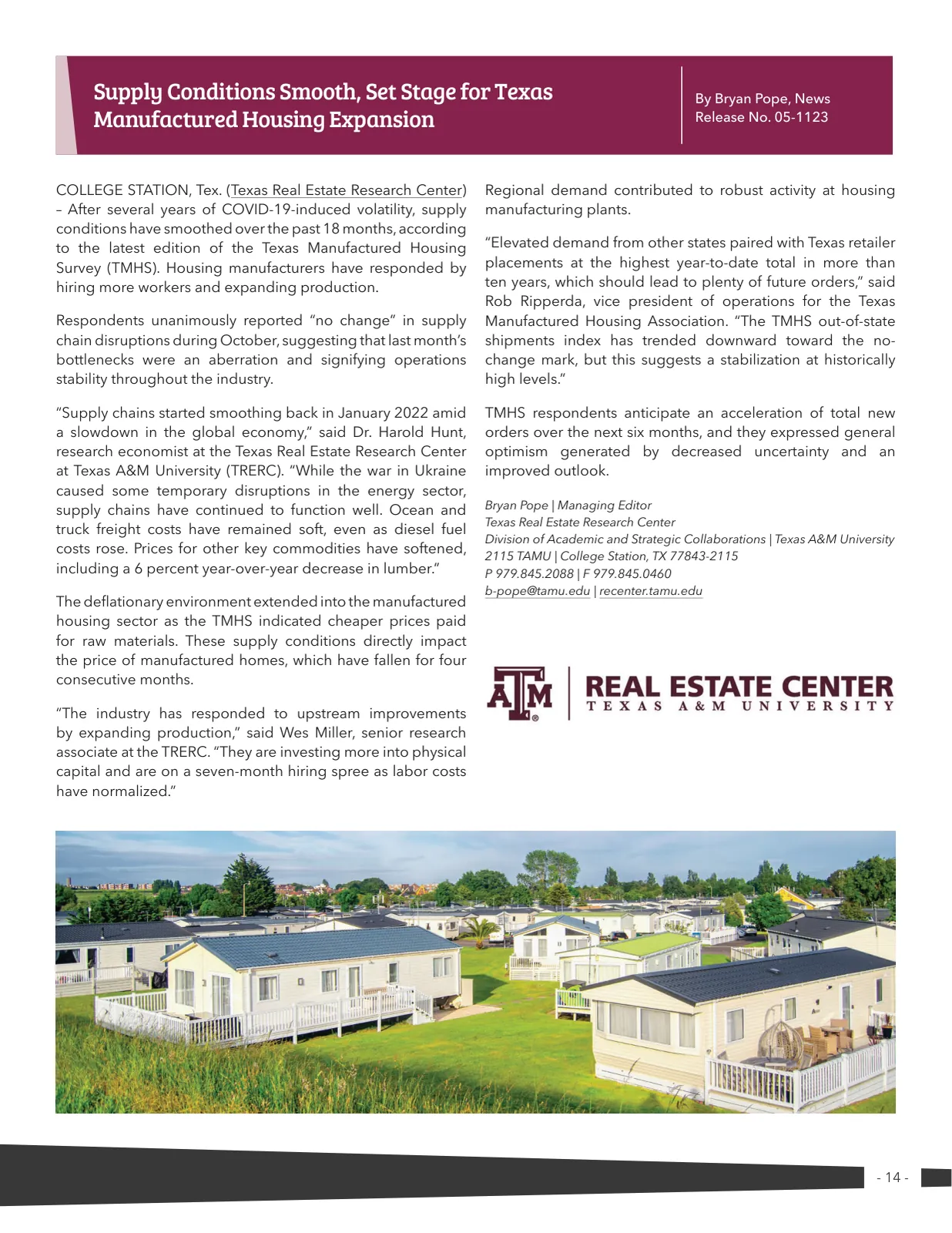
COLLEGE STATION, Tex. (Texas Real Estate Research Center) – After several years of COVID-19-induced volatility, supply conditions have smoothed over the past 18 months, according to the latest edition of the Texas Manufactured Housing Survey (TMHS). Housing manufacturers have responded by hiring more workers and expanding production.
Respondents unanimously reported “no change” in supply chain disruptions during October, suggesting that last month’s bottlenecks were an aberration and signifying operations stability throughout the industry.
“Supply chains started smoothing back in January 2022 amid a slowdown in the global economy,” said Dr. Harold Hunt, research economist at the Texas Real Estate Research Center at Texas A&M University (TRERC). “While the war in Ukraine caused some temporary disruptions in the energy sector, supply chains have continued to function well. Ocean and truck freight costs have remained soft, even as diesel fuel costs rose. Prices for other key commodities have softened, including a 6 percent year-over-year decrease in lumber.”
The deflationary environment extended into the manufactured housing sector as the TMHS indicated cheaper prices paid for raw materials. These supply conditions directly impact the price of manufactured homes, which have fallen for four consecutive months.
“The industry has responded to upstream improvements by expanding production,” said Wes Miller, senior research associate at the TRERC. “They are investing more into physical capital and are on a seven-month hiring spree as labor costs have normalized.”
Regional demand contributed to robust activity at housing manufacturing plants.
“Elevated demand from other states paired with Texas retailer placements at the highest year-to-date total in more than ten years, which should lead to plenty of future orders,” said Rob Ripperda, vice president of operations for the Texas Manufactured Housing Association. “The TMHS out-of-state shipments index has trended downward toward the no-change mark, but this suggests a stabilization at historically high levels.”
TMHS respondents anticipate an acceleration of total new orders over the next six months, and they expressed general optimism generated by decreased uncertainty and an improved outlook.
Bryan Pope | Managing Editor Texas Real Estate Research Center Division of Academic and Strategic Collaborations | Texas A&M University 2115 TAMU | College Station, TX 77843-2115 P 979.845.2088 | F 979.845.0460 [email protected] | recenter.tamu.edu
SUBSCRIBE!
Manufactured Housing Review Magazine
www.manufacturedhousingreview.com [email protected]
Special INSURANCE PROGRAMS with Industry Leading Value
Manufactured Home Retailers Manufactured Home Community Owners
Protect your Investments
INSURANCE MOBILE
800-458-4320 800-458-4320
• Retailers • Communities • Developers • Transporters • Installers
800-458-4320 [email protected]
Call or email today for a free consultation
Kurt Kelley - President
Competitive Markets vs. “Price Fixing”
By now, most everyone in the industry has seen or heard news coverage related to the class-action lawsuit, which was filed against Datacomp, and its customers. Skimming the suit, it appears to build a narrative that mobile home park owners are intentionally using ‘less than ethical’ means for establishing competitive rent pricing and must be held accountable. The key allegation in this narrative being the use of “price-fixing,” which is in fact, very illegal.
The claim of price-fixing is an interesting one to make, especially in the case of open competitive markets, such as housing and rental markets. For those unfamiliar, the term is defined as “the maintaining of prices at a certain level, by agreement with competing sellers.” Historically, price-fixing was a simple way around the laws prohibiting the establishment of a monopoly (wherein a single entity owns 100% of the market/competition). Both price-fixing and monopolies are highly illegal, because they allow for sellers to be set to any price, no matter how unreasonable, due there being no alternative options for consumers.
Bringing the case of price-fixing back to the context of competitive open markets though, and before we start thinking about our cable an internet companies and their fixed service areas, the most important (legal) aspect of the price-fixing claim is that there must be a conscious agreement between competitors, which is not the case if one entity merely matches the prices of another. Which in the case of this lawsuit, no such evidence of agreement has been submitted.
If the allegations where upheld though, it would call into question the practices of every area of real estate in the U.S.
After all, for marketability, it is common practice to keep an eye on your competitors and comparable properties, in order to set accurate and competitive prices. While oil refineries and high-end manufacturers may be subject to corporate espionage, spying on one another for the latest edge in industry standards or untapped markets, at the level of the retail outlet, simply looking across the street to verify a posted price per gallon would seem to be no real threat to the industry.
As unfounded allegations like these are often thrown about without a requirement for supporting evidence, I would like to take the next few moments to engage a bit deeper with the specifics of the concept of “price fixing.” I feel that this may be a case were ‘knowledge is power’ and supporting our community with a deeper understanding will help us all fight back, or at least feel more secure in the face of such claims against our livelihood.
1. Price-fixing is applicable in rental markets, just as it is in the sale of concrete goods, or in the cost of services… However, the danger of price fixing is that it is (or may be) used to artificially inflate and maintain the prices of goods and services which would cost less if the sellers did not conspire remove competition. Industry standards in mobile home rent is on average, $300 per month. So it is a hard case to make that when compared to other housing alternatives, that there is any artificial inflation of mobile home rental costs. In my experience, it is just the opposite. Park owners are typically “conspiring” to keep prices low, more than high.
2. Price-fixing denotes conscious organization of competitors to control the market… This is also an important aspect, as the reality of the mobile housing industry is that it is extremely fragmented. Datacomp itself (as the target of the lawsuit) only holds a small number of institutional clients, totaling less than 10% of the 44,000+ institutionally owned mobile home parks. In this case, it is not really reasonable to claim that a 10% market share holder could manipulate pricing for the entire industry.
3. Price-fixing is a legal term, which has meaning in a court of law… Many of us, myself included, hear terms like these thrown about and we take a step back. After all, how many of us went to law school, or have a property attorney in our back pocket? If we are renting mobile homes, I’d wager, not many of us. It is natural to be intimidated by intimidating/powerful language, but as stated above, the real power comes from knowledge about what these words mean, not the words themselves. False accusations are a crime. The law has a duty to protect you from these as well.
Wrapping things up, if you were concerned about the suit against Datacomp, I would encourage you to take heart, as a flock of attorneys have already taken the case. There is little evidence to support the claims against the mobile home industry, and once this lawsuit is settled, it will add a new chapter to the law history of the mobile home industry, affording us all greater protection from such claims in the future. Until the suit is over though, I would ask that each of you take the time to learn as much as you can about the types of legal terms and jargon that you may hear being flung about in relation to our livelihood. Learn the terms others use to condemn and use those same terms to protect yourself!
CJ Dees, PhD A multi-talented freelance writer with a diverse background and a passion for words. Experienced in social media marketing and professional blogging, he has learned to craft his unique insights for a multitude of audiences. An Air Force veteran and current Federal employee, his discipline and dedication are reflected in his writing. Cody is a savvy real estate investor and entrepreneur, always seeking new opportunities. His words not only inform but also inspire, making him a sought-after voice in the worlds of business and content creation.
Enhancing Safety and Efficiency
The Importance of Effective Severe Weather Monitoring for Manufactured Home Managers
Manufactured homes are an affordable and attractive housing option for millions of individuals and families. However, if not installed and anchored correctly, they are vulnerable to severe weather damage, so ensuring the safety of residents becomes a top priority for manufactured home managers.
In addition to record heat this summer, destructive storm outbreaks are capturing headlines. These seemingly sudden events make it crucial for managers to have access to reliable and timely information to protect their communities. This article explores the significance of an effective tool to monitor severe weather and highlights the value of site-specific monitoring tools to enhance safety and preparedness.
The Need for Effective Severe Weather Monitoring
Manufactured home communities often face unique challenges when dealing with severe weather. When not anchored and installed correctly, these structures are more susceptible to damage from high winds, tornadoes, and hurricanes, posing severe risks to the safety of residents. Because of their location (Midwest and Southeast), many of these communities are prone to extreme weather events year-round, amplifying the necessity for efficient monitoring tools.
While some forward-thinking communities have installed storm shelters, unfortunately, most still need this option. This leaves residents having to search out safe shelter options and develop a plan ensuring they have enough time to get to them before evolving weather threats.
The Severe Weather Process
The National Weather Service (NWS) employs a three-phase process to identify and notify severe weather. The best way to consider this is as an escalating “ready-set-go” methodology. However, the terminology the NWS uses can be confusing, so it is critical to understand what the terms mean and what people living in manufactured home communities should do as storm threats unfold.
The Ready Phase - Outlooks
Days before a severe weather outbreak is often expected, the NWS’ Storm Prediction Center (SPC) issues a Convective Outlook, rating the level of anticipated severe weather on a scale from 1 to 5. It indicates that the right conditions are present for developing dangerous severe storms that could produce damaging wind, tornadoes, or large hail. Typically, these threat zones in the outlook cover entire states or parts of whole states.
Here is an example of such an outlook with an Enhanced threat (level 3 out of 5) for the Mid-Mississippi River Valley:
Typically, most people see these kinds of depictions only during the local TV weather broadcast or through social media posts. However, it is essential to note that depending on how you use social media, you may need to see this information promptly.
Learn more about the details of Outlooks here: https://www.spc.noaa.gov/misc/about.html#Convective%20Outlooks.
The Set Phase - Watches
Once it becomes apparent that storms are beginning to develop, SPC issues watches for tornadoes or severe thunderstorms. These are generally issued several hours before storms start to form. Watches usually include multiple
counties, sometimes spread across several states. Here is an example of a tornado watch:
Also, watches can have separate designations. In the rare cases when SPC anticipates a widespread, long-lasting outbreak of intense tornadoes or destructive winds that could result in power outages, they can issue Particularly Dangerous Situation or PDS watches.
Dissemination methods must be fully equipped to explain these threat levels. For many, the nuance of the difference between a regular tornado watch and a PDS watch may take time to become apparent.
The Go Phase – Warnings
The NWS begins issuing warnings when active storms produce dangerous conditions, such as tornadoes, winds over 58 mph, or hail larger than a quarter. These are narrowly focused, short-range warnings targeting specific areas. Here is an example of a tornado warning:
People learn about these in multiple ways, from weather radios, apps, or outdoor sires. Also, TV stations may interrupt broadcasts with a live weather report or scrolling words and maps over their programming.
Often these sources don’t entirely overlap, leading to confusion, over-warning, and delays in evacuations or protective measures, putting residents and property at risk. While these sources are valuable, they often lack the specificity and immediacy required to take timely and targeted action. Usually, legacy methods, such as weather radios, know a threat is in a county but can’t indicate specifically “where” in the county.
HazardCall: An Innovative Solution
HazardCall offers a revolutionary approach to severe weather monitoring and communication for manufactured home managers. By leveraging advanced technology and real-time data, HazardCall provides managers with the tools to keep their communities safe and informed. Escalating notifications are modeled after the way weather threats escalate and are handled by the NWS utilizing “ready, set, GO.”
HazardCall delivers instant alerts to managers’ and residents’ smartphones, notifying them of severe weather threats in their specific location. In the case of life-threatening warnings, HazardCall calls residents, and they hear bi-lingual messages designed to incite action.
Text and email notifications come with details of the threat, graphic images, and safety instructions. These are designed to eliminate confusion and clearly explain the impending dangers.
Many clients use HazardCall to direct their safety processes, for example, when to open shelters or make swift decisions to protect residents and property.
Finally, HazardCall also gives managers an instant messaging platform to notify residents about weather responses and anything else going on, such as water outages, changes to the trash schedule, or community events.
Conclusion
As severe weather patterns increase in frequency and severity, manufactured home managers play a pivotal role in ensuring the safety and well-being of their residents during such circumstances. An effective tool like HazardCall can significantly enhance its ability to monitor severe weather and respond promptly to potential threats while also functioning
as a vital communication tool for ANY purpose. If your community is employing the services of such multi-purpose communication tools, you’re likely already covering the cost of having such a state-of-the-art weather safety service in place.
Utilizing HazardCall helps managers stay ahead of severe weather, prioritize safety, and foster a culture of preparedness that safeguards residents and property. Embracing such innovative solutions is not just a wise investment but a testament to the commitment of manufactured home managers toward the well-being of their communities.
Manufactured Home Loans In A Zip
The Zippy Diff erence
Full-Service Provider
We fi nance new & used homes, LTOs, RTOs, RPOs, and down payment assistance programs.
Close in As Little As 5 Days
100% digital process means loans close in a zip.
No Personal Recourse
We replaced the personal guarantee with a short-term community guarantee to better address community owners’ needs.
© 2022. Zippy, Inc. All rights reserved.
Gene Norman, Certified Broadcast Meteorologist, Senior Meteorologist
Gene is a veteran broadcast meteorologist, having earned multiple Emmy and Associated Press awards over 25 years as the Chief Meteorologist at TV stations in Atlanta, Houston, and Birmingham. In 2015, he relocated to Atlanta and represents WeatherCall – a nationwide severe weather monitoring service. This role combines Gene’s weather expertise with his passion for public safety. In 2017, Gene helped WeatherCall launch HazardCall, a messaging, and weather alerting service aiding manufactured housing communities.
Gene has given several presentations on safety and communication at various manufactured housing conferences, including SECO, MHI, and the Tunica Show. Additionally, HazardCall has been a sponsor at these conferences. In 2021 and 2022, Gene served on the organizing committee for SECO.
Innovative Funding Solutions
Community
Zippy Funding
Funding
100% digital experience
No personal guarantee
Zippy-serviced
No fees out of pocket
Community-set lending criteria
Market-set lending criteria
Contact us today to learn how to partner with Zippy!
Chris Donsbach
HEAD OF COMMUNITY PARTNERSHIPS [email protected] (865) 257-8249
Zippy is an Equal Housing Lender. As prohibited by federal law, we do not engage in business practices that discriminate on the basis of race, color, religion, national origin, sex, marital status, age (provided you have the capacity to enter into a binding contract), because all or part of your income may be derived from any public assistance program, or because you have, in good faith, exercised any right under the Consumer Credit Protection Act. The federal agency that administers our compliance with these federal laws is the Federal Trade Commission, Equal Credit Opportunity, Washington, DC, 20580.
Home lending products off ered by Zippy Loans, LLC. Zippy Loans, LLC is a direct lender. NMLS #2189776. 2807 Allen St., Suite 335, Dallas, TX 75204. Not available in all states (www.nmlsconsumeraccess.org).
Finding Vendors Shouldn’t Feel Like A Game
Here are a couple of methods you can use to ensure your projects are noticed and not neglected, by vendors who know and serve our industry as finding vendors should not feel like a game.
Recently as my granddaughters are getting older, we’ve started playing a favorite childhood game of hide and seek. Either I am really good at hiding or their 4- and 2-year-old minds aren’t the best at seeking, but I find myself having to give them clues to my hiding spots.
It usually starts with a small whistle or something and then as they get closer, I’ll even whisper their names so I can be found. Then I have to react with great enthusiasm once I’ve been discovered, only to reset the game and do it all over again.
As a housing provider, I feel like this same type of game takes place whenever I have a service need at a property, only this time it is the vendor for a particular service who seems to be hiding and I’m trying desperately to find them. Unfortunately for me, they aren’t always wanting to be found and aren’t really giving me any clues to their whereabouts.
One of the challenges that we as small to midsize housing providers face on a regular basis is finding vendors that will work on our projects. In a world where private equity seems to be gobbling up small businesses with regularity, we are often forced to use large vendors who treat us more like a number and less like a customer they are trying to acquire.
In an economy and workforce where these things are so challenging, here are a couple of methods you can use to ensure your projects are noticed and not neglected, by finding vendors who know and serve our industry.
Join a Local Association
For most of us, there are associations in and around our local areas that are dedicated to promoting and supporting people just like you.
These associations share market updates and best practices to help everyone from the newest landlord to the seasoned veteran. One other great thing about associations is that they almost always have a supportive group of local vendors that belong to their association, vendors who can repair just about anything that can go wrong on your property.
By being part of an association, they are already showing their commitment to our industry and using them when things break at your property can be a reward for their loyalty to housing providers. These smaller vendors provide the same quality of work for a better price since they are not trying to satisfy the shareholders involved with private equity.
Ask Your Fellow Housing Providers
One of the best parts of being an investor and housing provider is the great community that exists among us.
If you are new to the business or new to an area, find a local person who is in the same situation and start asking questions. Who do you use for (fill in the blank)? Why do you use them? How much on average do they charge for this type of service? How are they when interacting with tenants? You’ll quickly find the vendors that you want to seek and also those you may want to hide from.
Use a Vendor Management Service
We’ve all seen or heard the ads for vendor management services; they seem to be on most channels of communication multiple times a day. When looking for vendors this way, be cautious.
Always read the reviews and when necessary, call the vendor and ask about specific reviews that you may have seen. Ask questions about both professional and criminal background qualifications that they use when hiring employees to represent them. Incorporating the first two principals, ask if
SUBSCRIBE! they are part of any local associations or if they provide service to other housing providers in the area.
In short, exercise your due diligence in procuring the right vendors for you and your jobs, not just ones that pay the price for national or local advertising. As a company, we have developed a service called VendorVIP that is focused on identifying the right contractors and then connecting them with housing providers.
No more closing your eyes and counting to ten; when it comes to managing your property, leave the games to others and get serious about finding the best vendors available. By using the resources available to you in your local community, you can more easily find the vendors that will most benefit your investment and your bottom line.
Scot Aubrey is Vice-President of Rent Perfect, a private investigator, and fellow landlord who manages short-term rentals. Subscribe to the weekly Rent Perfect Podcast (available on YouTube, Spotify, and Apple Podcasts) to stay up to date on the latest industry news and for expert tips on how to manage your properties. To learn about VendorVIP, visit web.vendorvip.com/vvweb/
Manufactured Housing Review Magazine
www.manufacturedhousingreview.com [email protected]
How Much Is Capital Gains Tax in Real Estate?
If you own an asset for less than a year, you’ll owe short-term capital gains tax on it. The IRS taxes these short-term profits at the regular income tax bracket rates. For example, if you pay taxes at the 24% tax bracket, you’ll owe Uncle Sam 24% of your short-term capital gains from that year.
If you hold an asset longer than a year, the IRS taxes your gains at a lower tax rate. Expect to pay 0-20% (exact tax tables below).
Another crucial difference between how capital gains are taxed versus ordinary income: you don’t pay different tax rates for different income segments. If your total taxable income is above the threshold for paying 15% capital gains tax, all of your capital gains are taxed at 15%.
For example, say you earned $150,000 last year, of which $50,000 were long-term capital gains. You pay 15% of the total capital gains, rather than paying 0% on one portion and 15% on another (the way that ordinary income tax brackets work. You’d pay a total capital gains tax bill of $7,500 for the year.
Short-Term vs. Long-Term Capital Gains
Before diving into individual strategies to avoid real estate capital gains taxes, you first need a baseline understanding of short-term versus long-term capital gains.
If you own an asset — any asset — for less than a year and then sell it for a profit, the IRS classifies that profit as a short-term capital gain, taxed at your regular income tax rates. For example, say you flip a house and earn a $50,000 profit on top of your $85,000 salary. As a single person, you would pay taxes on that extra $50,000 in income at the 24% federal tax rate.
Regular income tax rates, and therefore short-term capital gains tax rates, read as follows in 2023:
Tax
Rate Single Married Filing Jointly Head of Household 10% $0 – $11,000 $0 – $22,000 $0 – $15,700
12% $11,001 – $44,725 $22,001 – $89,450 $15,701 – $59,850
22% $44,726 – $95,375 $89,451 – $190,750 $59,851 – $95,350
24% $95,376 – $182,100 $190,751 – $364,200 $95,351 – $182,100
32% $182,101 – $231,250 $364,201 – $462,500 $182,101 – $231,250
35% $231,251 – $578,125 $462,501 – $693,750 $231,251 – $578,100
37% $578,126 and up $693,751 and up $578,101 and up
But when you own an asset for more than a year and sell it for a profit, the IRS classifies that income as a long-term capital gain. Instead of taxing it at your regular income tax rate, they tax it at the lower long-term capital gains tax rate (15% for most Americans).
Here are the long-term capital gains tax brackets for tax year 2022:
Capital Gains Tax on Home Sales vs. Rental Properties
The short version: homeowners get an exemption on capital gains tax (under some circumstances). Landlords don’t.
Capital Gains Tax Rate Single
0% $0 – $41,675 $0 – $83,350 $0 – $55,800
15% $41,676– $459,750 $83,351 – $517,200 $55,801 – $488,500
20% $459,751 and up $517,201 and up $488,501 and up
Additional Net Investment Income Tax
3.8% MAGI above $200,000
Married Filing Jointly Head of Household
MAGI above $250,000
MAGI above $200,000
Single homeowners can avoid capital gains tax on the first $250,000 of profits; married homeowners can dodge capital gains tax on up to $500,000. They must have lived in the property for at least two of the last five years however. That means second homes or vacation homes don’t qualify (more on the Section 121 exclusion below). House hackers who live in a property with up to four units, or a single-family property with an accessory dwelling unit, do qualify for the exclusion.
And the long-term capital gains brackets for 2023:
Capital Gains Tax Rate Single
Married Filing Jointly
Head of Household
0% $0 – $44,625 $0 – $89,250 $0 – $59,750
15% $44,626 – $492,300 $89,251 – $553,850 $59,751 – $523,050
20% $492,301 and up $553,851 and up $523,051 and up
Additional Net Investment Income Tax
3.8% MAGI above $200,000
MAGI above $250,000
MAGI above $200,000
The easiest way to lower your capital gains taxes is simply to own the asset, whether real estate or stocks, for at least a year.
Read the entire article
G. Brian Davis is a landlord, real estate investor, and co-founder of SparkRental. His mission: to help 5,000 people reach financial independence by replacing their 9-5 jobs with rental income. If you want to be one of them, join Brian, Deni, and guest Scott Hoefler for a free masterclass on how Scott ditched his day job in under five years.
How to Avoid Becoming a Crooked Contractor’s Victim
Because you are a savvy landlord, you routinely run background checks on your prospective tenants. You know these screenings are the best way to keep out undesirable renters while protecting your investment. But are you aware that it is just as important to screen the contractors you intend to hire?
Think about it. Hiring the wrong contractor can result in damage to your property, delays in completing a project and a significant amount of financial loss. In other words, hiring someone without vetting them first will probably be the worst decision you make all year.
The Case of the Disappearing Roofer
For example, you see that a new roof is being installed on the building down the street from your apartment building.
Seeing the project reminds you that your tenants are complaining about your building’s leaking roof. Maybe this is a sign that it’s time to fix it.
After you take a cursory look at your neighbor’s job, you ask the contractor for his business card and then ask him to stop by to give you an estimate on re- roofing your place.
Later that day, the roofer comes by, has a brief look at your job and gives you a quote that is too good to be true. So, you hire him to begin the following week. After all, your neighbor thought the man was good enough to replace his roof, so it follows that he should do a good job on yours. Right?
You have determined that much of the leakage is due to the interior gutter system, which the new roofer redesigns to take advantage of existing overflows. This shortcut will make them the primary drainage to create a better flow. He shows you the finished work and it seems to be OK. You’re not a roofer, so you trust him and pay for the job.
About 15 months later, your roof collapses following a night of heavy rain. The weight of the nine inches of water accumulated at the drain causes extensive damage to the building.
Inspection shows that the contractor did not install the overflows although he was paid to do so and he is suddenly nowhere to be found.
How could this situation have been avoided?
A belated investigation into the roofer’s background reveals that not only doesn’t he have a state roofing contractor’s license, he has been sued many times for sub-standard work. In other words, he was completely unqualified to do this type of work.
In just a few minutes, lnfomatchPlus.com could have saved you from untold hours of contending with insurance companies, bankers, more contractors and a building full of angry tenants. You would have known immediately that this fellow is not licensed to be a roofer and has liens and lawsuits to prove it.
If It Ain’t Broke, He’ll Fix It
Your tenant in a single-family home you own calls to tell you that a hose blew on the water heater and the area around it is flooded. Of course, it’s late on a Friday night and your regular plumber is nowhere to be found. So, you Google local plumbers and finally find one that is willing to go to the home that night.
This would be the time you should visit lnfomatchPlus.com to quickly run a background screening on this plumber you do not know. In an instant, you will know if he is a licensed plumber, has a criminal record, liens and judgments against him and even if he is a sex offender. But you trust Google and give the man the address of your rental.
When you meet “George,” he immediately says, “Fixing this heater is going to cost ‘big money.”’ He fixes the hose, examines the water heater’s electrical system and announces it’s going to be $1775 to repair it. Since it’s Friday night, he asks for a check or cash, which you pay.
The next day, your tenant decides to play back their indoor security footage and watches George deliberately break the water heater’s circuit board. You check your bank and sure enough, the check has already been cashed. In the end, you
have to replace the unit due to George’s shoddy work while you add another lien to his collection.
lnfomatchPlus to the Rescue
These are just two examples of why you need to run lnfomatchPlus background searches on every contractor you plan to hire. Discover if the person has a criminal record, is a sex offender or a terrorist. Are they using someone else’s Social Security Number? You can also order searches for bankruptcies, liens, judgments and even ask them to get a 10-panel drug test.
Our exclusive commercial business credit reports are a crucial tool helping to provide you with the most complete and in-depth evaluation of an organization’s credit ratings data.
Investigate contractors and vendors and ensure their business is in good standing.
The cost of lnfomatchPlus searches is nominal compared to the potential losses you can incur when hiring a dishonest person or company.
Nancy Abrams · Assistant Editor · American Apartment Owners Association · (866) 579-2262 · [email protected]
Nancy Abrams has enjoyed a long career in real estate marketing throughout Southern California and Las Vegas. She formerly represented 19 Merill Lynch Realty branch offices, property managers The Roberts Companies, new home developers, including master planned communities Peccole Ranch and The Valencia Company and shopping centers for Sandy Sigel of NewMark Merrill.
Texas Housing Manufacturers Prepare for Growth Despite Rising Costs
COLLEGE STATION, Tex. (Texas Real Estate Research Center) – Increased production and sales stimulated manufactured housing activity for the seventh straight month in August, according to the latest Texas Manufactured Housing Survey (TMHS). Robust activity helped bolster the industry outlook through at least the first quarter of 2024.
“One reason for the recent optimism could be the relative stability of chattel loan interest rates compared with mortgage rates for site-built housing,” said Dr. Harold Hunt, research economist at the Texas Real Estate Research Center at Texas A&M University (TRERC). “Chattel loans are characterized by a smaller secondary market, and lenders have more flexibility since they aren’t trying to conform to conventional rules to sell notes.”
Despite the relative stability in chattel loan rates, prices received for finished homes have trended downward for more than a year. That trend may be shifting as raw material costs jumped upward in August, and manufacturers expect ongoing increases for the rest of the year.
“Lumber and diesel fuel prices increased 5.7 and 8.4 percent, respectively, during the first three weeks of August,” according to Rob Ripperda, vice president of operations for the Texas Manufactured Housing Association. “Lumber prices have been volatile and have moved down from their intra-month peak, but diesel prices have climbed steadily since July and hit manufacturers both when shipping materials in and, even more so, when shipping homes to retailers.”
Labor costs also elevated in August, contributing to pricing pressures that are building in the industry.
“Despite raising wages, expanding payrolls, and extending workweeks, housing manufacturers are struggling to keep pace with the current flow of orders,” said Wes Miller, TRERC senior research associate. “The industry’s optimistic outlook outweighed these obstacles, prompting preparations to increase capital expenditures despite the higher interest rate environment.”
All TMHA members with manufacturing facilities in the state were invited to participate in the sentiment survey, and the survey panel represents 89 percent of HUD-code homes produced in Texas.
Funded by Texas real estate license fees, TRERC was created by the state legislature to meet the needs of many audiences, including the real estate industry, instructors, researchers, and the public. Thousands of pages of data are available at the Center’s website. News is also available in our twice-weekly electronic newsletter RECON, our Real Estate Red Zone podcast, our daily NewsTalk Texas feed, on Facebook, on Twitter, on LinkedIn, and on Instagram.
Subscribe to Center news releases here.
Bryan Pope | Managing Editor Texas Real Estate Research Center Division of Academic and Strategic Collaborations | Texas A&M University 2115 TAMU | College Station, TX 77843-2115 P 979.845.2088 | F 979.845.0460 [email protected] | recenter.tamu.edu
How To Perform Due Diligence on A Park ONLY Using AI
This article and our promise: you will take away a new resource or idea regardless of being a new or veteran park investor.
Okay, full disclosure: the title may be a little clickbaity. While AI can be used for some offsite tasks it cannot be used for onsite. That is until Due Diligence Partners unveils their first onsite droid. Some AI applications and tactics to use will be revealed in part III of this three-part article.
*** Tune in next quarter for Part II (Onsite) ***
Part I: Offsite Due Diligence – Expert Level
Let’s skip the standard Due Diligence (DD) basics which includes (1) requesting all DD docs, (2) asking about problems, and (3) doing a basic compliance audit of park licensing and zoning.
Now that you have the basics down, here is what you do:
1. Get Intense on Historical Data
A seller can’t hide all the evidence! If you don’t have at least a dozen historical maps, then you need resources. Get historical maps from EarthPro, QGIS, Maptitude, ArcGIS, USGS, Historic Aerials, and 3rd party reports such as old/new plats or surveys and Phase I.
Red flags that might impact your target value include lots that have never been used before (Why haven’t they been used, and what are the hidden infill costs?), sections that remain abandoned (Could this be related to hidden utility easements or drainage/flooding?), and the park’s history (Why was a section wiped out a decade ago? Has the layout made maximum occupancy impossible?). Your goal is to understand the history before starting onsite.
2. Zoning Doesn’t Matter
What? That’s right, just because something is zoned MHP doesn’t mean that you don’t have a usability and infill nightmare on your hands. We’ve run into this problem with many of the hundreds of parks we’ve looked at. Timing is critical here – within days of contract execution, you should have 20-30 questions for city departments to answer, while giving the city a deadline reply date that works for your DD timeline.
What to ask – ALL USABILITY/COMPATIBILITY/RESTRICTION related questions that are specific to the park you are purchasing. And ask all utility and inspection/infill related questions as well. Asking the city the right questions can help avoid so many unexpected requirements and penalties. Here are just a few examples: 400K on new owner for fire hydrants, non-reported infill inspection and prep costs of 4K per pad, lots deemed abandoned, home age restrictions, home type restrictions, abandonment by time restrictions, new requirements triggered by new owner, and unusable lots due to new code standards.
3. Assume the Worst Until Proven Otherwise
This is a motto we live by, and it keeps us out of trouble. It’s not being pessimistic - it’s being practical and helps force scrutiny. Motto #2: Remove the subjective and only accept black or white answers. Both rookie and experienced investors fall into
We hope you enjoyed reading our top three Offsite Due Diligence items to be aware of. Stay tuned for Part II next quarter – Onsite Due Diligence! the same traps time and time again – “the answer seems to be right”, “manager’s answer seems trustworthy”, “handyman’s reason for home problems seem legit” … STOP. Either learn from mistakes or hire someone that has the time to dig in. If you don’t have days and weeks to dig up the good stuff, then it is cents on the dollar of what it will save you down the road by outsourcing it.
What are some common red flags? These may include missing private utility records, missing leases (get estoppels), missing historical occupancy and move-in dates, reported strength doesn’t match historical evidence, neighboring comps that not even the park owner knows about, ALL the unreported expenses (you should have a list of 100+ possible expenses to check), expenses paid out of management or other account, why certain assets have stayed vacant or unused, and understanding the true economics if bank deposits or tax returns do not align or exist.
About the Author: Steve Edel, Partner at MHC Due Diligence Partners Serial Entrepreneur | Founder of Tech and Real Estate Companies | Multiple Company INC 500 | Acquired 50 MHCs Across Multiple States | Speaker at Industry Events Like TMHA, TexCO, and MHI Email: [email protected]
Questions? Contact: Justin Gonzales, 202-421-9636, [email protected] Managing Partner at MHC Due Diligence Partners | Real Estate, Finance, and Manufacturing Expert | Team Growth and Performance Driven | Unparalleled Customer Satisfaction Advocate
Landlord Tenant Laws
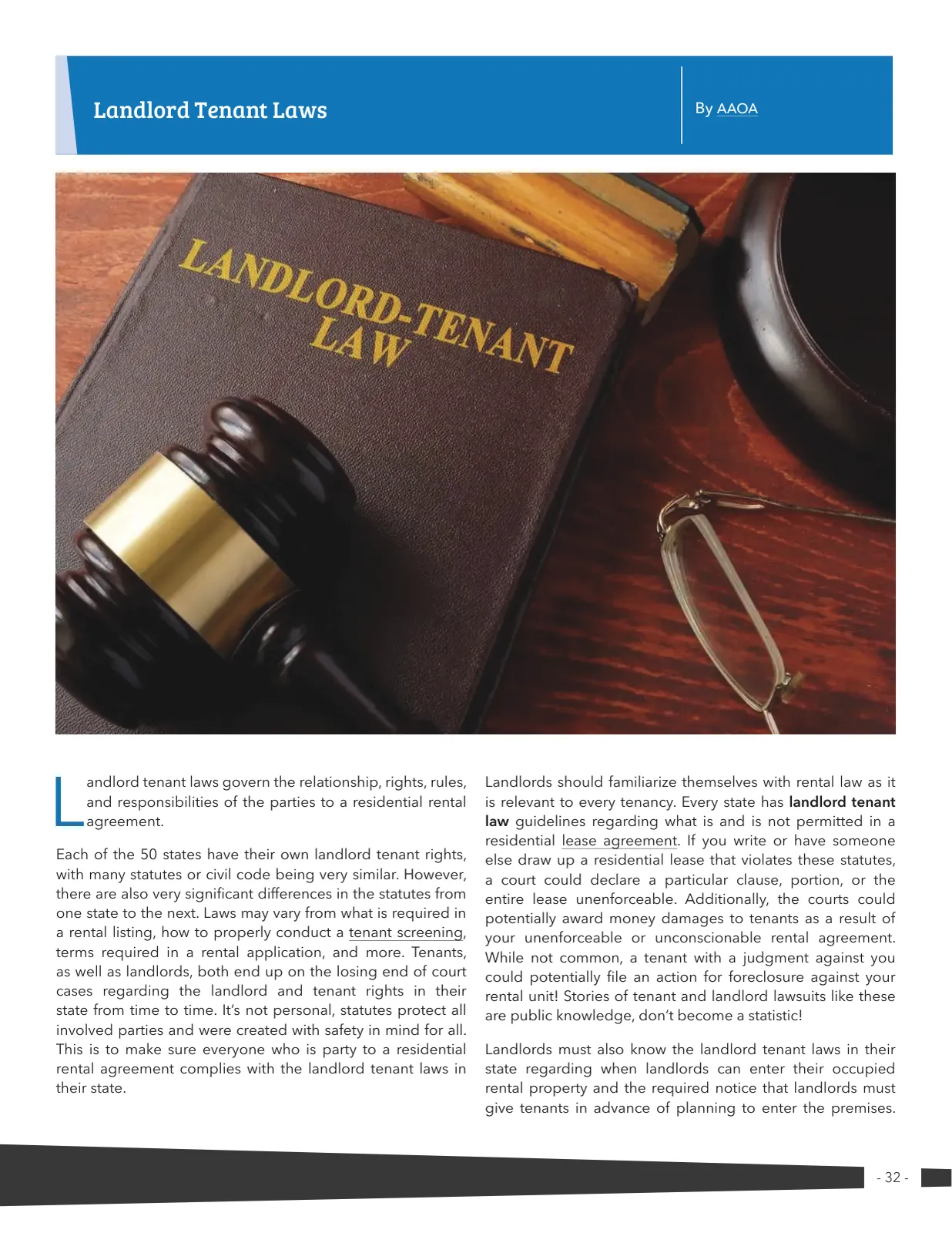
Landlord tenant laws govern the relationship, rights, rules, and responsibilities of the parties to a residential rental agreement.
Each of the 50 states have their own landlord tenant rights, with many statutes or civil code being very similar. However, there are also very significant differences in the statutes from one state to the next. Laws may vary from what is required in a rental listing, how to properly conduct a tenant screening, terms required in a rental application, and more. Tenants, as well as landlords, both end up on the losing end of court cases regarding the landlord and tenant rights in their state from time to time. It’s not personal, statutes protect all involved parties and were created with safety in mind for all. This is to make sure everyone who is party to a residential rental agreement complies with the landlord tenant laws in their state.
Landlords should familiarize themselves with rental law as it is relevant to every tenancy. Every state has landlord tenant law guidelines regarding what is and is not permitted in a residential lease agreement. If you write or have someone else draw up a residential lease that violates these statutes, a court could declare a particular clause, portion, or the entire lease unenforceable. Additionally, the courts could potentially award money damages to tenants as a result of your unenforceable or unconscionable rental agreement. While not common, a tenant with a judgment against you could potentially file an action for foreclosure against your rental unit! Stories of tenant and landlord lawsuits like these are public knowledge, don’t become a statistic!
Landlords must also know the landlord tenant laws in their state regarding when landlords can enter their occupied rental property and the required notice that landlords must give tenants in advance of planning to enter the premises.
One of the most important aspects of landlord law in any state is the statutes governing violation of the lease. If tenants fail to pay rent on time or damage the property, you cannot just throw them out, set their belongings outside, change locks or take other illegal or criminal actions. In accordance with renters landlords rights you must also supply tenants with fair and proper notices. If you fail to word notices as designated in the statutes, you could possibly lose your case in court.
Landlords must also comply with all federal laws in addition to landlord tenant laws in their state.
In addition to complying with all state landlord tenant laws, you must also adhere to all federal laws regarding housing and discrimination. Unless a particular apartment building or other type of housing is specifically designated for a particular group, such as an elderly housing complex, you may not discriminate against any applicant in any manner that violates federal laws. You cannot forbid families with children unless your apartment is for elderly or disabled adults. You cannot forbid a person or family of another race or culture from renting your property. Just as you stress the importance to your tenant that you expect compliance with the terms of your lease and landlord tenant laws, you also have the same responsibilities.
Where ever your property is located it is in your best interest, and for the security of your investment, to ensure a security deposit is provided prior to move in. The amount of security deposits paid before move in will provide you with protection against repairs and services, eviction, disputes, an unpaid utility, or other unforeseen issues. You will need to return any deposits held within a reasonable period of time as well as include a specific breakdown for any deductions.
Attorneys specializing in landlord-tenant matters can provide assistance regarding laws in your area, how to return a deposit, additional provisions for the lease agreement, or even help with an early lease termination if necessary. Sometimes a phone call with the attorney will be sufficient saving you time and money over an office visit.
Apartment rental laws in all states allow the landlord to perform a proper tenant background check. To properly screen the applicant a rental application with a signature release will be required. AAOA’s landlord forms provide this release.
It is important to recognize that landlord rights apply to the state where your rental properties are located, not where you live. If you have rental properties in more than one state, knowing the applicable statutes in each of the states is crucial. For example, California renters rights may vary greatly from Florida landlord tenant law.
We encourage you to please learn more about the landlord tenant statutes in your state. The American Apartment Owners Association website provides access to landlord tenant laws and resources to help guide you free of charge, no payment required! Although the information is free and we always have it available it does not substitute for the advice of an attorney. While attorneys may charge fees for their service, it’s good business practice to retain local counsel. Click on the state where you have rental properties to learn more.
Alabama (AL) Alaska (AK) Arizona (AZ) Arkansas (AR) California (CA) Colorado (CO) Connecticut (CT) Delaware (DE) Florida (FL) Georgia (GA)
Hawaii (HI) Idaho (ID) Illinois (IL) Indiana (IN) Iowa (IA) Kansas (KS) Kentucky (KY) Louisiana (LA) Maine (ME) Maryland (MD)
Massachusetts (MA) Michigan (MI) Minnesota (MN) Mississippi (MS) Missouri (MO) Montana (MT) Nevada (NV) Nebraska (NE) New Hampshire (NH) New Jersey (NJ)
New Mexico (NM) New York (NY) North Carolina (NC) North Dakota (ND) Ohio (OH) Oklahoma (OK) Oregon (OR) Pennsylvania (PA) Rhode Island (RI) South Carolina (SC)
South Dakota (SD) Tennessee (TN) Texas (TX) Utah (UT) Vermont (VT) Virginia (VA) Washington (WA) West Virginia (WV) Wisconsin (WI) Wyoming (WY)
Giving You Guidance.
Empowering you with the rental industry resources & education you need.
JOIN AAOA FOR FREE
SERVING YOU
139K
19YRS
MEMBERS
11K
REVIEWS
3M
UNITS MANAGED
Find Quality Tenants Learn
Reliable credit/background checks Option for landlord or tenant pay LeaseGuarantee to protect your rental income
Download Legal Forms
150+ Premium state-specific forms 20 Free landlord forms Attorney reviewed & customizable
Unlimited recorded & live webinars AAOA Today e-newsletter Free access to RENT Magazine
Grow Your Portfolio
Exclusive off-market listings Financing for your investments Vendor directory & discounts
AAOA.com 866.579.2262 [email protected]
Legal Alert! Rules for Using Criminal History to Screen Tenants
In a landscape that continually evolves, the U.S. Department of Housing and Urban Development (HUD) has once again brought to light an important regulation by reinstating the Discriminatory Effects Rule. This development holds far-reaching implications for those who navigate the property management sector. This article seeks to illuminate the intricacies of this recent move by HUD, charting its trajectory and the subsequent effects it may cast upon property management professionals.
Understanding the Discriminatory Effects Rule
Central to the ongoing battle against housing discrimination, the Discriminatory Effects Rule emerges as a paramount framework. Its primary objective is to clarify the concept of disparate impact in the context of the Fair Housing Act. Under the purview of this rule, a policy, even when neutral on its face, can be flagged if it disproportionately hampers or affects any protected group.
In layman’s terms, the Discriminatory Effects Rule is a key tool in the fight against housing discrimination. It helps explain the idea of “disparate impact” related to the Fair Housing Act. Basically, this rule says that even if a housing policy seems fair at first glance, it can still be considered discriminatory if it ends up hurting a specific group more than others.
For example, a blanket rule that excludes anyone with a criminal record from living on-site seems fair in light of resident safety. However, this rule can have a discriminatory effect based on race, national origin, and disability. Although it is not unlawful to have a rule about criminal history, there are other ways to achieve resident safety without discriminatory effects.
The Historical Backdrop: Rescinding and Reinstating
The Discriminatory Effects Rule, initially adopted by HUD in 2013, did not remain untouched by the shifting of administrative perspectives. With the turn of a new administration in 2019, the rule was recalibrated, which left some feeling that the new stance was more amenable or helpful to landlords and not so much of a protection for residents. So what catalyzed the return to the 2013 understanding? Following the 2019 alterations, a series of litigations emerged, championed by various advocacy groups. Additionally, a federal judicial intervention halted the execution of the 2019 modifications, prompting discussions about their alignment with the foundational court case that set the initial standards. This evaluative process subsequently led HUD to reinstate the 2013 version of the rule, deeming it more in line with established precedents.
Implications for Property Management Professionals
Navigating the maze of housing laws can be a formidable challenge. A critical takeaway is the absolute necessity for property management professionals to insulate themselves from disparate impact claims. This demands an acute awareness and meticulous evaluation of occupancy policies and criminal history screening practices, given their susceptibility to challenges.
The revival of the Discriminatory Effects Rule serves as a poignant reminder of the commitment required to eliminate housing discrimination. With this reinstatement, property management professionals bear the onus of ensuring their operations align seamlessly with the stipulations of the rule. By recognizing the intricate dynamics of disparate impact and proactively amending any unintentional biases, they can foster an inclusive housing environment.
Charting the Path Ahead
As we step into the future, the onus remains squarely on property management experts to stay abreast of fair housing legislation. Periodic training and continued education become non-negotiable, ensuring preparedness and adherence. With knowledge as the guiding compass, property managers can adeptly steer clear of complaints, ensuring a compliant and inclusive housing landscape for all.
In conclusion, as housing regulations evolve, professionals in the field must remain vigilant, informed, and proactive in their approach, ensuring fairness and equality in housing opportunities.
We have developed innovative, cost-effective training suites to educate our valued clients on how to protect their property, company, residents, and even their career. These courses are available for Single User and Group Accounts. Our courses are also available to you and your company whether you want to train them on our LMS, or course hosting and licensing to train employees on your LMS.
Many of our courses are offered in English and Spanish and all of our training is on demand. This means you can take the training at your convenience. From home or work, from your desktop or smartphone, our training is available to you and your employees 24/7. You can always save your progress and pick up from where you left off because we believe training should fit your schedule. All courses come with certificates of completion. Use Discount Code: mhr15 for 15% off your next course.
KATHELENE WILLIAMS Attorney and President The Fair Housing Institute Kathi Williams is one of the founders of Fair Housing Institute. FHI is the accomplished vision of Kathi who views its educational courses as the best method housing providers can use to accomplish compliance and avoid litigation. Kathi is also a partner in the Law Firm of Williams Edelstein Tucker, P.C. providing defense and preventative representation for the housing industry in all civil rights matters. During the many decades Kathi has been advising her housing provider clients, she developed a unique understanding of the most effective methods of communicating fair housing best practices through training.
SUNSTONE REAL ESTATE ADVISORS, MOBILE INSURANCE & TMHA
2024 TEXCO CONFERENCE
WEDNESDAY, FEBRUARY 28
THURSDAY, FEBRUARY 29
Welcome Reception
One Day Power Conference – Operating in Uncertain Times
THE WOODLANDS WATERWAY MARRIOTT HOTEL & CONVENTION CENTER 1601 LAKE ROBBINS DR, THE WOODLANDS, TX
Register today at TEXCOEVENT.COM
SPONSORSHIP OPPORTUNITIES AVAILABLE. CONTACT JULIE AT [email protected]
Mold in a Rental: Who is Responsible and What Can You Do?
Mold inspections are a must for landlords! They help spot and tackle any potential moldy issues in rental properties, keeping tenants healthy and safe. To ensure accuracy and avoid false alarms, hire a professional mold inspector who knows their stuff and has the right tools.
When assessing, inspect high-risk areas like bathrooms, kitchens, basements, and near windows/plumbing. Plus, use moisture meters and thermal imaging cameras to detect hidden moisture.
Based on the results, landlords should act fast to fix any issues. This may include mending leaks or improving ventilation. In some cases, professional mold remediation services may be needed.
By doing regular inspections and solving issues quickly, landlords can protect tenants’ health and their property’s value. Thus, mold inspections are vital for maintaining a safe living environment and preserving rental property over time.
Importance of mold inspection for landlords
Mold inspections are a must for landlords. It helps detect mold early, stopping costly damage and lawsuits. This keeps tenants safe and sound. Regular mold checks guarantee a healthy living environment. Mold can thrive in damp spots like bathrooms, basements, and kitchens, causing breathing troubles and allergic reactions. Landlords are responsible for eliminating health risks.
Unchecked mold can harm the structure of the property. Walls, ceilings, and floors can weaken, endangering the integrity of the home. Inspections spot the signs of moisture or mold growth, allowing landlords to take quick action.
Neglecting mold issues can bring legal consequences. Tenants may sue if they become ill from mold exposure. Landlords may be held responsible, having to pay fines or compensation.
InterNACHI found 20% of homes in the United States have mold issues. Landlords need to conduct mold inspections for tenant safety and to defend themselves from lawsuits.
Steps to conduct a mold inspection:
Do a mold inspection to maintain a safe living situation for landlords. Follow these steps:
1. Look at the outside of the property. Are there leaky roofs or broken gutters? These can be entry points for moisture and mold.
2. Inside, check bathrooms, kitchens, basements, and laundry rooms for visible signs of mold like damp walls, floors, or ceilings.
3. Use a moisture meter to detect hidden moisture. Mold grows in dampness, like from plumbing leaks or condensation.
4. Inspect HVAC systems and ventilation openings. Mold spreads from dirty filters.
5. If you spot suspicious areas or worry about mold, hire a pro to test air samples and take samples for laboratory analysis.
6. Document findings with photos and notes. This info helps when talking to tenants or contractors.
Preventing mold is better than dealing with consequences. Regular inspections and maintenance help avoid costly repairs and keep tenants safe. Inspect even if no visible mold.
Don’t wait – do regular inspections to protect your investment and people.
Interpreting the results of the inspection
Interpreting results is key. Here’s what it means:
Potential mold growth areas: Areas with humidity & poor air flow can be breeding grounds for mold. Pinpointing these helps put preventive steps in place, like fixing leaks or improving air circulation.
Mold spore count: Number of spores in the air reflects contamination level. High counts need pro remediation, while low levels can be managed with regular cleaning & maintenance.
Types of mold present: Different kinds of mold have different health risks & treatments. Identifying these helps figure out best remediation strategies & inform affected people of potential health hazards.
Extent of mold damage: Assessing damage helps landlords allocate resources properly. Minor damage may just need surface cleaning & fixing underlying issues. Extensive damage might call for more repairs or renovations.
Suggestions for interpreting & responding to the results:
1. Consult a qualified professional: A licensed inspector can give accurate assessments & steer you through the process. Their expertise ensures comprehensive evaluations & tailored recommendations.
2. Act swiftly on high levels or toxic molds: High spore counts or toxic molds like Stachybotrys need urgent attention. Professional remediation helps avoid health risks from getting worse or spreading.
3. Address underlying causes: Mold growth might be a sign of underlying issues – like water leaks, bad insulation, or poor air flow. Solving these at the root is key to avoiding future outbreaks & keeping a healthy living environment.
Interpreting inspection results thoroughly will help landlords take care of mold-related concerns in their properties, safeguarding tenants and making them happy.
Taking necessary actions based on the findings:
It’s vital for landlords to take action based on the results of a mold inspection. Here’s a 6-Step Guide to help you through:
1. Find out the extent of the mold: Work out the areas affected and judge how bad the mold is.
2. Do immediate remediation: Act quickly to get rid of the mold you can see, and tackle the cause of it.
3. Consult with experts: Call in specialists in mold removal who can guide and advise you.
4. Fix and restore: Put right any damage caused by moisture or mold, cleaning, drying and sanitizing the affected areas.
5. Monitor and prevent further growth: Regularly inspect and keep your property in order, to stop mold coming back. Deal with water leaks and dampness straight away.
6. Keep records: Save evidence of all inspections, repairs and maintenance, to show your commitment to tenant safety.
It’s also vital to talk openly with tenants about your findings, answering their queries quickly and giving them info on how you are dealing with the problem.
GreenWorks Environmental LLC report that around 50% of US homes have some form of mold, so landlords need to do regular mold inspections.
Legal obligations and responsibilities for landlords regarding mold
Landlords must be knowledgeable about local laws and regulations regarding mold in rental properties – this can differ from state to state. It’s also essential they disclose any known mold issues to potential tenants and provide them with remediation info.
Neglecting mold issues can lead to legal disputes and cause landlords to be liable for damages or health issues.
To avoid this, landlords should:
• Get professional mold inspectors
• Invest in preventative maintenance
• Educate tenants on mold prevention
An example: a tenant with respiratory problems due to prolonged mold exposure sued their landlord for medical expenses, relocation costs and emotional distress. The court ruled in favor of the tenant.
This highlights the significance of landlords fulfilling their legal obligations with regards to mold prevention and remediation.
Educating tenants about mold prevention and maintenance
Tenants must be informed of the criticality of proper ventilation. Encourage them to open windows periodically, for fresh air circulation and lower humidity levels. This can really reduce the possibility of mold growth.
Furthermore, tenants must be alert for any signs of leakages or moisture. A small leak can cause a large mold problem if not fixed quickly. They should be instructed to report any leaks right away for necessary repairs.
Cleaning habitually is also very helpful for preventing mold. Teach tenants the value of keeping their living space clean and dry. Stress the importance of wiping down surfaces regularly and cleaning up spills quickly.
Finally, it’s essential for landlords to remind tenants that their health and well-being can be affected by mold. Exposure to mold can cause various respiratory issues and allergies, which can have a negative impact on their quality of life. Taking proactive measures and following the guidelines provided can protect them from potential health risks associated with mold.
Conclusion
For landlords, a comprehensive mold inspection is critical to safeguard their tenants’ welfare.
Here are some primary insights:
• Locating probable moisture sources is essential. Leaks, condensation and inadequate ventilation can lead to mold proliferation.
• Routine upkeep and immediate repairs can avert mold problems from worsening. Rapid action is necessary to restrict the spread of mold.
• Engaging a certified mold inspector is recommended. Their proficiency and specialized apparatus can detect concealed mold and ascertain its scope.
• Documentation of the inspection procedure, including snaps and meticulous records, acts as invaluable proof in case of conflicts or court proceedings.
Moreover, teaching tenants regarding the importance of correct ventilation, reducing moisture accumulation, and informing any signs of mold at once can help prevent widespread contamination. Landlords should also think about regular follow-up inspections to guarantee that long-term mold prevention endeavors are efficient.
Pro Tip: Keep in mind that tackling slight mold issues early on saves money, time, and potential health hazards in the future. Take prompt and proactive action when it comes to mold inspection and remediation.
Frequently Asked Questions
Q: What is a mold inspection?
A: A mold inspection is a visual examination of a property to identify the presence of mold growth and determine its cause and severity.
Q: How often should landlords conduct mold inspections?
A: Landlords should conduct mold inspections regularly, especially in areas prone to moisture, such as basements, bathrooms, and kitchens. It is recommended to schedule inspections annually or whenever signs of moisture or mold are noticed.
Q: Can tenants request a mold inspection?
A: Yes, tenants have the right to request a mold inspection if they suspect mold growth in their rental property. Landlords should address such requests promptly and arrange for professional mold inspectors to assess the situation.
Q: Who is responsible for mold remediation, the landlord or tenant?
A: The responsibility for mold remediation depends on the cause of mold growth. If mold is a result of the landlord’s negligence, such as a leaky roof or plumbing issue, the landlord is typically responsible. However, if tenants’ actions, like excessive moisture accumulation due to improper ventilation, lead to mold growth, they may be held responsible.
Q: Are landlords required to provide a mold inspection report to tenants?
A: There is no universal requirement for landlords to provide mold inspection reports to tenants. However, it is good practice to keep records of mold inspections, including findings and any remediation measures taken, for transparency and legal purposes.
Q: Can mold inspections help prevent potential health issues?
A: Yes, mold inspections can help identify and address mold growth early on, minimizing the risk of potential health issues associated with prolonged exposure to mold, such as respiratory problems and allergies.
Settlements, Waivers, and Releases: Make Your Money Work
Landlords may not realize that, without a proper settlement document over tenant disputes and payments, they may cause headaches for themselves down the road.
The landlord/tenant arrangement is no different than any other contractual relationship.
Disputes often arise with accusations that one party is not living up to their obligations under the contract or applicable laws. Whether, for example, the tenant alleges their toilet wasn’t fixed quick enough or that the landlord unlawfully entered the premises without notice, money often changes hands as a result. The goal of this is obvious: pay money, make the problem go away. Many landlords mistakenly pay their tenants when a dispute arises, doing so through simply cutting a check and, at best, a “thank you” from their tenant. These landlords do not realize that, without a proper settlement document, they may have only caused more headaches for themselves down the road.
Payment of monies to a tenant without an agreement in place as to “why” and “for what” rests on several faulty assumptions: First, that the tenant agrees that they have been fully compensated for that claim or issue; second, that the tenant has no other claims or issues they feel need compensation; and third, that they won’t bring those claims later seeking further compensation.
In essence, the landlord assumes that their payment fully contracts their problems away entirely. If/when their tenant files suit alleging those claims, the landlord is usually shocked to learn that their money was handed out almost for nothing, as litigation costs usually dwarf that initial payment. What should happen, along with that exchange of that money, is the execution of a settlement agreement releasing any claims that may exist.
The necessity of a document evidencing the agreement is found in principles of contract law. Settlement agreements are contracts, subject to the basic rules of contract law. If you have reviewed a written settlement agreement, they usually contain waivers and releases dealing with any/all claims that exist as of the date of that agreement. As you can imagine, broad waivers and releases (which would protect the landlord) are usually not something non-lawyers discuss during conversations related to compensation. Even if those discussions arguably took place, in my experience, they would likely be denied/rejected by the tenant and disregarded by the court due to the lack of a document evidencing the same. Thus, verbal agreements are rarely enforceable and therefore not recommended.
A basic component of contract law is that the parties’ intent controls. For any release to be valid, there must be both knowledge of the existence of a claim and an intention to relinquish it, in the absence of a specific promise to release liability for unanticipated claims. Without a document evidencing such an intention, there is no evidence that the payment covers/releases every claim available. The court likely won’t save the landlord from the new claims filed by the tenant, barring unusual circumstances, leaving the landlord footing the bill for a fight they likely thought they had resolved.
While it’s easy to throw money at a problem, it’s important to make that money work.
If you have a dispute with a tenant in need of resolution, settlement documents related to these discussions are common. If a tenant refuses to sign any documents addressing the compensation provided, you may want to reconsider that payment until they are ready to properly document the understanding of the parties. At a minimum, you should document your efforts to settle the matter in writing, so that if the issue escalates, it can be helpful in the future.
Without these things in mind, you may be throwing your money down the drain.
Bradley S. Kraus is an attorney at Warren Allen LLP. His primary practice area is landlord/tenant law, but he also assists clients with various litigation matters, probate matters, real estate disputes, and family law matters. You can reach him at [email protected] or at 503-255-8795.
MANUFACTURED HOUSING & RV GROUP
Maximize Your Park
Value the market is seeing record breaking prices for manufactured home properties and RV resorts as well as never- before seen deal velocity. We will
Michael J. Nissley
Bruce Nell, MAI, MRICS, AI-GRS
National MHRV Director
Valuation & Advisory
+1 561 479 1588 [email protected]
+1 614 437 4687 [email protected]
The MHRV Team is a culmination of the most established and respected experts in the Industry. Most notably, Mike
Nissley and Bruce Nell who have been in the MHRV space for decades. Mike is considered one of the top brokers in the space and has assisted in closing more than $100B in transactions.
Bruce Nell is a best in class appraiser in the asset class given his penetration into the market early on and as appraised more than $700B worth of assets with $400B+ specifically in the MHRV space.
Both have established relationship spanning decades in the field and will bring a level of professionalism and incredible network that isn’t accessible by other firms.
This Senior-level team is supported by a strong roster of professionals that have been in Commercial Real Estate for 30+ years with institutional experience with banks and private equity groups. This ensures streamlined execution and best in class service to the team.
Accelerating success. help you maximize in the current market.
$400 Billion of MHRV
Appraisals each year the Valuation
& Advisory team appraises more than 1,500 manufactured home communities ranging from single to large multi-state portfolios.
50+ Years Experience specifically in the MHRV asset class and many of our team members are
MH & RV Park owners and property managers themselves.
Off Market
Opportunities we have a wealth of off market properties that are ideal opportunities for 1031 buyers to acquire.
30+ Years of Institutional
Experience with banks & private equity groups.
Solar Hot Buttons
Courtesy Qorax Energy
Solar panels can provide both financial and environmental benefits to residential and commercial properties, particularly in states that receive high amounts of sunshine. They offer a source of renewable energy while reducing electric bills, and in some states, they also allow property owners to increase their utility revenues. As technology advances, solar panels are becoming an increasingly popular option for property owners as a way to maximize the value of their properties. Within manufactured home communities (MHC), solar panels are typically affixed to otherwise unused carport roofs or other common area locations. However, despite the benefits afforded by solar panels, there are some key points MHC owners should consider when purchasing a property with solar panels or installing solar panels that may present challenges when it comes time to finance or sell their properties.
As is the case with residential properties, solar panels can be either owned or leased by the MHC property owner. Leased solar panels, as opposed to owned solar panels, are more likely to create issues when financing MHCs. Property owners often find the idea of leasing solar panels to be attractive for several reasons. Utilizing a third-party solar company to own and operate the solar panels enables the property owner to outsource installation, metering, and equipment maintenance. In other words, a lease arrangement allows the property owner to collect a check every month without the hassle of operating a solar array system. Property owners should be aware, however, that leased solar equipment comes with some strings attached.
Under a lease scenario, the property owner who is leasing the solar panels typically enters into a Power Purchase Agreement (“PPA”) with the solar panel owner/operator. PPAs can vary greatly and often come with fine print, including easements and equipment recovery clauses. Furthermore, PPAs can be tied to underlying contracts with municipal utility companies that may have obligations beyond the scope outlined in the PPA. One key issue for lenders is the PPA’s survivability in the event of foreclosure. After foreclosing on a property, a lender would have to assume the PPA and, therefore, lenders are often wary of becoming a party to additional obligations that are associated with a PPA. When a solar panel array is leased and subject to a complicated PPA, a lender may deem the potential liability too great and elect not to move forward with financing.
Because PPAs are typically structured with terms of 10 years or longer, they will more than likely come under scrutiny at some point in the property’s refinancing cycle. Many lenders view third-party solar companies and their industry as being unregulated with little consistency on which to base standard underwriting practices. A further challenge is that utility companies and their applicable laws vary from state to state. Additionally, if the solar panels are located on nearby land that is not owned by the same entity that owns the property benefitting from the solar panels, the structure becomes more complicated.
When solar panels are owned outright by the property owner and located on the property being financed, many of the aforementioned concerns are alleviated. Without a PPA or third-party solar company in place, lenders are generally more comfortable with the ownership structure, and therefore are more willing to underwrite the utility cost savings the property receives. Most lenders will conduct additional due diligence when solar panels are on site, which may result in additional legal costs, but the property should be eligible for financing with a “clean” structure in place (subject to any unforeseen issues).
Solar panels can be a great way to maximize your property’s value. However, we would advise MHC owners seeking financing to alert their lender of the presence of solar panels; where the solar panels are located; and whether they are leased or owned prior to moving forward with a formal loan application. It is always best to address any issues in advance before incurring time and expense attempting to make a determination late in the financing process.
Tony Petosa, Nick Bertino, and Matt Herskowitz are loan originators at Wells Fargo Multifamily Capital, specializing in providing financing for manufactured home communities through their direct Fannie Mae and Freddie Mac lending programs and correspondent lending relationships. If you would like to receive future newsletters from them or a copy of their Manufactured Home Community Market Update and Financing Handbook, they can be reached at 760.505.9001 (Tony), 858.336.0782 (Nick), or 760.840.3608 (Matt); and email: [email protected], [email protected], or [email protected].
Texas Manufactured Housing Production Up But Still Outpaced by Demand
COLLEGE STATION, Tex. (Texas Real Estate Research Center) – After adjusting to last year’s monetary-policy tightening, manufactured housing activity has accelerated through the first three quarters of 2023, according to the September edition of the Texas Manufactured Housing Survey (TMHS).
Production increased for the sixth straight month but failed to keep pace with new orders, leading to higher backlogs.
“Although mortgage interest rates continue to climb, they don’t seem to be dampening retail manufactured housing sales,” said Dr. Harold Hunt, research economist at the Texas Real Estate Research Center at Texas A&M University (TRERC). “However, the impact of higher rates may be felt in manufacturers’ cost of capital and restrain new investment.”
The TMHS capital-expenditures index has hovered above zero this year, but the forward-looking measure decelerated after spiking in August.
“One benefit of debt capital is that interest payments are usually tax deductible, so the cost of higher rates is partially offset by the reduction in taxable income,” said Hunt.
“It’s too early to tell how retail sales of manufactured housing did in September, but the hard data through August has retailers’ placement of homes outpacing shipments received for every month thus far in 2023,” according to Rob Ripperda, vice president of operations for the Texas Manufactured Housing Association. “The September TMHS indicates continued growth in new orders, suggesting retail demand has remained strong and that inventory levels have been reduced from their peaks one year ago.”
Labor constraints and material shortages may be contributing to manufacturers’ inability to keep up with new orders.
“While still subdued relative to pandemic disruptions, global supply chain pressure is showing signs of picking up,” said TRERC Senior Research Associate Wes Miller. “Survey respondents, however, expect conditions to smooth as we head into next year.”
The six-month outlook remains favorable for Texas’ manufactured housing industry with a consensus of elevated activity and decreased uncertainty propping up optimism for the start of next year.
About TRERC
The Texas Real Estate Research Center at Texas A&M University (TRERC) is the nation’s largest publicly funded organization devoted to real estate research. Funded by Texas real estate license fees, TRERC was created by the state legislature in 1971 to meet the needs of many audiences, including the real estate industry, instructors, researchers, legislators, and the public. A nine-member advisory committee appointed by the governor provides research guidance and approves the annual budget. TRERC research results are published for financial, socioeconomic, public policy, trade, legal, and land use and for local market economic analysis related to real estate. Public content, including digital and print documents and publications and multiple format videos, are available at the Center’s website. To request a free media subscription to our quarterly flagship magazine TG, contact Bryan Pope. Subscribe to TRERC news releases and other publications here.
About The Survey
This monthly sentiment survey gauges current conditions and expectations surrounding Texas’ manufactured housing industry. All members of the Texas Manufactured Housing Association with manufacturing facilities in the state are invited to participate, and the survey panel represents 89 percent of HUD-code homes produced in Texas. The survey was created by the Texas Real Estate Research Center at Texas A&M University, who administers it and calculates the responses.
Bryan Pope | Managing Editor Texas Real Estate Research Center Division of Academic and Strategic Collaborations | Texas A&M University 2115 TAMU | College Station, TX 77843-2115 P 979.845.2088 | F 979.845.0460 [email protected] | recenter.tamu.edu
The Required Partner in Any Refi or Acquisition – the Insurance Carrier
If anyone has been looking for insurance for their property in the last year or two, they know that costs are up. Like, way up. Outside of just the usual nod to inflation that we’ve all been talking about over the past year and a half, insurance costs have been on a precipitous rise that eclipses most other costs by a long ways. As someone who helps others structure their capital stack, this has been a more and more difficult part of the process. I wanted to dig into what is going on, where this might be headed and what, if anything, we can do about it. I tapped a long time insurance broker in the MHC industry, Kurt Kelley of Mobile Insurance, to try and get some answers.
With the increase in damage from natural disasters (flooding, hurricanes, forest fires and the like), insurance carriers have been both charging more for the same coverage and/or dropping their coverage options completely. This is directly related to the losses that these insurers have been taking and the increased rate of losses that they have incurred. Even in cases like flood insurance, much of which is underwritten by FEMA’s National Flood Insurance Program, there are still some flood losses incurred by non-government flood insurance carriers. All of this leads to a major supply and demand issue. More and more lenders are requiring more insurance to protect them from losses and less and less insurance companies are willing to provide that protection. As with anything where demand goes up and supply goes down, that leads to big increases in price (note the price increases for toilet paper during the early parts of the pandemic). Because the cost to build or repair a building increased over 50% the past three years, the demand for increased coverage limits has risen proportionately.
However, natural disasters are not the only things driving prices up. Increased crime has become another issue that has pushed liability coverages up above and beyond what inflation caused. Since the pandemic, the rise of homelessness on many city streets, the decline of police presence due to a drop in the pure number of officers and the overall trend to decline prosecution on lower level crimes has led to higher crime rates overall. These are hitting insurance costs at many high density residential spots inclusive of MHC and multifamily. Additionally, added regulation is forcing more cost onto insurers and lenders to increase coverage and cost. These regulatory items put added pressure on insurance companies for certain types of coverage, leading some to drop out altogether. As stated above, less supply and more demand continue to be the theme of the day.
But outside of just the sheer cost of getting insurance, there are other factors that can be problematic to a transaction. That being the complete unavailability of insurance at all. We have seen this in recent examples of transactions in Florida during the most recent hurricane season where insurers that would typically quote wind related coverages will completely decline coverage at any cost. This is due to the damage that has already been done by hurricanes and insurance companies still assessing the cost to them of that damage. While they are still counting that cost, they decline to quote any insurance so that they can recalculate their premiums. In the meantime, lenders are unwilling to take the risk that a property is without wind coverage during hurricane season in Florida, for very understandable reasons. This leaves transactions hanging in the balance waiting for either the insurance providers to begin reissuing insurance or finding other solutions to get to the closing table.
Due to all the factors above, I asked Kurt why it’s important to use an insurance broker who is experienced in the MHC industry. He had this to say, “An experienced MHC insurance broker understands typical multi-family property lender insurance requirements and has relationships with the specialty insurance company programs that can meet them. A seasoned specialty broker will help avoid closing delays, and can let you know early in the process when certain lender insurance requests are unlikely to be met.”
At Bellwether, we have seen that an experienced broker foresees lender - insurance company hurdles before they happen and can have contingency plans in place to help get around the potential issues. Even still, many of the headwinds that face the insurance industry are new and we are all navigating them together in real time. The combination of having an experienced insurance broker and lender/mortgage banker is paramount for getting through difficult market conditions like the ones we face today.
The bottom line here is that insurance costs are projected to continue to rise in the years to come. It’s prudent to factor that into your underwriting of new transactions as well as into your budgets for the coming year. This is particularly true for properties in high risk fire, wind, and crime zones. Further, this is a good time to evaluate your insurance landscape and make sure that you are using a seasoned professional. While they may not be able to save you every last penny on your insurance cost, they will likely save you much more by knowing what coverage is adequate, what isn’t worth paying for and keeping your deals alive.
UL
FL
AS
RH
UO
OW
TOUR 40+
STUNNING HOMES ON DISPLAY FROM
DOZENS OF MANUFACTURERS
Register TODAY!
Experience The Nation’s Largest Indoor Manufactured Housing Show
January 17-19, 2024
KENTUCKY EXPOSITION CENTER
Louisville, Kentucky
Join Us at the Midwest’s Premier Event for Manufactured Housing Professionals!
NETWORK with over 3,000 fellow attendees
A CAN’T-MISS
EXPLORE the latest industry trends and innovations from the leading manufacturers
EVENT WITH
100+
SPONSORS!
DISCOVER new ways to grow your business
LEARN from industry experts across 3 days of educational seminars
REGISTER ONLINE AT TheLouisvilleShow.com
Produced by the Midwest Manufactured Housing Federation and Its Five Member States: Illinois Manufactured Housing Association Indiana Manufactured Housing Association Kentucky Manufactured Housing Institute Michigan Manufactured Housing Association Ohio Manufactured Homes Association
SHOW MANAGED BY:
‘Trapped’: How Federally Backed Financing is Making Mobile Homes Less Affordable
Low-interest loans supported by Fannie Mae and Freddie Mac have fueled a spree of acquisitions of mobile home parks where new owners drive up costs for longtime residents.
WASHINGTON — It wasn’t long after residents of a mobile home senior community in Ohio were told that their property had been bought by a new owner, with the help of financing from federally backed Freddie Mac, that their costs started going up.
Kathy Bebout, who at 66 gets by on her late husband’s Social Security benefits, said the rent for the small lot her home sits on at Navarre Village went up $55 last fall to $425 a month — far from the $5- to $10-a-year increases she was accustomed to under the family that previously owned the property. She said she’s had to pick up extra work cleaning houses to afford the bigger bill.
“Everyone’s scared about what’s going to happen, what’s going to come. It has caused so much stress,” said Bebout, who said many of the community’s residents are in their 80s and unable to take on extra work to cover the higher costs. “These poor people in here, they’re not buying food or eating properly, everyone looks terrible, they’re so worried about the rent.”
Adding to residents’ frustration over the rising costs is who helped finance the sale of the property to Legacy Communities LLC, which runs dozens of mobile home parks across the country. The loan for the acquisition was financed by Freddie Mac — a government-sponsored enterprise that has been mandated to help support housing for low-income Americans since it was taken over by the federal government during the 2008 housing crisis.
But rather than preserving one of the last bastions of affordable housing, the role that Freddie Mac and its peer Fannie Mae have played in the market has done the opposite in some instances, affordable housing advocates and lawmakers say. They say the access to relatively cheap, low-risk capital provided by the federally backed entities has contributed to a surge in mobile home park acquisitions where new owners are raising rents and fees.
“Fannie and Freddie have added fuel to the fire. There’s just no question,” said Paul Bradley, president of ROC USA, which helps residents finance the purchase of their communities. “This competition to provide the lowest cost loans to park investors and their grab for market share helped fuel this.”
‘We’re all trapped’
Acquisitions of mobile home communities have been growing over the past decade with private equity firms and real estate investment trusts acquiring about a quarter of the lots available for manufactured homes in the U.S. between 2015 and 2021, according to data compiled by the Lincoln Institute of Land Policy.
But the activity has surged since 2020 as investors looked to mobile home communities as a relatively stable source of passive income amid a volatile economy. In 2022, there was $4.3 billion spent on acquisitions of mobile home parks affecting 60,000 units, according to real estate firm JLL.
As a result, residents across the country have reported spikes in their rents after their communities were acquired. The properties have also become a target for investors looking to redevelop the land, like in Phoenix where three mobile home parks are set to be closed in the coming weeks after they were sold to private developers. Because mobile home residents often own their home but not the land it sits on, they have few options when their lot rents get too high or the owner decides to redevelop the land.
At the Navarre Villages, Bebout was told it would cost $25,000 to move her 1,300 square foot manufactured home and then she’d have to buy a new piece of land to put it on or find an opening at another park.
“We feel trapped because we can’t even move our homes,” said Bebout. “We’d not only have to use the $25,000 to move it, but then you have to reconstruct it and you have to find a new place. I’m trapped, we’re all trapped.”
She could also lose money by selling her home because she was told its value has gone down because of higher rents for new residents. For those moving into the community, the rent has doubled to $700 a month. That higher rent has driven down the value of the homes in recent months, said Christine DiSabatino, 69, a real estate agent who lives in Navarre Village. One home that recently sold for $40,000 likely would have sold for more than $60,000 a year ago, before the rent increases were put in place, she said.
Legacy Communities chief operating officer Andrew Fells said in a statement that the company considers a number of factors when determining rent increases, including the cost of investments in improving and maintaining the property, operating and supply costs, the cost of loan interest and principal payments, as well as rents and other fees at comparable properties.
“The harsh economic realities of the past year have been particularly challenging,” said Fells. “The interest on our loan has more than doubled as a result of the dramatic rise in interest rates. We are also facing a regional (consumer price index) above 8%, cost increases for labor, insurance, taxes, utilities, supplies, and vendors who pass through their own cost increases.”
Legacy plans to invest $1.2 million in the Navarre Village in “capital investment to repair neglected infrastructure, add amenities and improve the community’s curb appeal” that could ultimately improve residents’ home values, said Fells. For those struggling with rent related to a job loss or illness, he said Legacy offers a catch-up payment installment plan.
“Rather than compromising on maintenance and allowing the community to fall into disrepair, we sought to lessen the impact of these increased costs on our existing residents by implementing higher rents on new residents entering the community,” Fells said.
But so far residents at Navarre say they haven’t seen any infrastructure improvements since Legacy purchased the property last fall. Additional amenities suggested by Legacy, like a pickle ball court or community fire pit, would be of little use to the property’s elderly residents, many of whom have difficulty carrying out basic daily tasks, said DiSabatino.
‘An impossible situation’
While there are a number of players involved in financing mobile home park acquisitions, lawmakers have turned their focus to Fannie and Freddie, given their federal mandate to promote affordable housing. A group of 17 Congress members sent a letter in August to the Federal Housing Finance Agency, which has overseen Fannie and Freddie since they were taken over in 2008, urging the agency to require longer-term leases to protect against sudden rent increases, additional eviction protections and to provide more opportunities for residents to purchase their community.
Sen. Sherrod Brown, an Ohio Democrat, sent a letter to the CEO of Freddie Mac in December about the rising costs at Navarre Village, asking for more details on how the firm goes about approving loans for acquisitions and what considerations it has for protecting tenants from rent increases.
“These sudden and drastic rent increases are putting Ohio seniors, many of whom live on fixed incomes, in an impossible situation — they can’t afford the rent increases, and they aren’t able to sell their homes because few potential buyers can afford Legacy Communities’ new lot rents,” Brown wrote.
But a Democratic Senate staffer who looked into the issue said there didn’t appear to be any violation of the existing laws or any clear legislative efforts on the table to strengthen requirements.
Fannie Mae financed $11.5 billion in manufacturing housing community loans between 2020 and 2022, and since getting into the manufactured housing business in 2000 it has financed more than 1,700 loans covering 750,000 manufactured housing sites, a Fannie Mae spokesperson said. Freddie Mac has purchased the loans for about 1,400 manufactured housing communities since it went into the business in 2014, which accounts for about 3% of the communities nationwide.
“Fannie Mae has been a leading source of liquidity for Manufactured Housing Communities since the early 2000s, and we remain committed to preserving and advancing this vital sector of the housing market,” a Fannie Mae official said in a statement noting that it had no authority over rent decisions by the owner.
Freddie and Fannie officials said they have been taking steps in recent years to help protect residents of mobile home communities as part of their federal mandate to preserve affordable housing. Starting in 2019, the entities began offering a discounted interest rate to borrowers who put specific tenant protections in place for their residents and since 2022, they have required all borrowers to put those protections in place.
The protections require community owners to provide 30 days written notice of rent increases, a five-day grace period for rent payments, 60 days’ notice before selling the community to a new owner, and measures to make it easier for people to sell their properties, such as the right to post a for-sale sign on their property.
But those protections don’t have any limits on how much a new owner can increase rents, and housing advocates say they provide the bare minimum projections for mobile-home owners and should go further.
“It feels ironic in a very unfortunate way that Fannie and Freddie are actually, by purchasing these loans, they’re making this problem worse not better,” said Jim Gray, a nonresident senior fellow at the Lincoln Institute of Land Policy. “What Fannie and Freddie really should be doing is making it easier to help people buy their own community and yet what they’re doing is they’re helping these predatory investors buy communities.
Though putting too many restrictions in place for borrowers could drive them to other lenders outside Fannie and Freddie’s network, where there would then be no tenant protections required, said a Freddie Mac spokesperson.
“We pioneered a requirement that all manufactured housing community loans we purchase include tenant protections, and we worked for years to get the market to adopt the standards,” the spokesperson said in a statement. “Freddie Mac is committed to protecting as many MHC tenants as we can. It’s a balancing act, as owner/operators can always opt for financing that does not include our protections.”
Aside from limits on rent increases, housing advocates say one thing the firms could do is support mortgages for people looking to buy a manufactured home and make it easier for residents trying to buy their mobile home community to get financing via Fannie or Freddie, allowing them to benefit from the lower interest rates they provide.
Fannie and Freddie “are the most affordable market rate debt for manufactured housing communities,” said Bradley of ROC USA. “So it’s off the table for co-ops, but it’s what industry is leveraging left and right.”
In the meantime, residents at Navarre Village said they were anxiously awaiting what would come next for their community.
“The rumors are just flying and it’s sad,” said DiSabatino. “Here are these seniors that really have no idea what they’re going to do or what they can do or how long they can afford to live here.
Shannon Pettypiece is senior policy reporter for NBC News digital. NBC News Digital is a collection of innovative and powerful news brands that deliver compelling, diverse, and visually engaging stories on your platform of choice.
Engineered for Strength. Designed for Beauty!
prime
Xterior Titan
Designed specifically for Manufactured Homes. Titan XTERIOR Prime is a foundation cover built to withstand the demands of everyday life. Our reinforced panel design resists damage caused by lawn care accidents, playful children, and mother nature. • Offers superior protection from high winds, frost heaving, and hail. • Covered by a Limited 1-year No Hole Warranty, extended to 5 years upon registration. • Panel colors include White, Dove, and Clay. • An insulated panel is also available... Titan XTERIOR Elite.
Foundation Covers | HVAC | Doors & Windows | Steps & Rails | Set Up Materials | Vinyl Siding | Plumbing | Electrical
www.stylecrestinc.com/titan-xterior | 800.945.4440
Tornado Storm Shelters, a Wise Investment
Selma Tornado: 7 dead in Alabama, Georgia courtesy Bloomberg
Years ago, I heard a story from a park owner in the south who said he approached his local city council in hopes of enlarging his existing park. During the discussion, a council member said he was opposed to all Mobile Home parks because they attracted tornadoes.
Yes, you read that correctly. Our affordable housing attracts tornadoes! I would love to know the scientific explanation of how a tornado would have the ability to select a manufactured housing community and then choose to destroy it.
This particular council member must not have seen site-built homes completely destroyed leaving only a concrete foundation, destroyed churches, schools or daycares.
This chart shows the severe weather disasters from January 2023 up to the writing of this article.
Since January 2023, there have been 1310 preliminary filtered reported tornadoes, 1165 confirmed tornadoes in the US. Worldwide, 108 tornado-related deaths have been confirmed, 75 of them in the US, 12 in China, nine in Indonesia, eight in Myanmar, three in Turkey and one in Saudi Arabia.*
The fact is, as a park owner I can control the exterior of the resident’s homes, the cleanliness of the community and how loud the music gets. What I cannot control is a tornado. A direct hit will destroy any man-made residential structure. Only a commercially built FEMA approved tornado shelter can survive a direct hit.
April 25-28, 2011, a super outbreak of 360 tornadoes were confirmed by NOAA’s National Weather Service in 21 states
from Texas to New York to Southern Canada. 348 people lost their lives. During this outbreak, 216 tornadoes touched down on the 27th.
While our Mountain View Estates community, outside of Chattanooga Tennessee, was spared during this outbreak, three of my cousins in Plainview Alabama completely lost their mobile homes. Another cousin lost a brick-and-mortar home. The Baptist church was destroyed, the high school in Ringgold Georgia was hit, thankfully the students had been dismissed. Cows and horses were found in trees for weeks afterwards. One person told of flying thru the air holding onto the base of a toilet.
It was during that time, after seeing the war like destruction, we realized our residents would not survive a direct hit.
After researching storm shelters over the next two years, we decided on a large 12’x 60’ shelter rated for 250mph by FEMA and it was installed in 2015. We also installed a 300-gallon, underground tank, to feed our emergency generator while the power is out. This shelter will provide protection for our whole MH community, saving lives.
Tornado shelter gives Rossville mobile home community peace of mind
A LARGE investment? Yes, over $100,000 at that time. Was it worth it? If a tornado was directly coming at your home and family, what would you pay to protect them? What is the value of the lives of your residents in your community if your park owner? Question- for those of us who have been financially blessed by our residents who chose to live in our communities, don’t we have a moral obligation to protect them to the best of our ability?
From a business standpoint, if you’re a small mom and pop like us, and might have a note at the bank on your community what are you going to do if you take a direct hit, and half your homes are gone. Half your income is gone. Can you make the Mountain View Estates in Rossville, GA, may have first tornado shelter payment? Would you not only lose your residents, but would you lose your business? How long will it take you to fill those empty spots and renew your income to pay that bank note?
Now, from a marketing standpoint, the shelter is a great tool to sell residency at our community. It also helps justify a higher monthly rent than might be normally charged. Our residents are happy to pay more to have this peace of mind during storm season.
That 2011 outbreak was the costliest in U.S. history at $10.2 Billion and 348 lives lost. While the damage could not have been prevented, the loss of life would have been far less.
This community’s shelter was the biggest and best investment we hope we never have to use. A simple internet search will lead you to several reputable commercial shelter vendors.
City officials who look down on manufactured housing communities, not wanting any expansion of this type of affordable housing, may have a change of mind after a FEMA approved tornado shelter is installed. Not to mention what a positive image generator this would be for our own parks.
*Wikipedia.org
David Roden Mountain View Estates
Fair Housing and Disabilities: Obesity, Smoking, and Hoarding
As a housing provider, it is essential to navigate the realm of reasonable accommodations and modifications while strictly adhering to fair housing laws. A crucial initial step in this process involves carefully identifying the unique needs of each resident. But it may not always be clear if a specific situation is actually considered a disability under the law.
Therefore, it is vital to delve into these situations to gain clarity and ensure compliance. In this article, we will explore three common scenarios that often necessitate clarification regarding the classification of a condition as a disability or not. By examining these cases, we aim to provide you with a deeper understanding of your obligations as a housing provider and help you navigate the intricacies of fair housing regulations.
Let’s consider the three following scenarios: Obesity, Smoking and Hoarding.
Decoding the Disability Debate: Is Obesity Legally Recognized?
Obesity, a global health concern affecting a significant portion of the population, has sparked a debate on whether it should be officially classified as a disability. This discussion carries substantial implications for fair housing practices.
While obesity itself is not recognized as a protected class under fair housing laws, perceptions and interpretations of disability play a role. The definition of disability encompasses mental or physical impairments that substantially limit major life activities. Therefore, some individuals may perceive obesity as a disability based on its impact on mobility, daily functioning, or other factors.
However, it is important to note that it is not within the purview of housing providers to determine whether someone is disabled or not. Making assumptions or treating individuals differently based on such perceptions can lead to discriminatory practices and potential violations of fair housing laws.
In the context of housing accommodations, offering equal opportunities and access to all available units is crucial. Steering individuals with perceived disabilities, such as offering only ground-floor units to someone with difficulty climbing stairs due to obesity, may be considered illegal under fair housing regulations. Instead, it is essential to provide individuals with choices and allow them to decide which accommodations suit their needs and preferences.
The classification of obesity as a disability remains a complex topic with implications for fair housing. While perceptions and interpretations may vary, it is crucial for housing providers to uphold fair housing laws by avoiding discriminatory practices and providing equal opportunities for all individuals, regardless of their perceived disabilities.
Unraveling the Status of Smoking: Can Housing Providers Ban Its Use?
In recent years, the discussion around smoking and its classification as a disability has gained attention. While smoking-related illnesses can result in disabilities, smoking itself is not recognized as a disability under The Fair Housing Act. The law protects individuals seeking treatment for addiction to drugs and alcohol, as these are recognized as a disability, but this protection has not been extended to smokers yet. So, based on this, can housing providers ban its use?
The answer is a clear yes. Properties have the right to establish and enforce no-smoking policies, including common areas, units, or the entire property, even in federally funded properties. In fact, public housing authorities have been instructed by HUD to restrict smoking altogether.
That being said, the provision of smoking areas is an option and may aid in resident compliance. Private market properties have the discretion to decide whether to offer smoking areas, while for federally funded properties, HUD recommends providing smoking areas but does not mandate it.
Navigating the Complexities of Fair Housing and Hoarding
While our other two areas of concern, obesity and smoking, are not necessarily considered a disability in themselves, hoarding is recognized as a mental disability. It falls under the protected category of disability in The Fair Housing Act.
Hoarding disorder is characterized by an individual who struggles to discard items due to sentimental reasons or a fear of letting go resulting in the accumulation of items regardless of value. It can also lead to the accumulation of pets which can result in an even greater concern.
There are five levels of hoarding, but it is difficult to identify it in its early stages. Therefore, training is necessary to recognize hoarding in its early stages to assist better and manage the situation before it escalates.
Having clear policies in place that allow for regular unit inspections greatly aids in this. For example, federally funded properties have government-provided leases that include language requiring units to be decent, safe, and sanitary. Additionally, specific notices can be provided in case of a hoarding situation. Private market properties can follow this direction while creating their own policies.
So, what should a housing provider do if an inspection results in identifying a hoarding situation? Since hoarding is considered a disability, an accommodation would need to be provided while you work together with the resident to achieve a resolution.
Documentation plays a critical role in this process. Property managers should inform the resident that they are aware of the situation and offer assistance. Assistance can range from providing a list of organizations that can help or by directly contacting these organizations on behalf of the tenant. Documentation will also aid if you need to proceed with an eviction to show that you operated in good faith and attempted all avenues of resolution.
Final Thoughts
Throughout this article, we have delved into three common scenarios that require clarification on the classification of a condition as a disability or not. As a housing provider, it is crucial to approach reasonable accommodations and modifications with a strong commitment to fair housing laws when a disability has been identified.
To avoid potential fair housing complaints, it is necessary to thoroughly examine and understand these situations. By gaining a deeper understanding of your obligations and navigating the intricacies of fair housing regulations, you can ensure fair housing compliance.
KATHELENE WILLIAMS Attorney and President The Fair Housing Institute Kathi Williams is one of the founders of Fair Housing Institute. FHI is the accomplished vision of Kathi who views its educational courses as the best method housing providers can use to accomplish compliance and avoid litigation. Kathi is also a partner in the Law Firm of Williams Edelstein Tucker, P.C. providing defense and preventative representation for the housing industry in all civil rights matters. During the many decades Kathi has been advising her housing provider clients, she developed a unique understanding of the most effective methods of communicating fair housing best practices through training.
LOS ANGELES COUNTY’S RENT REGISTRY FREQUENTLY ASKED QUESTIONS
What is the County’s Rent Registry?
The Rent Registry System (Rent Registry) was established under the County’s Rent Stabilization and Tenant Protections Ordinance (RSTPO) LACC Chapter 8.52 and the Mobilehome Rent Stabilization and Mobilehome Owner Protections Ordinance (MRSMOPO) LACC Chapter 8.57. The Rent Registry is an online service portal that allows landlords and mobilehome park owners to provide required rental housing information in compliance with the County ordinances, such as changes in tenancy, rental rates and amenities, as well as pay annual registration fees to administer and enforce the County’s Rent Stabilization Program.
Who is required to register?
Landlords and mobilehome park owners who rent units, rooms, or mobilehome spaces in unincorporated areas of Los Angeles County are required to register and pay applicable registration fees on an annual basis. Some units, properties, or mobilehome spaces may be exempt from registration fees. Property owners and mobilehome park owners may submit an exemption through the Rent Registry for review. Please visit our website or contact our office to understand if your property/unit is subject to the registration requirements. Property owners who own and reside in single-family homes are NOT required to register.
Property owners or mobilehome park owners who occupy unit(s) or mobilehome space(s) and who do not receive rent for any portion of the same property are NOT required to register. If you received a rent registration notification letter you can disregard the letter and email us at [email protected] to be removed from our mailing list. Please note, if you ever rent your single-family home, unit(s) or space(s), you will be required to register within thirty (30) days of the tenancy start date.
How do I register?
Online by visiting rentregistry.dcba.lacounty.gov, in-person by visiting our headquarters, or via US Mail. Contact our office if you would like a paper registration form.
What is the registration deadline, and how much will I have to pay?
All rental units must be registered, and fees paid by October 31, 2023, for this year only.
Registration fees fall into the following categories:
• $90 per Fully Covered Rental Unit*: Subject to rent restrictions and “Just Cause” eviction protections (e.g., At-Fault or No- Fault eviction reasons); • $30 per Partially Covered Rental Unit: Subject to “Just-Cause” eviction protections only (no rent restrictions); • $90 per Mobilehome Space* * Up to 50% of the annual registration fee for Fully Covered rental units and mobilehome spaces may be passed- through to tenants and mobilehome owners to be paid in (12) equal monthly installments, unless otherwise agreed to by the tenant or mobilehome owner. Penalties or late fees accrued for failure to register shall not be passed-through to the tenants/mobilehome owners.
How do I know if my property is Fully or Partially Covered?
Fully covered rental units consist of two or more units located on a single parcel (e.g., apartment complexes, duplexes, etc.) in the unincorporated areas of the County, with a Certificate of Occupancy issued on or before February 1, 1995. Partially covered rental units are units in the unincorporated area of the County that are not Fully Covered or identified as exempt from Chapter 8.52 of the County Code. Contact our office or visit our website for more information regarding coverage.
How can I pay the registration fee?
Landlords and mobilehome park owners can pay with a credit card or e-check through the online Rent Registry. Payments made by check (including cashier’s check and money order) can also be dropped off or mailed to the department at: DCBA, 320 West Temple St., Room G-10, Los Angeles, CA 90012.
What if I don’t register or pay fees for my rental unit(s) or mobilehome space(s)?
Failure to register and pay the annual registration fee by October 31, 2023, may result in penalties and late fees. Additionally, landlords and mobilehome park owners not current on the required registration fee will not be able to increase rent or pass-through costs to their tenant(s) and mobilehome owner(s).
For questions or assistance, please contact us at (800) 593-8222, [email protected], or visit our website for more information at dcba.lacounty.gov/rentregistry/.
We are an electronically delivered quarterly magazine focused on the Manufactured Housing Industry. From Manufactured Home Community Managers, to Retailers, to Manufacturers, and all those that supply and service them, we supply news and educational articles that help them run their businesses.
ManufacturedHousingReview.com
Have something to contribute or advertise?
Email us at [email protected]
Communications regarding any alleged offending, inappropriate, inaccurate or infringing content should be directed immediately to [email protected] along with the communicator’s contact information.