















Text version of this issue
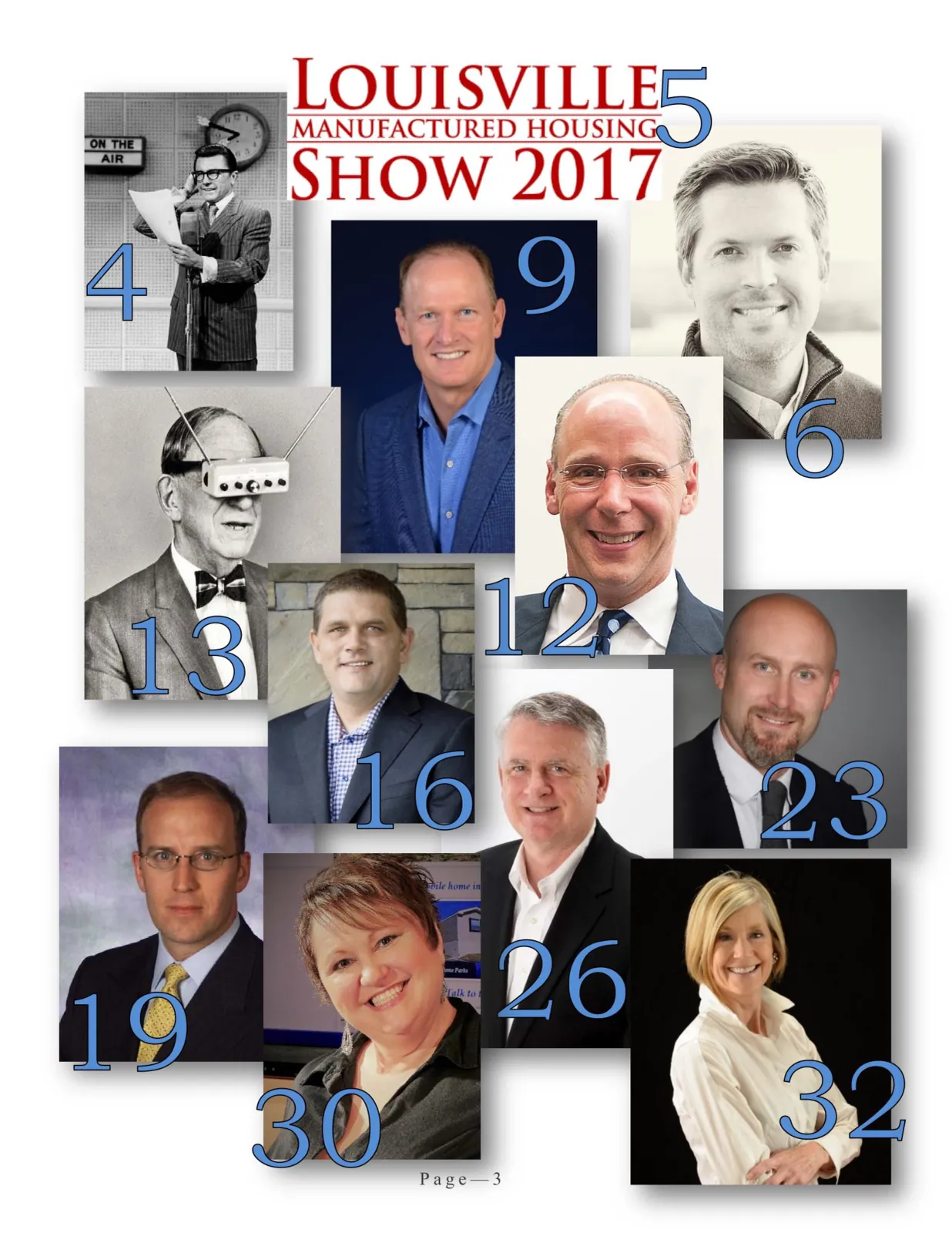
Louisville Manufactured Housing Show 2017
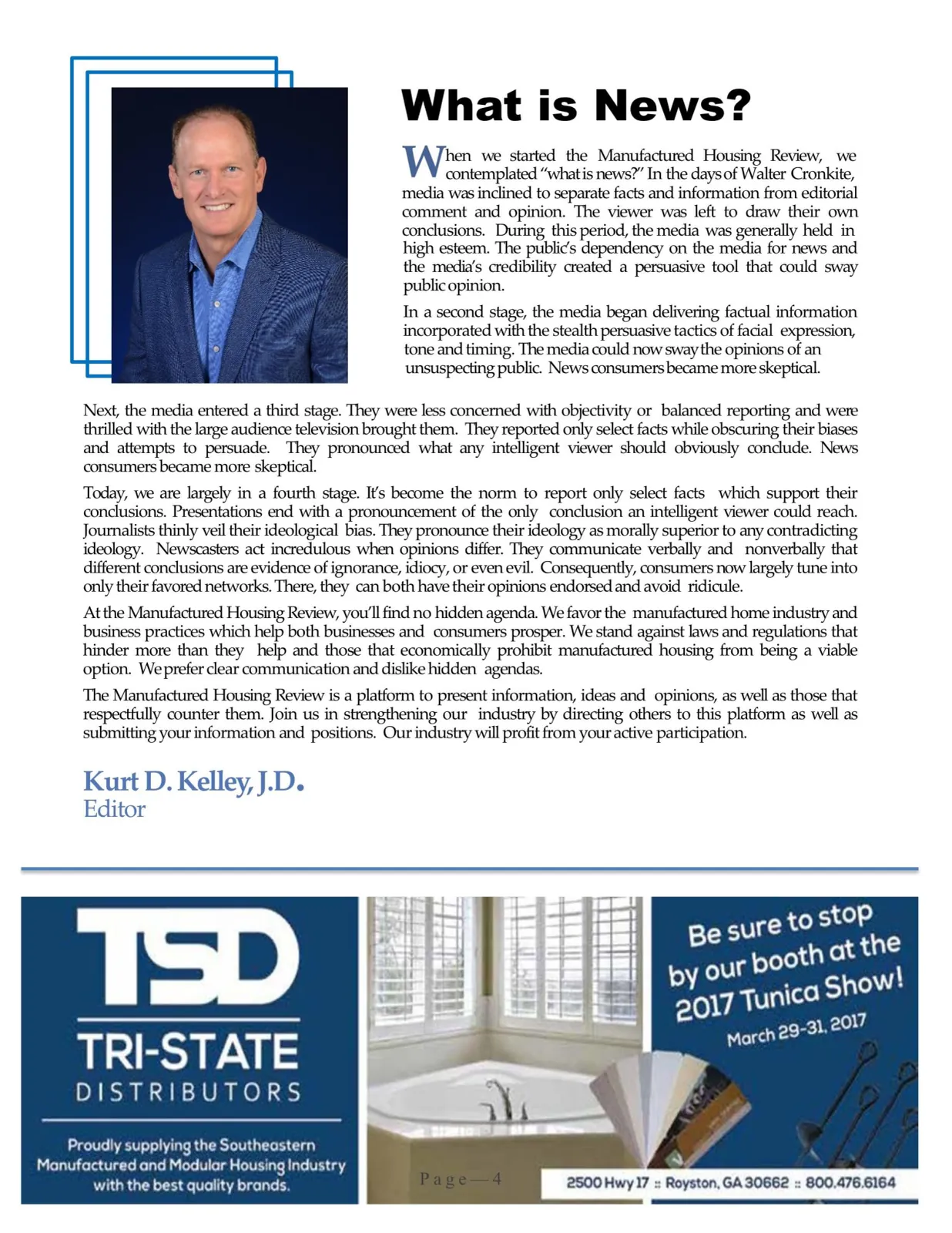
What is News?
When we started the Manufactured Housing Review, we contemplated “what is news?” In the days of Walter Cronkite, media was inclined to separate facts and information from editorial comment and opinion. The viewer was left to draw their own conclusions. During this period, the media was generally held in high esteem. The public’s dependency on the media for news and the media’s credibility created a persuasive tool that could sway public opinion.
In a second stage, the media began delivering factual information incorporated with the stealth persuasive tactics of facial expression, tone and timing. The media could now sway the opinions of an unsuspecting public. News consumers became more skeptical.
Next, the media entered a third stage. They were less concerned with objectivity or balanced reporting and were thrilled with the large audience television brought them. They reported only select facts while obscuring their biases and attempts to persuade. They pronounced what any intelligent viewer should obviously conclude. News consumers became more skeptical.
Today, we are largely in a fourth stage. It’s become the norm to report only select facts which support their conclusions. Presentations end with a pronouncement of the only conclusion an intelligent viewer could reach. Journalists thinly veil their ideological bias. They pronounce their ideology as morally superior to any contradicting ideology. Newscasters act incredulous when opinions differ. They communicate verbally and nonverbally that different conclusions are evidence of ignorance, idiocy, or even evil. Consequently, consumers now largely tune into only their favored networks. There, they can both have their opinions endorsed and avoid ridicule.
At the Manufactured Housing Review, you’ll find no hidden agenda. We favor the manufactured home industry and business practices which help both businesses and consumers prosper. We stand against laws and regulations that hinder more than they help and those that economically prohibit manufactured housing from being a viable option. We prefer clear communication and dislike hidden agendas.
The Manufactured Housing Review is a platform to present information, ideas and opinions, as well as those that respectfully counter them. Join us in strengthening our industry by directing others to this platform as well as submitting your information and positions. Our industry will profit from your active participation.
TSD TRI-STATE DISTRIBUTORS
Proudly supplying the Southeastern Manufactured and Modular Housing Industry with the best quality brands.
Be sure to stop by our booth at the 2017 Tunica Show!
March 29-31, 2017
2500 Hwy 17 :: Royston, GA 30662 :: 800.476.6164
2017 Louisville Manufactured Housing Show Draws Increased Attendance in All Categories
Setting the Stage for Better Industry Experience in 2018
February 21, 2017 - The 2017 Louisville Manufactured Housing Show was a positive success, with attendance numbers for 2017 at 2,929 attendees compared to 2,588 attendees in 2016. More than 1000 retailers took part in the show, rising from 873 in 2016; community manager attendees totaled 494 (428 in 2016) and 142 installers participated, compared to 99 in 2016. “We are very pleased at the positive results achieved with the 2017 Louisville Show and are confident that participants and attendees benefitted from the quality information presented during this gathering,” stated Dennis Hill, Show Coordinator. “This positive turnout is a testament to all the hard work and commitment put into developing and delivering a very beneficial forum for the manufactured housing industry. We plan on taking this momentum and making the 2018 Louisville Manufactured Housing Show an even better learning experience for industry participants.”
Other factors worked to bring this trade show to new heights, including the development of a new Internet marketing site (thelouisvilleshow.com) developed and administered by Darren Krolewski of MH Village. “Darren was instrumental in providing the new Internet site more detail and scope than ever before and we are particularly thankful to Darren for all his hard work and attention to detail.,” Hill added. The site exhibited a full range of information and logistics for the Show on the new site and plans call for retaining and expanding this Internet site for the 2018 Louisville Show. More information on the 2018 Show will be displayed on the Internet site in the coming months.
A full range of informative morning seminars drew favorable comments and reviews from Show attendees. Industry financial consultant Ken Rishel supervised the recruitment and participation of a wide range of marketing and communications experts who gave special insights and perspectives relevant to Show attendees. These insightful seminars are scheduled to be repeated in the 2018 Show and will be another special learning opportunity for attendees. “No one fully appreciates the hard work in organizing and putting on these seminars,” stated Hill. “A special thanks goes to Ken Rishel for his dedication and attention to these great seminars.”
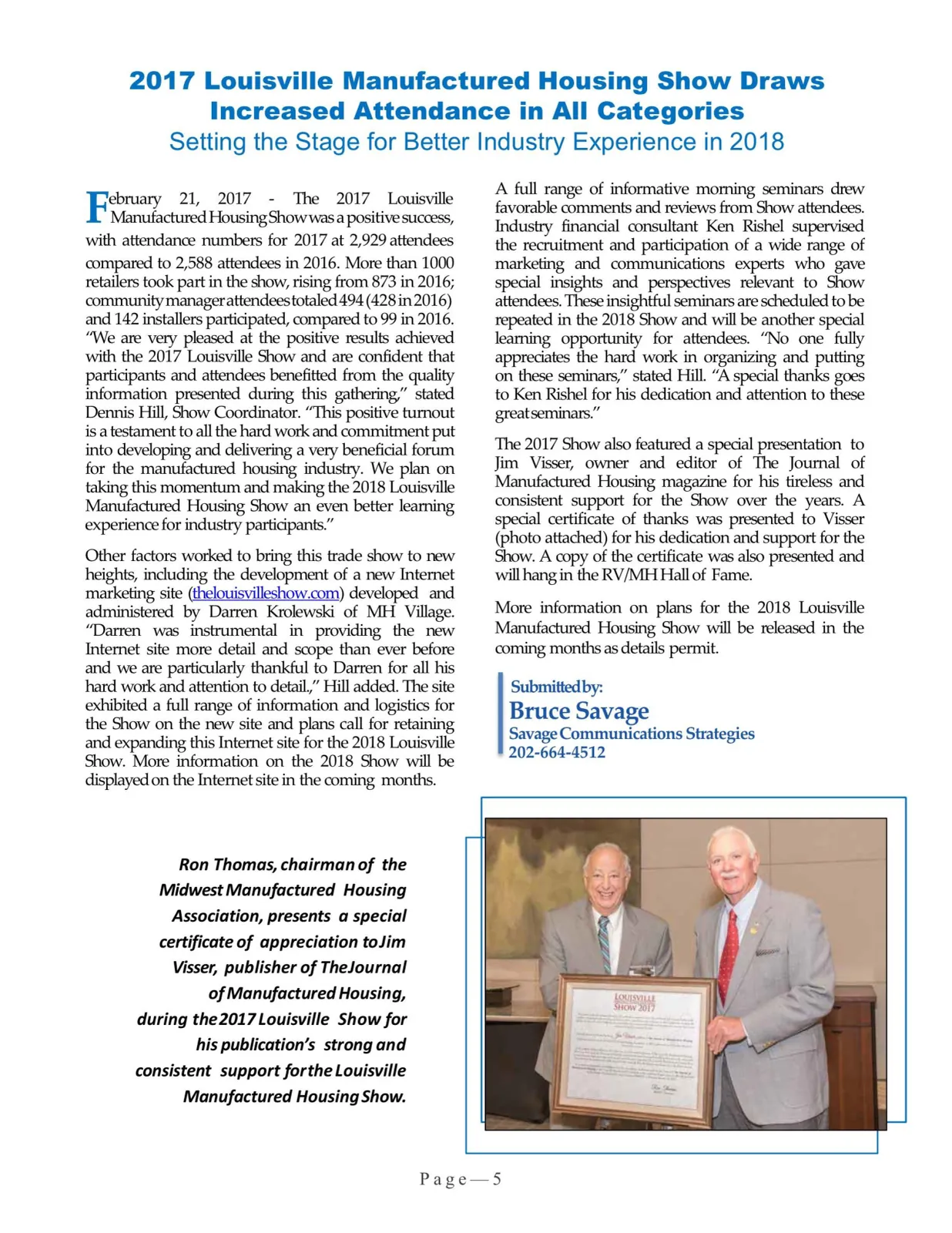
The 2017 Show also featured a special presentation to Jim Visser, owner and editor of The Journal of Manufactured Housing magazine for his tireless and consistent support for the Show over the years. A special certificate of thanks was presented to Visser (photo attached) for his dedication and support for the Show. A copy of the certificate was also presented and will hang in the RV/MH Hall of Fame.
More information on plans for the 2018 Louisville Manufactured Housing Show will be released in the coming months as details permit.
Ron Thomas, chairman of the Midwest Manufactured Housing Association, presents a special certificate of appreciation to Jim Visser, publisher of The Journal of Manufactured Housing, during the 2017 Louisville Show for his publication’s strong and consistent support for the Louisville Manufactured Housing Show.
SQUAD GOALS: Building Your MHC Dream Team
Slightly humorous (but important) lessons to learn while building your extended team
Want to go fast, go alone…want to go far, bring people with you. I completely stole this quote from someone. Who, I’m not sure. Perhaps it was on one of those cliché inspirational posters you see in the hallways of depressing office buildings. Or perhaps it was a fortune cookie. Either way, it’s actually insightful advice that I should listen to more often.
As an entrepreneur and owner of mobile home communities, it’s a constant struggle to fight the urge to do everything myself. Entrepreneurs strike out on their own precisely because we want to build something great and we’re good at getting things done. Plus, it’s our baby. How can we entrust our community, or our company, to others who are not going to care as much as we do?
I’D ARGUE YOU DON’T REALLY HAVE A CHOICE – Whether you own one or one hundred communities, you need a team and your team is going to make or break your operation. This is especially true if you’re an out-of-state investor. Our company would be lost without the extended team we’ve built through painstaking trial and error.
While detailing every internal and external team member within our company isn’t practical for this article, below are some key players. If you work for us (Park Street Partners) and were overlooked on this list and happen to be reading this article…you should get back to work! Just kidding, you’re also a special snowflake and are equally valuable to the team.
REAL ESTATE LAWYER – we rely heavily on our various lawyers (we rotate depending on the market and the type of debt involved). The lawyer we use for our largest securitized loans is a vital member of our team; she’s a killer. Wall Street lenders and their army of attorneys will try to smother you with a never-ending flood of complex documents hoping you just give up and sign whatever they send you. Without our detail-oriented lawyer I might have inadvertently promised our banker my first born or died from excessive paper cuts. Make sure you find a lawyer who is well versed in the intricacies of operating a manufactured home community.
PROPERTY MANGER – obviously your community’s most important hire. This cannot be understated. He / She will either drive you to cash flow heaven or right off the cliff. Hire right, establish clear procedures, company polices and expectations. Then watch them like a hawk until they earn your trust.
EVICTION LAWYER – I know what you’re thinking, “yeah more lawyers!” Who amongst us doesn’t want to pile up the legal bills? But processing evictions, while unpleasant, is crucial to the health of your business.
First of all, we love our tenants. The vast majority of our tenants are hard working people who want an affordable place to live and are happy to pay for that product. You should feel that way about your tenants too. Of course, it’s ok to feel differently about tenants that do not pay for the services your community provided them. For these tenants you’ll probably want an eviction attorney on your team who will act swiftly and mitigate the negative impacts of non-payers. That being said, you don’t need a $400 an hour lawyer for this job. You have to try really hard to lose an eviction hearing as a landlord. Here’s a short play I wrote about a typical eviction hearing...
Judge, “Did they pay the rent?”
Eviction Lawyer, “Nope.”
Judge, “Ok, case closed; evicted!”
Non-paying Tenant, “Wait...WHAT?”
Therefore, if you can’t find a reasonably priced evictions lawyer (one that ideally will charge you a flat fee per eviction) a good part-time manager can handle evictions. Just ensure they can attend an occasional hearing during working hours.
BOOKKEEPER AND CPA –You can always count the beans yourself, if you enjoy that sort of torture.
INSURANCE BROKER - critical member of the team. I’d normally say just do what we did on our first park and call Kurt Kelly (editor of the magazine) at Mobile Insurance as he’s seen it all in our industry. However, I don’t want this fine periodical to be accused of being Fake News!
Make sure your insurance broker has ample MHC experience and that he/she provides you with sufficient coverage and not a penny more. If your brother-in-law that sells life insurance on the side tells you he can get you a lower premium if you’d give him the business, pretend you’ve temporarily lost your hearing and excuse yourself from the room.
MORTGAGE BROKER- if you thought preparing the books on your own was tedious, well buckle up buddy. Sourcing your own mobile home park debt is a special kind of H-E double hockey sticks. On our first deal we called over 100 banks. No joke. One hundred. The bank that finally said yes later left us at the alter a couple weeks before closing. Lost money, lost effort, no deal…sad. The right mortgage broker will save you time, money and heartache.
MARKETING WIZARD – You probably want someone else dealing with your home adverting. Why? Because for the life of me, I can’t figure out how to keep our ads live on Craigslist. Our ads are ghosted constantly. We diligently write and post a thoughtful ad and minutes later...poof, cloud of dust, followed by crickets chirping. If you’re not an out-of-state operator you might not have this same ghosting problem as perhaps having an out of state IP address on rental listings screams “SCAM!” to Craigslist algorithms. Who knows? All I know is, we’ve recently started using a marketing professional on a trial basis and call volume is up and time spent on Craigslist is down. Win/win.
MOBILE HOME MOVER & INSTALLER - The wrong home mover and / or installer can cause you real problems. You want to get a licensed mover & installer with plenty of insurance that has the right equipment and team to safely (and legally) move, set and install homes in your park. The tenant in Lot 5 that says he can move and set a home with his 95 Chevy for 200 bucks is not your guy.
Ideally, you’ll also want a mover that has never lost a home on the highway. “Shoot…I wondered why we were moving a lot faster the last hundred miles!” If they’ve been moving homes long enough and haven’t had a home split in two on the interstate, that’s a good sign. That means they are probably careful enough to avoid homes with sagging frames that aren’t road worthy. Trust me, you don’t want a call from a state trooper saying your mover just laid down your recently purchased single-wide, which is now blocking traffic on Route 66.
HOME REPAIR CONTRACTORS - easily the hardest member of the team to find and depend on. I don’t know what it is about contractors, but they are notoriously squirrelly. Good luck pinning one down. You think you’ve got the perfect guy and then, just like that, they are no where to be found and your job is half done. You need them though. Once you find a good one, treat’em right and hold on to them for dear life.
YOUR BUSINESS PARTNER(S) – It’s lonely at the top; why not share the journey and the ups and downs with someone who has your back and some skin in the game? I could go on, but I’m not being paid by the word here. Wait, I’m not being paid at all for this article, what have I done? Anyway, just remember to surround yourself and your mobile home community with good people who can help you achieve your goals.
REMEMBER -No one succeeds alone and no one fails alone so keep working on building your squad. This has the added benefit of enabling you to blame others if things go wrong. For example, if any of these jokes don’t land I will blame my lovely wife who reviewed this article prior to its submission.
Brad Johnson is a real estate private equity professional. He is the co-founder of Park Street Partners, which is a real estate fund manager that owns and operates manufactured home communities in 11 states. Prior to forming Park Street Partners, Mr. Johnson worked for Wells Fargo’s Real Estate Investment Bank, Eastdil Secured.
If you want to learn more about Park Street Partners, please visit www.parkstreetpartners.net
Community Financing
• Non-Recourse • Long-Term LOW Fixed Rates • Loans For All Market Segments Served
Nationwide Service
Midwest Portfolio 6 MH Communities $7,000,000 Refinance 525 Sites • IN MI, OH
Undisclosed MH Community $4,522,000 Refinance 121 Sites • CT
Undisclosed MH Community $5,306,000 Acquisition 230 Sites • ME
Security Mortgage Group LLC
Income Property Consultants (585) 423-0230
www.SecurityMortgageGroup.net
2370 Monroe Avenue, Rochester, NY 14618
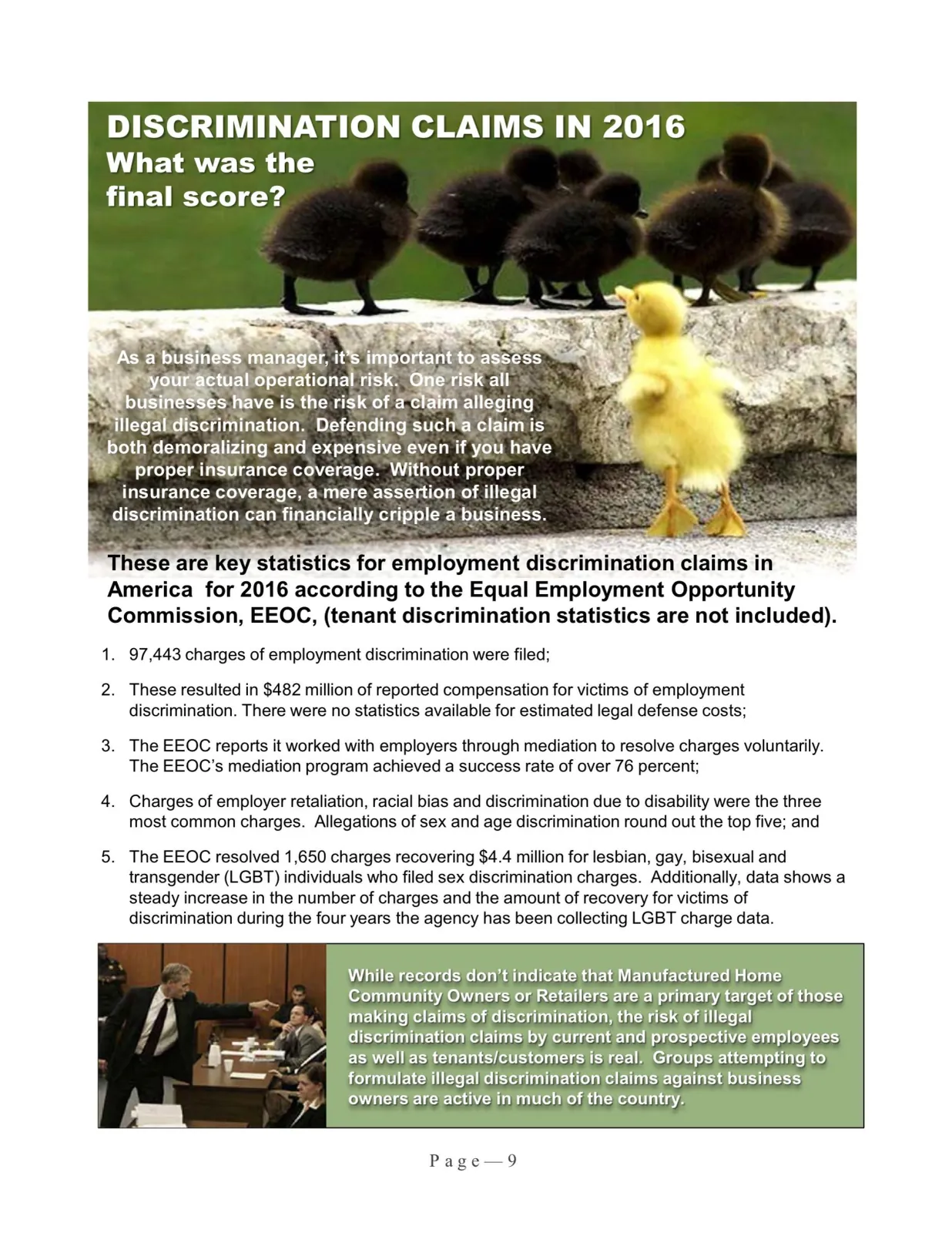
DISCRIMINATION CLAIMS IN 2016
What was the final score?
As a business manager, it’s important to assess your actual operational risk. One risk all businesses have is the risk of a claim alleging illegal discrimination. Defending such a claim is both demoralizing and expensive even if you have proper insurance coverage. Without proper insurance coverage, a mere assertion of illegal discrimination can financially cripple a business.
These are key statistics for employment discrimination claims in America for 2016 according to the Equal Employment Opportunity Commission, EEOC, (tenant discrimination statistics are not included).
1. 97,443 charges of employment discrimination were filed;
2. These resulted in $482 million of reported compensation for victims of employment discrimination. There were no statistics available for estimated legal defense costs;
3. The EEOC reports it worked with employers through mediation to resolve charges voluntarily. The EEOC’s mediation program achieved a success rate of over 76 percent;
4. Charges of employer retaliation, racial bias and discrimination due to disability were the three most common charges. Allegations of sex and age discrimination round out the top five; and
5. The EEOC resolved 1,650 charges recovering $4.4 million for lesbian, gay, bisexual and transgender (LGBT) individuals who filed sex discrimination charges. Additionally, data shows a steady increase in the number of charges and the amount of recovery for victims of discrimination during the four years the agency has been collecting LGBT charge data.
While records don’t indicate that Manufactured Home Community Owners or Retailers are a primary target of those making claims of discrimination, the risk of illegal discrimination claims by current and prospective employees as well as tenants/customers is real. Groups attempting to formulate illegal discrimination claims against business owners are active in much of the country.
8 Measures You Can Take Which Will Reduce Your Risk
1. While long detailed employee handbooks can cause more claims than they prevent, a short basic one which mandates that EEOC compliant hiring and Fair Housing Act compliance are mandatory and outlines basic employee benefits and obligations is a good idea;
2. Train your employees about what is “legal” discrimination (credit score, income, criminal history, prior landlord references, vicious breed dog owner…) vs “illegal” discrimination (race, age, sex, sexual orientation, disability, emotional support animal owner…);
3. Utilize application forms that are EEOC and Fair Housing Act compliant. Train employees on what can and cannot be asked of prospective employees and tenants/customers;
4. Make certain all prospective employees and tenants/customers are treated with the same procedures and tone. Role play over the phone with prospects using common black, Hispanic, and homosexual dialects to make sure they are treated consistently;
5. Prominently display both Fair Housing and EEOC posters in your office;
6. Create a company culture where it is clear that EEOC and Fair Housing compliance is mandatory with zero exceptions. Company culture starts at the top;
7. Properly pay and categorize all your workers. Wage law violations are the number one cause of civil liability claims in the U.S.; and
8. Carry Employment Practices Liability Insurance that includes third party (tenant/customer discrimination) coverage. Without it, even an innocent business can be overwhelmed with legal defense costs.
In a world where the media publicly sensationalizes any alleged act of racism, sexism, ageism, or homophobia, a virtual greenhouse for discrimination claims against business owners has developed. Know your risks, set your defenses, and invest the time to adopt business practices which minimize your legal exposure.
ROOM A EVIDENCE FOR
ROOM B EVIDENCE AGAINST
And these press guys wonder why everybody ignores them
they know they're allowed into both rooms, right?
Somewhere out there someone is looking for your property.
We will find them.
Mobile Home Parks • Manufactured Housing Communities • Sales • 1031 • Valuation • Consulting • Research • Education
We sell Pots of Gold™.
Stephanie McAnuff
Licensed Commercial Broker
www.McAnuffGroup.com
Helping Homeowners be Successful is in the Best Interest of Us All
SHORT SIGHTEDNESS AMONG OTHERWISE SMART PEOPLE IS ALWAYS A SHOCK
I posted a link to Bank of America’s Better Money Habits for a community owner group and it was rejected as “off-topic.” How can free online resources aimed at helping people pay you on time be of no interest? Why wouldn’t community owners want to have it in their back pocket for that household in need, or better yet post it on an intranet or community Facebook page for all to see and use?
WHAT’S THE HARM?
Access to such resources is squarely in the interest of community operators, be they commercial investors or resident associations. Several large operators are institutionalizing better resident services and relations because they understand customer referrals are the best source of new business, and retaining existing customers is better than trying to find new business!
We are investing significantly in online services – education, linkages to peers and back-room services and discounts – because we think it is an important part of the value proposition of resident ownership. Our intranet – with many pages accessible to the public and private pages for members only – is www.myROCUSA.org.
With now nearly 200 Resident Owned Communities (ROCs) and more than 12,000 home sites in ROC USA® Network, we have had to invest in online services. No ROC USA® community has ever failed or resold its property but some other co-ops have, so there are cautionary tales out there about co-ops that do not get the ongoing training and support they need to be successful.
Our vision is a digitally connected Network of ROCs, connected to one another, backroom services, local expert Technical Assistance Providers and the national office and a set of homeowner and community-centered resources that help homeowners and ROCs be successful. We are scaling local ownership but that doesn’t mean we think isolationism and going it alone is the best way forward in an increasingly consolidated market economy.
Paul Bradley is the founding president of ROC USA® , LLC. Prior to his appointment at ROC USA, he served as vice president for the New Hampshire Community Loan Fund. There he managed the Community Loan Fund’s 25-year old Manufactured Housing Park Program, expanding its cooperative development program, and initiating single-family lending and new production.
HELPFUL INFORMATION YOU MIGHT SHARE WITH YOUR RESIDENTS
The IRS Volunteer Income Tax Assistance (VITA) and the Tax Counseling for the Elderly (TCE) Programs offer free tax help for taxpayers who qualify. IRS Guide to free Tax Prep
For free and confidential information and referral, call 2-1-1 for help with food, housing, employment, health care, counseling and more. 2-1-1 for Emergency Support Systems
Paul Bradley is the founding president of ROC USA, LLC. He founded ROC USA as a source of financing and expert assistance in 2008 to help make resident ownership viable nationwide after spending 20 years helping manufactured home community owners in New Hampshire sell to their homeowners. Contact him at [email protected] .
9 Projects for 2017 to Enrich Both Your Life and Your Profitability
1. Update your technology. There are great ideal to be had on tech tools this time of year— why not take advantage of them for your business? Assess which technologies would help you do business more effectively in the coming year, whether that’s tablet computers or a software upgrade.
2. Get organized. Start 2017 off fresh by cleaning out your office. Purging piles and files of paper will make you feel lighter and more focused. Try scanning and saving important documents in the cloud instead. In addition to saving space, cloud storage makes it easy to access and share what you need.
3. Take a lesson. Learn something completely new, like how to use Instagram for marketing your business, or delve deeper into a subject you already know something about, so you can become a real expert. There are dozens of ways to educate yourself these days, from online tutorials and courses to in-person workshops and conferences. (SCORE offers plenty of each.) www.score.org/take-workshop
4. Leave your comfort zone. Try something that truly challenges you, whether that’s public speaking or skydiving. Yes, skydiving—stretching yourself in your personal life will translate into increased confidence in your business.
5. Broaden your connections. Reach out to someone you admire, and invite them to coffee to pick their brain. Reach out to someone you want to do business with to share ideas about how you could work together. Create an advisory circle of other businesspeople and professionals, and meet once a month to get and give both advice and inspiration.
6. Raise your profile. As a small business owner, you are your own best marketing tool. Whether you’re a B2B entrepreneur whose “community” consists of a particular industry, or a B2C entrepreneur whose community consists of your town, get out there and make a name for yourself. A B2B entrepreneur can contribute to the community by speaking or chairing panels at conferences or contributing to others’ blogs. A B2C entrepreneur can contribute by sponsoring local events or getting involved in local charities.
7. Share the burden. Small business owners tend to take everything on themselves. But no one can “do it all” without soon burning out. Think about what you can delegate, whether to employees or independent contractors, and do it. Let go of the small stuff so you can focus on what you enjoy doing and excel at.
8. Take care of yourself. If you’re not healthy, your business will suffer. As a busy entrepreneur, taking care of yourself is easier said than done, but you can do it by making small changes. Get a little bit more sleep, eat a little bit healthier, and move your body a little bit every day.
9. Get a grip on your finances. Create sales and financial projections for the coming year, and use them to assess whether you might need business financing. If you think you might, start investigating your options now. Check your business’s credit rating and take steps to improve it, if necessary. Talk to your bank about what type of financing they offer, and look into alternative financing solutions if you need to.
STYLECREST
JUST RIGHT.
Providing quality HVAC products that are just right for manufactured housing.
THE TEN BIGGEST ERRORS WHEN BUYING A MHC
Manufactured home communities can be terrific investments. They can create financial freedom and even become an empire. But that’s assuming you do it correctly. Unfortunately, there are many landmines that can reduce your investment plan to rubble. These are the ten biggest errors that rookies make in buying manufactured home communities. We have left off the obvious issues, such as no clear title, failed Phase I, easements that are impossible to work around, and massive floodplain – everyone knows those (or at least they should). But what are the more subtle problems that are less obvious?
NO EXIT STRATEGY
When buying a MHC, you should start at the end of the movie and work backwards. You should never buy a property that does not have a solid exit strategy. That means that you should avoid properties that offer high returns but no liquidity, such as high risk locations at peril of decline (think oilfield man camps) or floodplain or lack of an operating permit. There is an old adage that “before there can be return on capital, there has to be return of capital”. It holds true for MHC investing.
Capping Community Owned Home Income
If a 1980s manufactured home rents for $600 per month, and you take out the lot rent of $200, then the home has a value of $400 x 12 x 10 (based on a 10% cap rate) = $48,000. Is that right? Hardly. That home is worth around $5,000. You are guilty of “capping” the home income if you agreed to $48,000 – and you just lost $43,000 when you sell the property to the next buyer. Homes are personal property, not real property, and the whole concept of capping income is restricted to real property only.
EXCESSIVE DENSITY
Whenever you look at a property that has a density rate of 15 units per acre or higher, you need to make sure that two things are fine:
1. that the fire marshal has no problem with the spacing between homes and
2. that the lots will hold at least a 14’ x 46’ 2-bedroom unit.
If you buy a community that is so dense that you can’t bring in new homes, you are in a terrible position. And an even worse position if the fire marshal makes you remove a few.
BAD LOCATION
If you are looking at a location that is in a dangerous, undesirable area, then your phone is never going to ring when you have a home available for sale or rent. Some buyers have the misconception that all manufactured home community locations are created equally. They’re not. Your residents want to live in places that are clean, safe and desirable, with a good school district. A bad location will result in a bad ending.
LOW POPULATION
Manufactured home communities need plenty of potential customers and enough employers to keep them bringing in the money to pay the rent. In areas of low population, there is greater risk that this fragile ecosystem may get disturbed by the closure or reduction in one main employer, or some other event that damages the local economy. We generally favor metro population areas of 100,000 or greater, but will buy in areas with metro populations as low as 25,000 if the underlying fundamentals are strong and there is a huge demand for affordable housing in that market (Durango, Colorado, for example, only has a metro population of less than 55,000, but a median home price of $341,200 and the MHCs there perform remarkably well). But we would never buy a property in a market with a metro population of 1,500. That’s simply too rural.
LOW COMPETITIVE HOME PRICES
To have affordable housing, you first have-to-have non-affordable housing to create the need. We call this concept “contrast”. If stick-built and apartment prices are low, then who needs affordable housing or manufactured home communities? We prefer markets where stick-built median prices are around $100,000 or greater, and three-bedroom apartment rents are around $1,000 per month, but that’s just a guideline. Even a median home price of $70,000 and apartment rent of $700 might work, but clearly there’s no affordable housing demand with median home prices stand at $30,000 and apartment rents are around $300 per month (which they are in many small markets and blighted areas).
NON-DIVERSIFIED EMPLOYMENT – AND IN THE WRONG SECTORS
We have long preached the necessity of drilling down to see what the risk diversity is of the employers in a market. Too many markets have only one key private sector employer as the single largest job source. That’s fine until they announce layoffs or a closure, and then the market is destroyed. We prefer “recession-resistant” markets that have healthcare, education and government jobs as the prime industry – which have little risk of reduction. These type of markets demonstrated 4% unemployment during the Great RWWecession when the U.S. average exceeded 10%.
NO DEMAND
This is a byproduct of many of the earlier-named mistakes of low population, poor location and non-diversified job markets. Every property we buy includes a test ad in due diligence to gauge the demand in a market. We are looking for properties that can garner at least 30 calls in 10 days. We shun properties that have fewer than ten.
MASTER-METERED ELECTRIC OR GAS
This is a huge rookie error, as most people don’t even know what this means. Master-metered electric and/or gas means that the MHC owns all the lines and meters in the entire property, and is serviced by just one or more giant meters at the edge of the property. So you are basically your own power or gas company. Obviously, this is a huge amount of risk and worry for most owners, and has a host of complications that are all extremely expensive to fix.
PRIVATE UTILITIES
Many MHCs in the U.S. are on private water and/or sewer. While we prefer city utilities, private utilities are survivable if you know what you’re doing. One of the biggest mistakes first-time buyers make is to fail to budget for the repair of these items – or even do proper due diligence on them to begin with. While well water, septic, and packaging plant really work, you have to know their remaining useful life, the cost to replace them, and then budget accordingly. Lagoon, however, is both a financial issue and a workability one, as most cities and states are trying to end the use of this type of private sewer system.
CONCLUSION
While the manufactured home community business is not rocket science, there are more than a few pitfalls that all buyers should avoid. Most would, if they only knew what they were. The nice thing is that the path has been blazed many times before, and the answers are available if you only look around for them.
Dave Reynolds has been a manufactured home community owner for almost two decades, and currently ranks as part of the 5th largest community owner in the United States, with more than 23,000 lots in 28 states in the Great Plains and Midwest. His books and courses on community acquisitions and management are the top-selling ones in the industry. He is also the founder of the largest listing site for manufactured home communities, MobileHomeParkStore.com. To learn more about Dave’s views on the manufactured home community industry visit MobileHomeUniversity.com.
Kelley JEWELERS
107 West Main Street Weatherford, OK 73096
(580) 772-3113
www.kelleyjewelers.com
STORE HOURS
MONDAY - SATURDAY 9:30 AM - 5:30 PM
ROLEX OFFICIAL JEWELER
VISIT ROLEX.COM
Since 1931, people have trusted Kelley Jewelers for quality diamond jewelry at the right price. We proudly offer a lifetime warranty on every new ring purchased as a member of Preferred Jewelers International. As a member of Continental Buying group, we can assure you we are working every day to guarantee the best possible value.
Using Financing to Position Your Community for Long Term Success
Proper financing is an important component for the success of many community operators. Not only does it allow park owners to optimize their investment and returns, but long term fixed rates can provide interest rate security in an up and down market. However, many owners are unaware of some of the most important criteria commercial lenders look at when reviewing a loan request.
Over the past 24 months, Security Mortgage Group has provided over $500,000,000 in MHC loans for over 160 communities. With that experience, here are some of the most important aspects of preparing your community for a new loan and the potential benefits of refinancing.
TIMING- The loan process can take on average 60-70 days. It is important to review your existing mortgage’s payoff instructions as you may have a 3 to 12 month window prior to the loan’s due date to refinance without penalty. It’s important to be aware of payoff information so you have sufficient time to obtain new debt.
Too many times we have clients contact us 30-40 days before their note comes due. When you limit your available lending window you can potentially shrink your financing options, especially if there are any unforeseen delays in the process. We recommend reviewing your refinancing options at least one year in advance of the loan’s due date. This will allow you ample time to prepare and improve any aspects of your property in hopes of maximizing your loan terms.
Security Mortgage Group LLC
RECENT COMMUNITY LOANS CLOSED
COMMUNITY SPECIFICS - Lenders review all aspects of a transaction when determining their ability to provide financing. Just because your community may have an issue or two, it may not prevent you from obtaining new debt. Here are some of the main criteria to focus on in the year or so leading up to a refinance.
INFRASTRUCTURE – very simply, a park’s infrastructure consists of the roads, pads, utilities, and amenities. During the refinance process a property condition report will be performed analyzing the quality of the park’s infrastructure. Being prepared in advance in terms of repairing any deteriorated roads or pads and making sure all utilities are in working order could go a long way in both maximizing the appraised value and minimizing the amount of required lender immediate repairs.
FINANCING BENEFIT – Borrowing in excess of your current loan balance, with a long term fixed rate, could allow you to make necessary infrastructure upgrades at your community. Park upgrades can increase the park’s eye appeal for potential new tenants and help justify a rental increase, both of which increase the community’s overall valuation.
UTILITIES – If your community has onsite well water and septic it is important to make sure they are in working order and all municipal licenses, permits, and inspections are current. The individual home heating system has become something else to recognize; be prepared to provide information on the type (propane, natural gas, kerosene, etc.) and number onsite.
FINANCING BENEFIT – Upgrading onsite utilities with new debt is an effective way to increase value and avoid potential headaches down the road. Additional, excess funds could be used to sub- meter the utilities resulting in a net gain to the bottom line.
OCCUPANCY – Most lenders prefer a park with an occupancy above 75-80%. However, if the park is slightly below this figure, be prepared to provide an explanation. Is it trending upward? What efforts have you made to increase occupancy? What is the
FINANCING BENEFIT – If your community has vacancies to fill, pulling out some of the equity in your park by refinancing may allow you to reinvest in home inventory. In terms of value added, if your lot rent is $300 a month for example, for every tenant you add you could be adding $40,000-45,000 in park value assuming an average cap rate.
PARK OWNED & RENT-TO-OWN HOMES – Most lenders do not count the income or value of park owned homes or rent-to-own homes in their underwriting. It is helpful to separate out all home related revenues and expenses from your statements if possible. Additionally, most lenders prefer to see park owned homes held in a separate entity from the community. Finally, lenders prefer parks with under 30% park owned homes, however exceptions can be made.
CAPITAL EXPENSES AND INCOME & EXPENSE STATEMENT REVIEW – Our lenders base their loan amounts in large part on the net operating income of the park. We recommend reviewing your trailing few years of income/expense figures well in advance of a refinance request. It is important to make note of any one time or capital expenses included in your numbers as we would analyze these expenses separately. Note lenders will typically require a 4-5% management fee for underwriting purposes.
SURVEYS, TITLE, & LEGAL – A recurring stumbling block we see during the loan process relates to any complication with survey, title, or legal. Be aware that a new survey may be required. If any changes to the parcel in question have occurred it may take some time to satisfy the title requirements. We highly recommend using an attorney that is experienced in manufactured community loans as he/she can navigate the sometimes unique legal requirements.
Every community is unique, however, if your community has an issue it’s important to have a detailed explanation and a near term solution for the issue. For example, if occupancy is below 80%, be prepared to have a reason as to why, market occupancy, details on the historic occupancy (so hopefully an upward trend can be shown), and a business model for continued growth. Addressing an issue like this provides our lenders confidence in quoting your transaction.
GUARANTOR RELATED ITEMS -
In addition to the community, lenders also need to see certain minimum requirements from the guarantors, even on non-recourse debt. Being aware of these requirements a few years in advance of refinancing may help you prepare accordingly. Typically, any guarantor who is more than 25% owner of the borrowing entity must be underwritten including credit searches. Lenders prefer to see a borrower with a minimum credit score of 680. If any personal credit related issues exist such as foreclosures, bankruptcies, late payments, etc. it is important to provide a sufficient explanation.
The other major borrower requirement relates to overall net worth and liquidity. Most lenders like to see a minimum combined net worth of the guarantor(s) at least equal to the loan amount being requested. Regarding the liquidity position, most lenders like to see at least 6-9 months’ worth of principal and interest payments in liquid assets combined amongst all of the guarantors.
ACQUISITION FINANCING - When seeking financing for a new acquisition most of the criteria previously mentioned applies. It’s important to work with the seller as a part of your due diligence regarding explanations to any property related issue. We often see an acquisition delayed because a seller becomes frustrated with detailed lender requests. The more clarity a seller can provide upfront will not only provide peace of mind for you as a buyer, but help the lender preemptively address any negatives about a community.
SUMMARY - Preparing your community for an upcoming refinance can result in optimal valuation and superior loan terms. Being aware of the timing of your existing debt and the pitfalls to avoid are key factors. Also, with long term low interest rates and 30 year amortizations available in today’s market you can increase your park’s monthly cash flow and use excess loan funds to make community improvements insuring the long term financial success of your operation.
Security Mortgage Group LLC, owned and operated by Anthony DiMarco and Gerard DiMarco, Jr., is a national award winning MH Community lending broker based in Rochester, New York.
Gerard D. DiMarco, Jr., managing director, has been with Security Mortgage Group since 1992. Over the past 25 years Gerry has provided over $1.5 Billion in MH Community loans for community owners across the country.
Security Mortgage Group LLC
Protecting the rights and legal interests of manufactured housing community owners for more than 30 years.
ADA/Fair Housing Act
Residency Documents
Subdivisions
Rent Control
Regulatory Compliance
Failure to Maintain (FTM)
Leases
Closures
Utility Issues
Evictions
Development
Sales/Refinancing
GROUP LEADERS
BILL HART Managing Partner
JOHN PENTECOST Partner
BILL DAHLIN Partner
ROBERT WILLIAMSON Partner
HART | KING
4 Hutton Centre Drive, Suite 900 • Santa Ana, CA 92707
p: (714) 432-8700 • f: (714) 546-7457
hartkinglaw.com
Using Multifamily Data to Evaluate Expected Lot Rent Ranges
The old story goes that McDonalds spent millions of dollars scouting out the best locations for its restaurants. Burger King then just takes advantage of that info and comes in and opens across the street. I’m not sure if there is any truth behind that story, but none-the-less I’m a big fan of the strategy. As a MH guy, I’ve noticed a lot of useful data gleaned from the apartment space. Although we aren’t about to determine the best corner to sling burgers, we can use the price of the Big Mac to determine how much we are going to charge for the Whopper so to say.
While there are only 3 publicly traded companies in the MH space, there are over a dozen in the multi-family space. It’s very rare to see ground up development of a manufactured home community, but we see developers building apartments at a break-neck pace. Due to the increased amount of competition and capital in the space, accurate metrics are essential for developers to feel confident that their venture will make money. Additionally, thanks to the transparency of the internet and ease of comparison shopping for living space on-line, apartment rents efficiently adjust to fall in line with the true supply-demand dynamics. This isn’t the case with MHCs, where it’s often difficult to get accurate rent data. Also, due to the variable nature of billing for or passing through utilities, it is even more difficult to get an apples-to-apples comparison of rents.
Fortunately, we can take advantage of the existing, readily available information from the apartment industry and compare it to our asset class. We’ve spent a considerable amount of time trying to determine what the all-in payment for home and lot rent would be in a market, and we’ve come up with some pretty accurate, but complicated formulas, all of which depend on first determining accurate lot rent. Through trial and error and applying this method to hundreds of communities, we’ve come up with a simple method for determining the expected rental range for a community: whether a market is over heated, prime for development, or a prime opportunity for Buffet style value investing. The method is straightforward. You take your current lot rent and subtract out the additional cost for any utilities/ services you provide for the residents. For example, if your lot rent is $300 and the park pays for water, sewer, trash, and mows the lawn for your residents, you would take the average bills for the community for each, divide them by the number of residents and subtract them from the total lot rent. In this case let’s say the average water/ sewer bill is $60 per resident, trash is $15 per resident, and you are charged $15 per lot mowed, your true indexed rent would be $210.
Once we have this number, we take the address of the park and plug it in to rent-o-meter.com and compare it to 2 bedroom apartments in the immediate surrounding area.
This site aggregates thousands of apartment rents to give us very accurate multi-family rental information. There may be other sites that work as well, and if you are in a smaller market where this information isn’t readily available you may have to use good old fashion mystery shopping to get the numbers. Rent-o-meter will give you a range of rents: the low number in which 80% of rents are above, the median, and the high number in which 80% of rents are below. You can take those rents and multiply them by 40% to set your range. Why did we choose 40%? It seemed to fit our all-in home and payment model. Trial and error as well as an application across several markets, hundreds of communities yielded accurate useful data. Once you have your range compare where your community’s rents lay. If they line up in terms of quality and pricing, you’re in line with the fundamentals of the market. If they lay below that range, you likely are not charging enough, giving away too many services etc and should re-assess your rents. If you feel your community is below the quality levels necessary to charge those minimal rents, I would strongly encourage you to invest money back into your community for the sake of our industry. Conversely, if you are fortunate enough to be outpacing the market, ask yourself if you are on the forefront of moves in a
market that is fundamentally strengthening? The Dallas Fort Worth area is an example of a fundamentally strong market with lot rents leading multifamily rates as the overall market continues to strengthen. If you are outpacing the market and employment, population trends, etc. are not trending in a positive direction, you should proceed with caution.
Keeping up with rental trends is the key to maintaining value. Maintaining value helps assure you can provide a quality living environment for your residents, thus creating a long term win-win proposition. Doing so also promotes our industry and moves it toward more acceptance from residents and municipalities. Once we do that, we can continue to grow.
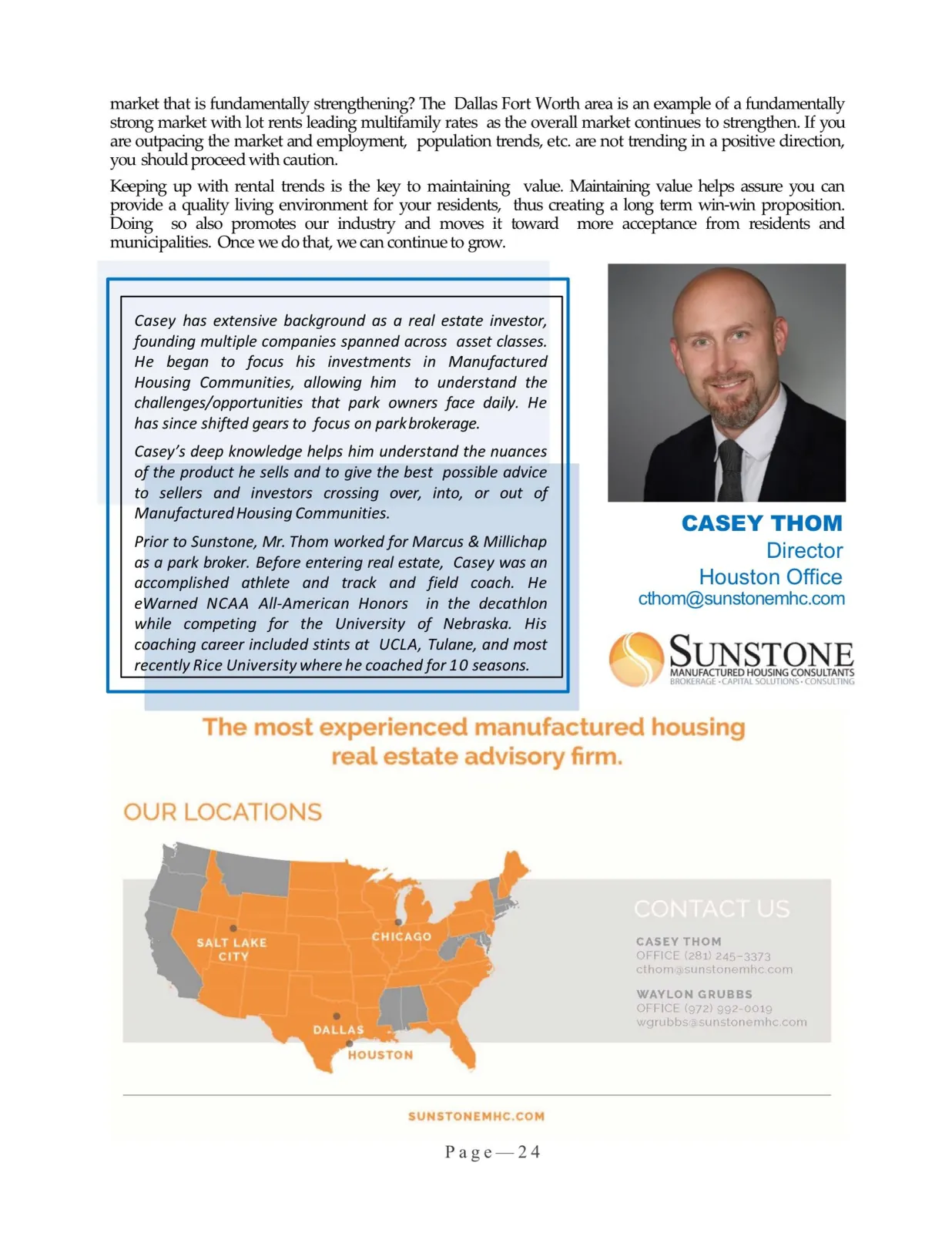
Casey has extensive background as a real estate investor, founding multiple companies spanned across asset classes. He began to focus his investments in Manufactured Housing Communities, allowing him to understand the challenges/opportunities that park owners face daily. He has since shifted gears to focus on park brokerage.
Casey’s deep knowledge helps him understand the nuances of the product he sells and to give the best possible advice to sellers and investors crossing over, into, or out of Manufactured Housing Communities.
Prior to Sunstone, Mr. Thom worked for Marcus & Millichap as a park broker. Before entering real estate, Casey was an accomplished athlete and track and field coach. He eWarned NCAA All-American Honors in the decathlon while competing for the University of Nebraska. His coaching career included stints at UCLA, Tulane, and most recently Rice University where he coached for 10 seasons.
CASEY THOM Director Houston Office [email protected]
SUNSTONE MANUFACTURED HOUSING CONSULTANTS BROKERAGE • CAPITAL SOLUTIONS • CONSULTING
The most experienced manufactured housing real estate advisory firm.
OUR LOCATIONS
SALT LAKE CITY
CHICAGO
DALLAS
HOUSTON
CONTACT US
CASEY THOM OFFICE (281) 245-3373 [email protected]
WAYLON GRUBBS OFFICE (972) 992-0019 [email protected]
SUNSTONEMHC.COM
Calendar of Events
South Central Manufactured Housing Institution, SCHMI Tunica Manufactured Housing Show https://www.scmhi.org/ March 28-31, 2017 = Tunica MS
Mobile Home University, MHU Park Investing Boot Camp http://www.mobilehomeuniversity.com/mobile-home-park-investing-books-and-courses/mobile-home-park-investors-boot-camp.php April 7-9, 2017 = Pittsburgh, PA
Louisiana Manufactured Housing Association, LMHA Crawfish Boil http://lmha.com/2017/02/09/april-19th-lmha-crawfish-boil-4-8pm/ April 19, 2017 = Baton Rouge, LA
Manufactured Housing Institute, MHI National Congress & Expo http://www.congressandexpo.com/ May 2-4, 2017 = Las Vegas, NV
Illinois Manufactured Housing Association, IMHA Annual Conference https://imha45.wildapricot.org/event-2407058 May 17, 2017 = Chicago, IL
Mobile Home University, MHU Park Investing Boot Camp http://www.mobilehomeuniversity.com/mobile-home-park-investing-books-and-courses/mobile-home-park-investors-boot-camp.php May 19-21, 2017 = Denver, CO
Texas Manufactured Housing Association, TMHA Fishing Outing http://www.texasmha.com/events May 23, 2017 = Aransas Pass, TX
Manufactured Housing Association of Oklahoma, MHAO Annual Convention http://www.mhao.org/ June 20-21, 2017 = Durant, OK
Manufactured Housing Communities of Arizona, AZMHCA Annual Conference http://azmhca.com/ June 21-23, 2017 = Chandler, AZ
Texas Manufactured Housing Association, TMHA Annual Convention http://www.texasmha.com/events September 10-12, 2017 = Dallas, TX
Manufactured Housing Institute, MHI Annual Meeting http://www.manufacturedhousing.org/mhi-annual-meeting/ September 17-19, 2017 = Orlando, FL
Southeast Community Owners, SECO Annual Symposium http://www.secoconference.com/ October 11-12, 2017 = Marietta, GA
Western Manufactured Housing Communities Association, WMA Convention & Expo http://www.wma.org/event/2017-wma-convention-expo October 16-19, 2017 = Reno, NV
National Communities Council, NCC Fall Leadership Forum http://www.manufacturedhousing.org/ncc-fall-leadership-forum/ November 1-3, 2017 = Chicago, IL
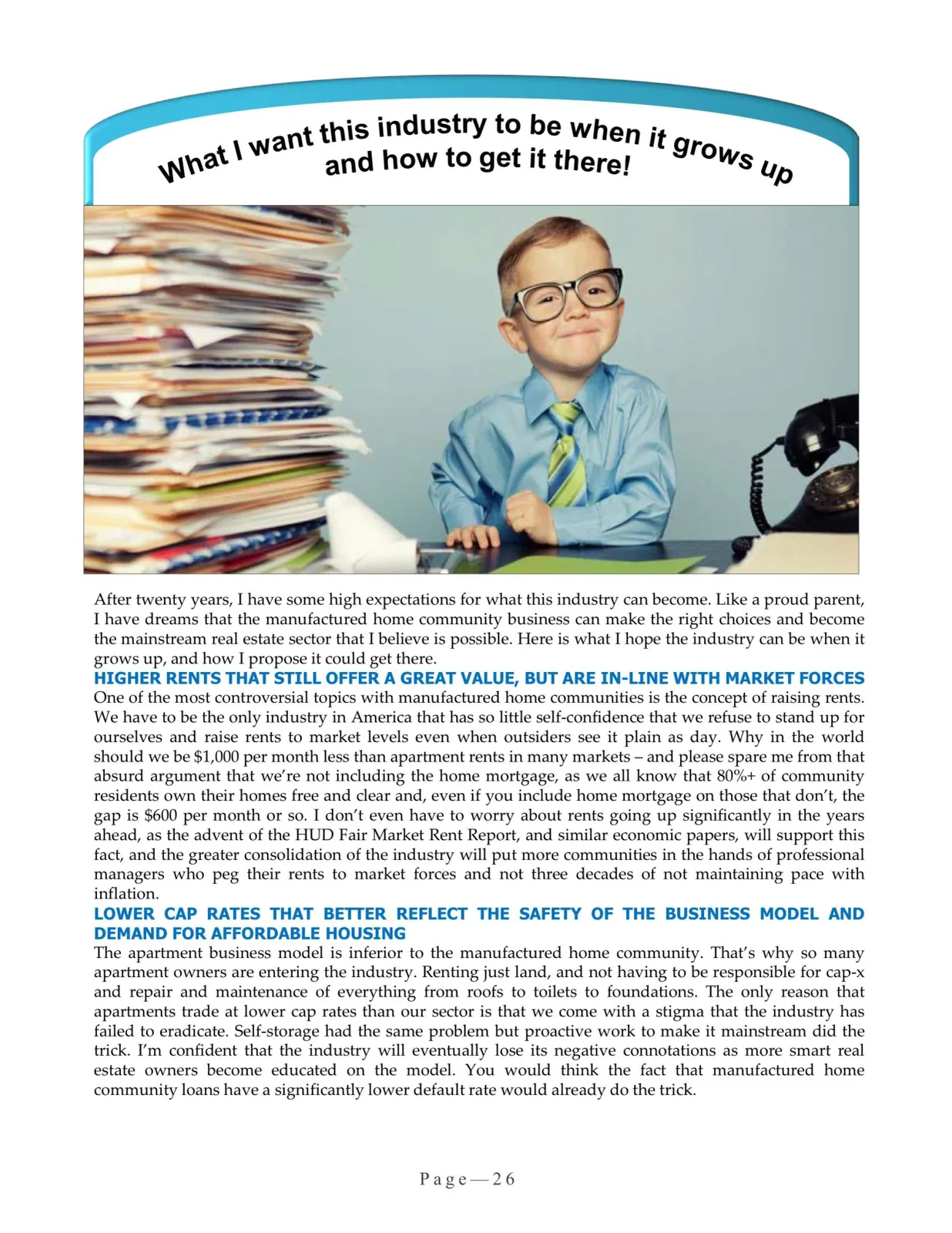
What I want this industry to be when it grows up and how to get it there!
After twenty years, I have some high expectations for what this industry can become. Like a proud parent, I have dreams that the manufactured home community business can make the right choices and become the mainstream real estate sector that I believe is possible. Here is what I hope the industry can be when it grows up, and how I propose it could get there.
HIGHER RENTS THAT STILL OFFER A GREAT VALUE, BUT ARE IN-LINE WITH MARKET FORCES
One of the most controversial topics with manufactured home communities is the concept of raising rents. We have to be the only industry in America that has so little self-confidence that we refuse to stand up for ourselves and raise rents to market levels even when outsiders see it plain as day. Why in the world should we be $1,000 per month less than apartment rents in many markets – and please spare me from that absurd argument that we’re not including the home mortgage, as we all know that 80%+ of community residents own their homes free and clear and, even if you include home mortgage on those that don’t, the gap is $600 per month or so. I don’t even have to worry about rents going up significantly in the years ahead, as the advent of the HUD Fair Market Rent Report, and similar economic papers, will support this fact, and the greater consolidation of the industry will put more communities in the hands of professional managers who peg their rents to market forces and not three decades of not maintaining pace with inflation.
LOWER CAP RATES THAT BETTER REFLECT THE SAFETY OF THE BUSINESS MODEL AND DEMAND FOR AFFORDABLE HOUSING
The apartment business model is inferior to the manufactured home community. That’s why so many apartment owners are entering the industry. Renting just land, and not having to be responsible for cap-x and repair and maintenance of everything from roofs to toilets to foundations. The only reason that apartments trade at lower cap rates than our sector is that we come with a stigma that the industry has failed to eradicate. Self-storage had the same problem but proactive work to make it mainstream did the trick. I’m confident that the industry will eventually lose its negative connotations as more smart real estate owners become educated on the model. You would think the fact that manufactured home community loans have a significantly lower default rate would already do the trick.
MORE PROFESSIONAL MANAGEMENT TALENT
This change will take more time, as the only way to increase the talent in the community manager pool is to pay higher salaries, and that’s directly tied to higher rents. So more industry consolidation is really going to create both end results. For too long, community managers have often not been deserving of the name “manager” in some properties, with the owner’s attitude being “well, that’s all I can afford”. The general level of play across all communities will one day be elevated, as new owners will be more demanding.
THE RESPECT OF THE MEDIA
This is one item that I think we are a contributor on. From letting a reporter from The New York Times live in one of our properties for a week – with the resulting article declaring that our communities “represent the best thing in affordable housing at a time when the nation’s need for low-cost places to live has never been greater” – to our recent three days of shooting with a major cable channel on a piece on affordable housing in the U.S., we have proactively kept our door open to the media. While MHI and others refuse to talk or debate for the good of the industry, we have been an outspoken cheerleader for our sector. We believe in the end, the U.S. media will find our industry is not a problem but a solution.
THE RESPECT OF CITY HALL
We’re seeing greater respect at city hall in all 28 states we operate in. Why is that? Several reasons. First, case law has broken the back of city opposition to filling vacant laws and operating manufactured housing communities under the protection of legal non-conforming “grandfathered” status. Just two years ago, the State of Mississippi joined the club with about a half-dozen states Supreme Courts that have rules in favor of the community owner over the city or town that opposed it. But I think it’s also part of the general elevation of the level of play of all community owners as a result of industry consolidation and more professional management. I think this trend will continue and accelerate. Recently, two different community owners told me of large grants and gifts they had received from city hall. Now that’s a new development.
GOVERNMENT SUPPORT OF THE ONLY NON-SUBSIDIZED FORM OF AFFORDABLE HOUSING
There appears to be a new interest (it’s about time, right?) on the part of the Federal Government to support the industry. When you consider the fact that we are the only non-subsidized affordable housing in the U.S., it’s kind of shocking it has taken decades for this appreciation to form. This new love is manifesting itself in the H.R. 3700 – which allows Section 8 voucher recipients to use those to buy manufactured homes – as well as the revitalized agency debt programs for community financing, as well as even the rumor of government support for manufactured home mortgages in the near future. I believe that this will only grow in strength as the U.S. government learns to appreciate all the hard work that community owners did to provide affordable housing against all odds and without support for so many years.
THE END OF THE NEGATIVE STIGMA
This is my biggest hope for the industry – the ability to dislodge the negative stigma that became attached to it at some point like a parasite. In the northern states in which we operate, there is no stigma to living in a manufactured home. They are simply called “homes” and our properties are simply called “communities”. However, there are many states in which the “trailer trash” label is a burden that residents bear. So how do you end this discrimination? First of all, our industry needs to do some smart marketing. The “Go RVing” campaign has been hugely successful for our sister industry, the RV park. I don’t recall ever seeing a unified advertising campaign for the manufactured housing industry. Second, I think that the American taste for living small, reflected in the “Tiny Home” movement, is going to break down the stereotypes and make the product chic again. Finally, I’m convinced that the salvation of any negative stigma will be the end result of the consolidation of the industry, in which professional owners end poor property condition and lax criminal and credit screening of residents. These new owners will bring fresh capital and enthusiasm and will ultimately bring manufactured housing communities into the uniform appearance of subdivisions.
CONCLUSION
I’m pretty comfortable that my goals for the industry will come to fruition. Some will happen sooner than others, but there is improvement in all areas on a continual basis. It’s a team effort. Everyone should help keep the industry on the correct path and lend encouragement where possible. The industry will grow up some day, and we will all look back on today and think “I was there in the early days” and be proud that we had a part in that development. We are all proud parents and stewards of the industry in some way, so make your contribution a positive one.
Frank Rolfe has been a manufactured home community owner for almost two decades, and currently ranks as part of the 5th largest community owner in the United States, with more than 23,000 lots in 28 states in the Great Plains and Midwest. His books and courses on community acquisitions and management are the top-selling ones in the industry. To learn more about Frank’s views on the manufactured home community industry visit MobileHomeUniversity.com.
SELLING YOUR PARK?
With ROC USA®, it’s as easy as:
Contact ROC USA®.
We’ll have a confidential discussion about your park and quickly decide whether a resident purchase is a viable option.
Sit back and relax.
ROC USA® & our regional affiliates will help residents through the entire purchase process and set them up for future success — at no cost to you.
Sign on the dotted line.
Our communities purchase at fair market value. Our specialized financing means all you need to provide is an opportunity for your homeowners to purchase.
Chat with Marc G. Smith today to learn more about an exit strategy that makes sense for you and your longtime customers:
[email protected] • (603) 513-2832
ROC USA® Resident Owned Communities BETTER TOGETHER
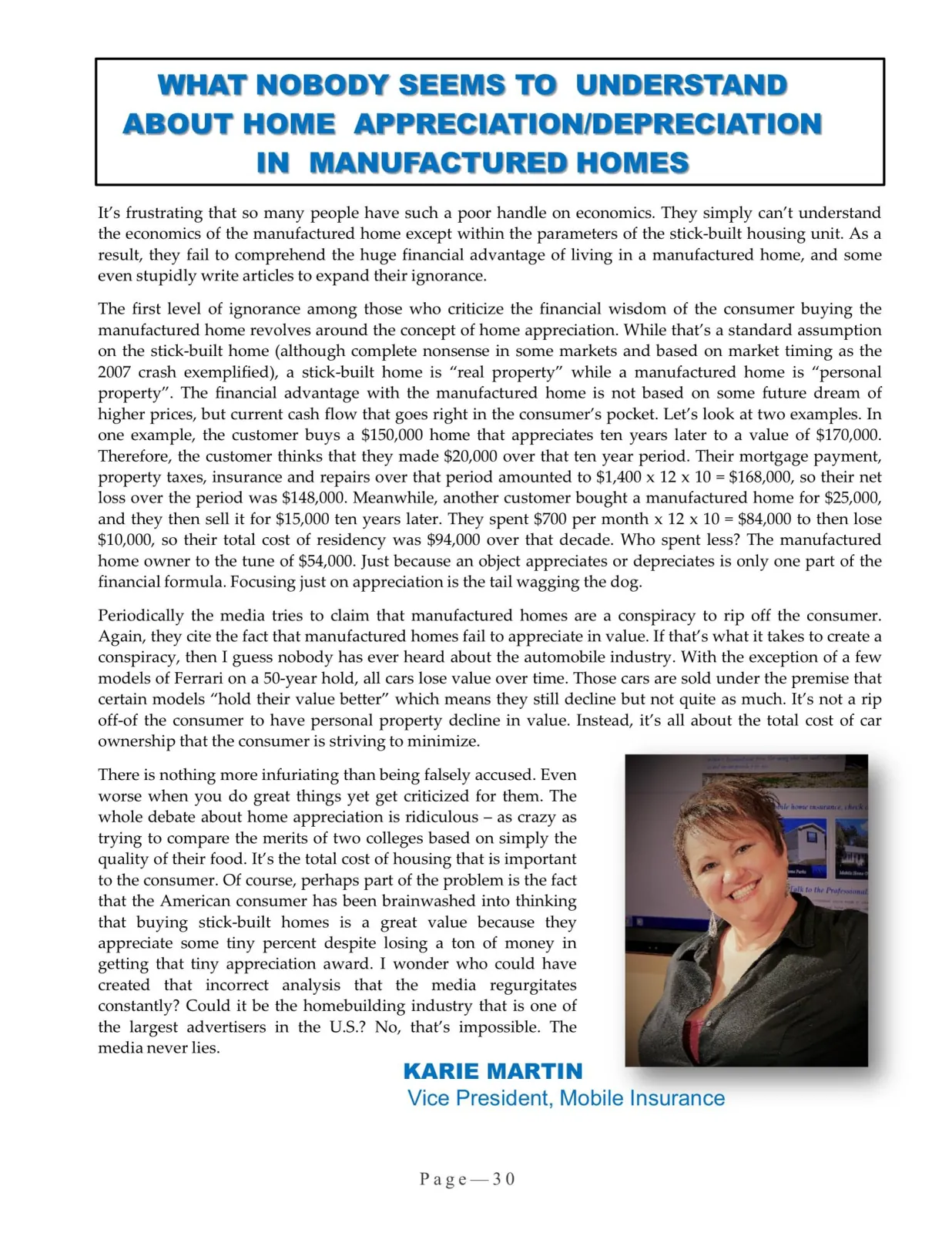
WHAT NOBODY SEEMS TO UNDERSTAND ABOUT HOME APPRECIATION/DEPRECIATION IN MANUFACTURED HOMES
It’s frustrating that so many people have such a poor handle on economics. They simply can’t understand the economics of the manufactured home except within the parameters of the stick-built housing unit. As a result, they fail to comprehend the huge financial advantage of living in a manufactured home, and some even stupidly write articles to expand their ignorance.
The first level of ignorance among those who criticize the financial wisdom of the consumer buying the manufactured home revolves around the concept of home appreciation. While that’s a standard assumption on the stick-built home (although complete nonsense in some markets and based on market timing as the 2007 crash exemplified), a stick-built home is “real property” while a manufactured home is “personal property”. The financial advantage with the manufactured home is not based on some future dream of higher prices, but current cash flow that goes right in the consumer’s pocket. Let’s look at two examples. In one example, the customer buys a $150,000 home that appreciates ten years later to a value of $170,000. Therefore, the customer thinks that they made $20,000 over that ten year period. Their mortgage payment, property taxes, insurance and repairs over that period amounted to $1,400 x 12 x 10 = $168,000, so their net loss over the period was $148,000. Meanwhile, another customer bought a manufactured home for $25,000, and they then sell it for $15,000 ten years later. They spent $700 per month x 12 x 10 = $84,000 to then lose $10,000, so their total cost of residency was $94,000 over that decade. Who spent less? The manufactured home owner to the tune of $54,000. Just because an object appreciates or depreciates is only one part of the financial formula. Focusing just on appreciation is the tail wagging the dog.
Periodically the media tries to claim that manufactured homes are a conspiracy to rip off the consumer. Again, they cite the fact that manufactured homes fail to appreciate in value. If that’s what it takes to create a conspiracy, then I guess nobody has ever heard about the automobile industry. With the exception of a few models of Ferrari on a 50-year hold, all cars lose value over time. Those cars are sold under the premise that certain models “hold their value better” which means they still decline but not quite as much. It’s not a rip off-of the consumer to have personal property decline in value. Instead, it’s all about the total cost of car ownership that the consumer is striving to minimize.
There is nothing more infuriating than being falsely accused. Even worse when you do great things yet get criticized for them. The whole debate about home appreciation is ridiculous – as crazy as trying to compare the merits of two colleges based on simply the quality of their food. It’s the total cost of housing that is important to the consumer. Of course, perhaps part of the problem is the fact that the American consumer has been brainwashed into thinking that buying stick-built homes is a great value because they appreciate some tiny percent despite losing a ton of money in getting that tiny appreciation award. I wonder who could have created that incorrect analysis that the media regurgitates constantly? Could it be the homebuilding industry that is one of the largest advertisers in the U.S.? No, that’s impossible. The media never lies.
Mobile Insurance
800-458-4320
WWW.MOBILEAGENCY.COM
Service is What WE Sell
Great Service * Great Value * Superior Knowledge
We offer special insurance programs for manufactured homes & RV’s
Retailers
Communities
Developers
Rental Home
Self Storage Facilities
CALL or visit us ONLINE to see our Special Safety Checklists, Insurance applications and Industry Operating Agreements!
Kurt Kelley, JD/President
What’s the Rent?
Amy Renter was eager to rent her first solo place. She had just been promoted to a new position as an assistant manager for Bix Boxes ‘R’ Us a few counties over in Midsize, MN, that paid $32,000 a year. Getting her name on a lease and moving into her own space was number one on her To Do list. She quickly scanned the online ads, asked her new colleagues for housing suggestions and actually drove around her new home town looking for rental signs and searching for the prefect neighborhood.
For Amy, price and comfort were major as she wanted to pay off her student loans as quickly as possible and an affordable home was key to that goal. Buying a home was not yet in sight but with her loans paid, she knew she’d be able to afford one in a few more years. As for comfort, Amy knew her parents and college age brother would be regular guests with the Midsize Marauders, a Triple-A minor league baseball team, affiliated with their favorite pro team, being a favorite activity of the family. So, when her co-worker, Dex, suggested looking at some of the mobile parks in the area, she thought it definitely was a good possibility. Amy had fond memories of visiting her grandmother who lived in the cutest little singlewide with a beautiful garden in a small tight knit community. She remembered the campfires and sleepovers and ‘trick or treating’ with the neighborhood children and how all the neighbors knew each other and helped each other out. Yeah, she thought, that’s what I want for my place.
After looking online at a sea of beige, too-small apartments, spacious single family rental homes and cozy mobile homes for rent, she found a 3-bedroom Victorian single family home for $1,100 per month which was quite a bit more than her $850 self-imposed rent budget. Surely, Amy figured, a raise in her salary would happen in the next 12-15 months, if she gave her all at her new job.
“And I could always tutor math students for extra money like I did in college” Amy said to herself. And maybe she could pay a little less on her loans… (Tracy Chapman’s Fast Car playing in the background)
Here’s the real deal. For $890 per month, Amy could have rented a new mobile home with 3-bedrooms and 2 baths, which unlike the house she did rent, had a new energy efficient HVAC, new appliances and a deck. It’s not that she didn’t consider this home. She loved the pictures online and the virtual tour really piqued her interest. It’s just that she couldn’t figure out what the lot rent was, what was included in the lot rent and if the lot rent was included in the home rent. The ad was unclear about who paid the utilities and when Amy texted the manager, she was slow to respond. By the time the park manager returned Amy’s call, Amy had already signed her lease on the Victorian.
Why did this mobile home park owner miss out on renting to a desirable tenant; a tenant that would have taken care of the property, paid rent on time, and been no problem for management? Someone who might have even bought the home in a few years?
Why did this prospective tenant miss out on getting a better value for her money (and mobile homes usually are a better value than any other housing choice) with new brand name appliances, better energy efficiency thus lower utility bills, and lower rent?
The easy thing is to blame the manager for not getting back to the prospect post haste. We have been doing this as an Industry for decades. It’s gotten us nowhere fast. Let’s flip the script. We have Mable Parker, part-time park manager, trying to rent lot #6. She has a dozen calls today about it on top of home-showings and her regular park duties. Most of the calls are people who aren’t checking out: bad income ratios, breed restricted dogs (no-no), or failed background checks. Every candidate wants to know how much is the lot rent and what it includes.
Our prospective tenants are viewing many, many housing options online and (in some places) in print. If we are lucky, they are considering mobile homes in mobile home parks as well. Here’s the Question: Why do so many owners act as if these new tenant prospects will call or drive to the park office to inquire about the home? Why do we shake our heads, year after year, lamenting that we know mobile homes are better homes and better deals than lots of site built dwelling units but the public turn up their collective noses at our homes?
Maybe we, Mobile Home Park Owners, make it too hard, too time consuming, which is to say not worth it, to check out our mobile home parks.
Mobile Home Parks are not OPEN FOR BUSINESS when our office, homes and website ads are guilty of:
Lot rent and what is included in the lot rent is NOT EASILY seen in ads, online ads, websites, or housing flyers.
Websites do not have at least 10 pictures of each home, and even better, a virtual tour.
Homes are not show ready (clean, in good repair, utilities on, pet smells or any bad smells gone, lawn mowed/snow shoveled, appliances installed).
If you feel guilty reading this, be assured you have a ton of company on this, ranging from the small park owner to the largest, most prestigious Mobile Home Park owners.
The “secret” lot rent is reminiscent of the real estate business 30 years ago, Back then the real estate agent was the “gate keeper” to any information on the home listing. One HAD to call the agent to find out the price and pretty much any other detail about the home. The newspaper ads and flyers purposely left out the price, so that the prospect had to call the agent. This way the agent “captured” the Buyer, holding hostage all the home information, forcing the Buyer to go through the agent.
That’s all changed now and the transparency of pricing, home inspections, sites like Zillow and Realtor.com have actually made the real estate business better for the consumers, the home owners (buyers and sellers) and even for the real estate agents.
Of course, the real estate business fought this like crazy at first, feeling worried that if the consumers knew everything about the home that the real estate agent would become superfluous and that would be the end of the real estate brokerage firms. Instead, marketing homes became easier with better qualified, better prepared, and better informed buyers who were ready to make deals leading to more sales, happier sellers, a lots of brokerage business.
Is it too late to make a New Year’s Resolution? Let’s resolve to market our mobile homes like it’s the 21st Century!
Let’s make it easy for the consumers to know everything there is to know about the lot rent and other charges. How will we know when this is working? When the customers call (email, text or shows up) saying they want to make an offer. Other than physically seeing the home and the mobile home park, they have learned everything they needed to know to make a decision. You will know it’s working when instead of the prospect having a laundry list of questions about the home and the park they go “here’s our application, application fee and down payment”. The home was sold before they even set foot in it..
Let’s revisit Mabel Parker and Amy Renter. Amy sees Mabel’s well written ad. “3-bed, 2-bath mobile home for rent in Midsize Perfection Park. $890 per month (includes lot rent of $250, Garbage) tenant pays all utilities, Pets allowed, breed restrictions, subject to completed background check, Application fee of $25. Option to purchase home at later date”. Now Mabel has fewer lackluster prospects and Amy knows that this is her dream rental and maybe here dream purchase? Amy rents and after 2 years buys the mobile home.
Do we have a financing problem or a transparency (marketing) problem?
We control the marketing. It’s up to each one of us to build the buzz about the tremendous value mobile home parks offer. And we can start by marketing our homes like the professionals we are.
A national expert in mobile home parks listings and sales Joanne’s specialty is Midwest mobile home parks. She is a former President of the Iowa Manufactured Housing Association and served on the Board of Directors of the Manufactured Housing Institute and is a past national Chairwoman of the Manufactured Housing Educational Institute. She started brokering the sales of Manufactured Home Communities and Mobile Home Parks in 2004; ranging in size from 30 home-sites to 400 plus. She developed a 485 home-site Manufactured Home Community in Marion, Iowa, zoned & permitted a 190 site Mobile Home development in Des Moines, Iowa and founded and operated Squaw Creek Village Home Sales, Inc. (1991-2001), selling new and pre-owned mobile homes. She continues to list and sell parks as well as runs Stevens Homes & Communities, writes a MHC/MHP newsletter, and hosts a call-in show for Owners by Owners to share best practices among MHP owners.
Joanne holds a BA from Loyola and has taken Executive MBA courses at the University of Chicago. As a broker/consultant for MHP owners, Joanne has helped MHP owners evolve their thinking about lot rent, individual water meters, water conservation and improving the cash flow and value of their parks.
“YOUR WORK IS GOING TO FILL A LARGE PART OF YOUR LIFE AND THE ONLY WAY TO BE TRULY SATISFIED IS TO DO WHAT YOU BELIEVE IS GREAT WORK. AND THE ONLY WAY TO DO GREAT WORK IS TO LOVE WHAT YOU DO.”
-STEVE JOBS
MANUFACTURED HOUSING REVIEW, LLC
We are an electronically delivered monthly magazine focused on the Manufactured Housing Industry. From Manufactured Home Community Managers, to Retailers, to Manufacturers, and all those that supply and service them, we supply news and educational articles that help them run their businesses.
281.460.8384
ManufacturedHousingReview.com
Communications regarding any alleged offending, inappropriate, inaccurate or infringing content should be directed immediately to [email protected] along with the communicator's contact information.