













Text version of this issue
Proposal Could Lower Manufactured Home Costs, Expand Housing Supply
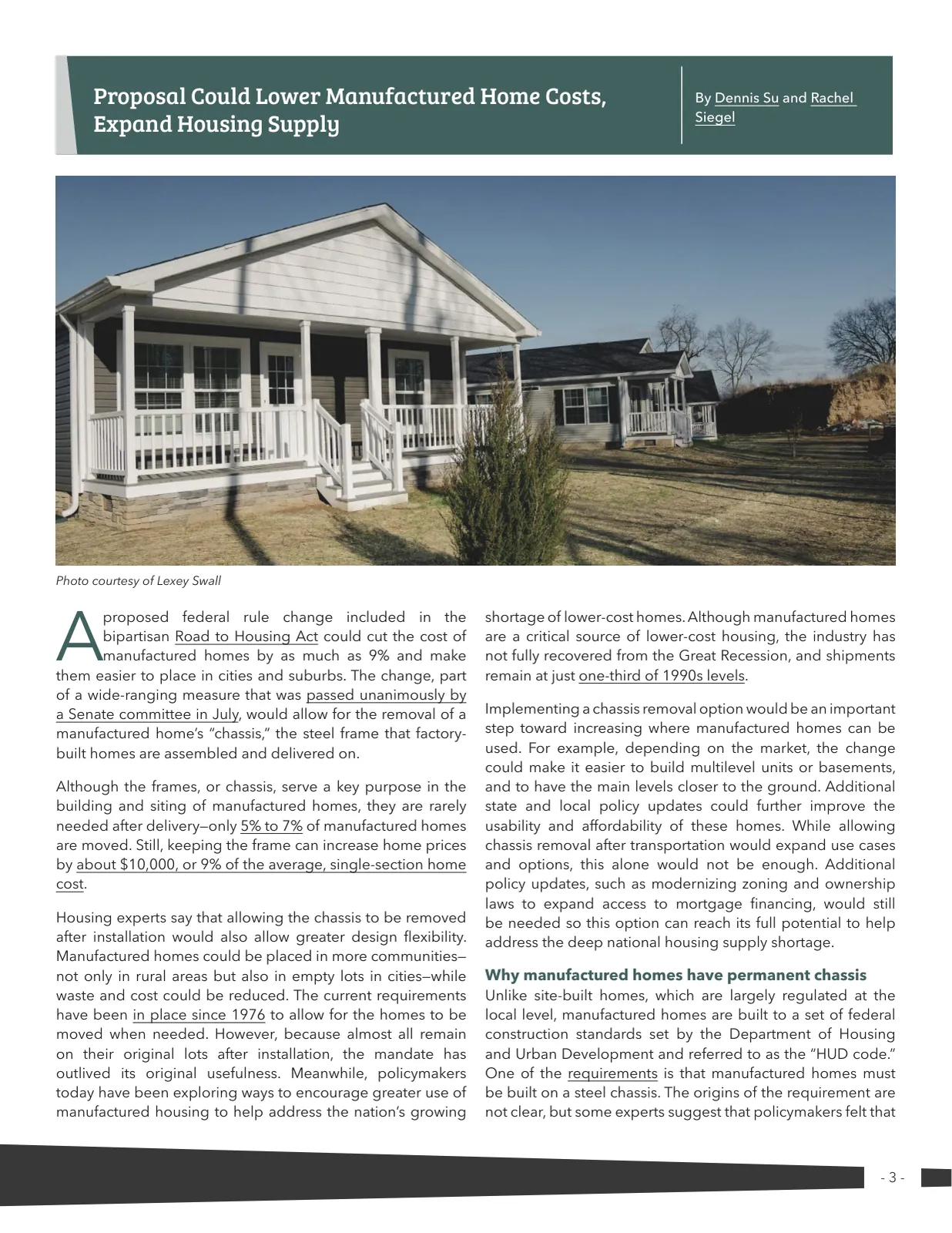
Photo courtesy of Lexey Swall
A proposed federal rule change included in the bipartisan Road to Housing Act could cut the cost of manufactured homes by as much as 9% and make them easier to place in cities and suburbs. The change, part of a wide-ranging measure that was passed unanimously by a Senate committee in July, would allow for the removal of a manufactured home’s “chassis,” the steel frame that factory-built homes are assembled and delivered on.
Although the frames, or chassis, serve a key purpose in the building and siting of manufactured homes, they are rarely needed after delivery—only 5% to 7% of manufactured homes are moved. Still, keeping the frame can increase home prices by about $10,000, or 9% of the average, single-section home cost.
Housing experts say that allowing the chassis to be removed after installation would also allow greater design flexibility. Manufactured homes could be placed in more communities—not only in rural areas but also in empty lots in cities—while waste and cost could be reduced. The current requirements have been in place since 1976 to allow for the homes to be moved when needed. However, because almost all remain on their original lots after installation, the mandate has outlived its original usefulness. Meanwhile, policymakers today have been exploring ways to encourage greater use of manufactured housing to help address the nation’s growing shortage of lower-cost homes. Although manufactured homes are a critical source of lower-cost housing, the industry has not fully recovered from the Great Recession, and shipments remain at just one-third of 1990s levels.
Implementing a chassis removal option would be an important step toward increasing where manufactured homes can be used. For example, depending on the market, the change could make it easier to build multilevel units or basements, and to have the main levels closer to the ground. Additional state and local policy updates could further improve the usability and affordability of these homes. While allowing chassis removal after transportation would expand use cases and options, this alone would not be enough. Additional policy updates, such as modernizing zoning and ownership laws to expand access to mortgage financing, would still be needed so this option can reach its full potential to help address the deep national housing supply shortage.
Why manufactured homes have permanent chassis
Unlike site-built homes, which are largely regulated at the local level, manufactured homes are built to a set of federal construction standards set by the Department of Housing and Urban Development and referred to as the “HUD code.” One of the requirements is that manufactured homes must be built on a steel chassis. The origins of the requirement are not clear, but some experts suggest that policymakers felt that
the chassis were essential for the homes to remain moveable and to increase stability if they were not on permanent foundations.
However, given that moving manufactured homes is challenging and expensive—and the reality that just 5% to 7% of such homes are ever moved once installed—the requirement is no longer needed. Furthermore, in cases in which the home is permanently attached to a foundation, usually when the homeowner also owns the land beneath the home, the chassis isn’t required for structural support and can be a hindrance. The requirement can add thousands of dollars in extra costs, make it impossible to build multilevel or multiunit homes in higher-cost markets or on smaller lots, cause basements to be dug deeper, and prevent homes from being closer to the ground, when that would be preferable. Allowing greater flexibility in configuring manufactured homes could help expand this lower-cost option in urban centers. For example, manufactured homes could provide a crucial source of housing on vacant lots and in higher-cost markets where multistory manufactured housing configurations are needed.
Removing chassis can reduce cost and increase design flexibility
Updating HUD code to allow the removal of the chassis could both make homes more affordable and provide builders and developers with greater design flexibility to meet the wants and needs of a diverse range of communities and neighborhoods. According to the Niskanen Center, a public policy think tank, removing the chassis requirement could reduce the cost of manufactured homes by anywhere from $5,000 to $10,000, roughly 7% to 9% for the average, single-section manufactured home.
In terms of material costs, builders would no longer have to build one chassis per section of home and could instead reuse a single chassis across multiple units. They could transport each section on a chassis that would then be removed and reused for future shipments. Removing the requirement would also save on installation costs; builders would no longer have to dig basements deep enough to contain a large steel frame.
Without the chassis, builders could better cater to the preferences of prospective homebuyers. More cities and densely populated communities would be able to benefit as well. For multilevel homebuilders, chassis removal would allow units to stack more easily without including the additional height and weight of a steel chassis on the upper-level section in the ceiling of the ground floor.
Next steps for state and local policy
Allowing manufactured homes to be made with removable chassis would be an important step forward. However, additional steps are needed at the state and local levels to ensure that these homes are treated like other homes. For example, policymakers at times justified exclusionary zoning regulations that precluded manufactured homes from a community simply because the chassis allowed those homes to be moved. Even with the chassis requirement in place, lawmakers in nine states over the past five years have recognized the importance of access to manufactured housing as a source of lower-cost homes and passed legislation to require zoning policies to allow them. Removing the chassis requirement altogether could provide even more impetus for states and localities to update policies.
Similarly, titling laws that automatically treat manufactured homes as movable or “personal” property (much like a car or trailer) must be reconsidered because they can inhibit the use of this option. Mortgage financing can be obtained only when a home is owned as real estate. Although most states allow the conversion of personal property to real estate, only about half of manufactured homes are titled that way, so mortgage financing becomes impossible regardless of the quality of the home or borrower qualifications. This results in higher borrower costs and fewer consumer protections.
Updates to chassis requirements and titling rules would help to ensure that manufactured homes are treated like other single-family homes and are eligible for mortgages. Improving policies across the board would help to expand the use of manufactured housing to better meet the needs of American families and boost its role in addressing the nation’s housing shortage.
Dennis Su works with Pew’s housing policy initiative. He assists with research on issues related to housing finance, manufactured housing, and land use.
Rachel Siegel guides research and policy for Pew’s housing policy initiative, focusing on manufactured and other lower cost homes.
Perverts in the Park!? What Kind of Perverts?
Rent-paying tenants that take care of their home, home site, and follow the rules are what community owners want. They are ideal tenants that are a magnet for other ideal tenants.
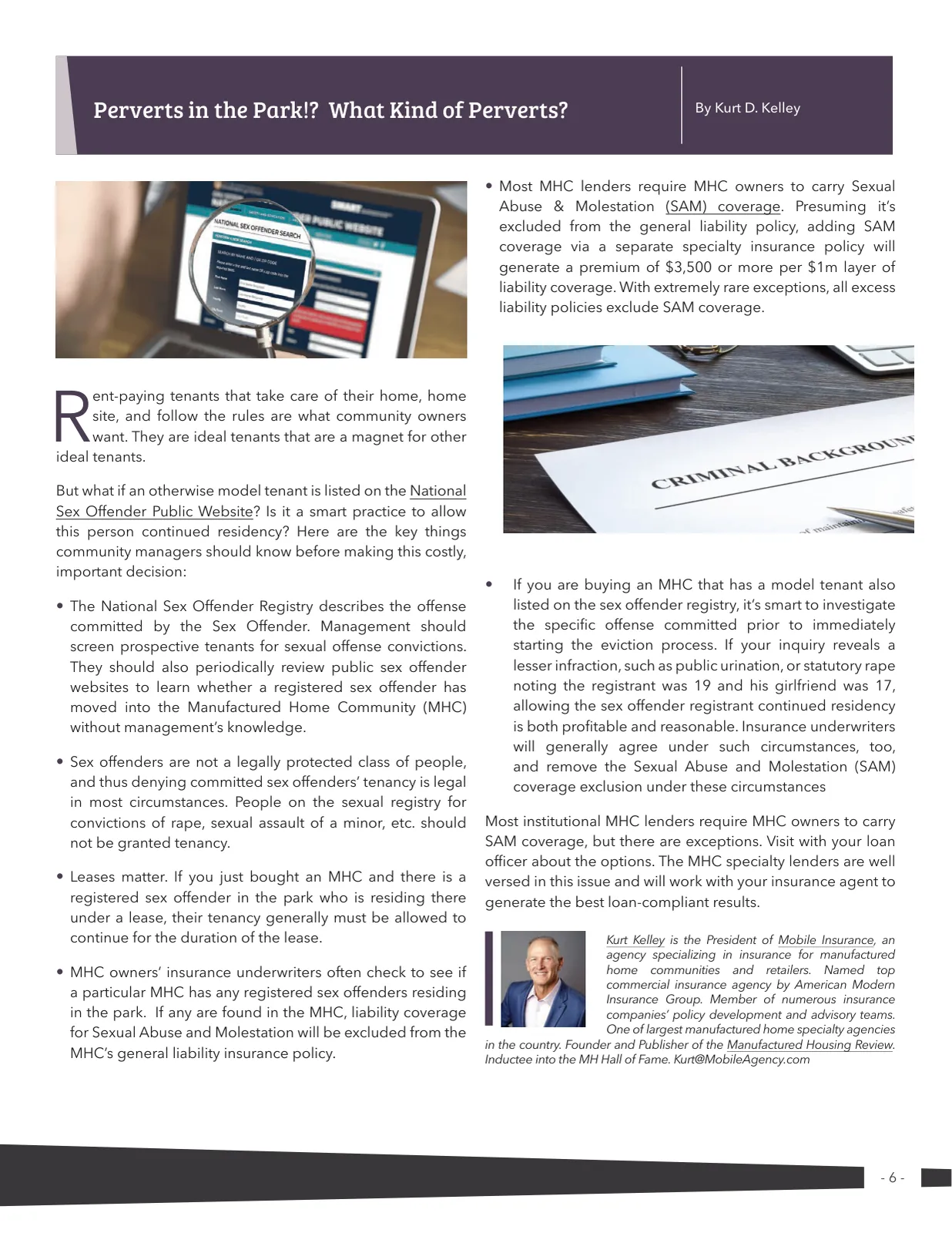
But what if an otherwise model tenant is listed on the National Sex Offender Public Website? Is it a smart practice to allow this person continued residency? Here are the key things community managers should know before making this costly, important decision:
• The National Sex Offender Registry describes the offense committed by the Sex Offender. Management should screen prospective tenants for sexual offense convictions. They should also periodically review public sex offender websites to learn whether a registered sex offender has moved into the Manufactured Home Community (MHC) without management’s knowledge.
• Sex offenders are not a legally protected class of people, and thus denying committed sex offenders’ tenancy is legal in most circumstances. People on the sexual registry for convictions of rape, sexual assault of a minor, etc. should not be granted tenancy.
• Leases matter. If you just bought an MHC and there is a registered sex offender in the park who is residing there under a lease, their tenancy generally must be allowed to continue for the duration of the lease.
• MHC owners’ insurance underwriters often check to see if a particular MHC has any registered sex offenders residing in the park. If any are found in the MHC, liability coverage for Sexual Abuse and Molestation will be excluded from the MHC’s general liability insurance policy.
• Most MHC lenders require MHC owners to carry Sexual Abuse & Molestation (SAM) coverage. Presuming it’s excluded from the general liability policy, adding SAM coverage via a separate specialty insurance policy will generate a premium of $3,500 or more per $1m layer of liability coverage. With extremely rare exceptions, all excess liability policies exclude SAM coverage.
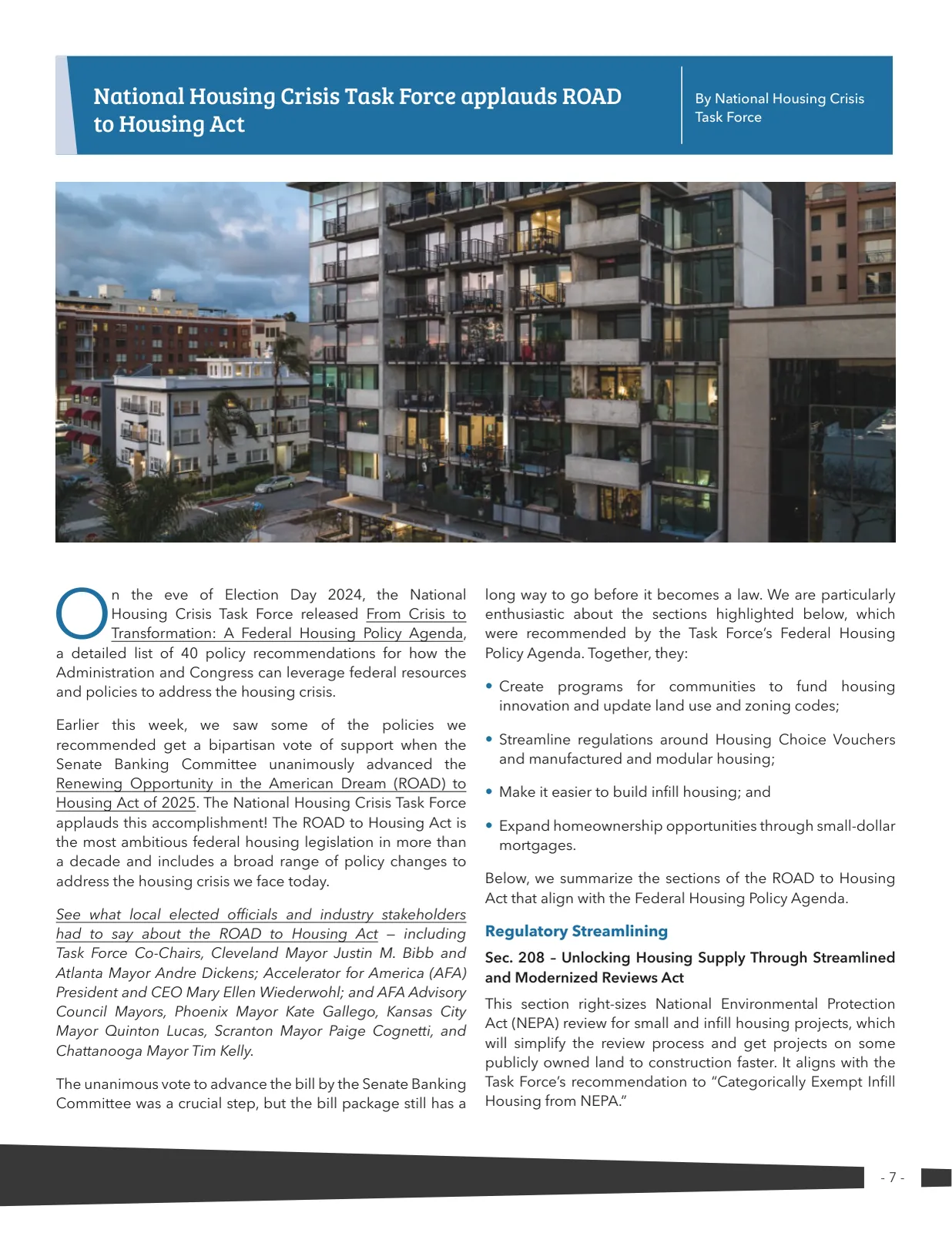
If you are buying an MHC that has a model tenant also listed on the sex offender registry, it’s smart to investigate the specific offense committed prior to immediately starting the eviction process. If your inquiry reveals a lesser infraction, such as public urination, or statutory rape noting the registrant was 19 and his girlfriend was 17, allowing the sex offender registrant continued residency is both profitable and reasonable. Insurance underwriters will generally agree under such circumstances, too, and remove the Sexual Abuse and Molestation (SAM) coverage exclusion under these circumstances
Most institutional MHC lenders require MHC owners to carry SAM coverage, but there are exceptions. Visit with your loan officer about the options. The MHC specialty lenders are well versed in this issue and will work with your insurance agent to generate the best loan-compliant results.
Kurt Kelley is the President of Mobile Insurance, an agency specializing in insurance for manufactured home communities and retailers. Named top commercial insurance agency by American Modern Insurance Group. Member of numerous insurance companies’ policy development and advisory teams. One of largest manufactured home specialty agencies in the country. Founder and Publisher of the Manufactured Housing Review. Inductee into the MH Hall of Fame. [email protected]
National Housing Crisis Task Force applauds ROAD to Housing Act
On the eve of Election Day 2024, the National Housing Crisis Task Force released From Crisis to Transformation: A Federal Housing Policy Agenda, a detailed list of 40 policy recommendations for how the Administration and Congress can leverage federal resources and policies to address the housing crisis.
Earlier this week, we saw some of the policies we recommended get a bipartisan vote of support when the Senate Banking Committee unanimously advanced the Renewing Opportunity in the American Dream (ROAD) to Housing Act of 2025. The National Housing Crisis Task Force applauds this accomplishment! The ROAD to Housing Act is the most ambitious federal housing legislation in more than a decade and includes a broad range of policy changes to address the housing crisis we face today.
See what local elected officials and industry stakeholders had to say about the ROAD to Housing Act — including Task Force Co-Chairs, Cleveland Mayor Justin M. Bibb and Atlanta Mayor Andre Dickens; Accelerator for America (AFA) President and CEO Mary Ellen Wiederwohl; and AFA Advisory Council Mayors, Phoenix Mayor Kate Gallego, Kansas City Mayor Quinton Lucas, Scranton Mayor Paige Cognetti, and Chattanooga Mayor Tim Kelly.
The unanimous vote to advance the bill by the Senate Banking Committee was a crucial step, but the bill package still has a long way to go before it becomes a law. We are particularly enthusiastic about the sections highlighted below, which were recommended by the Task Force’s Federal Housing Policy Agenda. Together, they:
• Create programs for communities to fund housing innovation and update land use and zoning codes;
• Streamline regulations around Housing Choice Vouchers and manufactured and modular housing;
• Make it easier to build infill housing; and
• Expand homeownership opportunities through small-dollar mortgages.
Below, we summarize the sections of the ROAD to Housing Act that align with the Federal Housing Policy Agenda.
Regulatory Streamlining
Sec. 208 – Unlocking Housing Supply Through Streamlined and Modernized Reviews Act
This section right-sizes National Environmental Protection Act (NEPA) review for small and infill housing projects, which will simplify the review process and get projects on some publicly owned land to construction faster. It aligns with the Task Force’s recommendation to “Categorically Exempt Infill Housing from NEPA.”
Sec. 213 – Housing Affordability Act
This section requires the Federal Housing Administration (FHA) to study multifamily loan limits and then grants the U.S. Department of Housing and Urban Development (HUD) rulemaking authority, with FHA input, to adjust those limits to better match housing market costs and enhance affordability. It aligns with the Task Force’s recommendation to “Modernize HUD Programs for More Rapid Housing Production,” which explicitly called for this change to FHA loan limits.
Offsite Construction
Sec. 301 – Housing Supply Expansion Act
This section updates the federal definition of manufactured housing to include modular and prefabricated units not built on a permanent chassis to encourage innovation and expand naturally occurring affordable housing. It also aligns with the Task Force’s recommendation to “Modernize HUD Programs for More Rapid Housing Production,” including striking the word “chassis” from Section 603(6) of the National Manufactured Housing Construction and Safety Standards Act of 1974 to allow for better-quality manufactured housing and expanded applicability of the HUD Code.
Sec. 302 – Modular Housing Production Act
This section directs HUD to study financing barriers for modular construction within HUD’s programs and authorizes HUD to fund a study on the use of a standardized code for modular construction. It aligns with the Task Force’s recommendations to “Create a National Performance-Based Building Code for Modular Housing” and to “Develop an Evidence-Based Model Multifamily Building Code for Adoption by States and Localities to Reduce Construction Costs.”
Sec. 304 – PRICE Act
This section authorizes HUD’s Preservation and Reinvestment Initiative for Community Enhancement (PRICE) Program to provide grants to communities to maintain, protect, and stabilize manufactured housing and manufactured housing communities. It aligns with the Task Force’s call to “Maintain and Expand Support for Manufactured Housing Residents and Communities.”
Program Modernization
Sec. 405 – Choice in Affordable Housing Act
This section will reduce HUD inspection delays by allowing units that are financed through other federal housing programs to automatically satisfy voucher inspection requirements if inspected within the past year. Additionally, the bill allows new landlords to request pre-inspections to increase access to housing for voucher holders and encourage landlord participation. It aligns with the Task Force’s recommendation to “Support Reforms for Greater Utilization of Housing Choice Vouchers,” which included authorizing additional flexibility for Public Housing Authorities to streamline the process for landlords who wish to participate in the Housing Choice Voucher program, such as allowing for pre-inspection of units.
Sec. 502 – HOME Investment Partnerships Reauthorization and Improvement Act
This section reauthorizes the HOME Investment Partnerships Program and makes critical updates to improve program administration and facilitate the construction of more affordable housing. It aligns with the Task Force’s recommendation to “Modernize HUD Programs for More Rapid Housing Production,” including streamlining and updating the HOME Program and other important HUD programs to facilitate the financing of affordable housing for cities and private-sector developers.
Read the Full Section-by-Section Breakdown
In addition to the sections noted above, the Task Force’s Federal Housing Policy Agenda recommends more robust changes to the Housing Choice Voucher, housing production and preservation, and homelessness programs than the ROAD to Housing Act currently proposes. We will continue to monitor the legislative package as it moves forward and share key updates on how it could impact state and local governments’ efforts to increase housing affordability and production in their communities. Stay tuned!
We encourage you to contact your Congressional delegation about the importance of federal action to ease the housing crisis, and as you and your policy teams review the ROAD to Housing Act, please let us know how you expect to impact housing production, preservation, and affordability in your community.
The Task Force focuses on five key segments of housing interventions: land, construction, capital, regulation and policy, and governance. By holistically evaluating these areas, the Task Force aims to ensure a brighter future for America’s housing.
Powerful Property Management
Handle any property management challenge—from the mundane to the mighty—with Rent Manager.
From collecting and processing rent to creating budgets and forecast models, with Rent Manager’s comprehensive features, you’ll always be ready.
To learn more, scan the QR code or visit RentManager.com/MH
With New Plan, Hochul Fast-Tracks Housing Supply
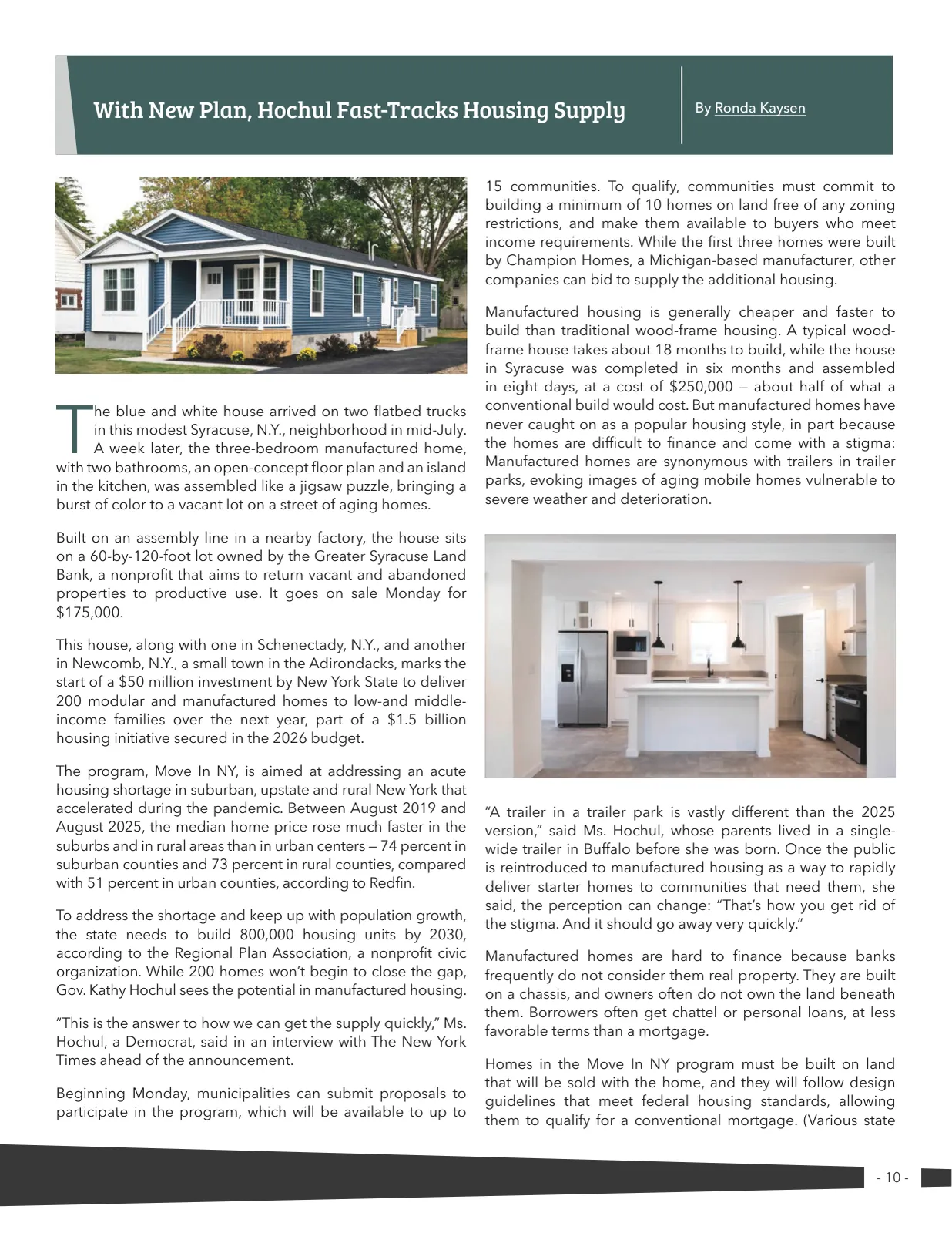
The blue and white house arrived on two flatbed trucks in this modest Syracuse, N.Y., neighborhood in mid-July. A week later, the three-bedroom manufactured home, with two bathrooms, an open-concept floor plan and an island in the kitchen, was assembled like a jigsaw puzzle, bringing a burst of color to a vacant lot on a street of aging homes.
Built on an assembly line in a nearby factory, the house sits on a 60-by-120-foot lot owned by the Greater Syracuse Land Bank, a nonprofit that aims to return vacant and abandoned properties to productive use. It goes on sale Monday for $175,000.
This house, along with one in Schenectady, N.Y., and another in Newcomb, N.Y., a small town in the Adirondacks, marks the start of a $50 million investment by New York State to deliver 200 modular and manufactured homes to low-and middle-income families over the next year, part of a $1.5 billion housing initiative secured in the 2026 budget.
The program, Move In NY, is aimed at addressing an acute housing shortage in suburban, upstate and rural New York that accelerated during the pandemic. Between August 2019 and August 2025, the median home price rose much faster in the suburbs and in rural areas than in urban centers — 74 percent in suburban counties and 73 percent in rural counties, compared with 51 percent in urban counties, according to Redfin.
To address the shortage and keep up with population growth, the state needs to build 800,000 housing units by 2030, according to the Regional Plan Association, a nonprofit civic organization. While 200 homes won’t begin to close the gap, Gov. Kathy Hochul sees the potential in manufactured housing.
“This is the answer to how we can get the supply quickly,” Ms. Hochul, a Democrat, said in an interview with The New York Times ahead of the announcement.
Beginning Monday, municipalities can submit proposals to participate in the program, which will be available to up to 15 communities. To qualify, communities must commit to building a minimum of 10 homes on land free of any zoning restrictions, and make them available to buyers who meet income requirements. While the first three homes were built by Champion Homes, a Michigan-based manufacturer, other companies can bid to supply the additional housing.
Manufactured housing is generally cheaper and faster to build than traditional wood-frame housing. A typical wood-frame house takes about 18 months to build, while the house in Syracuse was completed in six months and assembled in eight days, at a cost of $250,000 — about half of what a conventional build would cost. But manufactured homes have never caught on as a popular housing style, in part because the homes are difficult to finance and come with a stigma: Manufactured homes are synonymous with trailers in trailer parks, evoking images of aging mobile homes vulnerable to severe weather and deterioration.
“A trailer in a trailer park is vastly different than the 2025 version,” said Ms. Hochul, whose parents lived in a single-wide trailer in Buffalo before she was born. Once the public is reintroduced to manufactured housing as a way to rapidly deliver starter homes to communities that need them, she said, the perception can change: “That’s how you get rid of the stigma. And it should go away very quickly.”
Manufactured homes are hard to finance because banks frequently do not consider them real property. They are built on a chassis, and owners often do not own the land beneath them. Borrowers often get chattel or personal loans, at less favorable terms than a mortgage.
Homes in the Move In NY program must be built on land that will be sold with the home, and they will follow design guidelines that meet federal housing standards, allowing them to qualify for a conventional mortgage. (Various state
financing programs will be available to buyers for down payment and mortgage assistance).
Unlike trailer homes, modern manufactured homes can now include features that make them almost indistinguishable from wood frame houses, including open kitchens, pitched roofs, garages and porches. While the three models are almost identical, Champion Homes can build ones as large as 2,300 square feet with five bedrooms.
Rural communities and smaller cities both need new housing, but their needs are not the same. While a city like Syracuse struggles with vacant lots and deteriorating properties, a tiny, forested town like Newcomb also needs to find the money to fund basic infrastructure like roads and sewers before it can start building houses. Michael J. Borges, the executive director of the Rural Housing Coalition of New York, worries that rural communities could be overlooked in a program that sets a 10-home minimum. “When you’re trying to build housing in rural areas, you need programs that are specific to rural areas,” Mr. Borges said.
The program also faces a hurdle in communities that have been known to push back against building affordable housing, particularly manufactured homes. Rather than force towns to build, Ms. Hochul’s plan offers incentives, like zero-percent loans and partial grants. She hopes the incentives, along with the reality that communities need more housing, is enough to persuade municipalities to participate.
“Their communities will stagnate if they don’t build more housing,” Ms. Hochul said. “We’ll lose kids, not to Florida and Texas; we’ll lose them to New Jersey and Connecticut because they built more housing. That’s what’s happening.”
Ronda Kaysen, a real estate reporter for The Times, writes about the intersection of housing and society.
Experts Say These 10 Modular Home Trends Are Going to Be Everywhere
Photo Courtesy of Chris Coe
Modular homes have evolved significantly over the past decade—not just in construction methods, but also in how they reflect modern design trends and homeowner preferences. What was once a limited catalog of basic, builder-grade options or overly ornate styles meant to distinguish them from U.S. Department of Housing and Urban Development (HUD)–certified manufactured homes has transformed. Today’s modular designs look like any other traditional site-built residence, says Tammie Davidson, the director of interior design at Champion Homes.
Davidson explains that the modular home market has now reached a middle ground between functionality and beautiful design. “Modular interiors today have matured into trend-forward, thoughtfully curated spaces that stand shoulder-to-shoulder with on-site builds,” she adds.
Those trends, however, may emerge on a slightly different timeline than non-modular spaces. Because modular facilities are built in a factory, they generally stock materials in advance and sell homes built from those inventories, Davidson says, so they can’t as easily switch over to new, trendy finishes because leftover inventory could result in a loss.
“At the same time, modular homes absolutely track with current design trends,” she explains. “Facilities rely on careful forecasting to ensure their selections have longevity, so fleeting, short-lived fads rarely make it into the standard material palette.”
Below, we’ve listed 10 trends that Davidson and another modular home expert—Jordon Rogove, architect and CEO of Liv-Connected—predict we’ll see in the next year or two. You’ll likely find that they closely align with traditional home trends too, from the general aesthetics that are popular to the specific constructions of certain features, like kitchen cabinetry.
Sustainably Made Homes
As more homeowners in general are looking toward sustainable design, Rogove says it’s the same for people looking to invest in modular housing. Liv-Connected specializes in this type of build, making a conscious environmental commitment with each project. Rogove adds that their clientele is directly asking for natural and low-volatile organic compound (VOC) materials, photovoltaics—solar powered energy—and battery power storage in their modular homes.
Photo Courtesy of Chris Coe
Accessory Dwelling Units
Aside from primary houses, Rogove says that they’ve seen an uptick in people who want a modular house as an accessory dwelling unit (ADU) as well. “We see an interest from clients wanting to age in place or seeking accessory dwelling units for multigenerational living,” he adds. “Liv-Connected was born from a desire to build a smart modular home that could connect owners with healthcare and could detect falls or other incidents and issue an alert for help.”
Integrated Indirect Lighting
When it comes to the cosmetic design details, Rogove says that their clients have been drawn to integrated indirect lighting in their modular homes. This type of lighting “has been shown to be more comfortable and beneficial to health,” he explains. As more of the younger generations have become opposed to the “big light,” also known as the overhead and direct light fixture in a room, this trend tracks.
Modern or Farmhouse Aesthetics
Modular homes often follow the same design trends as traditional houses, and about a decade ago, the farmhouse style dominated. Today, however, homeowners are leaning more toward contemporary or modern aesthetics, with subtle
nods to farmhouse charm. Rogove notes that most of their clients prefer a modern look, though rustic elements still have their place.
Davidson echoes this point, saying that the current farmhouse aesthetic isn’t as heavy as the one so popular in the past. “Think warm woods paired with neutral palettes, creating a versatile backdrop for eclectic layering,” she says. This particular direction makes it easy to mix soft goods like white linen slipcovers with midcentury accents and contemporary art.
Taupe Cabinetry
As warmer tones are beginning to dominate the home space, Davidson says that taupe cabinetry is becoming more popular, as it’s the perfect balance between gray and beige. She describes it as the new “go-to neutral” because it offers warmth while feeling modern and versatile.
Colorful Tile
Look at any tile trend report for 2025, and you’ll find that homeowners are really loving a colorful moment. Davidson says it’s the same with modular houses: “Moving beyond white subway tile, customers are drawn to ceramics with rich color, whether in glazed or silk finishes.” For both kitchens and bathrooms, a bold, eye-catching tile is what’s desired.
Stained Wood Grains
Though there’s a time and place for painted cabinetry, Davidson says that stained wood is becoming more popular in modular homes. The natural warmth creates a more grounded and organic look, replacing the classic farmhouse style of painted cabinets and leaning more modern.
Statement Lighting
“Instead of relying solely on recessed can lighting, homeowners are layering pendants and chandeliers,” Davidson says. “Milk glass, smoked glass, square-tube candelabras, and mixed gold-and-black finishes are trending for both function and mood.” One of the top trends that designers love for living rooms in 2025 is bold lighting, too.
Ceramic Flooring
Rather than stick with wood flooring in modular homes, homeowners are choosing luxury vinyl tile (LVT) and patterned vinyl roll goods that resemble ceramic. These options allow for more options in both design style and budget, as well as comfort underfoot, according to Davidson.
Walls That Work Harder
“In 2026, modular interiors will lean into personality with 3D wall applications, bold surface treatments, and wallpaper that adds depth, color, and texture,” Davidson explains, adding that plain white walls simply aren’t enough. As general interior trends continue towards a more personality-filled path, modular home trends will follow.
Meghan Shouse is House Beautiful’s Digital Editor. House Beautiful is dedicated to bringing you the best in home inspiration and design education. Founded in 1896, we are the oldest continually-published shelter magazine in the United States, and we are proud to carry on this legacy of great design.
THE CONCERNED COMMUNITY OWNER: Common Sense Defeats The Stupidity Of The “Price Fixing” Class Action
For several years now the mobile home park industry has been under the cloud of a massive “price-fixing” class action against several of the largest owners and clients of Datacomp. Recently, however, the whole mess was tossed out when U.S. District Judge Franklin U. Valderrama ruled that the plaintiffs had failed to plausibly allege a price-fixing agreement or conspiracy under the Sherman Antitrust Act. The judge said the evidence presented did not show a clear “invitation” to join a conspiracy among the defendants, but rather parallel conduct insufficient on its own to prove collusion.
I’m not a lawyer – I don’t even like lawyers – but it didn’t take a law degree to see the problems with this case from the onset. They included:
• Mobile home park lot rents are insanely low and don’t need any artificial means of support to go up and yet stay at 100% occupancy since you have $500 per month community lot rents competing with $2,000 pe month apartments and $400,000 single-family homes. If park owners are supposedly price-fixing, they must be pretty bad at it, right?
• Most of the park owners in the U.S. attempt to artificially keep their lot rents low – not high – because nobody likes to be the most expensive in the market, due to the general belief that being at the top opens you up to negative media articles and potential “raiding” from other park owners. We call this attitude “mom and pop quantitative easing” and it’s been the rule of the land for at least half-a-decade.
• Most mobile home parks are so different – certainly nothing even remotely approaching a commodity – that it would make no sense to “collude”. Every market has everything from dirt-road dumps to 5-star senior parks and consumers make their choices based on many variables with price being only one. Literally, no two mobile home parks are alike.
I think we all knew instinctively that this case would go nowhere once the case went to court, but all mobile home park owners were still in a state of shock after suffering through Covid, nationwide eviction moratoriums and 11 consecutive interest rate increases by the Fed (collectively known as the “Biden Era”). So we all thought “sure it’s a stupid case” but yet we had no confidence in the system or its ability to protect Americans from the insanity we had all been going through for years.
However, with this case behind the industry, we are not out of the woods yet. All landlords in the U.S. – and particularly park owners – are under constant attack from groups representing the “Free Rent Movement”. And, just like the “Free Love Movement” of the 1960s, their mission is to scare good-natured Americans into submission through bullying. One of their mantras is that “private equity groups are ruining the U.S. housing market” and, in many ways, that’s probably the root of the now-failed class action suit which targeted exclusively the nation’s largest community owners and two REITs.
But perhaps this latest win will change the momentum of the game. Maybe Judge Valderrama’s decision is the start of a new era in which common sense has returned to an America desperate to erase the entire Biden agenda and its leftist attitudes.
I think we all look forward to a new era in which we can focus on delivering America’s only form of non-subsidized affordable housing free from attacks from the “Free Rent Movement” and those that support its socialist agenda. And the end of this baseless class action suit is definitely a step in the right direction.
Here’s to a great 2026!
The Concerned Community Owner is a column dedicated to the challenges and insights of Managers, Owners, and Investors navigating today’s real estate landscape. These articles come from readers across the nation, sharing real experiences and pressing concerns.
Do you have a perspective to share? Submit your article to: [email protected] —contrary opinions welcome!
States Take Crucial Steps to Expand Supply of Lower-Cost Single-Family Homes
The urgency to build more homes grows as the nation confronts a widespread housing shortage, estimated at 4 million to 7 million homes. To combat this problem, policymakers are embracing manufactured housing—homes built in a factory according to a federal standard—as a fast and efficient solution for communities that need new single-family homes. During the past five years, nine states have enacted zoning reforms to facilitate use of manufactured homes, which typically cost 45% less per square foot than traditional, site-built homes, as a housing option in more neighborhoods.
The impact and effectiveness of these new laws will need to be evaluated over time, but early indications from interviews with manufactured home developers, manufacturers, and other experts, as well as recent case studies and examples across states, show the potential of these policies to help bring more manufactured homes to market.
Local zoning barriers often rule out manufactured housing as a viable option for prospective homeowners, despite its affordability and its quality, which is now on par with site-built housing. Zoning laws and other factors—such as limited access to affordable loans with interest rates and consumer protections similar to those of mortgages—have contributed to persistently low manufactured home shipments in the past two decades. Currently, builders deliver about 100,000 manufactured homes per year, approximately a quarter of the industry’s 1998 production level.
Manufactured homes: Safety and affordability
Modern manufactured houses are the only type of homes in the U.S. that must meet a single national standard: the Manufactured Home Construction and Safety Standards, also known as the Housing and Urban Development (HUD) code. In effect since 1976, the HUD code sets standards for construction and design, including fire safety, wind resistance, and durability as well as energy efficiency—and in 1994, it was upgraded to a higher level. The HUD federal standard, combined with the efficiencies gained from building the homes on an assembly line in a factory, results in significant savings for the homebuyer. In 2020, a new manufactured home installed on a foundation costs 35% to 73% as much as a similar site-built home. A buyer saved about $53,000 on the larger, highest-end manufactured home and more than $100,000 on a smaller, more modest model.
In fact, in many places, especially rural areas and depopulated cities, a manufactured home is the only feasible way to build new single-family housing. Construction costs for site-built homes can sometimes exceed the home’s value, generating no profit for builders and developers and leaving them with little incentive to invest. Some rural areas also lack available workers to build new homes. In addition, if zoning laws prohibit manufactured homes, vacant lots remain empty and mortgage-qualified customers have few, if any, quality homes to buy.
Local zoning barriers to manufactured housing
Zoning policies do not reflect the quality of modern manufactured homes and often prevent communities from using them. These policies include:
• Explicit rules that limit locations of manufactured homes in certain neighborhoods.
• Design standards (e.g., roof pitch, cladding materials, foundation types) that apply only to manufactured homes and make it difficult or impossible to put manufactured homes in certain neighborhoods.
• Minimum lot size and street-setback requirements that erode the cost savings of using manufactured homes because land costs are high.
These policies limit manufactured homes as a housing option for qualified borrowers looking for a “starter” home, perpetuate affordability gaps, and bar people from attainable homeownership. Though manufactured homes are frequently allowed in rural areas, zoning restrictions in suburban and more metropolitan areas often allow these homes only in land-lease communities or “mobile home parks,” which are more likely to be located in areas prone to natural disasters or are cut off from community services such as municipal water and sewer. Yet these homes could be used as a lower-cost substitute for site-built, single-family homes in urban and suburban residential neighborhoods. Changing this type of
zoning code could provide an important opportunity to 3.2 million renters across the country who can’t currently afford site-built homes. A new manufactured home, if available, would fit their budget.
When manufactured homes are allowed in neighborhoods and offered as real estate like site-built homes, the buyer can qualify for a mortgage, which typically has more affordable monthly payments compared with other forms of financing, such as loans for just the home. More importantly, the value of manufactured homes owned with land appreciates similarly to that of site-built homes.
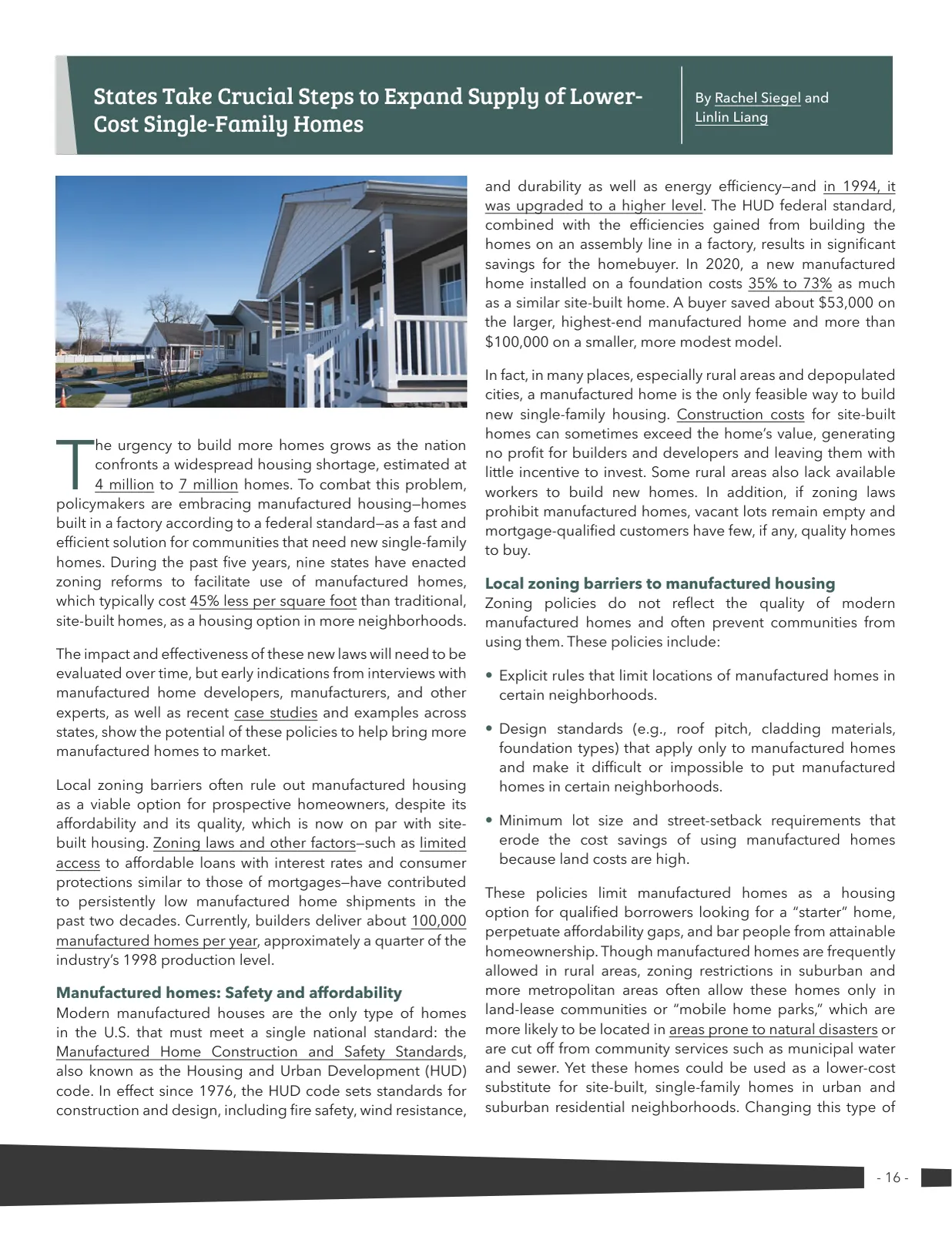
Local stakeholders and policymakers are working together to expand housing supply with manufactured homes in an increasing number of communities. For example, developers are building new neighborhoods of manufactured homes in Hagerstown, Maryland, and North Knoxville, Tennessee. In California, manufactured homes can now be used as preapproved accessory dwelling units (ADUs), which streamlines both construction of the home and securing of the permits. In Detroit, a community land trust worked with partners to install new manufactured homes on previously vacant lots. In New York, the state Housing Trust Fund Corp. is in the process of installing high-end manufactured homes on formerly vacant lots in neighborhoods in the cities of Syracuse and Schenectady, and the town of Newcomb. Many builders have found that by using manufactured homes, they can provide more single-family homes in places that need affordable options. But first, zoning regulations must allow them.
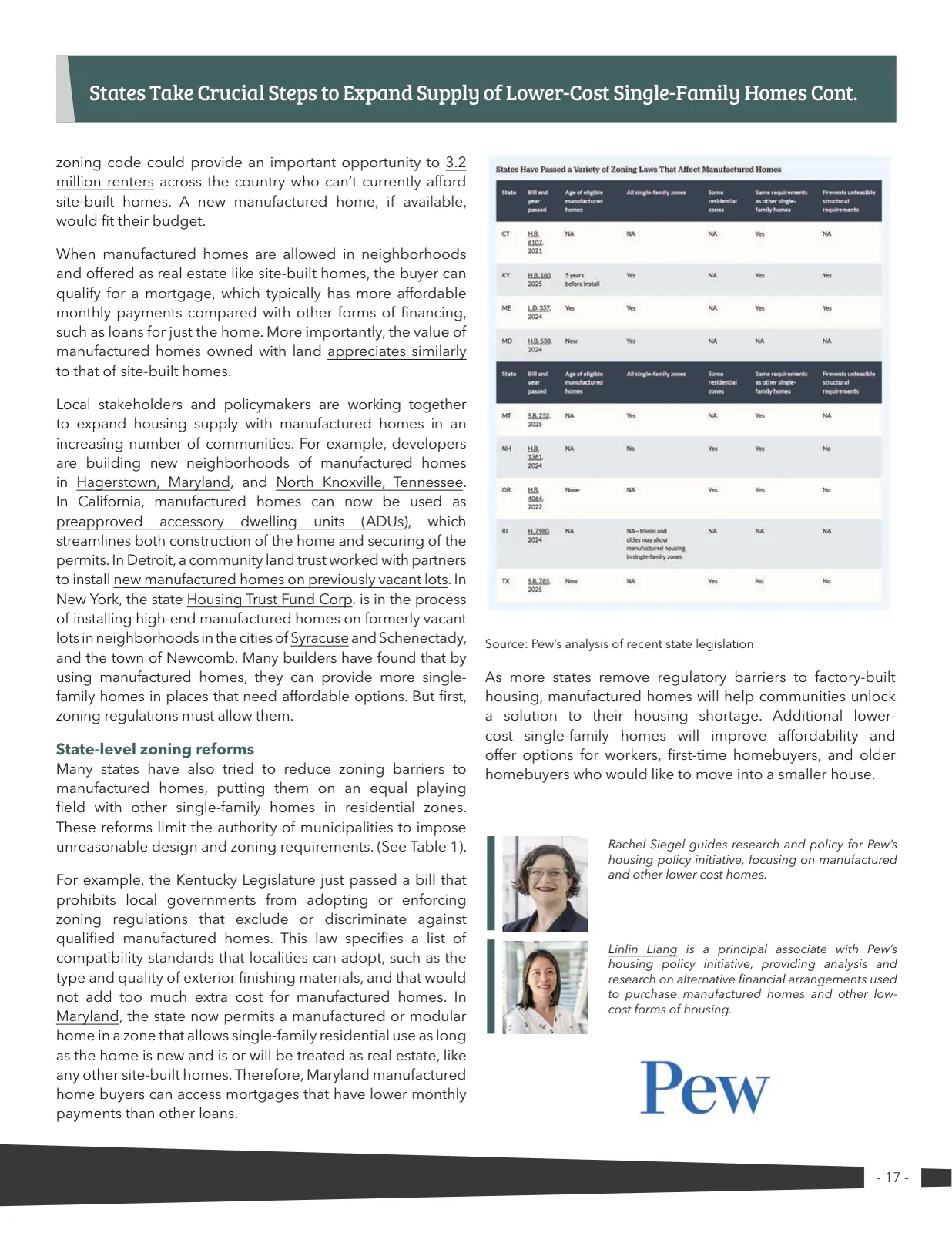
Source: Pew’s analysis of recent state legislation
As more states remove regulatory barriers to factory-built housing, manufactured homes will help communities unlock a solution to their housing shortage. Additional lower-cost single-family homes will improve affordability and offer options for workers, first-time homebuyers, and older homebuyers who would like to move into a smaller house.
State-level zoning reforms
Many states have also tried to reduce zoning barriers to manufactured homes, putting them on an equal playing field with other single-family homes in residential zones. These reforms limit the authority of municipalities to impose unreasonable design and zoning requirements. (See Table 1).
Rachel Siegel guides research and policy for Pew’s housing policy initiative, focusing on manufactured and other lower cost homes.
For example, the Kentucky Legislature just passed a bill that prohibits local governments from adopting or enforcing zoning regulations that exclude or discriminate against qualified manufactured homes. This law specifies a list of compatibility standards that localities can adopt, such as the type and quality of exterior finishing materials, and that would not add too much extra cost for manufactured homes. In Maryland, the state now permits a manufactured or modular home in a zone that allows single-family residential use as long as the home is new and is or will be treated as real estate, like any other site-built homes. Therefore, Maryland manufactured home buyers can access mortgages that have lower monthly payments than other loans.
Linlin Liang is a principal associate with Pew’s housing policy initiative, providing analysis and research on alternative financial arrangements used to purchase manufactured homes and other low-cost forms of housing.
$100,000 Is the New “Poor”
I’ve been meaning to write on the true level of poverty in this country.
A smarter man beat me to it.
Michael Green contends that the real poverty line - where a family can afford basic needs - isn’t remotely close to the government’s stated $31,200…. it’s $100K+.
Here are my favorite highlights from the article:
• When you are drowning, and you see the lifeguard throw a life vest to the person treading water next to you—a person who isn’t swimming as hard as you are—you don’t feel happiness for them. You feel a homicidal rage at the lifeguard.
• Our entire safety net is designed to catch people at the very bottom, but it sets a trap for anyone trying to climb out. As income rises from $40,000 to $100,000, benefits disappear faster than wages increase.
• Childcare: In 1955, this cost was zero because the economy supported a single-earner model. Today, it’s $32,000. That’s an infinite increase in the cost of participation.
• The Poverty Line measures Americans who cannot afford a minimum food diet multiplied by three. It’s not measuring who can afford rent (which is up 4x relative to wages). It’s not measuring who can afford childcare. It’s measuring starvation.
My Thoughts
Somewhat ironically, Wall Street is finally starting to wake up to the crisis the MHP industry sees every day.
The economy is BROKEN for unskilled labor.
Participation Line > Poverty Line
If you don’t have basic assets (a smartphone, a great credit score, high-speed internet, affordable childcare options, subsidized healthcare), you don’t get to play the game.
These things are table stakes in our modern society and without them you are properly screwed.
Furthermore, in a world of AI, this will get way worse before it gets better (if ever).
Just like equity investments (which most can’t afford), those that invest in AI + personal growth will see compounding advantages. Those that can’t (or won’t) will see stagnation.
What are the implications for our industry?
• Manufactured housing is needed now more than ever.
• Real estate markets continue to bifurcate between luxury and affordability - the middle is a brutal place to compete or invest.
• The industry needs to further embrace second chance tenants - when families are in financial ruin they have no credit, no down payments, no chance. They can’t pass a tenant screen and can’t get hired in higher wage sectors. Yet most American families are still worth betting on. That info is in their financial accounts. A lot of operators go with their gut on borderline tenant screening decisions, Artificial Intelligence can help operators make those bets systematically and profitably.
• A larger percentage of the country will figure out the math on benefits vs. work and will choose the free stuff path. On a long enough time horizon, that means more parks will resemble 55+ communities, fully occupied on weekdays with a higher percentage of tenants on fixed + inflation incomes.
• We’re going to need expanded parks, new housing stock and upgraded communities to welcome the disappearing middle class. That means a lot of capital will find a productive home in MHC.
And finally, this article is a nice reminder that….
You should feel incredibly proud for working (and/or investing) in affordable housing. It’s literally keeping families on the right side of survival. Don’t let anyone tell you otherwise.
Clay Holmes, of MHP Weekly, is “The Salty MHP Investor,” delivering “The Mother’s Milk of Mobile Home Park Investing” through sharp, practical advice.
Giving You Guidance.
Empowering you with the rental industry resources & education you need.
JOIN AAOA FOR FREE
SERVING YOU
139K
19YRS
MEMBERS
11K
REVIEWS
3M
UNITS MANAGED
Find Quality Tenants Learn
Reliable credit/background checks Option for landlord or tenant pay LeaseGuarantee to protect your rental income
Download Legal Forms
150+ Premium state-specific forms 20 Free landlord forms Attorney reviewed & customizable
Unlimited recorded & live webinars AAOA Today e-newsletter Free access to RENT Magazine
Grow Your Portfolio
Exclusive off-market listings Financing for your investments Vendor directory & discounts
AAOA.com 866.579.2262 [email protected]
A Guide to Buying or Selling a Manufactured Housing Community in Colorado
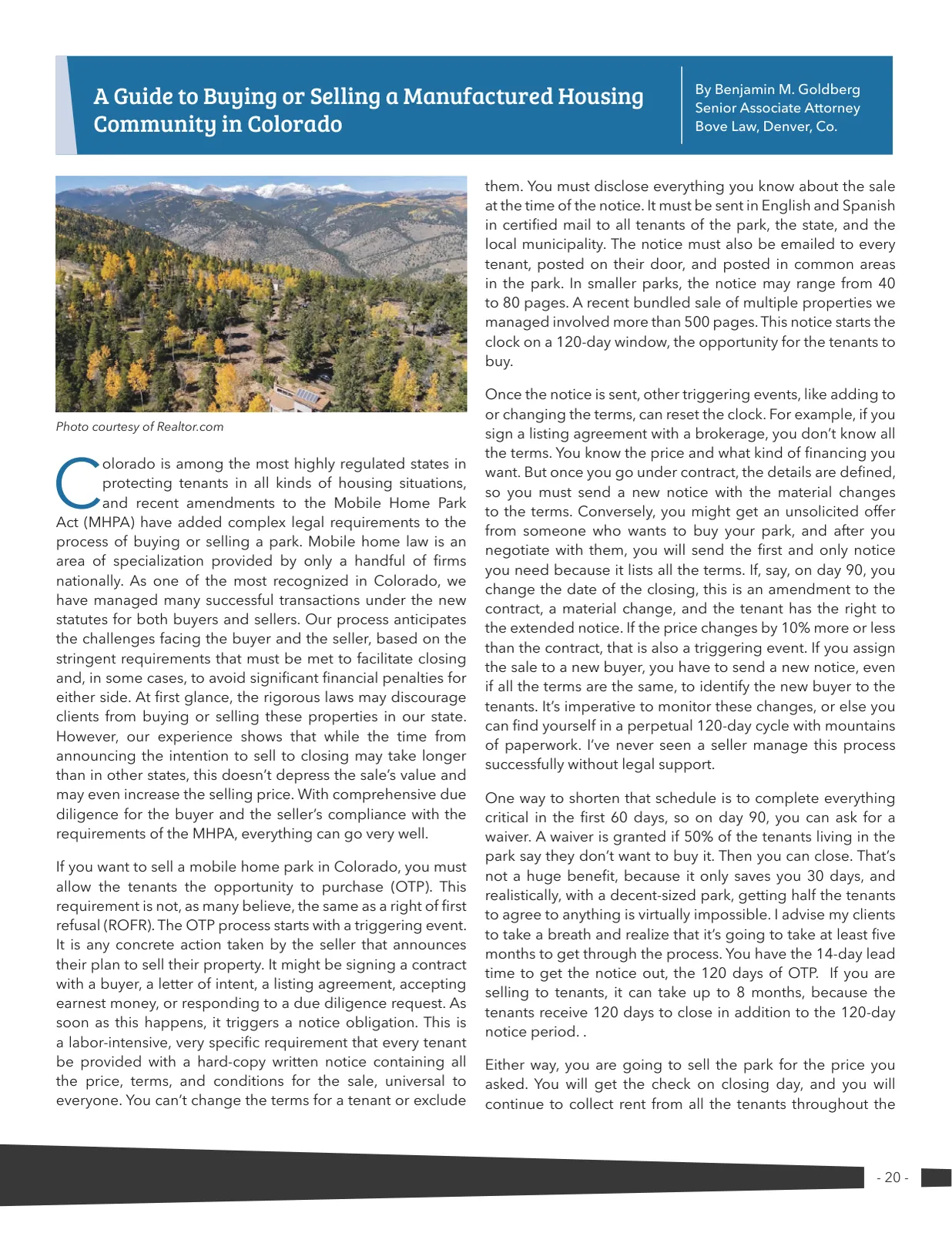
Photo courtesy of Realtor.com
Colorado is among the most highly regulated states in protecting tenants in all kinds of housing situations, and recent amendments to the Mobile Home Park Act (MHPA) have added complex legal requirements to the process of buying or selling a park. Mobile home law is an area of specialization provided by only a handful of firms nationally. As one of the most recognized in Colorado, we have managed many successful transactions under the new statutes for both buyers and sellers. Our process anticipates the challenges facing the buyer and the seller, based on the stringent requirements that must be met to facilitate closing and, in some cases, to avoid significant financial penalties for either side. At first glance, the rigorous laws may discourage clients from buying or selling these properties in our state. However, our experience shows that while the time from announcing the intention to sell to closing may take longer than in other states, this doesn’t depress the sale’s value and may even increase the selling price. With comprehensive due diligence for the buyer and the seller’s compliance with the requirements of the MHPA, everything can go very well.
If you want to sell a mobile home park in Colorado, you must allow the tenants the opportunity to purchase (OTP). This requirement is not, as many believe, the same as a right of first refusal (ROFR). The OTP process starts with a triggering event. It is any concrete action taken by the seller that announces their plan to sell their property. It might be signing a contract with a buyer, a letter of intent, a listing agreement, accepting earnest money, or responding to a due diligence request. As soon as this happens, it triggers a notice obligation. This is a labor-intensive, very specific requirement that every tenant be provided with a hard-copy written notice containing all the price, terms, and conditions for the sale, universal to everyone. You can’t change the terms for a tenant or exclude them. You must disclose everything you know about the sale at the time of the notice. It must be sent in English and Spanish in certified mail to all tenants of the park, the state, and the local municipality. The notice must also be emailed to every tenant, posted on their door, and posted in common areas in the park. In smaller parks, the notice may range from 40 to 80 pages. A recent bundled sale of multiple properties we managed involved more than 500 pages. This notice starts the clock on a 120-day window, the opportunity for the tenants to buy.
Once the notice is sent, other triggering events, like adding to or changing the terms, can reset the clock. For example, if you sign a listing agreement with a brokerage, you don’t know all the terms. You know the price and what kind of financing you want. But once you go under contract, the details are defined, so you must send a new notice with the material changes to the terms. Conversely, you might get an unsolicited offer from someone who wants to buy your park, and after you negotiate with them, you will send the first and only notice you need because it lists all the terms. If, say, on day 90, you change the date of the closing, this is an amendment to the contract, a material change, and the tenant has the right to the extended notice. If the price changes by 10% more or less than the contract, that is also a triggering event. If you assign the sale to a new buyer, you have to send a new notice, even if all the terms are the same, to identify the new buyer to the tenants. It’s imperative to monitor these changes, or else you can find yourself in a perpetual 120-day cycle with mountains of paperwork. I’ve never seen a seller manage this process successfully without legal support.
One way to shorten that schedule is to complete everything critical in the first 60 days, so on day 90, you can ask for a waiver. A waiver is granted if 50% of the tenants living in the park say they don’t want to buy it. Then you can close. That’s not a huge benefit, because it only saves you 30 days, and realistically, with a decent-sized park, getting half the tenants to agree to anything is virtually impossible. I advise my clients to take a breath and realize that it’s going to take at least five months to get through the process. You have the 14-day lead time to get the notice out, the 120 days of OTP. If you are selling to tenants, it can take up to 8 months, because the tenants receive 120 days to close in addition to the 120-day notice period. .
Either way, you are going to sell the park for the price you asked. You will get the check on closing day, and you will continue to collect rent from all the tenants throughout the
process. The state knows about your pending sale, but I haven’t seen that knowledge result in increased complaints by the Colorado Department of Local Affairs (DOLA), the agency that enforces the MHPA. The myth that it is just not worth the effort to buy or sell a mobile home community in Colorado because of the complex OTP noticing requirements and extended time frame is easily debunked by reviewing the transactions we’ve helped our Colorado clients complete.
Effectively managing the OTP noticing process for the seller is one aspect of transactional legal support and helping the buyer understand their responsibilities is another. Through scrupulous due diligence, we can identify any problems that the seller hasn’t rectified that may be passed on to the buyer. DOLA has the jurisdiction to add the new owner to any pending cases that may be in litigation. The good news for the buyer is that a new law enacted last year requires disclosure of all pending DOLA complaints. Sellers are responsible for all the current penalties, and DOLA can force them to set aside money in escrow for unfinished cases to pay potential penalties.
Additionally, if the seller hasn’t taken care of them, DOLA can impose a penalty of 30% of the purchase price or the list price, whichever is higher, and return it to the tenants. The tenants can initiate an independent lawsuit for an additional 30%, leaving 60% of the sale price at risk. The Attorney General can put a cloud on the title, declaring it defective if transferred without complying with the statute, and can sue to stop the sale. At this point, the monetary remedy is on the seller, and you can’t close. DOLA can also require the buyer and seller to resolve a complaint within a year of purchase. In other words, the state can go after an unsuspecting buyer for the sins of a less-than-transparent seller.
Through our ongoing contact with the DOLA officials, we regularly request complaint records for our clients who are buying a park. Conversely, I have clients preparing to put their parks up for sale who ask me to review all their documents and ensure there are no surprises for the buyer. Your property is more marketable when you can show the seller that you are fully compliant with all DOLA regulations, rather than walking into a nightmare of outdated documentation. With established
policies on tenant issues such as emotional support animals, vetting for criminal activity, and unauthorized accessory structures, it’s much easier for a new owner to manage the park.
If the motivation is the seller’s inability to keep up with the regulations and the lack of capital to make improvements, then it is a good idea to sell. As a buyer, it’s a good time to buy, but only if you are willing to put in the capital and energy needed to deliver a high-quality housing product. Don’t buy to keep the status quo and collect rent checks. The tenants have high expectations for where they live. It may be a mobile home park, but it is their home. The onus is on the owner to meet their end of the contract and maintain a safe, habitable environment. Upkeep is crucial, as is quick and comprehensive repair of problems.
Tenants purchase parks mainly because they embrace the ideal of owning the land under their homes. There is a sense of guiding one’s destiny and having a say in how their community will flourish and prosper to the benefit of all. That’s an honorable dream, but, as in most cases, governance by a committee with personal stakes in the outcome of decisions can be difficult. Often, these sales are financed by nonprofit organizations that fund the loan, take a percentage, and offer the dream of self-determination. Sometimes local municipalities contribute funding to support their mission of affordable housing. The problems arise when the co-op formed to run the park realizes that its equity is not increasing. At the same time, the cost of maintaining the property rises—rent increases to support infrastructure. In Aspen, one tenant-owned park experienced an increase of several hundred dollars per month. Issues about neighbors’ lifestyles don’t go away. There’s still the tenant with four dogs that bark incessantly, and there is the neighbor who won’t pay their rent. Maybe a sewer line breaks. The previous owner would have absorbed the repair cost through a multi-park budget, but now the tenants have to pay the plumber. I’ve heard of tenants setting up GoFundMe accounts to handle these problems. And just because the park is tenant-owned, all the MHPA regulations still apply!
Due diligence is particularly crucial to those tenant groups considering the benefits of owning their park. The recent foreclosures of two parks in Fremont, CO, underscore the dire consequences of inadequate research and planning. In the worst-case scenario, tenants can’t make a mortgage because they can’t afford to pay their rent, capital improvements fail, and ultimately, someone sweeps in and buys the park for pennies on a dollar. While the new owner will comply with DOLA regulations that enhance the quality of life, the aesthetic improvements may be nil. It’s very risky, but no one is telling tenants about it. I implore them to find out what they are getting into, to have a backup plan, and to weigh the financial responsibilities of ownership against the limited contractual obligation to pay rent to a managing entity.
In cases where I have represented buyers and sellers in a sale, which is possible through a waiver, I have been able to identify problems to the benefit of both parties. Certain areas will create maintenance costs in every park, and knowing the background of a specific park is particularly helpful. We study the locations of trees and sewer lines, review snow-removal impediments, parking limitations, and street access. The more the buyer and seller know about the park, the better the seller’s understanding of its current value and their responsibilities before the sale, and the buyer’s expectations for their investment. Yes, there are rigorous legal processes to buying and selling a mobile home park in Colorado, but when managed professionally, the rewards are worth it.
Benjamin M. Goldberg, Senior Associate Attorney with Bove Law in Denver, County Mr. Goldberg helps his clients buy and sell mobile home communities in Colorado, effectively navigating them through the complicated tenants’ Opportunity to Purchase (OTP), and due-diligence processes. He is well versed in every aspect of the county and state statutes and advises our clients on changes that may affect their businesses. Mr. Goldberg defends and litigates complaints for his clients in front of the Mobile Home Park Oversight Program and Colorado Civil Rights Division, on matters ranging from compliance with the Mobile Home Park Act to Fair Housing.
Manufactured Housing at a Crossroads
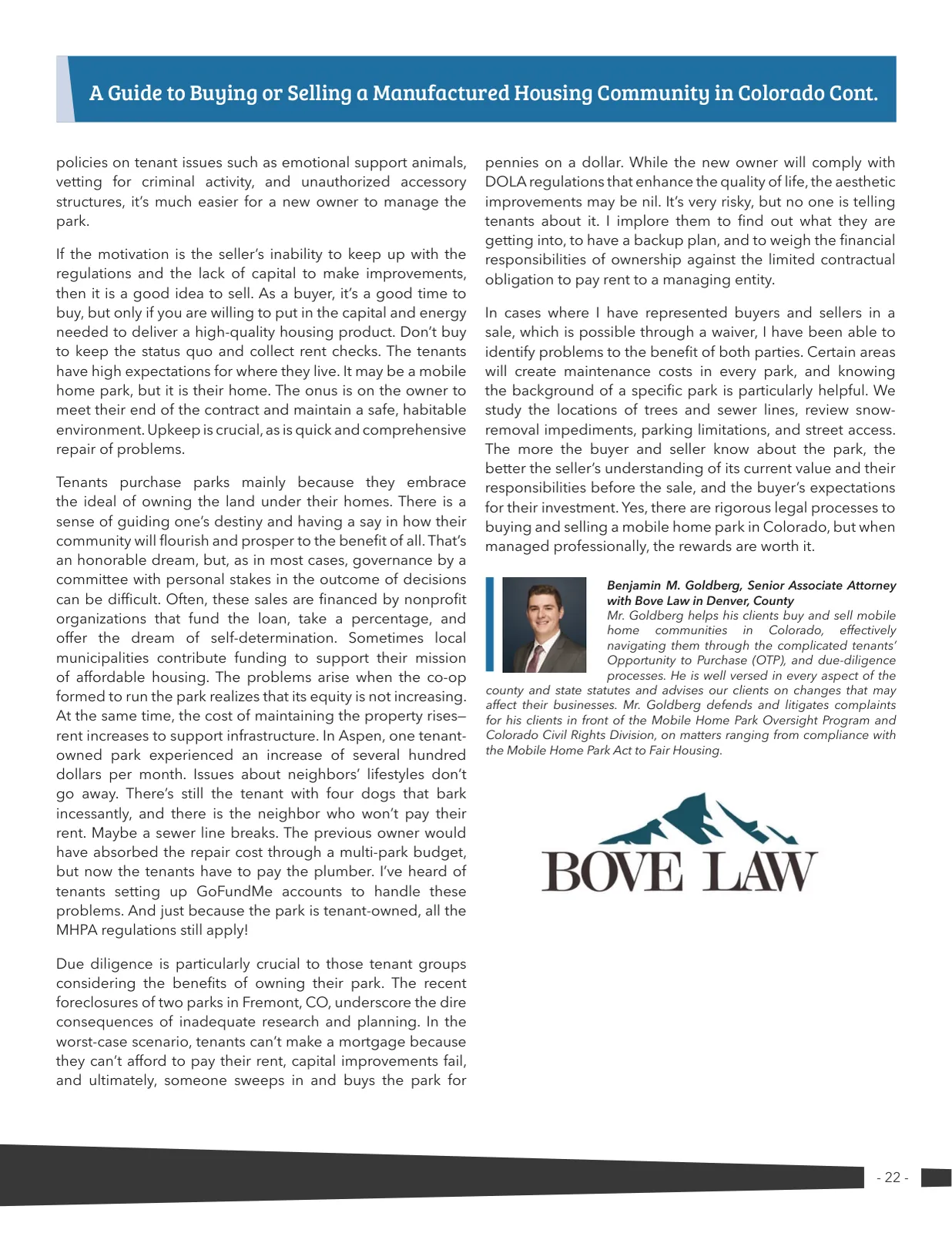
Photo courtesy of Getty Images
This fall in Atlanta, policymakers, lenders, and practitioners gathered with housing advocates, homeowners, developers, and researchers for the twentieth anniversary of the Innovations in Manufactured Housing (I’m HOME) Network conference. What began two decades ago as an experiment in reframing manufactured housing—from a problem to be eliminated into a solution to be scaled—has matured into one of the most diverse and influential gatherings in the housing field. The conference reflected how far manufactured housing has come and set the stage for the immense work that needs to be done to address the affordability crisis in the housing sector.
After days of critical discussion on concrete steps that can be taken to advance affordable and attainable housing solutions through off-site built housing, one resounding message emerged: manufactured housing is “just housing.” While it has long been stigmatized, 22 million people in the United States live in manufactured housing, and it now stands at the center of conversations about how to address the nation’s affordability crisis. However, policy and regulatory barriers to greater usage, often rooted in outdated myths, remain.
Owners of manufactured homes spoke candidly about the challenges of converting titles from personal property—a category often used for manufactured housing that is more akin to a vehicle than a house—to real estate, a bureaucratic hurdle that locks too many into costly, less-protected financing. Advocates highlighted how community loan funds in places like New Hampshire have created a path to mortgages and loans for home improvement, leading to housing and community stability. Researchers pointed out that as real estate market assessments have climbed, manufactured homeowners face the same tax pressures as their site-built neighbors—a reminder that manufactured housing owners are navigating the same housing market, only with fewer protections and options.
What is clear, participants agreed, is that the value proposition of manufactured housing has never been stronger. Manufactured housing remains one of the few naturally occurring sources of affordable housing. The homes themselves have changed: new models are more energy efficient, climate resilient, and designed with the same durability as their traditional counterparts. Manufactured homes are capable of being produced at a cost that site-built homes cannot match. According to the US Census Bureau, manufactured homes can be built for a fraction of the cost of site-built homes, about $85 per square foot compared to $167, offering 30–50 percent savings and making them one of the most efficient sources of unsubsidized affordable housing in the country. Community preservation strategies such as Right of First Refusal laws have showed that resident ownership of mobile home communities can stabilize neighborhoods and protect affordability, while new financing products from Fannie Mae and others point toward more inclusive mortgage markets.
The Urban Institute has documented the wealth-building potential of manufactured homes when titled as real estate, while Pew Charitable Trusts has shed light on the risks facing the half-million families who turn to contracts for deed or rent-to-own arrangements, often without the consumer protections that mortgages provide. Both research and the lived experience converge to show that manufactured housing works, but its promise will only be realized with more consistent policy and financing support.
As our future Manufactured Housing Industry Benchmark will show, six manufactured housing factories closed in 2024, even as demand for homes grew. Production must expand just as preservation efforts intensify, and financing must adapt to reach buyers who are otherwise steered into predatory alternatives. Off-site housing has always been about more than homes; it is about gentle density, resilient communities, and a pathway into ownership. Given the urgency of the affordability crisis, the time has come for the broader housing field to embrace manufactured housing as a cornerstone rather than a sideline.
No Time Like the Present
Momentum is building in Washington. The recently introduced Bipartisan Road to Housing Act reflects a new federal willingness to consider factory-built housing as part of the affordability solution. Provisions in that bill that would streamline environmental reviews, encourage local zoning reforms, and develop model codes all point toward easier entry for manufactured homes in places where they are desperately needed. The bill could also unlock new financing streams, though gaps remain, notably the absence of any mention of
CDFIs, which have proven to be vital intermediaries in serving lower-income buyers. Even as federal policy opens doors, participants in Atlanta underscored that the real work still happens locally. Zoning ordinances, community acceptance, and financing practices at the ground level will determine whether manufactured housing expands or stalls.
The story of manufactured housing has always been one of persistence against stigma, financing gaps, and policy neglect. But the I’m HOME 2025 conference showed that it is also a story of resilience, innovation, and community. With the right mix of research, policy change, and coalition building, the next twenty years can ensure that manufactured and modular housing are recognized as central pillars of the American housing system.
Looking ahead, off-site construction is poised to play an important role. Modular homes—which also begin in factories, but are not built on a chassis like manufactured homes—can meet missing-middle demand, provide urban infill solutions, and normalize factory-built housing for policymakers and consumers alike. For the Lincoln Institute of Land Policy, which has long invested in the innovations that make manufactured housing a viable part of the affordable housing ecosystem, the next step is clear: modular housing must be part of the I’m HOME Network. By linking modular with manufactured, the field can move beyond old distinctions and work toward a shared goal: housing that is affordable, resilient, and accessible to all.
Daniel Janzow is a policy analyst at the Lincoln Institute of Land Policy. For generations, the Lincoln Institute has been a well-established force for change and a provider of high-quality education and publications on dozens of topics of global interest.
Special INSURANCE PROGRAMS with Industry Leading Value
Manufactured Home Retailers Manufactured Home Community Owners
INSURANCE MOBILE
800-458-4320 800-458-4320
Call or email today for a free consultation
Protect your Investments
• Retailers
• Communities
• Developers
• Transporters
• Installers
800-458-4320 [email protected]
Kurt Kelley - President
These 3D Printed Homes in Texas are Redefining Durable, Affordable Housing
What’s happening in Houston is a good example of what’s plaguing the country.
Climate change is compounding an affordability crisis by increasing flood and heat risks on under-insured and low-income neighborhoods.
And now, the city’s affordability gap has widened to nearly $176,000, according to the Kinder Institute’s 2025 State of Housing report.
But on a 13-acre stretch of land near Hobby Airport, a new development is offering a glimpse at an affordable, scalable, and resilient solution.
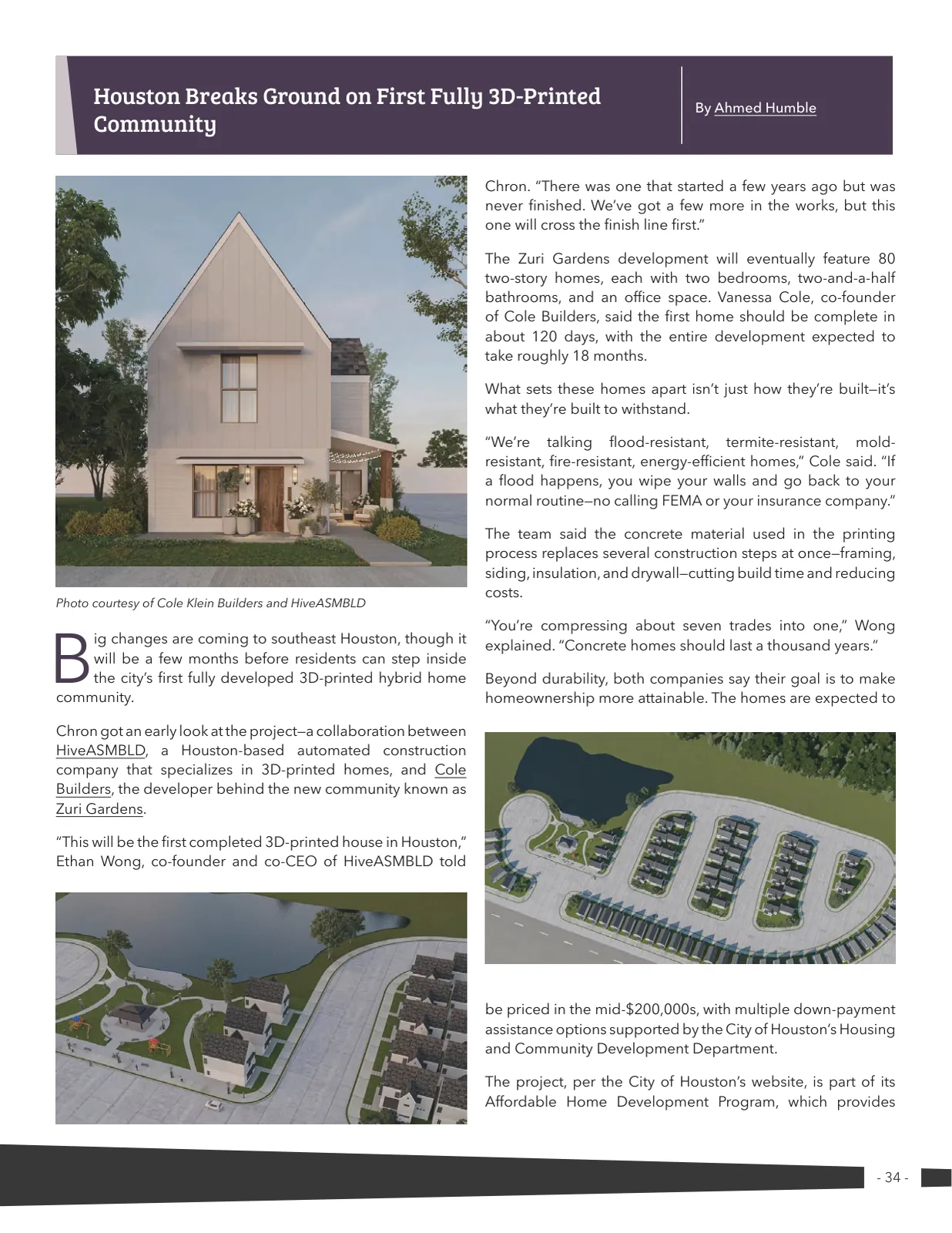
Zuri Gardens, led by local builders Cole Klein and 3D-construction startup HiveASMBLD, will be the city’s first large-scale affordable housing community built using 3D printing.
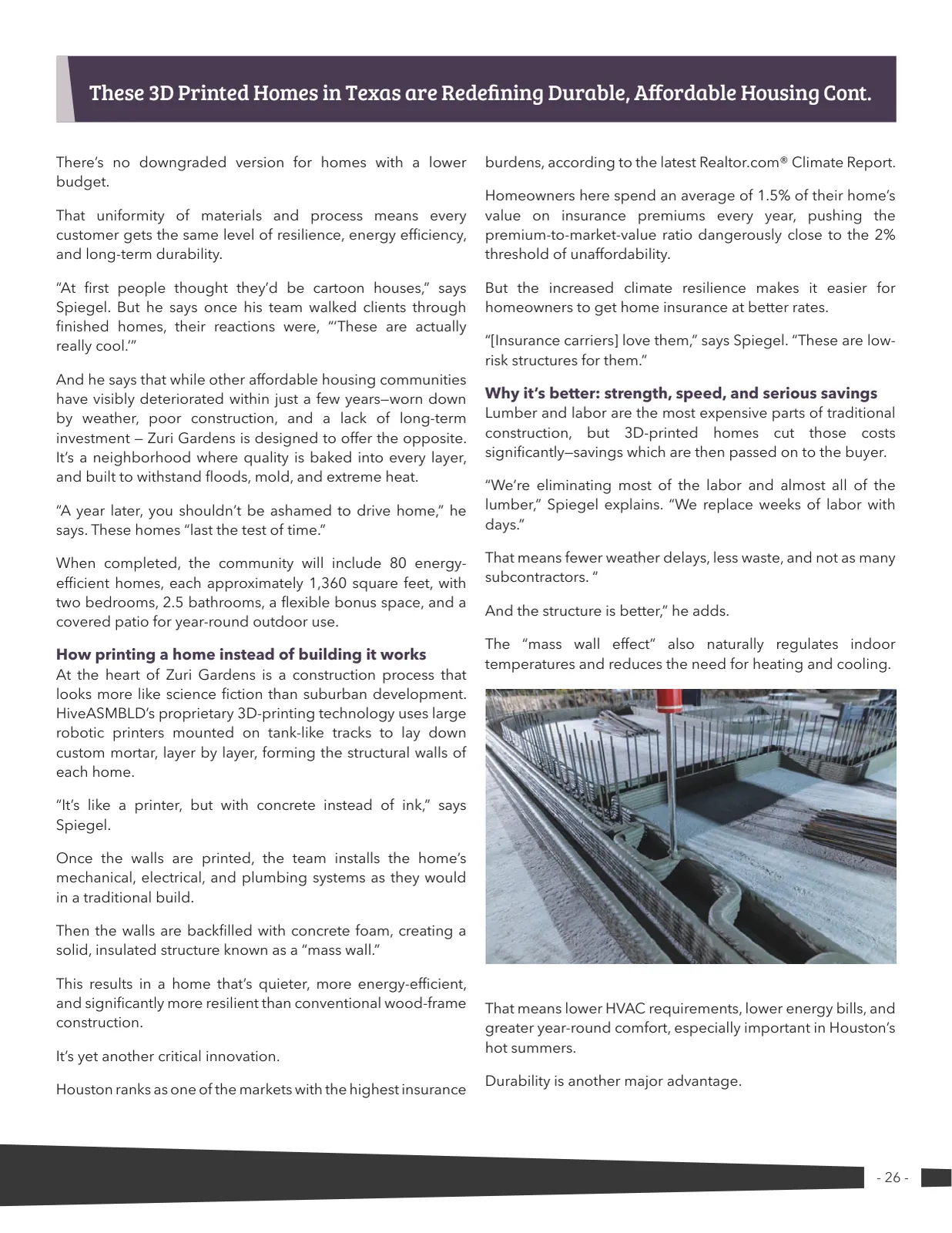
Each home is printed using a proprietary concrete blend — faster, stronger, and more efficient than traditional construction
— and will sell in the mid to high $200Ks, with down payment assistance of up to $125,000 from the City of Houston.
“Homebuyers and potential buyers are ready for something they can afford, that’s also built well,” says Robert Spiegel, chief development officer of HiveASMBLD. “And that’s what we’re delivering.”
With 80 energy-efficient homes, built to withstand flooding, mold, and extreme heat, Zuri Gardens could be the blueprint for solving one of the most urgent challenges in housing today: how to build smarter, faster, and stronger in the places that desperately need it.
Giving affordable housing the same quality as luxury homes
In most markets, affordability comes at a cost—and it’s usually structural. Lower-income buyers are often left with homes made from cheaper materials, thinner walls, and lower-quality finishes that can deteriorate faster than middle- and high-end construction.
But at Zuri Gardens, the team behind the project is taking a different approach.
“A $4 million home and an entry-level home get the same walls,” says Spiegel. “We don’t cut corners just because it’s affordable housing.”
What makes this novel approach possible is the technology itself. Every home that HiveASMBLD builds is printed using the same proprietary mortar, machines, and reinforced concrete system.
There’s no downgraded version for homes with a lower budget.
That uniformity of materials and process means every customer gets the same level of resilience, energy efficiency, and long-term durability.
“At first people thought they’d be cartoon houses,” says Spiegel. But he says once his team walked clients through finished homes, their reactions were, “‘These are actually really cool.’”
And he says that while other affordable housing communities have visibly deteriorated within just a few years—worn down by weather, poor construction, and a lack of long-term investment — Zuri Gardens is designed to offer the opposite. It’s a neighborhood where quality is baked into every layer, and built to withstand floods, mold, and extreme heat.
“A year later, you shouldn’t be ashamed to drive home,” he says. These homes “last the test of time.”
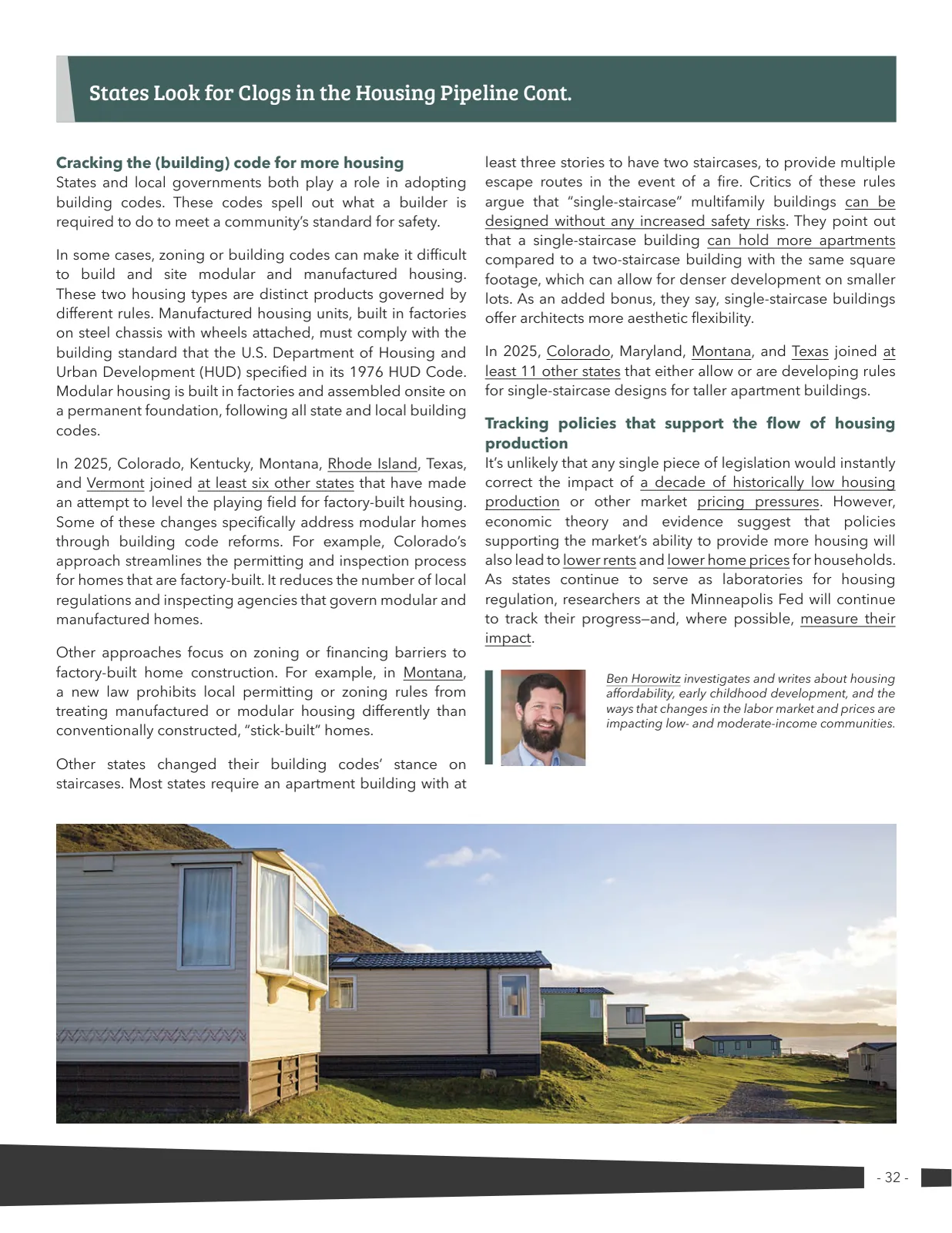
When completed, the community will include 80 energy-efficient homes, each approximately 1,360 square feet, with two bedrooms, 2.5 bathrooms, a flexible bonus space, and a covered patio for year-round outdoor use.
How printing a home instead of building it works
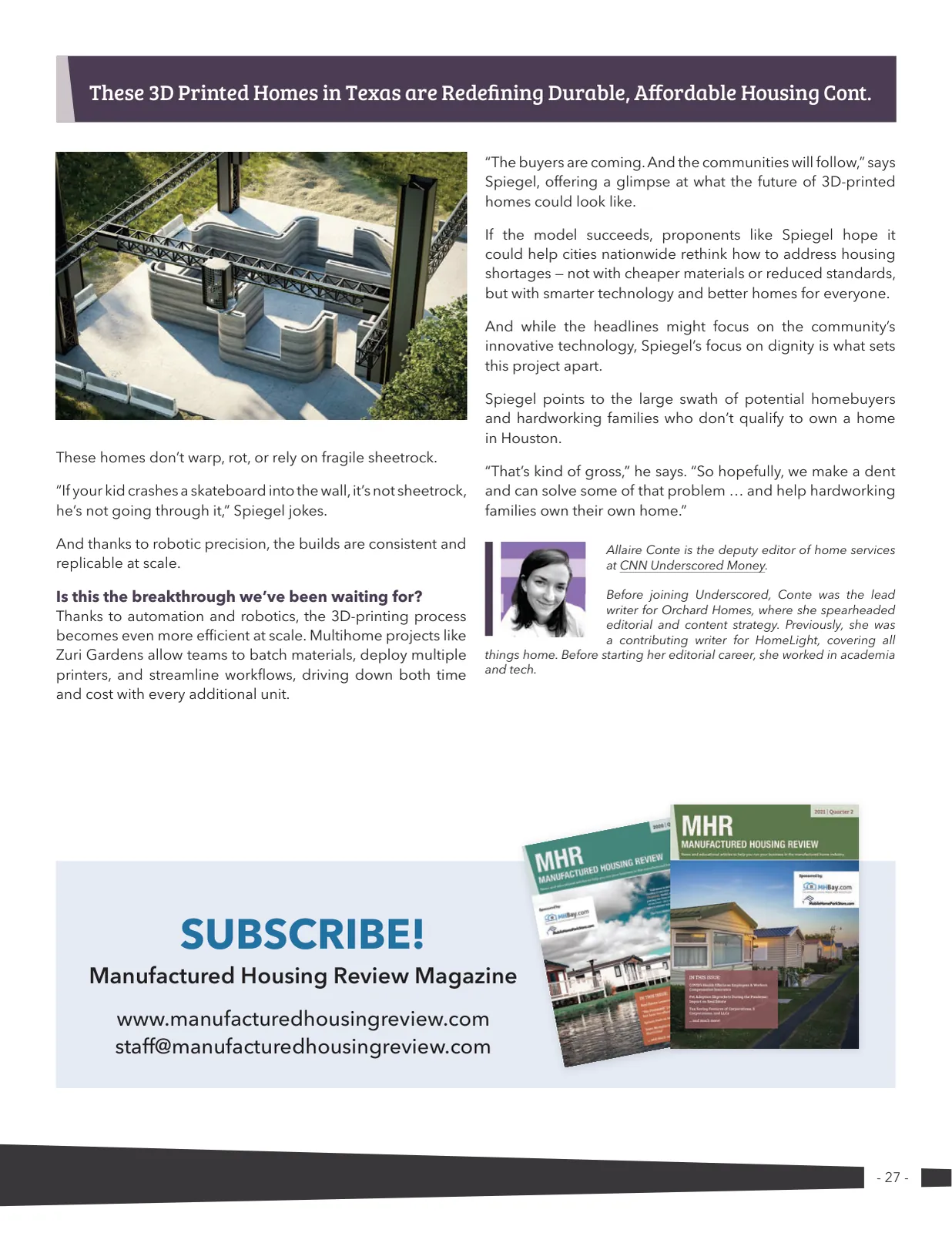
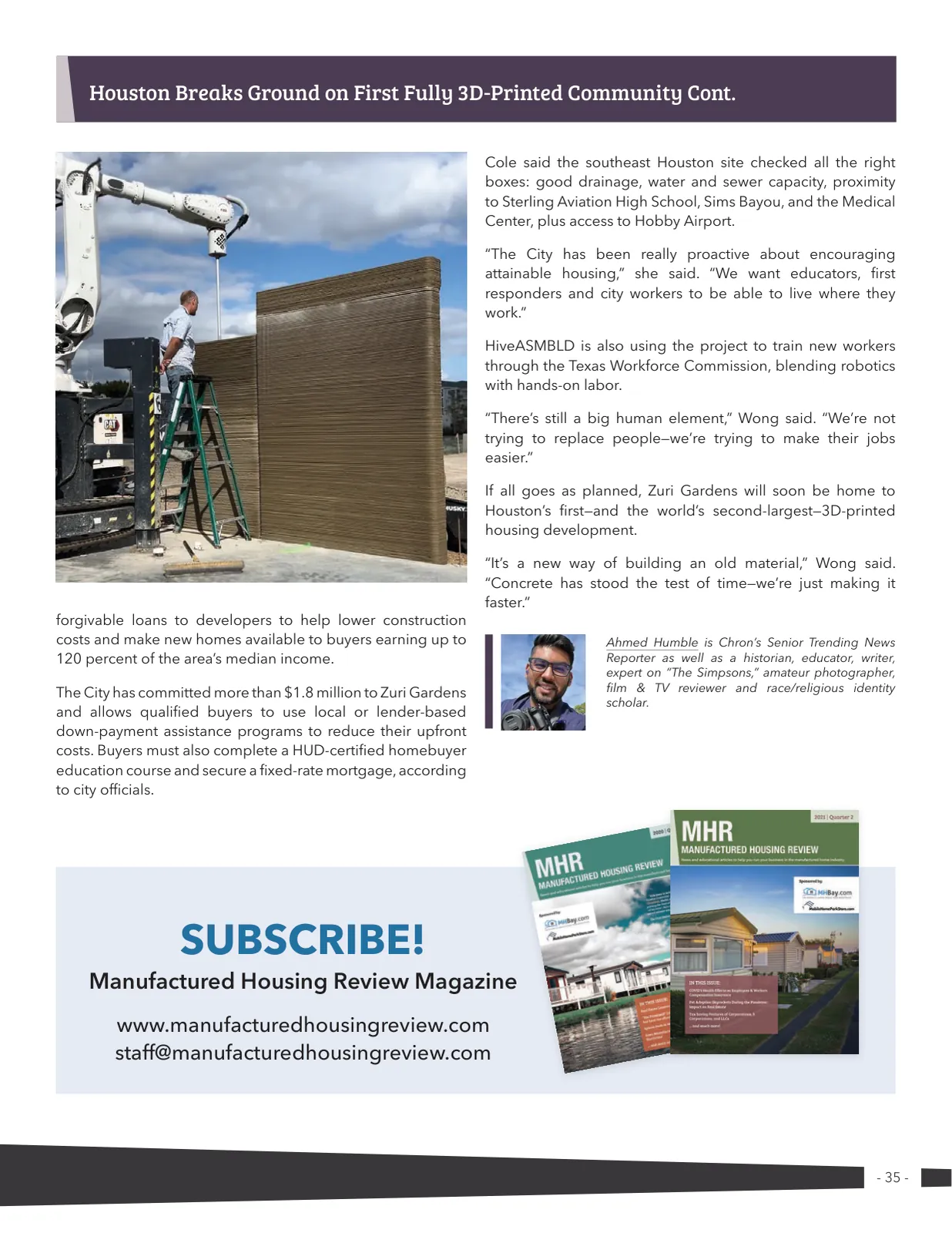
At the heart of Zuri Gardens is a construction process that looks more like science fiction than suburban development. HiveASMBLD’s proprietary 3D-printing technology uses large robotic printers mounted on tank-like tracks to lay down custom mortar, layer by layer, forming the structural walls of each home.
“It’s like a printer, but with concrete instead of ink,” says Spiegel.
Once the walls are printed, the team installs the home’s mechanical, electrical, and plumbing systems as they would in a traditional build.
Then the walls are backfilled with concrete foam, creating a solid, insulated structure known as a “mass wall.”
This results in a home that’s quieter, more energy-efficient, and significantly more resilient than conventional wood-frame construction.
It’s yet another critical innovation.
Houston ranks as one of the markets with the highest insurance burdens, according to the latest Realtor.com® Climate Report.
Homeowners here spend an average of 1.5% of their home’s value on insurance premiums every year, pushing the premium-to-market-value ratio dangerously close to the 2% threshold of unaffordability.
But the increased climate resilience makes it easier for homeowners to get home insurance at better rates.
“[Insurance carriers] love them,” says Spiegel. “These are low-risk structures for them.”
Why it’s better: strength, speed, and serious savings
Lumber and labor are the most expensive parts of traditional construction, but 3D-printed homes cut those costs significantly—savings which are then passed on to the buyer.
“We’re eliminating most of the labor and almost all of the lumber,” Spiegel explains. “We replace weeks of labor with days.”
That means fewer weather delays, less waste, and not as many subcontractors. “
And the structure is better,” he adds.
The “mass wall effect” also naturally regulates indoor temperatures and reduces the need for heating and cooling.
That means lower HVAC requirements, lower energy bills, and greater year-round comfort, especially important in Houston’s hot summers.
Durability is another major advantage.
These homes don’t warp, rot, or rely on fragile sheetrock.
“If your kid crashes a skateboard into the wall, it’s not sheetrock, he’s not going through it,” Spiegel jokes.
And thanks to robotic precision, the builds are consistent and replicable at scale.
Is this the breakthrough we’ve been waiting for?
Thanks to automation and robotics, the 3D-printing process becomes even more efficient at scale. Multihome projects like Zuri Gardens allow teams to batch materials, deploy multiple printers, and streamline workflows, driving down both time and cost with every additional unit.
SUBSCRIBE!
“The buyers are coming. And the communities will follow,” says Spiegel, offering a glimpse at what the future of 3D-printed homes could look like.
If the model succeeds, proponents like Spiegel hope it could help cities nationwide rethink how to address housing shortages — not with cheaper materials or reduced standards, but with smarter technology and better homes for everyone.
And while the headlines might focus on the community’s innovative technology, Spiegel’s focus on dignity is what sets this project apart.
Spiegel points to the large swath of potential homebuyers and hardworking families who don’t qualify to own a home in Houston.
“That’s kind of gross,” he says. “So hopefully, we make a dent and can solve some of that problem … and help hardworking families own their own home.”
Allaire Conte is the deputy editor of home services at CNN Underscored Money.
Before joining Underscored, Conte was the lead writer for Orchard Homes, where she spearheaded editorial and content strategy. Previously, she was a contributing writer for HomeLight, covering all things home. Before starting her editorial career, she worked in academia and tech.
Manufactured Housing Review Magazine
www.manufacturedhousingreview.com [email protected]
Women Advancing Manufactured Housing Celebrates Four Years of Progress and Community
On October 16th, Women Advancing Manufactured Housing (WAMH) celebrated its four-year anniversary — a moment that really shows how much this group has grown since its beginnings at the SECO conference back in 2021. What started as a small gathering of women who saw a need for connection and representation has evolved into a nationwide network with a clear purpose: to support and elevate women across every corner of the manufactured housing industry.
WAMH was founded by a dedicated group of industry leaders — Justine Natalia, Maria Horton, Sherrie Clevenger, Maryuri Barberan, and Kim Shultz-Rainford — who took the initiative to create a shared space where women could learn, collaborate, and champion one another. Their vision laid the groundwork for what WAMH has become today.
Over the past four years, WAMH has continued to live out its mission: uplifting women in the industry, improving public perception of manufactured housing, and expanding opportunities for professional growth. Programs like Workwear for Success and ongoing member events have strengthened the community and created meaningful touchpoints for women at every level of the profession.
This year’s anniversary celebration took place over Zoom — a fitting choice for a group with members spread across the country. It was still a warm, high-energy moment to reflect on everything WAMH has accomplished so far. And while the virtual format worked beautifully for bringing everyone together, members are already looking ahead with excitement. A little birdie told us the five-year anniversary may coincide with SECO ’25, bringing WAMH back to the conference where it all began.
As WAMH moves into year five, the momentum is unmistakable. Membership is growing, conversations are deeper, and the sense of community is stronger than ever. For anyone working in or around manufactured housing, now is the perfect time to get involved, connect, and be part of the next chapter.
Learn more at womenadvancingmanufacturedhousing.com or connect with WAMH on LinkedIn for upcoming meetings and opportunities.
Kara Mathis leads marketing and digital communications at Pentagon Properties, Inc. in Atlanta, where she focuses on social media and digital marketing. She also supports behind-the-scenes planning and communications for the SECO Conference and is an active member of Women Advancing Manufactured Housing (WAMH).
States Look for Clogs in the Housing Pipeline
For the third year in a row, we’ve taken an inventory of new changes states have made to their regulatory frameworks for housing. The results indicate that in 2025, places with a history of making it easier to build homes are taking things further. More states are going beyond land use reform and are now revisiting building codes and other regulations.
These changes are often inspired by data that suggest many regions are in the midst of a housing shortage. A greater supply of homes could ease the price pressures increasingly felt by households. State policymakers probably hope that making it easier to build homes will make it cheaper to buy or rent one.
At the Federal Reserve Bank of Minneapolis, we regularly hear stories about housing shortages in the Ninth Federal Reserve District, in communities large and small. We also hear a lot about how the regulatory environment for housing production varies quite a bit, even within a metropolitan area.
That’s why we track housing-related regulatory changes around the country. By examining shifts in the rules for construction and the potential change in supply levels that may follow, we can better understand how the Ninth District’s housing prices might move in the future. This work is part of our Community Development and Engagement team’s focus on low- and moderate-income households, and it helps inform Federal Reserve leaders as they weigh decisions about monetary policy.
Making production easier through a steady stream of tweaks
Local governments establish comprehensive plans and zoning codes that lay out the ground rules for development within their boundaries. In this article, we’ll refer to these as “land use regulations.” Builders can apply for exemptions from some of them. Even if a proposed project conforms to a locality’s rules, however, the development process often requires approval by local elected officials. That introduces uncertainty, risk, and delays. Developers, housing affordability advocates, and economists often argue that these add significant cost to housing development.
That’s why many efforts to lower the cost of housing production focus on revising land use ordinances. As was the
case last year, some of 2025’s most significant changes came in state legislatures that are hardly rookies when it comes to rethinking land use rules.
California, Florida, Maine, Montana, Oregon, and Washington enacted major land use reforms within the past few years. Each returned to the matter in 2025. In total, states made too many updates to describe in detail here. Many states honed their existing laws to clarify policymakers’ original intentions. Others expanded housing-friendly policies’ reach to new parts of a state.
For example, in 2023, Montana passed a suite of laws intended to ease the barriers that land use regulations can create for housing construction. The reforms largely focused on efforts to make it easier to build multifamily buildings, duplexes, and accessory dwelling units (ADUs).
In 2025, Montana legislators doubled down on the theme. In some cases, this meant expanding the geographic coverage of a reform. The 2023 laws required municipalities to allow ADUs. The 2025 update extended that requirement to unincorporated areas.
Montana’s latest reforms also addressed issues that might interfere with its prior attempts to encourage housing production. For example, the 2023 reforms did not address parking requirements. Nationally, such requirements vary considerably across local jurisdictions for everything from bowling alleys to missing middle housing.
Parking spaces can add significant costs to housing development. Advocates of reform often argue that mandated parking minimums force builders to provide too many spaces. When cities have reduced or eliminated parking minimums, developers still build parking—they just tend to build less of it. In 2025, Montana greatly reduced the number of parking spaces a locality can require for a housing unit. For some projects, parking requirements will be eliminated completely, giving developers the responsibility to assess and meet market demand for spaces.
Changing processes along with policy
Regardless of how many changes a state or locality makes to land use regulations, there will still be a need to adjudicate any requested deviations from those rules. Sometimes these processes are tied directly to land use. For example, developing new housing often requires a subdivision of property.
Subdivision as a legal process occurs when a property owner wishes to transform a single parcel into multiple lots. Sometimes subdivision takes place when a developer is turning large tracts of land into small, single-family home lots—in a “subdivision”—to resell to households. In other cases, an owner of a single-family home could subdivide their lot to build another single-family home to sell or rent.
In many places, an owner of a single-family home would undergo the same involved, multistep subdivision-approval process as a large developer. Such requirements add significant costs, time delays, and risk to small projects that are unlikely to have a large impact on a neighborhood.
In 2025, California, Maine, Montana, Rhode Island, Utah, and Washington made changes to their subdivision processes. Generally, these changes allow smaller projects to be treated administratively. An administrative process allows professional staff to determine whether a project checks all the boxes necessary for a builder to break ground. That’s more predictable than a process that requires elected officials to vote on a proposal.
In some cases, states are also re-examining and reconfiguring processes outside of the land use realm that impact housing production. These processes serve some broader policy goal, like environmental protection or historic preservation.
For example, the California Environmental Quality Act (CEQA), which dates to 1970, allows community members to request an environmental review for construction projects. A law California passed in June 2025 exempts smaller, infill residential developments from CEQA’s requirements. The critics who proposed the changes argued that CEQA was being applied to projects that were unlikely to pose a meaningful environmental risk. In such cases, they argued, CEQA added delays and costs to the building process without meeting its environmental protection goals.
In addition to rethinking environmental reviews, states are revisiting the way historic preservation decisions are made. Historic preservation status can allow local jurisdictions to hang on to architectural character that’s important for a community—something that’s hard to put a price tag on. But critics argue that in some cases, historic preservation is used to protect properties of dubious historical significance in order to limit housing production or commercial development. In 2025, Hawaii, Montana, and Washington changed the way historic preservation decisions are made in order to provide more certainty in their approaches.
Cracking the (building) code for more housing
States and local governments both play a role in adopting building codes. These codes spell out what a builder is required to do to meet a community’s standard for safety.
In some cases, zoning or building codes can make it difficult to build and site modular and manufactured housing. These two housing types are distinct products governed by different rules. Manufactured housing units, built in factories on steel chassis with wheels attached, must comply with the building standard that the U.S. Department of Housing and Urban Development (HUD) specified in its 1976 HUD Code. Modular housing is built in factories and assembled onsite on a permanent foundation, following all state and local building codes.
In 2025, Colorado, Kentucky, Montana, Rhode Island, Texas, and Vermont joined at least six other states that have made an attempt to level the playing field for factory-built housing. Some of these changes specifically address modular homes through building code reforms. For example, Colorado’s approach streamlines the permitting and inspection process for homes that are factory-built. It reduces the number of local regulations and inspecting agencies that govern modular and manufactured homes.
Other approaches focus on zoning or financing barriers to factory-built home construction. For example, in Montana, a new law prohibits local permitting or zoning rules from treating manufactured or modular housing differently than conventionally constructed, “stick-built” homes.
Other states changed their building codes’ stance on staircases. Most states require an apartment building with at least three stories to have two staircases, to provide multiple escape routes in the event of a fire. Critics of these rules argue that “single-staircase” multifamily buildings can be designed without any increased safety risks. They point out that a single-staircase building can hold more apartments compared to a two-staircase building with the same square footage, which can allow for denser development on smaller lots. As an added bonus, they say, single-staircase buildings offer architects more aesthetic flexibility.
In 2025, Colorado, Maryland, Montana, and Texas joined at least 11 other states that either allow or are developing rules for single-staircase designs for taller apartment buildings.
Tracking policies that support the flow of housing production
It’s unlikely that any single piece of legislation would instantly correct the impact of a decade of historically low housing production or other market pricing pressures. However, economic theory and evidence suggest that policies supporting the market’s ability to provide more housing will also lead to lower rents and lower home prices for households. As states continue to serve as laboratories for housing regulation, researchers at the Minneapolis Fed will continue to track their progress—and, where possible, measure their impact.
Ben Horowitz investigates and writes about housing affordability, early childhood development, and the ways that changes in the labor market and prices are impacting low- and moderate-income communities.
Houston Breaks Ground on First Fully 3D-Printed Community
Photo courtesy of Cole Klein Builders and HiveASMBLD
Big changes are coming to southeast Houston, though it will be a few months before residents can step inside the city’s first fully developed 3D-printed hybrid home community.
Chron got an early look at the project—a collaboration between HiveASMBLD, a Houston-based automated construction company that specializes in 3D-printed homes, and Cole Builders, the developer behind the new community known as Zuri Gardens.
“This will be the first completed 3D-printed house in Houston,” Ethan Wong, co-founder and co-CEO of HiveASMBLD told Chron. “There was one that started a few years ago but was never finished. We’ve got a few more in the works, but this one will cross the finish line first.”
The Zuri Gardens development will eventually feature 80 two-story homes, each with two bedrooms, two-and-a-half bathrooms, and an office space. Vanessa Cole, co-founder of Cole Builders, said the first home should be complete in about 120 days, with the entire development expected to take roughly 18 months.
What sets these homes apart isn’t just how they’re built—it’s what they’re built to withstand.
“We’re talking flood-resistant, termite-resistant, mold-resistant, fire-resistant, energy-efficient homes,” Cole said. “If a flood happens, you wipe your walls and go back to your normal routine—no calling FEMA or your insurance company.”
The team said the concrete material used in the printing process replaces several construction steps at once—framing, siding, insulation, and drywall—cutting build time and reducing costs.
“You’re compressing about seven trades into one,” Wong explained. “Concrete homes should last a thousand years.”
Beyond durability, both companies say their goal is to make homeownership more attainable. The homes are expected to be priced in the mid-$200,000s, with multiple down-payment assistance options supported by the City of Houston’s Housing and Community Development Department.
The project, per the City of Houston’s website, is part of its Affordable Home Development Program, which provides
forgivable loans to developers to help lower construction costs and make new homes available to buyers earning up to 120 percent of the area’s median income.
The City has committed more than $1.8 million to Zuri Gardens and allows qualified buyers to use local or lender-based down-payment assistance programs to reduce their upfront costs. Buyers must also complete a HUD-certified homebuyer education course and secure a fixed-rate mortgage, according to city officials.
SUBSCRIBE!
Cole said the southeast Houston site checked all the right boxes: good drainage, water and sewer capacity, proximity to Sterling Aviation High School, Sims Bayou, and the Medical Center, plus access to Hobby Airport.
“The City has been really proactive about encouraging attainable housing,” she said. “We want educators, first responders and city workers to be able to live where they work.”
HiveASMBLD is also using the project to train new workers through the Texas Workforce Commission, blending robotics with hands-on labor.
“There’s still a big human element,” Wong said. “We’re not trying to replace people—we’re trying to make their jobs easier.”
If all goes as planned, Zuri Gardens will soon be home to Houston’s first—and the world’s second-largest—3D-printed housing development.
“It’s a new way of building an old material,” Wong said. “Concrete has stood the test of time—we’re just making it faster.”
Ahmed Humble is Chron’s Senior Trending News Reporter as well as a historian, educator, writer, expert on “The Simpsons,” amateur photographer, film & TV reviewer and race/religious identity scholar.
Manufactured Housing Review Magazine
www.manufacturedhousingreview.com [email protected]
Brookfield Reportedly Eyeing $10B Manufactured Housing Buy That Could Set New Record
Canadian investment giant Brookfield and Singapore’s sovereign wealth fund are circling a potentially record-breaking deal.
Singapore’s GIC is in talks to sell its stake in manufactured homes landlord Yes Communities for more than $10B to Brookfield Asset Management. The sale would be the largest U.S. commercial exit for a sovereign wealth fund, and it would come at a time when a glut of new supply is testing the multifamily sector’s resilience.
The negotiations were first reported by The Financial Times on Sunday, with Bloomberg confirming the news, both citing anonymous sources. Brookfield declined Bisnow’s request for comment Monday morning.
Yes Communities is also working with Goldman Sachs on a potential initial public offering this year that could raise $1B or more for the firm, Bloomberg reported in December.
Denver-based Yes operates nearly 300 manufactured home developments and more than 55,000 housing sites across the United States, with a focus in the Southwest, Midwest and Southeast. GIC and another unnamed institutional investor acquired a 71% equity interest in Yes in 2016, with the seller, San Francisco-based Stockbridge Capital Group, holding onto the remaining stake.
The talks between Brookfield and GIC are at an advanced stage, but there’s no guarantee of a deal. If it closes, the transaction would be the largest ever commercial exit for a sovereign wealth fund and would cut GIC’s reliance on the U.S. real estate market while giving it a boost in liquidity, Diego Lopez, the managing director of research firm Global SWF, told Bloomberg.
GIC has continued to invest in U.S. assets — it partnered with Kite Realty Group in July to buy 921K SF in Florida retail malls — but it’s also been active in Europe. It partnered with British Land on a $400M office development at 1 Broadgate in London and teamed up with German investor MEAG on a $1.6B data center investment fund.
Brookfield, an investment giant that oversees more than $1T in assets, including more than $270B in real estate, has been shuffling its portfolio as macroeconomic fortunes shift.
It paid $428M for a 3.6M SF Sun Belt industrial portfolio in July, but surrendered two office properties from a 12-asset suburban Washington, D.C., office portfolio in August. That same month, it handed Houston’s largest office complex to its mezzanine lender.
In July, it sold a 467-property net lease portfolio to Starwood Property Trust for $2.2B.
The cross-dollar funds are flowing despite ongoing global trade tensions and the tariff battle being waged from the White House. While Canadian shoppers can choose to buy local, global real estate funds are still being drawn to the massive deals available in the U.S.
Multifamily investors are betting that the wave of construction that began in the early days of the pandemic will find renters relatively fast, and the lack of new construction in the last two years means landlords will hold onto pricing power.
Bisnow is the world’s leading B2B platform serving the commercial real estate industry. From events and news to branded content and recruiting solutions, Bisnow reaches more than 11 million readers and hosts more than 350 events each year.
The Future of Housing: Evaluating the Progress of 3D-Printed Homes from 2019 Promises to 2025 Realities
When we first started talking about 3D printed homes back in 2019, the excitement was palpable. The construction industry had an impressive array of technological promises on the horizon, from 3D-printed bridges like the one in Amsterdam to groundbreaking print speeds from companies like WinSun and ApisCor. We were all asking: Where’s our building industry boom? Fast forward to 2025, and we find that while we’ve come a long way, the anticipated revolution has yet to fully materialise. But there’s a lot more to the story than simply unmet expectations.
The Early Buzz in 2019: Excitement and Optimism
In 2019, we were all watching with bated breath as startups and established companies alike began testing the boundaries of what 3D printing could do for the construction industry. With promises of drastically reduced build times, cheaper homes, and eco-friendly materials, the stage was set for a construction revolution.
One of the most thrilling developments was the Long Island startup, S-Squared, which aimed to print an entire house in just 30 hours. Their bold claim that a full-sized home could be produced for under $200,000 sparked excitement, particularly in high-cost areas like Long Island. With reduced labour costs, it seemed like a game-changer. Another major player was Sunconomy, which announced plans to build a 3D-printed geopolymer home in Texas, featuring sustainable systems like solar panels, wind energy, and rainwater collection - all for a projected cost of $289,000. These projects hinted at a future where homes could be built faster, cheaper, and more sustainably.
But the reality at the time was more complex. The technology had its share of hurdles: material science was still evolving, construction automation was in its infancy, and building designs had to be tailored for printability, a challenge few were prepared for. Despite these challenges, the industry was hopeful, with governments beginning to introduce legislation to allow for 3D-printed homes, and more projects under development internationally.
The Present Day: Achievements and Obstacles
As of 2025, 3D printing in construction has made significant strides, but the much-anticipated boom still feels just out of reach. Many of the early hurdles identified in 2019 are still present:
• Material Science: Reliable and durable 3D-printable cement and other building materials have improved but are still not at the point where they can replace traditional building materials for all construction projects. Material testing and optimisation continue to be key areas of development.
• Design and Printability: While more companies are now able to print homes, most of these projects remain custom jobs or limited to a small subset of structures, often focusing on simple designs rather than more complex buildings.
• Construction Automation: Some progress has been made in automating the construction process, but the broader industry has yet to integrate 3D printing into the mainstream construction workflow. Complexities like site preparation, structural integrity, and the order of operations remain significant obstacles to widespread adoption.
However, there have been notable achievements that bring hope for the future:
• Global Developments: Countries like China continue to push forward with 3D-printed infrastructure, including bridges and homes, showcasing the technology’s potential for large-scale projects. In the U.S., companies like ICON and Construction 3D are steadily refining their processes, producing homes for underserved populations in Texas and Mexico.
• Sustainability: One of the major selling points of 3D-printed homes has always been their eco-friendly potential. Some companies are finding ways to use recycled materials in 3D printing, such as plastics and even concrete waste. This reduces the carbon footprint of the construction process and addresses growing concerns about environmental impact.
• Permitting and Legislation: Governments are beginning to take 3D printing seriously, with new policies and permits allowing for more experimentation. The state of Texas, for example, has seen several 3D-printed homes completed with government support. Local building codes are also evolving to allow for the use of 3D printing technologies in residential construction, bringing us closer to mass adoption.
The Future of 3D Printed Homes: What’s on the Horizon?
Looking ahead, the future of 3D-printed homes seems brighter, albeit slower than anticipated. Some key developments to watch for include:
1. Automation and AI Integration: As AI and robotics continue to advance, the integration of intelligent systems into the construction process will likely expedite the production and scalability of 3D-printed homes. Automated construction sites will likely become more common, leading to faster and more cost-effective builds.
2. Affordable Housing Solutions: One of the most promising aspects of 3D-printed homes is their potential to provide affordable housing in areas where construction costs are prohibitively high. Whether it’s reducing labour costs or using low-cost materials, 3D printing could play a major role in solving the global housing crisis, particularly in disaster-stricken areas or regions lacking affordable housing options.
3. Customisation and Efficiency: With advancements in printing technology, homes will become more customisable than ever before, allowing for greater design flexibility. At the same time, efficiency in the construction process will increase, driving down costs and allowing for quicker turnaround times.
4. Sustainability at Scale: As the focus on sustainable building practices intensifies, the use of recycled and environmentally friendly materials in 3D-printed homes will likely become the standard. In addition to reducing the carbon footprint of construction, 3D printing has the potential to reduce waste and improve the overall environmental impact of the industry.
Conclusion: A Promising Future, But a Long Road Ahead
The journey from the initial excitement of 2019 to the present day has been filled with both challenges and successes. While the 3D printing of homes has not yet transformed the construction industry as rapidly as some had hoped, the steady progress being made offers plenty of reasons to be optimistic. The technology is improving, more projects are coming to completion, and regulations are catching up. For now, we may not see an entire city built with 3D printing, but we’re definitely heading in the right direction. The future holds promise for a more affordable, sustainable, and innovative construction landscape - one where 3D-printed homes could become a mainstream reality in the years to come.
Authentise blends deep experience in manufacturing, law, and digital transformation to deliver trusted solutions to some of the world’s most demanding industries.
We are an electronically delivered quarterly magazine focused on the Manufactured Housing Industry. From Manufactured Home Community Managers, to Retailers, to Manufacturers, and all those that supply and service them, we supply news and educational articles that help them run their businesses.
ManufacturedHousingReview.com
Have something to contribute or advertise?
Email us at [email protected]
Communications regarding any alleged offending, inappropriate, inaccurate or infringing content should be directed immediately to [email protected] along with the communicator’s contact information.