

















Text version of this issue
Why Professionalism, Not Regulation, Will Save Manufactured Housing’s Reputation
Manufactured housing occupies a strange place in American real estate. It is one of the most effective forms of unsubsidized affordable housing, yet it remains one of the most criticized. That tension has led to increasing calls for regulation, often framed as a way to protect residents and “fix” the industry.
The uncomfortable reality is that regulation will not solve manufactured housing’s reputation problem. In many cases, it will worsen it. What will actually improve the industry’s standing is far less dramatic and far more difficult: consistent professionalism from owners and operators.
Regulation Is a Reaction, Not a Cure
Regulation rarely emerges without a reason. It is typically a response to visible failures. Manufactured housing has provided critics with examples that are easy to weaponize: deferred maintenance, inconsistent rule enforcement, poor communication, and absentee ownership. Those failures, even when limited to a minority of operators, create narratives that invite political intervention.
Once regulation arrives, it is rarely precise. Legislators and regulators tend to treat all manufactured housing communities the same, regardless of operational quality. Rent controls, expanded notice requirements, and rigid enforcement rules do little to improve community conditions. Instead, they reduce flexibility, increase costs, and make reinvestment harder, particularly for owners already operating responsibly.
Well-run communities end up paying the price for those that poorly run. Regulation punishes professionalism and negligence with equal enthusiasm.
Reputation Is Built Locally, Not Nationally
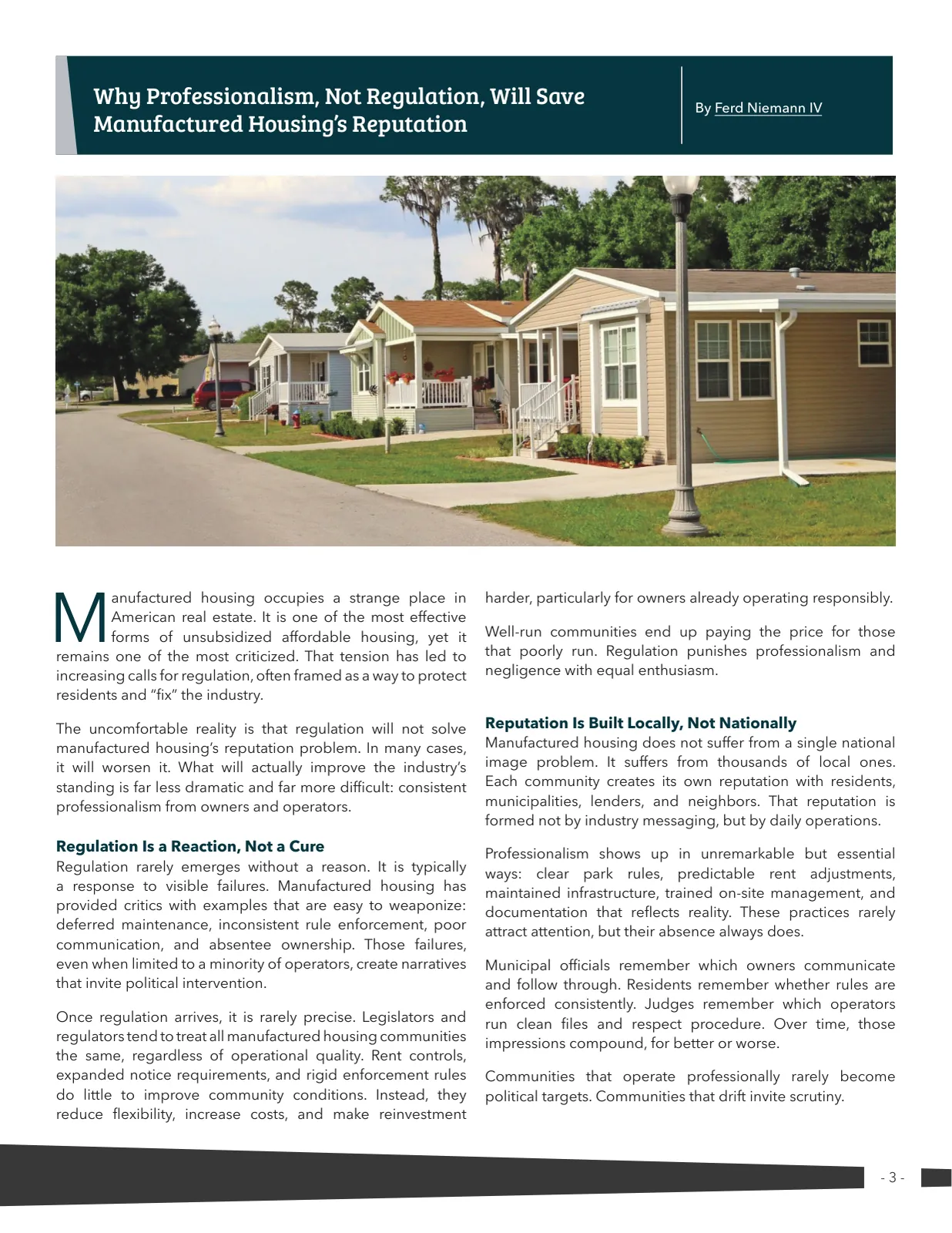
Manufactured housing does not suffer from a single national image problem. It suffers from thousands of local ones. Each community creates its own reputation with residents, municipalities, lenders, and neighbors. That reputation is formed not by industry messaging, but by daily operations.
Professionalism shows up in unremarkable but essential ways: clear park rules, predictable rent adjustments, maintained infrastructure, trained on-site management, and documentation that reflects reality. These practices rarely attract attention, but their absence always does.
Municipal officials remember which owners communicate and follow through. Residents remember whether rules are enforced consistently. Judges remember which operators run clean files and respect procedure. Over time, those impressions compound, for better or worse.
Communities that operate professionally rarely become political targets. Communities that drift invite scrutiny.
Strong Operations Benefit Residents
A persistent misconception in manufactured housing is that professional management works against residents. In practice, the opposite is true.
Clear rules protect residents who comply. Consistent enforcement reduces conflict and favoritism. Regular maintenance preserves safety, health, and dignity. Financial discipline ensures the community remains viable over time.
Disorder harms residents first. Deferred infrastructure, unclear expectations, and emotional decision-making create instability. Professional operations create predictability, which most residents value far more than leniency.
Communities that are run well tend to experience lower turnover, fewer disputes, and stronger resident relationships. These outcomes reduce the likelihood of activism, litigation, and regulatory attention.
The Industry Must Raise Its Own Standards
Every industry facing increased scrutiny eventually confronts the same choice: improve internally or accept externally imposed controls.
Manufactured housing cannot credibly argue against regulation while ignoring operational failures within its own ranks. Owners who neglect maintenance, ignore compliance, or treat communities as short-term extraction vehicles damage the entire sector, not just their own assets.
Industry leadership requires acknowledging that not all behavior deserves defending. Long-term credibility depends on distinguishing professional operators from negligent ones. That distinction cannot be made by lawmakers. It must be made by the industry itself.
Trade associations, lenders, and experienced operators all play a role. Training, best practices, and peer accountability are more effective at improving outcomes than any statute.
Professionalism Scales. Regulation Does Not.
As institutional capital continues to enter manufactured housing, scrutiny will increase. Investors, municipalities, and residents will expect higher standards, not looser ones.
Professional systems scale. Clear policies, documentation, compliance processes, and trained management can be replicated across portfolios. Regulation scales poorly. It introduces uncertainty, slows transactions, and discourages reinvestment, often harming the very residents it is intended to protect.
Capital flows toward competence. Municipal cooperation follows reliability. Resident satisfaction follows predictability.
None of those outcomes require new laws.
The Path Forward Is Unremarkable and Effective
There is no policy breakthrough or public relations campaign that will transform manufactured housing’s reputation overnight. Progress comes from consistent execution over time.
It looks like investing in infrastructure before failure forces the issue. It looks like training managers to enforce rules calmly and consistently. It looks like leases and park rules that are current, clear, and defensible. It looks like owners thinking in decades, not quarters.
Manufactured housing does not need to be rescued by regulation. It needs to be represented by professionals who understand that discipline, transparency, and accountability are not optional.
When communities are operated with professionalism and respect for both the business and the residents, reputation improves naturally. As reputation improves, the demand for regulation loses urgency.
That outcome benefits residents, operators, and the industry as a whole.
By Ferd E. Niemann IV, Partner at Niemann Law Group, a firm that specializes in representing community owners, sellers and buyers in all aspects of MHC transactions and management. Mr. Niemann hosts The Mobile Home Park Lawyer Podcast which focuses on issues associated with owning, buying/selling, and operating MHCs. In addition, Mr. Niemann has owned and operated 26 MHCs across over 1,700 sites.
Utility Management Made Easy
Rent Manager’s utility management solutions can help centralize and simplify operations for your manufactured housing communities.
• Group and monitor utility usage patterns to proactively flag abnormal consumption— identifying hidden leaks and equipment failures.
• Provide insight into how much you’re spending on utilities versus what you’re charging residents with cost recovery reporting.
• Determine how meter estimates are calculated based on previous averages or seasonal trends to ensure billing practices are uniform and secure.
To learn more, scan the QR code or visit RentManager.com/Utilities
• Perform meter swaps effortlessly, whether you’re upgrading to smart meters, replacing faulty equipment, or getting ready for a new resident.
• Capture real-time usage data for billing consistency and to prevent disputes when residents move in or out of your community.
Smarter utility management begins with Rent Manager.
Why Manufactured Housing Community Deals Stall — and Why Brokerage Often Makes It Worse
Most manufactured housing community (MHC) deals do not fail because of pricing, interest rates, or market cycles. They fail because expectations, information, and execution drift out of alignment—and no one forces them back together.
Manufactured housing is often treated like another commercial real estate category. It isn’t. An MHC is an operating business wrapped in land, shaped by utilities, legacy practices, and informal systems built over decades. That reality changes how transactions succeed or stall once diligence begins.
Sellers understand lived operational reality. Buyers underwrite risk, repeatability, and future execution. When those perspectives are not reconciled early, deals lose momentum quietly. There is rarely a blowup. Fatigue sets in. Confidence erodes. The transaction simply stops moving.
Where Friction Actually Comes From
The same pressure points surface repeatedly. Utilities are shared, privately owned, or poorly documented. Financials may be accurate but difficult to underwrite. Operating practices evolved without formal systems. Sellers expect speed; buyers require verification. Buyer fit goes unaddressed until late, when mismatches are hardest to fix.
None of this is unusual in manufactured housing. What is unusual is how often these issues are deferred instead of translated early, when leverage and patience still exist.
The Brokerage Gap
This is where brokerage either adds value or becomes part of the problem.
In manufactured housing, effective brokerage is not promotion. It is alignment. The broker’s job is to force clarity around price, structure, utilities, and timing—early enough to prevent false momentum. Passing questions back and forth without context is not brokerage. It is friction management without leadership.
When alignment work is delayed, enthusiasm replaces execution. It never lasts.
Buyers Have Tightened
Most sellers entering the market have already spoken with dozens of buyers. Many expressed interest. Few executed. As a result, disciplined buyers now filter aggressively.
They prioritize defensible utility narratives, income supported by actual collections, and realistic views of operational challenges. They value sellers who answer consistently and show flexibility on structure rather than relying on aspirational pricing.
Deals do not stall when issues surface. They stall when issues are obscured or deferred.
Prepared Sellers Close Faster
The smoothest transactions rarely involve perfect assets. They involve prepared sellers. Preparation does not mean flawless records. It means clarity—organized numbers, early utility documentation, known points of flexibility, and a realistic understanding of what the asset actually is.
Clarity builds confidence. Confidence sustains momentum.
Noise vs. Progress
Manufactured housing is loud. Progress is quiet. High communication volume is not execution. Effective brokerage reduces the noise-to-signal ratio by narrowing conversations, asking better questions, and sequencing decisions properly.
When communication is grounded in what is known, what is missing, and what happens next, deals move. When it remains vague, they don’t—regardless of price.
Execution Is the Differentiator
In a crowded market, buyer discipline has become the true advantage. Disciplined buyers ask fewer questions, follow through consistently, close loops quickly, and underwrite reality rather than hope. Over time, that discipline compounds. Sellers recognize it. Brokers prioritize it. Trust narrows the field.
The Bottom Line
Manufactured housing brokerage is being exposed. Promotion is losing to preparation. Theatrics are losing to transparency. Volume is losing to discipline.
Deals do not close faster because they are marketed louder. They close faster because fewer things are left unresolved.
That is not branding.
That is execution.
Jason Ramshaw is the founder of Rhino Communities, a manufactured housing–focused brokerage and advisory firm specializing in MHC sales, acquisitions, and strategic consulting nationwide. He is also partnered with Equity Consultants Real Estate, which drives the Rhino deal engine by structuring, underwriting, and executing transactions with disciplined, financeable precision across the Rhino platform.
Why You’re Not Getting Seller Financing
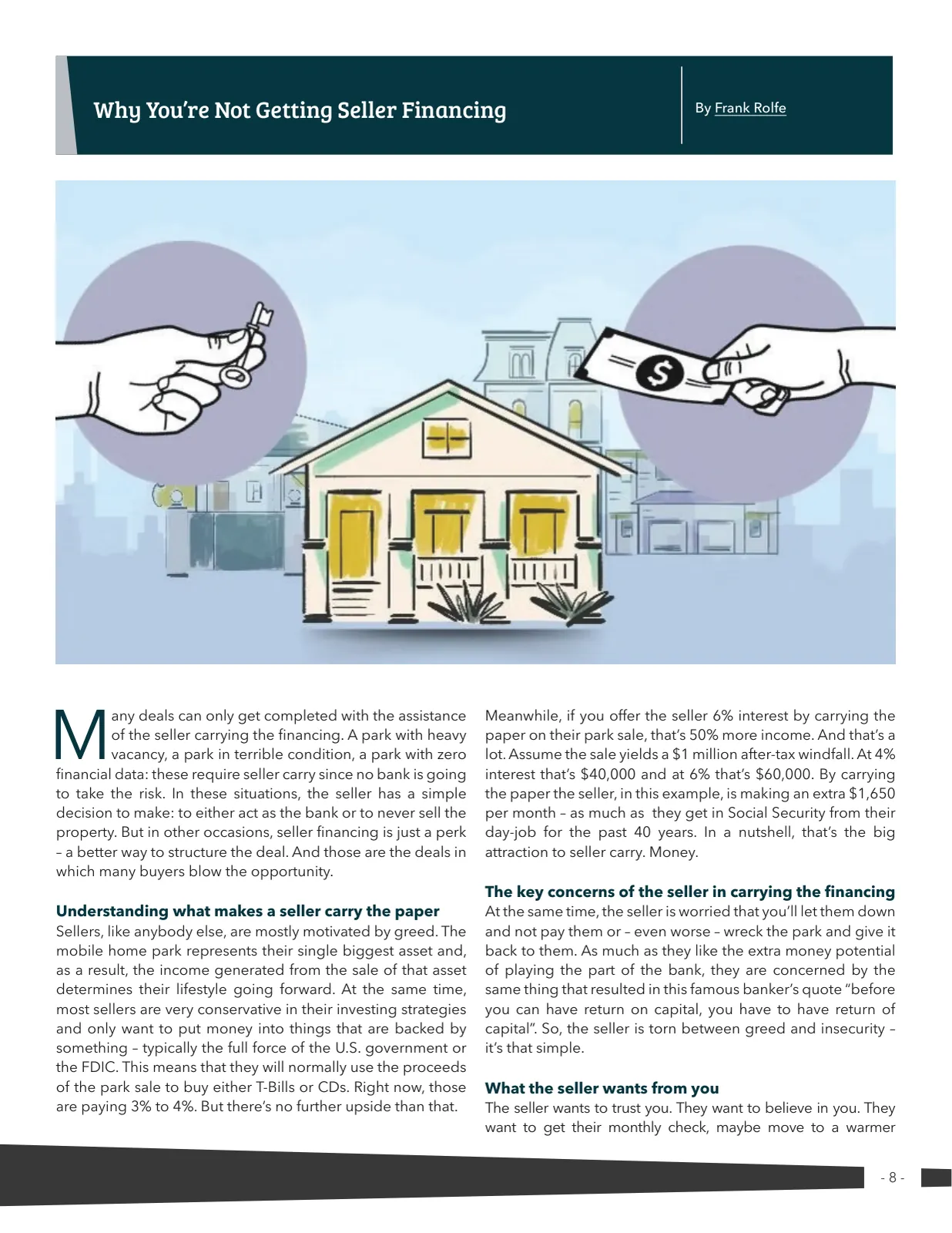
Many deals can only get completed with the assistance of the seller carrying the financing. A park with heavy vacancy, a park in terrible condition, a park with zero financial data: these require seller carry since no bank is going to take the risk. In these situations, the seller has a simple decision to make: to either act as the bank or to never sell the property. But in other occasions, seller financing is just a perk – a better way to structure the deal. And those are the deals in which many buyers blow the opportunity.
Understanding what makes a seller carry the paper
Sellers, like anybody else, are mostly motivated by greed. The mobile home park represents their single biggest asset and, as a result, the income generated from the sale of that asset determines their lifestyle going forward. At the same time, most sellers are very conservative in their investing strategies and only want to put money into things that are backed by something – typically the full force of the U.S. government or the FDIC. This means that they will normally use the proceeds of the park sale to buy either T-Bills or CDs. Right now, those are paying 3% to 4%. But there’s no further upside than that.
Meanwhile, if you offer the seller 6% interest by carrying the paper on their park sale, that’s 50% more income. And that’s a lot. Assume the sale yields a $1 million after-tax windfall. At 4% interest that’s $40,000 and at 6% that’s $60,000. By carrying the paper the seller, in this example, is making an extra $1,650 per month – as much as they get in Social Security from their day-job for the past 40 years. In a nutshell, that’s the big attraction to seller carry. Money.
The key concerns of the seller in carrying the financing
At the same time, the seller is worried that you’ll let them down and not pay them or – even worse – wreck the park and give it back to them. As much as they like the extra money potential of playing the part of the bank, they are concerned by the same thing that resulted in this famous banker’s quote “before you can have return on capital, you have to have return of capital”. So, the seller is torn between greed and insecurity – it’s that simple.
What the seller wants from you
The seller wants to trust you. They want to believe in you. They want to get their monthly check, maybe move to a warmer
climate, and never hear from you except maybe a Christmas card. They know that your goal is to make money with their property, and to maybe bring it back to life after sometimes a long period of diminishing interest. But they need to be 100% sure that you will not let them down. Their retirement depends on it, as does their image with their spouse and children who, the entire time, are saying “are you sure we’re going to get paid”?
What the seller never wants from you
Sellers are immediately turned off by anyone who appears that they “need” seller carry. It only makes sense. A seller assumes that if the buyer can’t get a loan from a real bank, then they shouldn’t be doing it either. Yet many buyers openly disclose to the seller “I declared bankruptcy a couple years ago, so I need seller financing”. That’s the kiss of death. Seller carry only works when it’s in the seller’s best interest not the buyer’s. At least, that needs to be their perception of the situation.
Additionally, sellers will draw conclusions from every little thing about you as to whether they should trust you or not. This includes what you wear (better be conservative), what you drive (better not be too flashy) and what time you arrive (better not be late).
How to get the deal done
So, if you want to get seller financing, the pathway is clear:
Offer 50% or so more interest than a T-Bill or CD pays.
Appear completely trustworthy and of the caliber any bank would approve.
Dress conservatively, drive a solid car, and always be on time.
But there’s one other condition you have to meet, and it’s maybe the most important of all: BONDING. “Bonding” means that the seller likes you. Look at you as a friend. Cares about what happens to you. It’s a force more powerful than money to some sellers. Because at a certain age you start to lose interest in dollars and gain interest in something “bigger” than money – altering the direction of the universe. A seller who likes you will definitely agree to a seller carry construction. So how do you get that? Spending time with the seller (in person or by phone) and being a likable person. Being “nice” gets you everywhere when it comes to seller carry.
Rowlett: a case study
I once bought a mobile home park east of Dallas in an upscale suburb called Rowlett. The seller was a nice guy who built the park from scratch in the 1970s and kept it in pretty good condition. The park could attain regular bank financing but, like any buyer, I really wanted seller carry as the rate would be lower and the loan would be non-recourse. But I couldn’t break through the seller’s concern about being the lender, and I had to go out and get a regular bank loan. But as the closing approached, the seller called me and said “I’ve changed my mind – I want to carry the paper”. So I cancelled the bank commitment and converted it to a seller carry deal. What had changed? Two things: 1) he had come to the realization that I was offering a lot higher rate than what he’d get in a T-Bill or CD and 2) I had spent more time with him in diligence and broken the ice so he trusted me and bonded with me. And that’s the way to get seller financing.
Conclusion
Every seller who owns their park free and clear (which is most of them) has the ability to carry the paper. It’s up to you to properly negotiate and position yourself to make that happen. It’s not rocket science. Use these tips and your odds of success will go up exponentially.
Frank Rolfe has been an investor in mobile home parks for almost two decades, and has owned and operated hundreds of mobile home parks during that time. He has ranked, with his partner Dave Reynolds, as high as the 5th largest mobile home park owner in the U.S., with over $1 billion worth of mobile home parks. Along the way, Frank began writing about the industry, and his books and educational programs on community acquisition and management became among the best-selling in the business. To learn more about Frank’s insights and expertise, visit www.MobileHomeUniversity.com.
Preparing for Today’s Agency Lending Environment
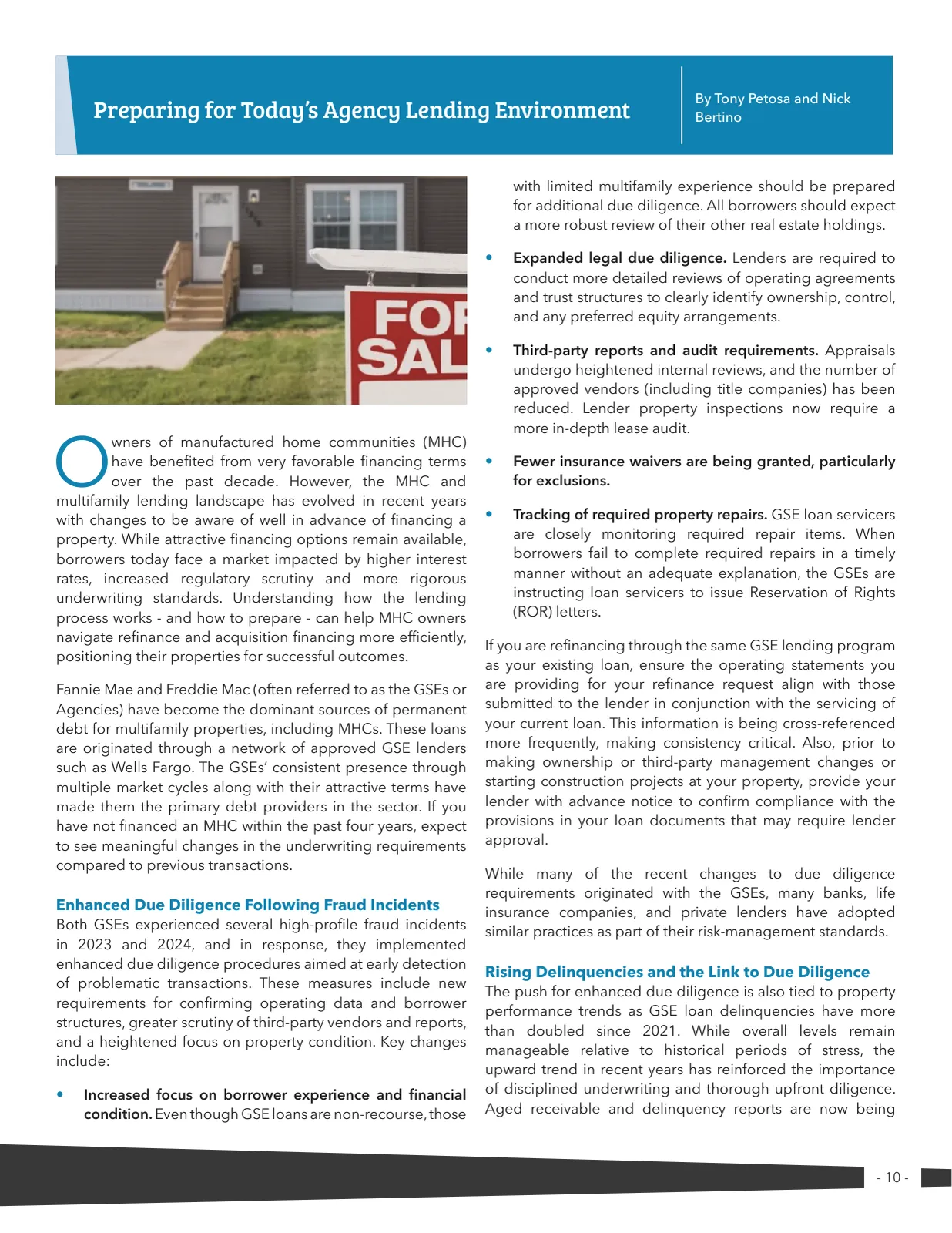
Owners of manufactured home communities (MHC) have benefited from very favorable financing terms over the past decade. However, the MHC and multifamily lending landscape has evolved in recent years with changes to be aware of well in advance of financing a property. While attractive financing options remain available, borrowers today face a market impacted by higher interest rates, increased regulatory scrutiny and more rigorous underwriting standards. Understanding how the lending process works - and how to prepare - can help MHC owners navigate refinance and acquisition financing more efficiently, positioning their properties for successful outcomes.
Fannie Mae and Freddie Mac (often referred to as the GSEs or Agencies) have become the dominant sources of permanent debt for multifamily properties, including MHCs. These loans are originated through a network of approved GSE lenders such as Wells Fargo. The GSEs’ consistent presence through multiple market cycles along with their attractive terms have made them the primary debt providers in the sector. If you have not financed an MHC within the past four years, expect to see meaningful changes in the underwriting requirements compared to previous transactions.
Enhanced Due Diligence Following Fraud Incidents
Both GSEs experienced several high-profile fraud incidents in 2023 and 2024, and in response, they implemented enhanced due diligence procedures aimed at early detection of problematic transactions. These measures include new requirements for confirming operating data and borrower structures, greater scrutiny of third-party vendors and reports, and a heightened focus on property condition. Key changes include:
• Increased focus on borrower experience and financial condition. Even though GSE loans are non-recourse, those with limited multifamily experience should be prepared for additional due diligence. All borrowers should expect a more robust review of their other real estate holdings.
Expanded legal due diligence. Lenders are required to conduct more detailed reviews of operating agreements and trust structures to clearly identify ownership, control, and any preferred equity arrangements.
• Third-party reports and audit requirements. Appraisals undergo heightened internal reviews, and the number of approved vendors (including title companies) has been reduced. Lender property inspections now require a more in-depth lease audit.
• Fewer insurance waivers are being granted, particularly for exclusions.
Tracking of required property repairs. GSE loan servicers are closely monitoring required repair items. When borrowers fail to complete required repairs in a timely manner without an adequate explanation, the GSEs are instructing loan servicers to issue Reservation of Rights (ROR) letters.
If you are refinancing through the same GSE lending program as your existing loan, ensure the operating statements you are providing for your refinance request align with those submitted to the lender in conjunction with the servicing of your current loan. This information is being cross-referenced more frequently, making consistency critical. Also, prior to making ownership or third-party management changes or starting construction projects at your property, provide your lender with advance notice to confirm compliance with the provisions in your loan documents that may require lender approval.
While many of the recent changes to due diligence requirements originated with the GSEs, many banks, life insurance companies, and private lenders have adopted similar practices as part of their risk-management standards.
Rising Delinquencies and the Link to Due Diligence
The push for enhanced due diligence is also tied to property performance trends as GSE loan delinquencies have more than doubled since 2021. While overall levels remain manageable relative to historical periods of stress, the upward trend in recent years has reinforced the importance of disciplined underwriting and thorough upfront diligence. Aged receivable and delinquency reports are now being
closely scrutinized at the initial quote stage as well as throughout the process leading up to loan closing. Lenders are less willing to rely on historical borrower relationships and informal assurances. Documentation has become more important than ever.
What to Do Moving Forward
Loan quote turnaround times have lengthened with the GSEs as a result of enhanced procedures, staffing constraints and a large volume of maturing loans. We recommend beginning preparation of your refinance well ahead of loan maturity, submitting information to your lender at least four months in advance. Key action items in advance of seeking financing:
Assess the overall quality and curb appeal of your community. Landscaping, entry features, and signage should present a well-maintained first impression.
Enforce community rules to foster pride of ownership in both the community and its homes.
Identify your competitive set with a market survey of comparable properties that includes their rents, occupancy and amenities.
For properties with elevated vacancy (15% or higher), outline a clear business plan for improving occupancy. This also applies to properties with community-owned homes at 25% or higher as lenders will need to outline the path toward stabilized occupancy and reduced home inventory.
Become familiar with the GSEs’ Tenant Site Lease Protections (TSLPs) mandate. The requirement for borrowers to implement TSLPs within 12 months of loan closing became effective in 2022 on all newly originated GSE MHC loans.
Even though spreads on GSE loans are tight by historical standards, most borrowers today are refinancing into interest rates materially higher than their existing loans. Consequently, many owners are delaying refinancing until their current loans are about to mature. In this situation we recommend an early assessment of your property’s value factoring in recent appraisal trends and loan-to-value constraints. This is particularly important for shorter-term fixed and floating rate loans originated when rates were lower as well as loans structured with full-term interest only payments. In these instances, the new loan sizing may fall short of the proceeds level needed to cover the payoff of the existing loan unless the property has experienced significant cash flow growth during the loan term.
As you can see, there are a number of items that require planning ahead, which is why it is never too early to start the financing process.
Evaluating Financial Performance
Well in advance of seeking financing, begin reviewing your property’s operating performance and the format of your financial information. Expect to provide lenders with a current rent roll, operating statements for the past three years, and a trailing 12-month (T12) statement broken out by month.
Some areas to focus on include:
Rent collections. Monthly collection trends on the T12 are closely analyzed, especially following recent rent increases.
Park-owned rental home operations. As GSE lenders do not include home rental income in underwriting, separate rental home income from site rent on your operating statements. Likewise, clearly break out any expenses related solely to rental homes.
Other income. Segregate ancillary income such as utility reimbursements, laundry, late fees, and any other income sources.
Non-recurring expenses. Clearly identify any one-time or capital expenditures even if they are expensed in your operating statements.
The goal is to arrive at the highest defensible underwritten Net Operating Income (NOI). Clear, well-supported financials help maximize NOI, translating into higher loan proceeds and more attractive loan terms.
Presenting the Borrower and Management Team
When pursuing a formal quote and pre-approval (versus a soft quote) to issue a loan application, GSE lenders perform a detailed review of the property’s ownership structure and management team. Your loan submission should include:
An organizational chart identifying managing members and all entities and individuals with a 25%+ ownership interest.
Biographies of key principals (KPs). KPs are typically managing members and/or members with voting control.
A summary of the KPs’ financial wherewithal (net worth and liquidity), Schedule of Real Estate Owned (SREO), and a summary of relevant real estate and MHC experience.
If the property is managed by a third-party management company, include a resume outlining the company’s qualifications.
Today’s GSE lending environment rewards preparation and detailed documentation and includes a heightened focus on experience and track record. While enhanced due diligence adds time and complexity, well-organized borrowers who understand the process and present their communities and information professionally will benefit. By starting early and assembling consistent financial and operational information, MHC owners can position themselves for smoother financing executions.
Tony Petosa and Nick Bertino are loan originators at Wells Fargo Multifamily Capital, specializing in financing manufactured home communities through their direct Fannie Mae and Freddie Mac lending programs and correspondent lending relationships. For more information or for a copy of their Manufactured Home Community Market Update and Financing Handbook, they can be reached at 760.505.9001 (Tony) or 858.336.0782 (Nick) and email: [email protected] or [email protected]; or visit www.wellsfargo.com/mhc.
Special INSURANCE PROGRAMS with Industry Leading Value
Manufactured Home Retailers Manufactured Home Community Owners
Protect your Investments
INSURANCE MOBILE
800-458-4320 800-458-4320
• Retailers • Communities • Developers • Transporters • Installers
Call or email today for a free consultation
800-458-4320 [email protected]
Kurt Kelley - President
THE CONCERNED COMMUNITY OWNER: The Socialist Argument Flaws
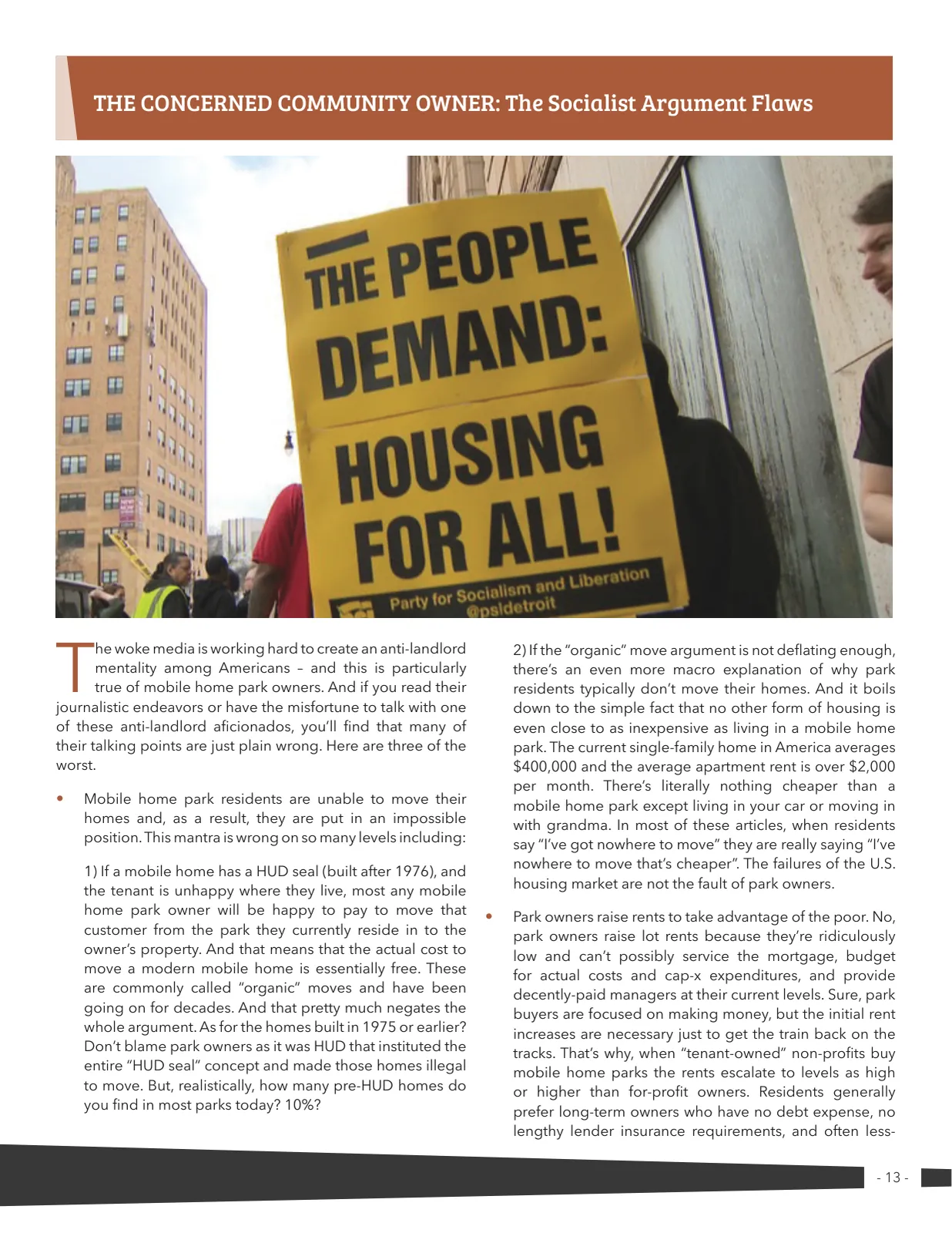
The woke media is working hard to create an anti-landlord mentality among Americans – and this is particularly true of mobile home park owners. And if you read their journalistic endeavors or have the misfortune to talk with one of these anti-landlord aficionados, you’ll find that many of their talking points are just plain wrong. Here are three of the worst.
Mobile home park residents are unable to move their homes and, as a result, they are put in an impossible position. This mantra is wrong on so many levels including:
1) If a mobile home has a HUD seal (built after 1976), and the tenant is unhappy where they live, most any mobile home park owner will be happy to pay to move that customer from the park they currently reside in to the owner’s property. And that means that the actual cost to move a modern mobile home is essentially free. These are commonly called “organic” moves and have been going on for decades. And that pretty much negates the whole argument. As for the homes built in 1975 or earlier? Don’t blame park owners as it was HUD that instituted the entire “HUD seal” concept and made those homes illegal to move. But, realistically, how many pre-HUD homes do you find in most parks today? 10%?
2) If the “organic” move argument is not deflating enough, there’s an even more macro explanation of why park residents typically don’t move their homes. And it boils down to the simple fact that no other form of housing is even close to as inexpensive as living in a mobile home park. The current single-family home in America averages $400,000 and the average apartment rent is over $2,000 per month. There’s literally nothing cheaper than a mobile home park except living in your car or moving in with grandma. In most of these articles, when residents say “I’ve got nowhere to move” they are really saying “I’ve nowhere to move that’s cheaper”. The failures of the U.S. housing market are not the fault of park owners.
Park owners raise rents to take advantage of the poor. No, park owners raise lot rents because they’re ridiculously low and can’t possibly service the mortgage, budget for actual costs and cap-x expenditures, and provide decently-paid managers at their current levels. Sure, park buyers are focused on making money, but the initial rent increases are necessary just to get the train back on the tracks. That’s why, when “tenant-owned” non-profits buy mobile home parks the rents escalate to levels as high or higher than for-profit owners. Residents generally prefer long-term owners who have no debt expense, no lengthy lender insurance requirements, and often less-
than-professionally trained management because this results in lower rents. However, family owners eventually sell their investment to capture its value. Those proceeds become the main source of their retirement funding like a 401k account does for a long term corporate employee. The new owners funding that retirement fund must pay their lenders, maintain broad insurance coverage, and run all operations professionally. Plus, new ownership often brings improved services and property upgrades.
Private equity groups hurt the quality of life in the properties they buy. Probably second only to “Trump Derangement Syndrome” is “Private Equity Derangement Syndrome” – and it’s equally bizarre. In many stories, the writer admits that the private equity group has spent millions on fixing infrastructure but, somehow, that has resulted in a lower quality of life because of a strict adherence to rent being due on the first and residents following the rules for the benefit of their neighbors. According to these writers, park tenants prefer to live in anarchy with roving pitbulls, non-running cars on every lot and loud music blaring over living in a well-manicured, secured and calm environment. No sane person would believe this. In every mobile home park in America that has been bought by a private equity group, maybe 1% of the residents are mad (the ones, of course, that have to start paying rent or following the rules) and 99% are delighted.
Even though these rebuttals are common sense, you would be surprised at how many good-natured individuals are swayed by the repetitive idiocy of the socialist media. So feel free to start educating your state and federal elected officials of these simple, logical arguments. While a screaming socialist gets plenty of screen time, most adults are somewhat skeptical of the “anti-landlord” bias and you have a good chance of getting your elected officials back on the right track with a little effort.
Better yet, join and become an active participant in our state’s manufactured housing association. They know these arguments well and are very capable of lobbying for your rights where it counts the most.
The Concerned Community Owner is a column dedicated to the challenges and insights of Managers, Owners, and Investors navigating today’s real estate landscape. These articles come from readers across the nation, sharing real experiences and pressing concerns.
Do you have a perspective to share? Submit your article to: [email protected] —contrary opinions welcome!
House Passes Key Manufactured Housing Reforms
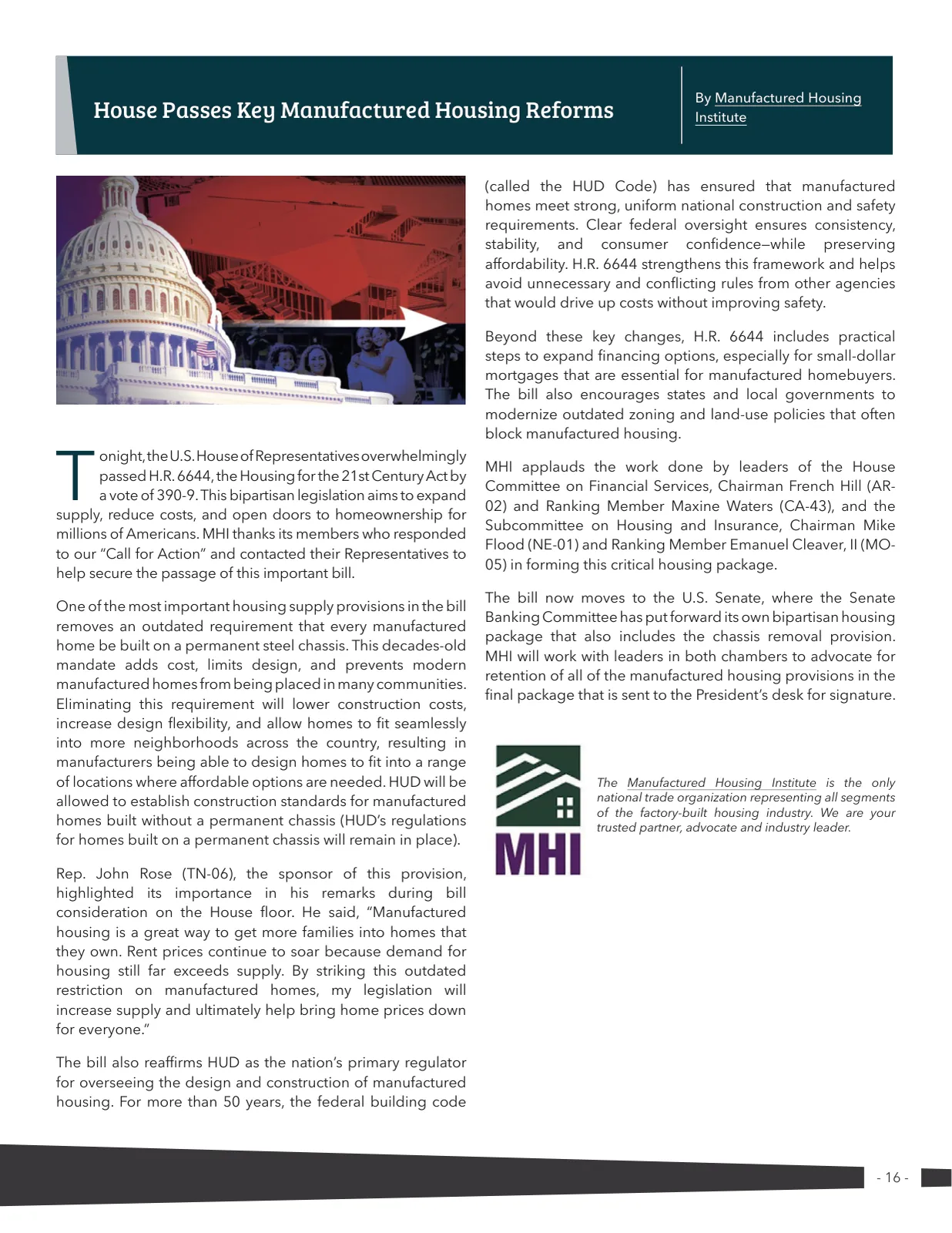
Tonight, the U.S. House of Representatives overwhelmingly passed H.R. 6644, the Housing for the 21st Century Act by a vote of 390-9. This bipartisan legislation aims to expand supply, reduce costs, and open doors to homeownership for millions of Americans. MHI thanks its members who responded to our “Call for Action” and contacted their Representatives to help secure the passage of this important bill.
One of the most important housing supply provisions in the bill removes an outdated requirement that every manufactured home be built on a permanent steel chassis. This decades‑old mandate adds cost, limits design, and prevents modern manufactured homes from being placed in many communities. Eliminating this requirement will lower construction costs, increase design flexibility, and allow homes to fit seamlessly into more neighborhoods across the country, resulting in manufacturers being able to design homes to fit into a range of locations where affordable options are needed. HUD will be allowed to establish construction standards for manufactured homes built without a permanent chassis (HUD’s regulations for homes built on a permanent chassis will remain in place).
Rep. John Rose (TN-06), the sponsor of this provision, highlighted its importance in his remarks during bill consideration on the House floor. He said, “Manufactured housing is a great way to get more families into homes that they own. Rent prices continue to soar because demand for housing still far exceeds supply. By striking this outdated restriction on manufactured homes, my legislation will increase supply and ultimately help bring home prices down for everyone.”
The bill also reaffirms HUD as the nation’s primary regulator for overseeing the design and construction of manufactured housing. For more than 50 years, the federal building code (called the HUD Code) has ensured that manufactured homes meet strong, uniform national construction and safety requirements. Clear federal oversight ensures consistency, stability, and consumer confidence—while preserving affordability. H.R. 6644 strengthens this framework and helps avoid unnecessary and conflicting rules from other agencies that would drive up costs without improving safety.
Beyond these key changes, H.R. 6644 includes practical steps to expand financing options, especially for small‑dollar mortgages that are essential for manufactured homebuyers. The bill also encourages states and local governments to modernize outdated zoning and land‑use policies that often block manufactured housing.
MHI applauds the work done by leaders of the House Committee on Financial Services, Chairman French Hill (AR- 02) and Ranking Member Maxine Waters (CA-43), and the Subcommittee on Housing and Insurance, Chairman Mike Flood (NE-01) and Ranking Member Emanuel Cleaver, II (MO- 05) in forming this critical housing package.
The bill now moves to the U.S. Senate, where the Senate Banking Committee has put forward its own bipartisan housing package that also includes the chassis removal provision. MHI will work with leaders in both chambers to advocate for retention of all of the manufactured housing provisions in the final package that is sent to the President’s desk for signature.
The Manufactured Housing Institute is the only national trade organization representing all segments of the factory-built housing industry. We are your trusted partner, advocate and industry leader.
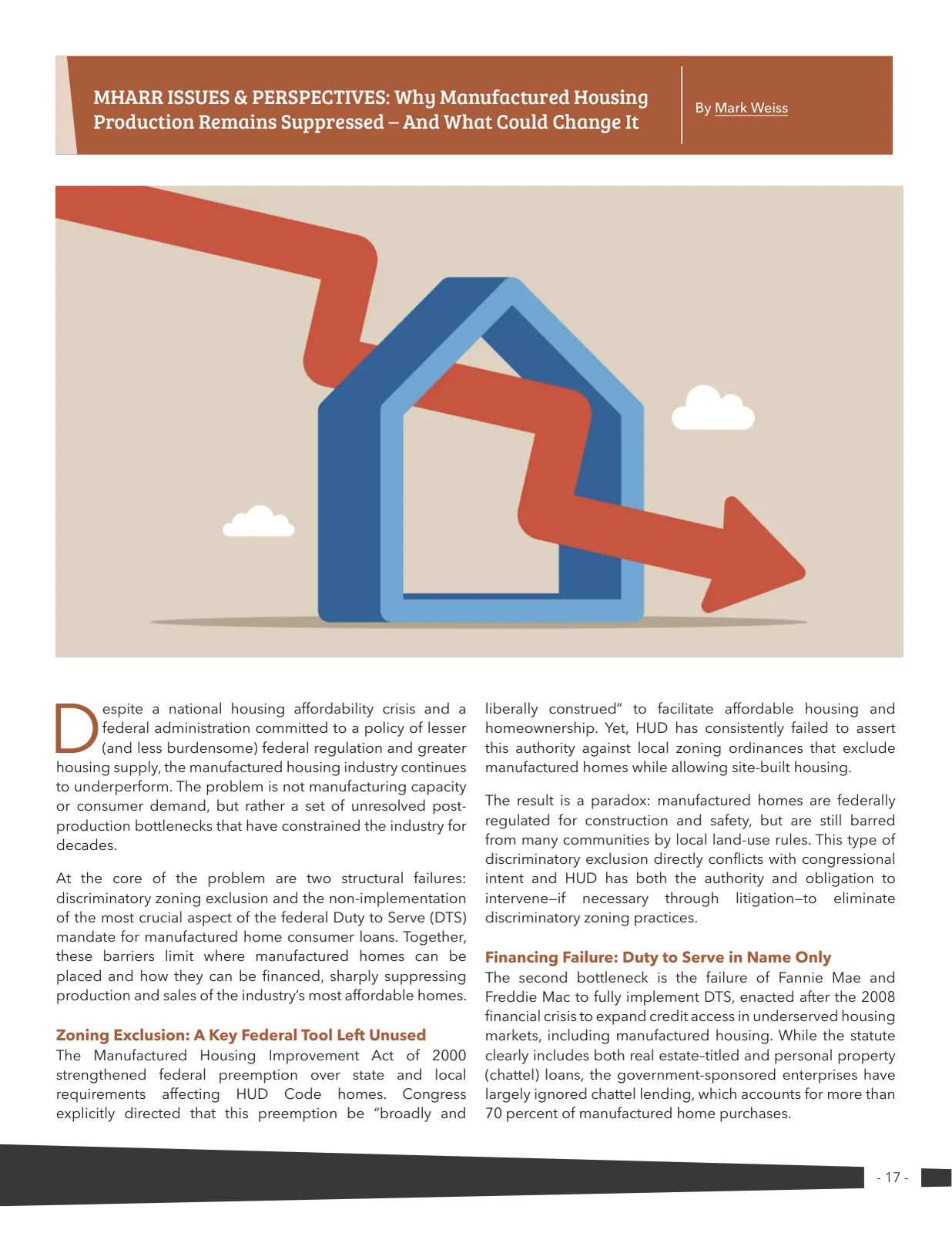
MHARR ISSUES & PERSPECTIVES: Why Manufactured Housing Production Remains Suppressed – And What Could Change It
Despite a national housing affordability crisis and a federal administration committed to a policy of lesser (and less burdensome) federal regulation and greater housing supply, the manufactured housing industry continues to underperform. The problem is not manufacturing capacity or consumer demand, but rather a set of unresolved post-production bottlenecks that have constrained the industry for decades.
At the core of the problem are two structural failures: discriminatory zoning exclusion and the non-implementation of the most crucial aspect of the federal Duty to Serve (DTS) mandate for manufactured home consumer loans. Together, these barriers limit where manufactured homes can be placed and how they can be financed, sharply suppressing production and sales of the industry’s most affordable homes.
Zoning Exclusion: A Key Federal Tool Left Unused
The Manufactured Housing Improvement Act of 2000 strengthened federal preemption over state and local requirements affecting HUD Code homes. Congress explicitly directed that this preemption be “broadly and liberally construed” to facilitate affordable housing and homeownership. Yet, HUD has consistently failed to assert this authority against local zoning ordinances that exclude manufactured homes while allowing site-built housing.
The result is a paradox: manufactured homes are federally regulated for construction and safety, but are still barred from many communities by local land-use rules. This type of discriminatory exclusion directly conflicts with congressional intent and HUD has both the authority and obligation to intervene—if necessary through litigation—to eliminate discriminatory zoning practices.
Financing Failure: Duty to Serve in Name Only
The second bottleneck is the failure of Fannie Mae and Freddie Mac to fully implement DTS, enacted after the 2008 financial crisis to expand credit access in underserved housing markets, including manufactured housing. While the statute clearly includes both real estate–titled and personal property (chattel) loans, the government-sponsored enterprises have largely ignored chattel lending, which accounts for more than 70 percent of manufactured home purchases.
Instead, DTS implementation has focused on higher-cost manufactured homes titled as real estate, including so-called “MH Select” and “cross-mod” homes (among others). This leaves mainstream buyers -- often lower-and moderate-income individuals and/or families -- dependent on a small number of portfolio lenders, resulting in higher interest rates, reduced competition, and fewer qualified buyers. This failure not only violates both the spirit and letter of DTS, but systematically disadvantages the most affordable segment of the housing market.
Legislative Distraction: Fixing Yesterday’s Problems
A further problem lies in current industry advocacy priorities, particularly support for the pending “ROAD to Housing Act.” While that bill would remove the long-standing permanent chassis requirement and clarify HUD’s authority over construction standards, including so-called “energy” standards, it does not address zoning exclusion or DTS noncompliance—the issues that most directly suppress production.
Focusing on these “low-hanging” reforms risks giving the appearance of progress while leaving the industry’s core constraints untouched. Even if enacted, such legislation would likely benefit higher-priced, non-mainstream HUD Code homes and dominant lenders, while doing little to expand access to genuinely affordable mainstream manufactured housing.
Energy Standards: An Additional Cost Burden
Compounding these challenges are U.S. Department of Energy (DOE) energy standards for manufactured housing, which the statutory Manufactured Housing Consensus Committee (MHCC) has confirmed, are excessive and discriminatory, as well as the product of a flawed regulatory process. The DOE standards would significantly increase home purchase costs for consumers who already rely on manufactured housing for affordability—despite evidence that manufactured homes already perform well on energy efficiency metrics. As a result, DOE’s constant underlying threat to implement these excessively costly standards (and related enforcement mechanisms) significantly compounds consumer anxiety within the mainstream HUD Code manufactured housing market, ultimately leading to reduced sales and production.
The Bottom Line
The stagnation of the HUD Code manufactured housing industry is not inevitable. Federal law already provides the tools needed to expand placement, improve financing access, and boost production, as well as the development of new and expanded manufactured housing communities. What is missing is the political will and industry post-production representation necessary to demand the enforcement and full, robust implementation of those laws.
Until zoning discrimination is challenged, DTS is fully implemented for consumer chattel loans, and unnecessary regulatory costs are rolled back, manufactured housing will continue to fall short of its full potential to provide hundreds-of-thousands of new homes each year, as a scalable, affordable housing solution -- despite an unprecedented affordable housing crisis and a desperate need that it could readily solve.
Given the failure of the housing bills pending in the House and Senate at press time to directly address discriminatory zoning exclusion and/or DTS non-implementation within the dominant chattel financing market, MHARR has developed and released (on September 8, 2025) statutory amendments to address and remedy both of these key issues. The Manufactured Housing Institute (MHI) (i.e., the industry’s post-production national representation), however, has yet to give any public or private indication (that MHARR is aware of) that it would support – or has supported -- the inclusion of these additional provisions, which are absolutely essential to breaking the regulatory logjam that has suppressed the industry and the availability of truly affordable housing and homeownership for far too long.
Time is of the essence, though, as MHI and the entire industry should now seek to include these crucial amendments in the housing bill ultimately put before a House-Senate conference committee, which will decide the language and structure of any final bill.
Mark Weiss is the President and CEO of the Manufactured Housing Association for Regulatory Reform (MHARR) in Washington, D.C. He has served in that position since January 2015 and, prior to that, served as MHARR’s Senior Vice President and General Counsel.
MHARR is a Washington, D.C.-based national trade association representing the views and interests of independent producers of federally regulated manufactured housing.
“MHARR-Issues and Perspectives” is available for re-publication in full (i.e., without alteration or substantive modification) without further permission and with proper attribution to MHARR.
Manufactured Housing Association for Regulatory Reform (MHARR) 1331 Pennsylvania Ave N.W., Suite 512 Washington D.C. 20004 Phone: 202/783-4087 Fax: 202/783-4075 [email protected]
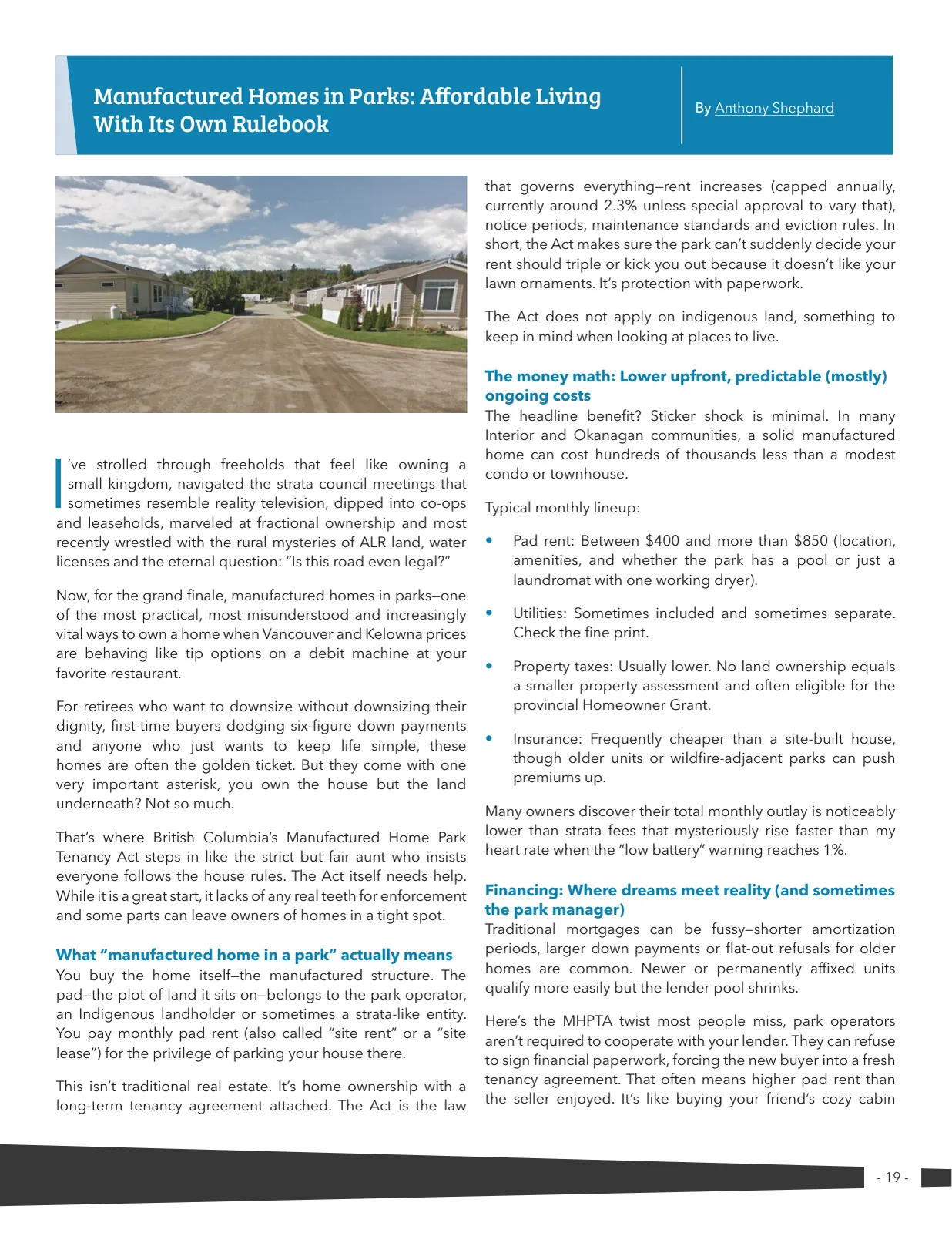
Manufactured Homes in Parks: Affordable Living With Its Own Rulebook
I’ve strolled through freeholds that feel like owning a small kingdom, navigated the strata council meetings that sometimes resemble reality television, dipped into co-ops and leaseholds, marveled at fractional ownership and most recently wrestled with the rural mysteries of ALR land, water licenses and the eternal question: “Is this road even legal?”
Now, for the grand finale, manufactured homes in parks—one of the most practical, most misunderstood and increasingly vital ways to own a home when Vancouver and Kelowna prices are behaving like tip options on a debit machine at your favorite restaurant.
For retirees who want to downsize without downsizing their dignity, first-time buyers dodging six-figure down payments and anyone who just wants to keep life simple, these homes are often the golden ticket. But they come with one very important asterisk, you own the house but the land underneath? Not so much.
That’s where British Columbia’s Manufactured Home Park Tenancy Act steps in like the strict but fair aunt who insists everyone follows the house rules. The Act itself needs help. While it is a great start, it lacks of any real teeth for enforcement and some parts can leave owners of homes in a tight spot.
What “manufactured home in a park” actually means
You buy the home itself—the manufactured structure. The pad—the plot of land it sits on—belongs to the park operator, an Indigenous landholder or sometimes a strata-like entity. You pay monthly pad rent (also called “site rent” or a “site lease”) for the privilege of parking your house there.
This isn’t traditional real estate. It’s home ownership with a long-term tenancy agreement attached. The Act is the law that governs everything—rent increases (capped annually, currently around 2.3% unless special approval to vary that), notice periods, maintenance standards and eviction rules. In short, the Act makes sure the park can’t suddenly decide your rent should triple or kick you out because it doesn’t like your lawn ornaments. It’s protection with paperwork.
The Act does not apply on indigenous land, something to keep in mind when looking at places to live.
The money math: Lower upfront, predictable (mostly) ongoing costs
The headline benefit? Sticker shock is minimal. In many Interior and Okanagan communities, a solid manufactured home can cost hundreds of thousands less than a modest condo or townhouse.
Typical monthly lineup:
Pad rent: Between $400 and more than $850 (location, amenities, and whether the park has a pool or just a laundromat with one working dryer).
• Utilities: Sometimes included and sometimes separate. Check the fine print.
Property taxes: Usually lower. No land ownership equals a smaller property assessment and often eligible for the provincial Homeowner Grant.
• Insurance: Frequently cheaper than a site-built house, though older units or wildfire-adjacent parks can push premiums up.
Many owners discover their total monthly outlay is noticeably lower than strata fees that mysteriously rise faster than my heart rate when the “low battery” warning reaches 1%.
Financing: Where dreams meet reality (and sometimes the park manager)
Traditional mortgages can be fussy—shorter amortization periods, larger down payments or flat-out refusals for older homes are common. Newer or permanently affixed units qualify more easily but the lender pool shrinks.
Here’s the MHPTA twist most people miss, park operators aren’t required to cooperate with your lender. They can refuse to sign financial paperwork, forcing the new buyer into a fresh tenancy agreement. That often means higher pad rent than the seller enjoyed. It’s like buying your friend’s cozy cabin
and discovering the lot rent just got a surprise cost-of-living adjustment. Plan accordingly.
Repairs and maintenance are all yours. There are no surprise levies. You’re responsible for the whole enchilada—roof, skirting, plumbing, furnace, deck, you name it.
The upside is there is no $15,000 special assessment because the neighbors’ hot tub sprang a leak. The downside is you budget for repairs like any detached-home owner.
Good parks enforce appearance and maintenance standards, which helps protect resale values and prevents the neighborhood from turning into a post-apocalyptic trailer park aesthetic.
Insurance: Standard but ask the right questions
Coverage is usually straightforward—structure, contents, liability—but premiums depend on age, foundation, updates and whether you’re in a wildfire or flood zone. The park insures the land and common areas. You cover your home.
Quick Comparisons
Versus freehold: Much cheaper entry but no land equity and permanent pad rent.
Versus strata: Freedom from council drama and runaway fees but you’re 100% on maintenance.
Versus co-ops/leaseholds: Usually easier to sell (open market, though buyer approval is common), lower costs, more lifestyle flexibility.
Versus rural ALR: Fewer arguments about water rights and road access. More about hoping the park owner doesn’t sell to a developer with big dreams.
The bottom line
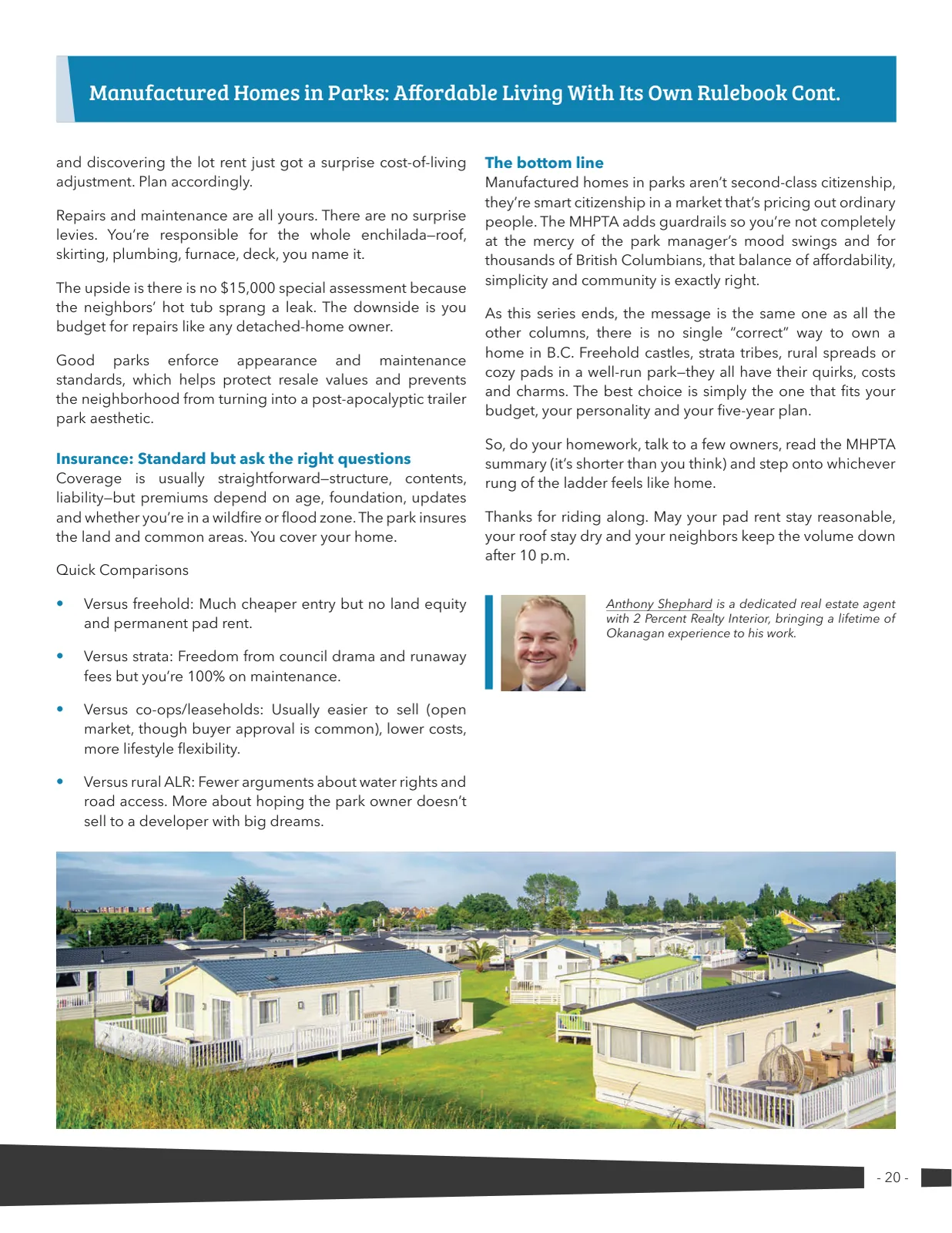
Manufactured homes in parks aren’t second-class citizenship, they’re smart citizenship in a market that’s pricing out ordinary people. The MHPTA adds guardrails so you’re not completely at the mercy of the park manager’s mood swings and for thousands of British Columbians, that balance of affordability, simplicity and community is exactly right.
As this series ends, the message is the same one as all the other columns, there is no single “correct” way to own a home in B.C. Freehold castles, strata tribes, rural spreads or cozy pads in a well-run park—they all have their quirks, costs and charms. The best choice is simply the one that fits your budget, your personality and your five-year plan.
So, do your homework, talk to a few owners, read the MHPTA summary (it’s shorter than you think) and step onto whichever rung of the ladder feels like home.
Thanks for riding along. May your pad rent stay reasonable, your roof stay dry and your neighbors keep the volume down after 10 p.m.
Anthony Shephard is a dedicated real estate agent with 2 Percent Realty Interior, bringing a lifetime of Okanagan experience to his work.
MHI Congress and Expo Returns to Las Vegas in April
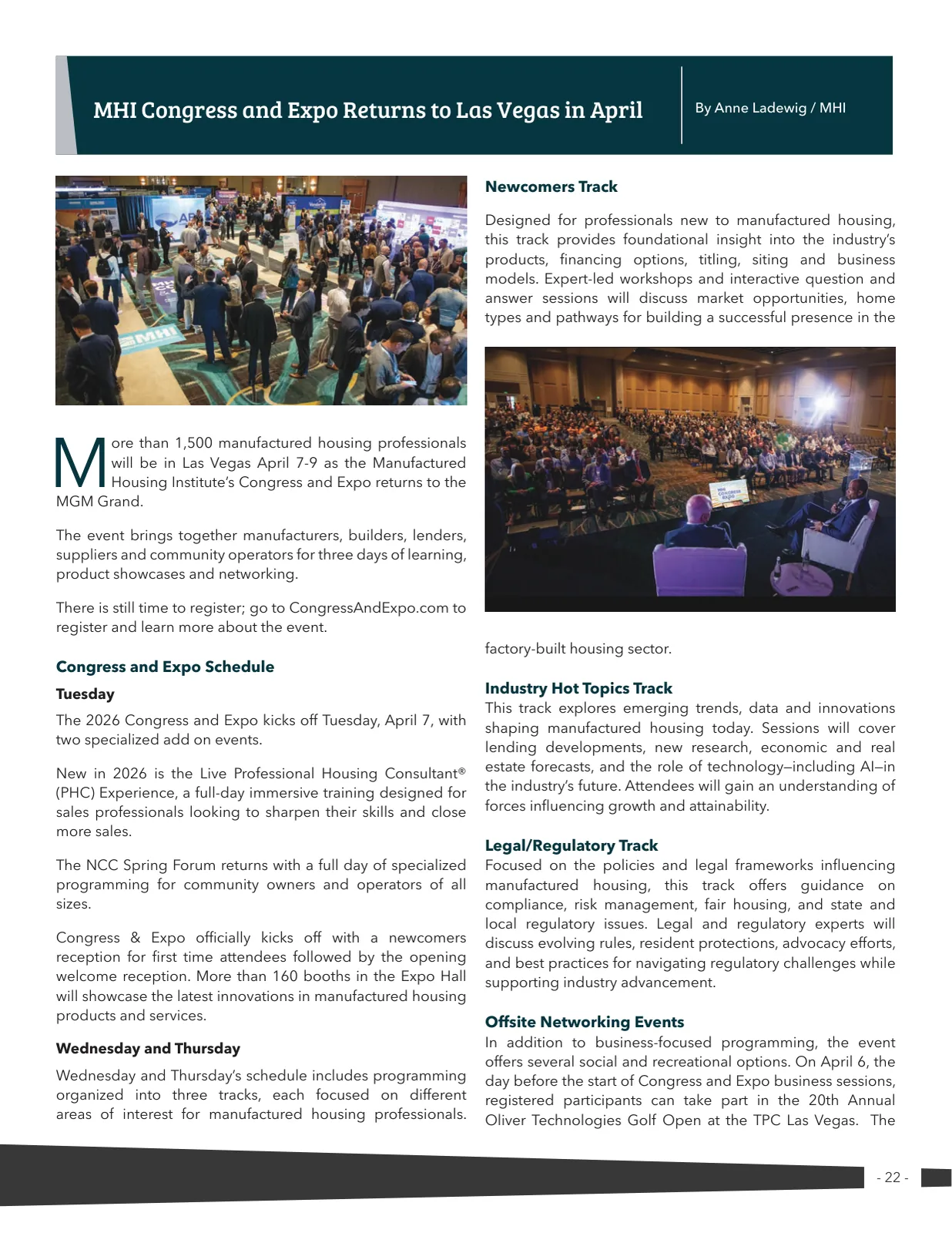
More than 1,500 manufactured housing professionals will be in Las Vegas April 7-9 as the Manufactured Housing Institute’s Congress and Expo returns to the MGM Grand.
The event brings together manufacturers, builders, lenders, suppliers and community operators for three days of learning, product showcases and networking.
There is still time to register; go to CongressAndExpo.com to register and learn more about the event.
Congress and Expo Schedule
Tuesday
The 2026 Congress and Expo kicks off Tuesday, April 7, with two specialized add on events.
New in 2026 is the Live Professional Housing Consultant® (PHC) Experience, a full-day immersive training designed for sales professionals looking to sharpen their skills and close more sales.
The NCC Spring Forum returns with a full day of specialized programming for community owners and operators of all sizes.
Congress & Expo officially kicks off with a newcomers reception for first time attendees followed by the opening welcome reception. More than 160 booths in the Expo Hall will showcase the latest innovations in manufactured housing products and services.
Wednesday and Thursday
Wednesday and Thursday’s schedule includes programming organized into three tracks, each focused on different areas of interest for manufactured housing professionals.
Newcomers Track
Designed for professionals new to manufactured housing, this track provides foundational insight into the industry’s products, financing options, titling, siting and business models. Expert-led workshops and interactive question and answer sessions will discuss market opportunities, home types and pathways for building a successful presence in the factory-built housing sector.
Industry Hot Topics Track
This track explores emerging trends, data and innovations shaping manufactured housing today. Sessions will cover lending developments, new research, economic and real estate forecasts, and the role of technology—including AI—in the industry’s future. Attendees will gain an understanding of forces influencing growth and attainability.
Legal/Regulatory Track
Focused on the policies and legal frameworks influencing manufactured housing, this track offers guidance on compliance, risk management, fair housing, and state and local regulatory issues. Legal and regulatory experts will discuss evolving rules, resident protections, advocacy efforts, and best practices for navigating regulatory challenges while supporting industry advancement.
Offsite Networking Events
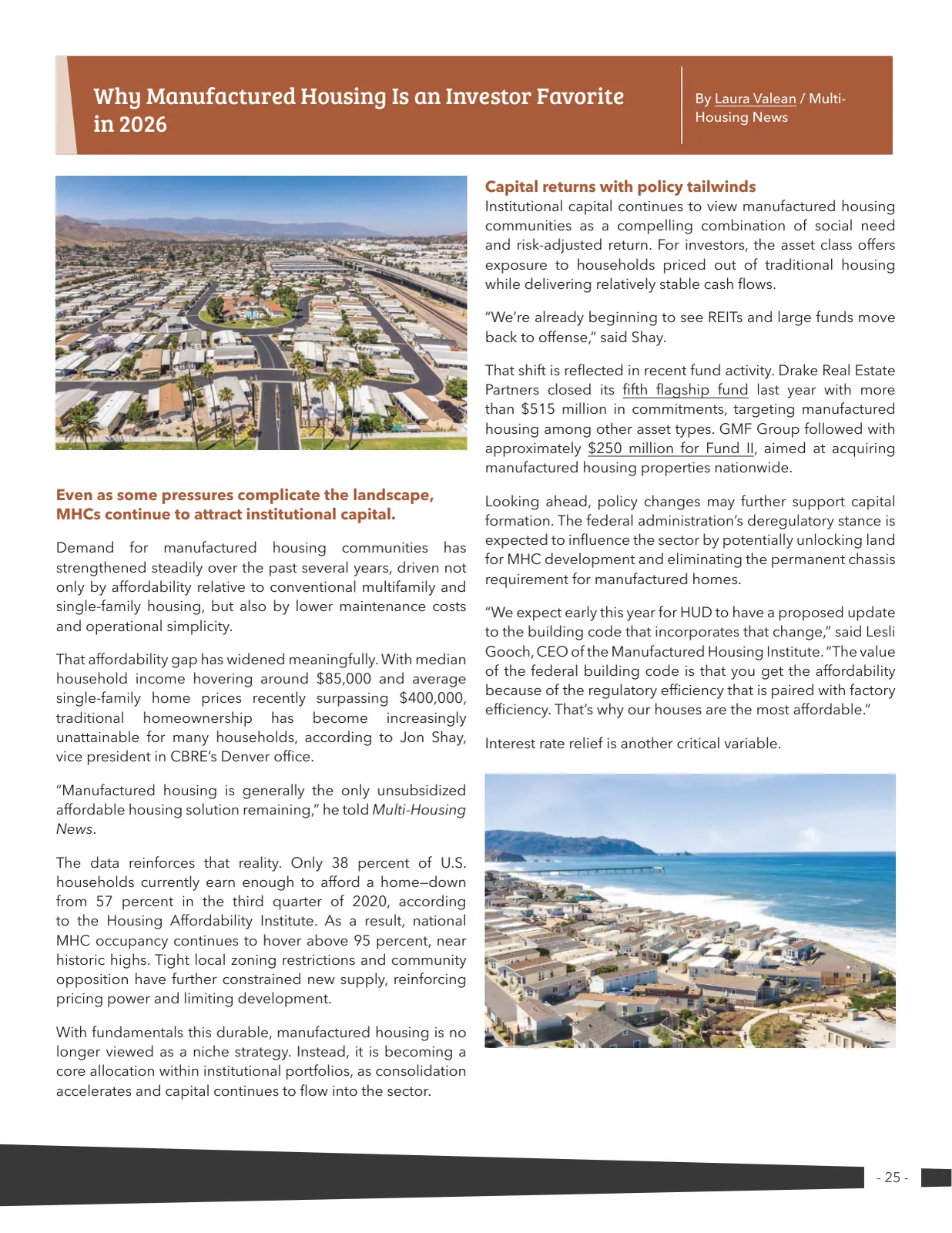
In addition to business-focused programming, the event offers several social and recreational options. On April 6, the day before the start of Congress and Expo business sessions, registered participants can take part in the 20th Annual Oliver Technologies Golf Open at the TPC Las Vegas. The
tournament includes lunch, shuttle service from the MGM Grand, and a chance to win prizes.
Also available on Monday is the 8th Annual Hart Kienle Pentecost/Lutz, Bobo and Telfair Clay Shoot, another optional activity designed to foster industry relationships in an informal outdoor setting before the main conference begins. A separate registration is required for both events.
Awards and Recognition
Another key feature of the 2026 Congress and Expo is the MHI Excellence in Manufactured Housing Awards program, which honors industry excellence in categories such as sustainability leadership, community impact, and retail sales accomplishments. The awards recognize organizations and professionals who have demonstrated outstanding service, innovation or community leadership in the manufactured housing industry.
The Expo Hall
MHI Congress and Expo’s Expo Hall serves as a hub for business activity throughout the event. Companies in attendance represent a broad cross-section of the industry — from lenders and brokers to material suppliers and technology innovators.
There is still time to register; go to CongressAndExpo.com to register and learn more about the event.
The Manufactured Housing Institute is the only national trade organization representing all segments of the factory-built housing industry. We are your trusted partner, advocate and industry leader.
Unlock potential in every property.
For 25 years, we’ve remained the only property management software partnering exclusively with manufactured housing.
Learn More
Why Manufactured Housing Is an Investor Favorite in 2026
Even as some pressures complicate the landscape, MHCs continue to attract institutional capital.
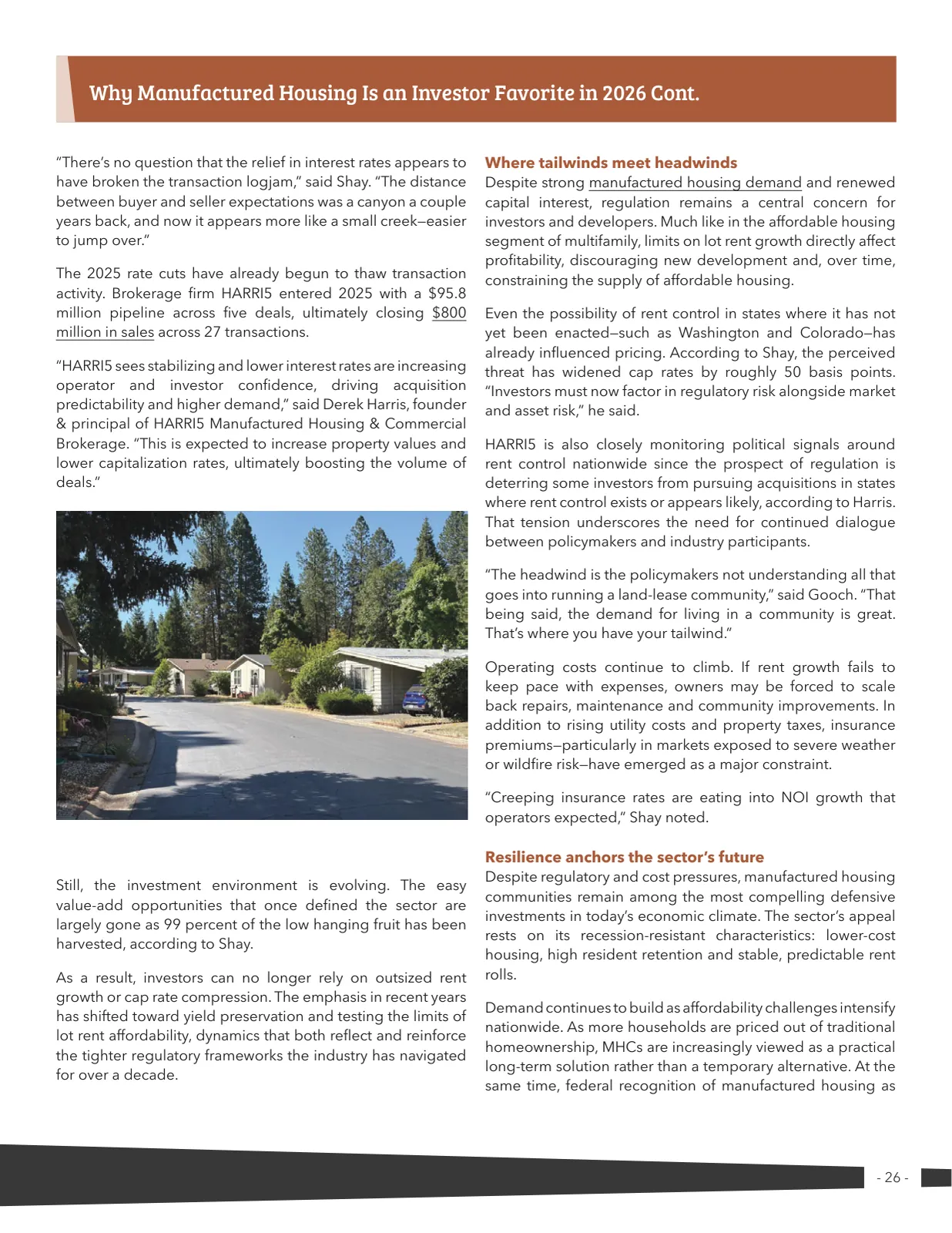
Demand for manufactured housing communities has strengthened steadily over the past several years, driven not only by affordability relative to conventional multifamily and single-family housing, but also by lower maintenance costs and operational simplicity.
That affordability gap has widened meaningfully. With median household income hovering around $85,000 and average single-family home prices recently surpassing $400,000, traditional homeownership has become increasingly unattainable for many households, according to Jon Shay, vice president in CBRE’s Denver office.
“Manufactured housing is generally the only unsubsidized affordable housing solution remaining,” he told Multi-Housing News.
The data reinforces that reality. Only 38 percent of U.S. households currently earn enough to afford a home—down from 57 percent in the third quarter of 2020, according to the Housing Affordability Institute. As a result, national MHC occupancy continues to hover above 95 percent, near historic highs. Tight local zoning restrictions and community opposition have further constrained new supply, reinforcing pricing power and limiting development.
With fundamentals this durable, manufactured housing is no longer viewed as a niche strategy. Instead, it is becoming a core allocation within institutional portfolios, as consolidation accelerates and capital continues to flow into the sector.
Capital returns with policy tailwinds
Institutional capital continues to view manufactured housing communities as a compelling combination of social need and risk-adjusted return. For investors, the asset class offers exposure to households priced out of traditional housing while delivering relatively stable cash flows.
“We’re already beginning to see REITs and large funds move back to offense,” said Shay.
That shift is reflected in recent fund activity. Drake Real Estate Partners closed its fifth flagship fund last year with more than $515 million in commitments, targeting manufactured housing among other asset types. GMF Group followed with approximately $250 million for Fund II, aimed at acquiring manufactured housing properties nationwide.
Looking ahead, policy changes may further support capital formation. The federal administration’s deregulatory stance is expected to influence the sector by potentially unlocking land for MHC development and eliminating the permanent chassis requirement for manufactured homes.
“We expect early this year for HUD to have a proposed update to the building code that incorporates that change,” said Lesli Gooch, CEO of the Manufactured Housing Institute. “The value of the federal building code is that you get the affordability because of the regulatory efficiency that is paired with factory efficiency. That’s why our houses are the most affordable.”
Interest rate relief is another critical variable.
“There’s no question that the relief in interest rates appears to have broken the transaction logjam,” said Shay. “The distance between buyer and seller expectations was a canyon a couple years back, and now it appears more like a small creek—easier to jump over.”
The 2025 rate cuts have already begun to thaw transaction activity. Brokerage firm HARRI5 entered 2025 with a $95.8 million pipeline across five deals, ultimately closing $800 million in sales across 27 transactions.
“HARRI5 sees stabilizing and lower interest rates are increasing operator and investor confidence, driving acquisition predictability and higher demand,” said Derek Harris, founder & principal of HARRI5 Manufactured Housing & Commercial Brokerage. “This is expected to increase property values and lower capitalization rates, ultimately boosting the volume of deals.”
Still, the investment environment is evolving. The easy value-add opportunities that once defined the sector are largely gone as 99 percent of the low hanging fruit has been harvested, according to Shay.
As a result, investors can no longer rely on outsized rent growth or cap rate compression. The emphasis in recent years has shifted toward yield preservation and testing the limits of lot rent affordability, dynamics that both reflect and reinforce the tighter regulatory frameworks the industry has navigated for over a decade.
Where tailwinds meet headwinds
Despite strong manufactured housing demand and renewed capital interest, regulation remains a central concern for investors and developers. Much like in the affordable housing segment of multifamily, limits on lot rent growth directly affect profitability, discouraging new development and, over time, constraining the supply of affordable housing.
Even the possibility of rent control in states where it has not yet been enacted—such as Washington and Colorado—has already influenced pricing. According to Shay, the perceived threat has widened cap rates by roughly 50 basis points. “Investors must now factor in regulatory risk alongside market and asset risk,” he said.
HARRI5 is also closely monitoring political signals around rent control nationwide since the prospect of regulation is deterring some investors from pursuing acquisitions in states where rent control exists or appears likely, according to Harris. That tension underscores the need for continued dialogue between policymakers and industry participants.
“The headwind is the policymakers not understanding all that goes into running a land-lease community,” said Gooch. “That being said, the demand for living in a community is great. That’s where you have your tailwind.”
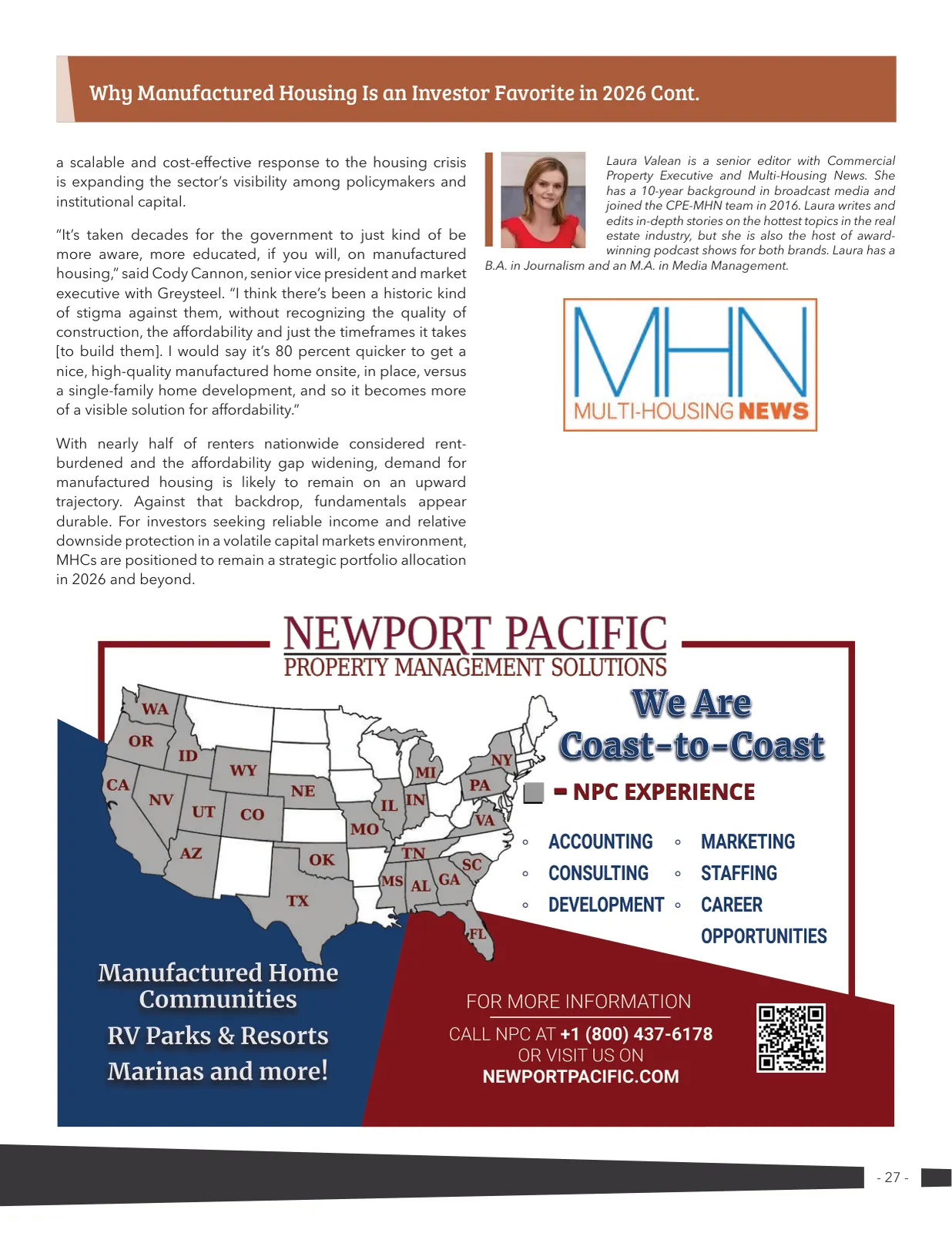
Operating costs continue to climb. If rent growth fails to keep pace with expenses, owners may be forced to scale back repairs, maintenance and community improvements. In addition to rising utility costs and property taxes, insurance premiums—particularly in markets exposed to severe weather or wildfire risk—have emerged as a major constraint.
“Creeping insurance rates are eating into NOI growth that operators expected,” Shay noted.
Resilience anchors the sector’s future
Despite regulatory and cost pressures, manufactured housing communities remain among the most compelling defensive investments in today’s economic climate. The sector’s appeal rests on its recession-resistant characteristics: lower-cost housing, high resident retention and stable, predictable rent rolls.
Demand continues to build as affordability challenges intensify nationwide. As more households are priced out of traditional homeownership, MHCs are increasingly viewed as a practical long-term solution rather than a temporary alternative. At the same time, federal recognition of manufactured housing as
a scalable and cost-effective response to the housing crisis is expanding the sector’s visibility among policymakers and institutional capital.
“It’s taken decades for the government to just kind of be more aware, more educated, if you will, on manufactured housing,” said Cody Cannon, senior vice president and market executive with Greysteel. “I think there’s been a historic kind of stigma against them, without recognizing the quality of construction, the affordability and just the timeframes it takes [to build them]. I would say it’s 80 percent quicker to get a nice, high-quality manufactured home onsite, in place, versus a single-family home development, and so it becomes more of a visible solution for affordability.”
With nearly half of renters nationwide considered rent-burdened and the affordability gap widening, demand for manufactured housing is likely to remain on an upward trajectory. Against that backdrop, fundamentals appear durable. For investors seeking reliable income and relative downside protection in a volatile capital markets environment, MHCs are positioned to remain a strategic portfolio allocation in 2026 and beyond.
Laura Valean is a senior editor with Commercial Property Executive and Multi-Housing News. She has a 10-year background in broadcast media and joined the CPE-MHN team in 2016. Laura writes and edits in-depth stories on the hottest topics in the real estate industry, but she is also the host of award-winning podcast shows for both brands. Laura has a B.A. in Journalism and an M.A. in Media Management.
Giving You Guidance.
Empowering you with the rental industry resources & education you need.
JOIN AAOA FOR FREE
SERVING YOU
139K
19YRS
MEMBERS
11K
REVIEWS
3M
UNITS MANAGED
Find Quality Tenants Learn
Reliable credit/background checks Option for landlord or tenant pay LeaseGuarantee to protect your rental income
Download Legal Forms
150+ Premium state-specific forms 20 Free landlord forms Attorney reviewed & customizable
Unlimited recorded & live webinars AAOA Today e-newsletter Free access to RENT Magazine
Grow Your Portfolio
Exclusive off-market listings Financing for your investments Vendor directory & discounts
AAOA.com 866.579.2262 [email protected]
The Texas Community Owners Event
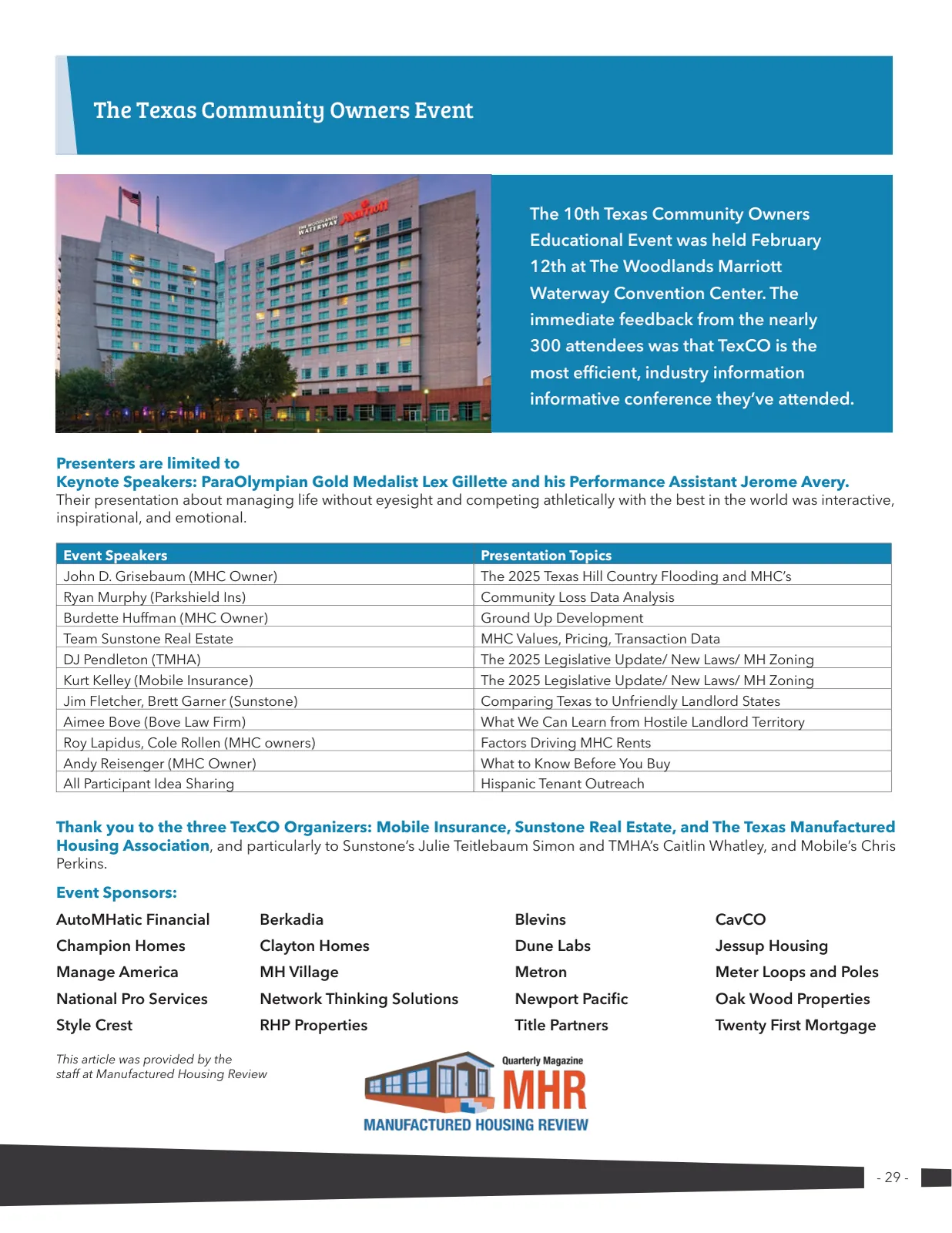
The 10th Texas Community Owners Educational Event was held February 12th at The Woodlands Marriott Waterway Convention Center. The immediate feedback from the nearly 300 attendees was that TexCO is the most efficient, industry information informative conference they’ve attended.
Presenters are limited to Keynote Speakers: ParaOlympian Gold Medalist Lex Gillette and his Performance Assistant Jerome Avery.
Their presentation about managing life without eyesight and competing athletically with the best in the world was interactive, inspirational, and emotional.
Event Speakers Presentation Topics
John D. Grisebaum (MHC Owner) The 2025 Texas Hill Country Flooding and MHC’s Ryan Murphy (Parkshield Ins) Community Loss Data Analysis Burdette Huffman (MHC Owner) Ground Up Development Team Sunstone Real Estate MHC Values, Pricing, Transaction Data DJ Pendleton (TMHA) The 2025 Legislative Update/ New Laws/ MH Zoning Kurt Kelley (Mobile Insurance) The 2025 Legislative Update/ New Laws/ MH Zoning Jim Fletcher, Brett Garner (Sunstone) Comparing Texas to Unfriendly Landlord States Aimee Bove (Bove Law Firm) What We Can Learn from Hostile Landlord Territory Roy Lapidus, Cole Rollen (MHC owners) Factors Driving MHC Rents Andy Reisenger (MHC Owner) What to Know Before You Buy All Participant Idea Sharing Hispanic Tenant Outreach
Thank you to the three TexCO Organizers: Mobile Insurance, Sunstone Real Estate, and The Texas Manufactured
Housing Association, and particularly to Sunstone’s Julie Teitlebaum Simon and TMHA’s Caitlin Whatley, and Mobile’s Chris Perkins.
Event Sponsors:
AutoMHatic Financial Berkadia Blevins CavCO
Champion Homes Clayton Homes Dune Labs Jessup Housing
Manage America MH Village Metron Meter Loops and Poles
National Pro Services Network Thinking Solutions Newport Pacific Oak Wood Properties
Style Crest RHP Properties Title Partners Twenty First Mortgage
This article was provided by the staff at Manufactured Housing Review
The Rise of Manufactured Home Investing as a 2026 Strategy
Manufactured home communities have long lived in the shadows of more mainstream asset classes. But in a market defined by affordability challenges, shifting demographics, and constrained housing supply, that’s starting to change.
More investors are taking a second look – not for speculative growth, but for consistent, defensible returns. As 2026 approaches, manufactured housing community (MHC) investing is earning a place in more sophisticated portfolios.
Manufactured Homes vs. Mobile Homes: What’s the Difference?
Though the terms are often used interchangeably, they refer to different things:
Mobile homes were built before June 15, 1976, when federal building standards did not exist.
Manufactured homes are HUD-regulated, factory-built homes constructed after June 15, 1976. They follow national codes for quality, safety, and energy efficiency.
Today, the vast majority of homes in manufactured housing communities are technically manufactured homes, not mobile homes. However, the term “mobile home park” is still commonly used when referring to the property type.
Supply Is Flat, But Demand Isn’t
Manufactured housing communities remain one of the most supply-constrained real estate asset classes. Barriers to entry are high due to zoning restrictions, land costs, and community resistance. While few new communities are being developed, manufactured housing production is climbing.
In 2024, U.S. factories shipped over 103,000 new manufactured homes, up more than 15% from the year prior, according to Construction Coverage. These homes increasingly serve working-class families priced out of traditional housing.
Meanwhile, the affordability gap in U.S. housing continues to widen. Over 20 million renters now spend more than 30% of their income on housing. Manufactured homes remain one of the last truly affordable options for working families.
As a result, well-located manufactured housing communities often see 90–95%+ occupancy and low turnover – even in slowing markets.
Sticky Tenancy, Predictable Returns
Unlike traditional multifamily housing, residents in manufactured housing communities often own their homes and rent only the land underneath. That structure brings several advantages for investors:
Lower ongoing maintenance costs for the operator Reduced tenant turnover (relocating a home can cost $5,000+)
Less exposure to short-term rental volatility That kind of predictability is attracting investors looking for yield in a high-rate environment.
Institutional Interest Is Growing
Ten years ago, manufactured housing communities were seen as a “mom-and-pop” niche. Today, institutional capital is entering, but selectively.
Large players like Blackstone have made headlines with major acquisitions. While institutional ownership still represents a small fraction of the market, their presence is helping validate the asset class.
Risks to Watch
No asset class is without risk. Investors should carefully evaluate:
Infrastructure quality – Older communities may require costly upgrades to utilities, roads, or septic systems.
Tenant profile – While tenant ownership promotes stability, under-managed communities may still face delinquency issues.
Regulatory environment – Certain states have enacted rent control or zoning rules that limit operational flexibility.
And like all real estate, manufactured housing communities are interest-rate sensitive. Valuations and cap rates have already shifted in response to recent hikes.
SUBSCRIBE!
Why 2026 Could Be a Strategic Entry Point
After years of aggressive cap rate compression, the manufactured housing market is beginning to normalize. Buyer competition is easing, and sellers are adjusting expectations: creating more breathing room for experienced operators.
At the same time, demand fundamentals remain strong. For investors seeking reliable cash flow and downside protection, manufactured housing communities offer a middle ground between traditional rentals and commercial assets.
Final Takeaway
Manufactured housing community investing isn’t a trend; it’s a response to real, lasting demand. As affordability challenges persist and lower-cost housing becomes more essential, the fundamentals behind this asset class will continue to strengthen.
For investors focused on long-term durability, 2026 may be the right time to look more closely at manufactured housing.
Dominion Financial Services (DFS) is a privately owned firm known for its speed, service, and reliability. Over the past two decades, DFS has grown to be a team of 100 and lends across the nation in all 50 states and DC. DFS is a one-stop-shop for residential real estate financing with its full suite of REI products.
Manufactured Housing Review Magazine
www.manufacturedhousingreview.com [email protected]
The 2026 MHP Outlook
Here’s what matters for private operators:
Margin Expansion is Back Baby!
Both ELS and Sun Communities posted textbook margin expansion last quarter. ELS grew MH rents 5% while holding expense growth to just 1%. This is after getting crushed on expenses in 2024.
That year revenues were up 2.8%, expenses up 7.7%. Ouch. 2024 was an outlier though, in most years there is compelling operating leverage baked into the MHC sector.
Thankfully, in 2025 it appears the tide turned for the major MHC operators.
So what moved the needle for these massive MHP portfolios on OpEx?
Labor.
ELS explicitly called out a 5% headcount reduction through “cross-training and killing overtime waste.” That’s a nice way of saying we sacked some people that were goosing up their overtime hours.
Sun cited “procurement standardization” and “technology-driven efficiencies” (corporate speak for “we threatened to fire all our vendors in exchange for discounts” and ….we canned our bottom performers).
This is a nice reminder - If you haven’t audited your vendors + variable staffing hours in the last two years, you’re leaving margin on the table.
Home Sales Still Stink
ELS sold just 114 new homes last quarter, down 34% from 173 homes a year ago. This is the third straight quarter of declining home sales velocity.
Interest rates remain a headwind (help likely on the way given recent Fed pick + inflation and muted jobs numbers).
Used home sales were higher though as the company likely had an easier time selling them for cash vs. new w/ financing.
One takeaway here for private operators: don’t rely on home sale margins to help boost 2026 revenues.
The total rental homes in their portfolio are higher, but the total number is still insignificant as ELS still highly prioritizes the lot rent only model.
Sun Communities however continues to grow its home rental portfolio:
The Company’s investment in occupied rental homes at September 30, 2025 was $863.4 million, an increase of 18.4% from $729.5 million at September 30, 2024.
Sun is more comfortable keeping home inventory on their balance sheet as rentals rather than selling them at a break-even or small loss (a common mhp operator strategy).
This is likely a function of both the headwinds in the home financing market and reduced sales velocity, but also the fact that lenders have inched higher on the percentage of POHs in parks they’ll finance.
Near-full portfolios, limited upside.
Sun is running at 98% MH occupancy. ELS is at 95% (94% in Florida after finally stabilizing post-hurricane). Both are essentially full – and well above the ~90% industry average, which BTW is close to the 3rd MHC REIT’s (UMH) occupancy (88.2%).
This matters because organic growth has been anemic since THE GREAT RATE SPIKE OF 22’ (that’s what I’ve been calling it. I keep waiting to hear it in the wild, but it’s not sticking).
However, the REITs are finally back on the hunt for new acquisitions. SUN just dropped $457M on 14 communities in October. If you’re sitting on a quality portfolio and thinking about an exit, good news: the whale bid is back.
What about utilities?
Neither operator flagged utilities as a headwind this quarter. ELS specifically cited “lower utility costs” as a tailwind. If you’re above $100/site/month in variable utilities, you might have recovery or efficiency opportunities worth chasing. Energy costs are obviously something to watch for those few communities that don’t have direct billed electric.
The bottom line for operators:
The public MH REITs are “telling us” three things: (1) 5-6% annual rent growth is still achievable in quality portfolios, (2) expense control is a primary focus for 2026, and (3) home sales remain a bit stagnant, but the majors are optimistic sales will pick up in 2026.
Both companies are guiding to ~5% rent increases for 2026, therefore pricing power remains intact.
The question for the MHP owners out there is whether your expenses are in control to capture the unreal operating leverage baked into the MHP business model.
Clay Holmes, of MHP Weekly, is “The Salty MHP Investor,” delivering “The Mother’s Milk of Mobile Home Park Investing” through sharp, practical advice.
MHCC Recommends Withdrawal of DOE “Final” Energy Rule but Problems Remain
The statutory Manufactured Housing Consensus Committee (MHCC), following a January 27-28, 2026 teleconference meeting called to formulate a response to the U.S. Department of Energy’s (DOE) September 3, 2025 Request for Input (RFI) regarding manufactured housing “energy conservation” standards, has called for DOE to withdraw its 2022 “final” manufactured housing energy standards rule, as well as its subsequent proposed manufactured housing energy standards enforcement rule.
While implementation of the DOE energy standards rule has been delayed by DOE, and DOE has yet to issue a final enforcement rule following its 2023 publication of a proposed rule, both actions remain pending and threaten to drastically increase the acquisition cost of manufactured homes – in return for speculative alleged “benefits” – at a time when the nation is facing an unprecedented affordable housing crisis, with a documented shortage of 7 million or more affordable “starter” homes.
MHARR, therefore, as it has consistently, since the inception of the DOE rulemaking, called upon and urged the MHCC to submit comments rejecting the bases, premises, analyses and alleged cost-benefit inputs underlying both DOE regulatory actions.
Consistent with this request and MHARR’s position, the MHCC’s comments call not only for the withdrawal of the DOE “final” standards and related proposed enforcement rule, but also make it unmistakably clear that any further activity regarding manufactured housing energy standards must be undertaken solely within the context of HUD’s manufactured housing standards development process, including full participation and involvement by the MHCC in accordance with the Manufactured Housing Improvement Act of 2000.
This latter point, as MHARR emphasized at the meeting, is particularly important in light of recent developments regarding manufactured housing legislation currently pending in Congress.
Specifically, a bill (H.R. 5184), filed by Rep. Erin Houchin – supported in its original form by MHARR – would have unequivocally repealed section 413 of the Energy Independence and Security Act of 2007 (EISA), which transferred manufactured housing energy regulation jurisdiction from HUD to DOE. That bill, however, was subsequently amended – and significantly watered down during the legislative process (an indication of the post-production sector’s weakness in Washington, D.C.) before it was passed by the House of Representatives. With the modified language, the bill would not repeal section 413 but, instead would authorize DOE to submit “recommended” manufactured housing energy conservation standards, subject to certain criteria and conditions. By preserving any element of DOE manufactured housing energy regulation authority, however, the modified bill leaves open the risk of further destructive DOE involvement regarding manufactured housing energy standards.
Given this unnecessary and inexplicable retention of any DOE jurisdiction over manufactured housing energy regulation, it was critical – and, indeed, imperative – that the MHCC, as a statutory panel of manufactured housing experts, thoroughly and completely reject both DOE proposals, and clearly state as well that DOE should exit this entire area of regulation in deference to HUD and the MHCC, and HUD’s statutory standards development process.
MHARR, for its part, has also submitted its own written comments in response to the DOE RFI, pointing out that a key input to DOE’s 2022 rule cost-benefit analysis – the federal “Social Cost of Carbon” metric – has been rejected by the Trump Administration, thereby rendering the entire cost-benefit basis for the 2022 “final” rule wholly void and illegitimate. Accordingly, multiple valid and compelling bases have been asserted for the withdrawal and repudiation of the 2022 DOE “final” standard and the 2023 proposed enforcement rule.
MHARR will, therefore, continue to carefully monitor this matter for further developments and will continue to oppose the baseless and destructive pending DOE standards.
MHARR is a Washington, D.C.-based national trade association representing the views and interests of independent producers of federally regulated manufactured housing.
Manufactured Housing Association for Regulatory Reform (MHARR) 1331 Pennsylvania Ave N.W., Suite 512 Washington D.C. 20004 Phone: 202/783-4087 Fax: 202/783-4075 [email protected]
Top 5 Mistakes Landlords Make while Handling Delinquent Tenants
Photo courtesy of AAOA
MISTAKE #1 WAITING TOO LONG TO ACT
HOPING THE TENANT WILL “CATCH UP NEXT MONTH” AND DELAYING NOTICES OR COMMUNICATION.
Why it’s a problem
Delays weaken your legal position and increase financial loss. You may think that waiting shows goodwill. In reality, delays weaken your legal standing because notice periods and procedural requirements begin only when official notices are served. The instinct to be patient is understandable, but delaying communication or waiting to send a required notice often results in larger losses. For example, a landlord who waits several weeks before making contact may discover the tenant has already lost a job or moved out without notice, leaving little chance of recovery.
DO INSTEAD
Contact the tenant immediately after a missed payment.
Send required late notices or pay-or-quit notices on time based on local laws.
MISTAKE #2 NOT DOCUMENTING EVERYTHING
RELYING ON VERBAL AGREEMENTS OR INFORMAL CONVERSATIONS.
Why it’s a problem
If the situation escalates to eviction or court, lack of documentation hurts your case. Some landlords rely on memory or quick conversations to manage delinquency issues. This is one of the costliest mistakes because courts require clear documentation of every step taken. A landlord who cannot produce a written record of communication, notices served, or payment attempts risks dismissal of the case. For instance, a tenant may claim the landlord verbally agreed to accept late payments without penalty. Without documentation proving otherwise, the court may side with the tenant. A little known pitfall is failing to log each attempted communication, even if the tenant does not respond. Silence from the tenant still contributes to your timeline, and judges often request proof that the landlord attempted resolution in good faith.
Photo courtesy of AAOA
DO INSTEAD
Keep a written log of communications, dates, notices, payment attempts, and any promises made.
Store copies of the lease, payment ledger, and notice receipts.
MISTAKE #3 ACCEPTING PARTIAL PAYMENTS UNDERSTANDING THE CONSEQUENCES
TAKING PARTIAL PAYMENTS BECAUSE IT SEEMS BETTER THAN NOTHING.
Why it’s a problem
In many jurisdictions, accepting partial payments can reset the eviction timeline or weaken your legal claim. Partial payments can feel like progress, yet they often work against the landlord. A typical example is a tenant who pays fifty dollars toward
Photo courtesy of AAOA a much larger balance. The landlord accepts it, believing it shows good faith, only to discover that the court now views the delinquency period as restarted. Issues can also arise from rent payment platforms that automatically label payments as the current month’s rent or accept partial payments. Be sure to update your rent payment platform settings if your tenant is delinquent.
DO INSTEAD
Contact the tenant immediately after a missed payment.
Send required late notices or pay-or-quit notices on time based on local laws.
“ACCEPTING PARTIAL PAYMENTS CAN RESET THE EVICTION TIMELINE OR WEAKEN YOUR LEGAL CLAIM.”
Photo courtesy of AAOA
MISTAKE #4 VIOLATING TENANT RIGHTS (EVEN ACCIDENTALLY)
CHANGING LOCKS, SHUTTING OFF UTILITIES, ENTERING THE UNIT WITHOUT NOTICE, OR HARASSING THE TENANT.
Why it’s a problem
These are often considered illegal “self-help evictions” and can lead to fines, lawsuits, or dismissal of your eviction case. Even well intentioned behavior can cause serious consequences. A landlord who stops by “just to check in” may unknowingly violate entry laws if proper notice was not given. Courts are quick to penalize these violations, and they can result in fines, lawsuits, or dismissal of an eviction case.
DO INSTEAD
Follow the formal legal process, step by step.
Give required notice before entering the property.
Let the court and law enforcement handle removals.
MISTAKE #5 NOT KNOWING THE LOCAL EVICTION LAWS
ASSUMING ALL STATES OR CITIES HAVE THE SAME RULES OR USING OUTDATED TEMPLATES.
Why it’s a problem
Eviction laws vary widely, and mistakes can cause cases to be dismissed or restarted. For example, a landlord may post a three-day notice based on an old requirement, unaware that the jurisdiction now mandates a longer timeline along with mandatory legal disclosures. These errors are avoidable yet extremely common. Another overlooked mistake involves improper service of notices. Some areas require both posting and mailing, while others have strict rules about who is legally allowed to serve the notice. Using the wrong landlord entity name on forms is another detail that can cause delays, especially for owners with multiple properties under different LLCs.
DO INSTEAD
Learn your state and city’s specific notice periods, service requirements, and court procedures.
Use updated forms from local housing authorities or landlord associations.
CONCLUSION
A voiding the above mistakes allows landlords a clear and legal path towards having the right to collect any unpaid rent. Once the proper steps have been followed, the use of a collection agency that understands rental laws and maintains full compliance can significantly improve the chances of successful recovery. An experienced agency understands rental laws, follows strict compliance standards, and has the resources to pursue payment even after a tenant moves on.
Mike Orlando brings 37 years of expertise in managing collection agencies. Known for his integrity and relentless drive for excellence, Mike successfully helped position Syncom as a leading performer in the industry.
AAOA.org
5 Huge Risks of Not Requiring Renters Insurance
Photo courtesy of AAOA
Tenants often assume that because the building is insured, their belongings and personal liability are covered too. In reality, a landlord policy is designed to protect the property owner, not the tenant’s personal property or the tenant’s liability exposure. That gap matters, especially when something goes wrong and it almost always does eventually.
Some landlords also hesitate because they believe requiring renters insurance is not legally allowed, or they worry it will create friction during leasing. But in most markets, landlords can require it as part of lease terms so long as it is implemented properly, such as at lease signing or renewal. In general, requiring renters insurance is widely accepted and increasingly common, particularly as insurance costs rise and liability claims become more expensive.
Renters insurance is typically intended to protect tenants in four major ways: personal property coverage, personal liability coverage, additional living expenses (loss of use), and guest medical payments. That same protection can also reduce risk for landlords, not because it replaces landlord insurance, but because it adds a crucial layer of coverage between a tenant’s everyday life and a landlord’s financial exposure.
Following are five of the biggest risks landlords take when they do not require renters insurance and why this small lease requirement can prevent major headaches later.
RISK #1 - HIGHER RISK OF LAWSUITS AND LIABILITY SPILLOVER
One of the most significant reasons to require renters insurance is liability. A tenant may unintentionally create a dangerous situation: a guest trips over an extension cord, a child gets injured on a loose rug, or a dog bites a visitor. When an injury occurs, lawyers often name everyone in sight: the tenant, the landlord, the property management company, and sometimes even vendors. Even if the landlord did nothing wrong, defending a claim can become expensive and time consuming.
Renters insurance can include personal liability protection for the tenant and can help pay legal defense costs and damages when the tenant is responsible. That matters because when a tenant has no coverage, the injured party may try to pursue the landlord’s insurance policy instead, especially if the tenant has few assets.
Dog bite claims are a perfect example of how quickly liability exposure can escalate. In 2024, the average cost per dog bite claim rose to $69,272, according to reporting based on Insurance Information Institute data. Without renters insurance, the landlord may face more pressure and more legal exposure, even if the tenant is clearly at fault.
In 2024, the average cost per dog bite claim rose to $69,272 BOTTOM LINE:
Renters insurance gives tenants their own liability safety net and reduces the chance that every incident turns into a landlord centered legal fight.
RISK #2 - THE “TEMPORARY HOUSING” PROBLEM (AND RELOCATION PRESSURE)
When a rental becomes uninhabitable due to a covered loss such as fire or water damage, tenants suddenly need somewhere to live. Some states require relocation assistance under certain conditions, and even when it is not required,
many landlords feel pressure to help. Meanwhile, the tenant is stressed and looking for immediate solutions.
Renters insurance commonly includes “loss of use” coverage, which helps pay for temporary lodging and additional living costs while repairs are made. When tenants do not have renters insurance, landlords may find themselves pulled into situations they did not cause and cannot easily fix quickly: requests for hotel reimbursements, demands for rent abatement, or disputes over who pays for meal costs while displaced.
Even with strong lease language, the practical reality is that displaced tenants often look for immediate help from the most reachable party: the landlord or manager. Renters insurance shifts that burden where it belongs and helps tenants get support faster, without turning the property owner into the default financial backstop.
“Displaced Tenants Often Look For Immediate Help From The Most Reachable Party: The Landlord Or Manager.”
BOTTOM LINE:
Without renters insurance, a property incident can turn into a costly and emotional relocation dispute.
RISK #3 - MORE PROPERTY DAMAGE CLAIMS DIRECTED AT YOU
When a tenant’s belongings are damaged, many tenants assume the landlord is responsible, particularly after theft, smoke damage, water leaks, or a building wide incident. But a landlord’s policy generally does not cover a tenant’s personal property. That mismatch between expectations and reality is where conflict begins.
If the tenant lacks renters insurance, they may demand compensation, withhold rent, or threaten legal action even if the landlord is not liable. They may also claim the landlord failed to maintain the property properly, even when the issue was sudden, unavoidable, or caused by the tenant.
Renters insurance is specifically designed to cover personal belongings in situations like theft and certain types of covered property damage. So even when the landlord’s policy and legal responsibility are clear, renters insurance reduces the likelihood that a frustrated tenant will turn to the landlord as the solution.
“Renters Insurance Reduces The Likelihood That A Frustrated Tenant Will Turn To The Landlord As The Solution.”
BOTTOM LINE:
Tenants without coverage are more likely to pursue the landlord directly for losses that are not the landlord’s responsibility.
RISK #4 - INCREASED INSURANCE PREMIUMS AND COVERAGE HEADACHES
Landlord insurance is already becoming more difficult and more expensive in many markets, particularly as insurers tighten underwriting standards. One of the easiest ways to protect your own insurance profile is to reduce the number of claims and disputes that funnel into your policy.
When tenants do not have renters insurance, they are more likely to file claims against the landlord’s policy or involve the landlord’s insurer during a dispute. Even if the claim is denied, it can still create administrative burden, put the property under scrutiny, and contribute to higher premiums at renewal. Some insurers also view frequent tenant related incidents as risk indicators.
Requiring renters insurance creates a clear separation: tenant losses go to the tenant’s policy first, reducing the odds that your insurer becomes the first call. In addition, renters insurance can include liability coverage that may respond before a landlord policy does in certain scenarios, providing an extra protective layer.
BOTTOM LINE:
Not requiring renters insurance can increase claim activity and contribute to higher premiums or harder renewals for landlords.
RISK #5 - MORE VACANCY RISK, ESPECIALLY WITH PETS AND MODERN TENANT EXPECTATIONS
Pet ownership is not a niche preference anymore. According to the American Pet Products Association’s 2024 to 2025 survey, about 71% of U.S. households own a pet. That means landlords who restrict pets too heavily may shrink their applicant pool and increase vacancy risk.
But pet friendly leasing comes with legitimate concerns: property damage, liability exposure, and neighbor complaints.
Requiring renters insurance can make pet policies easier to enforce because tenants can carry liability coverage and may also have options for endorsements depending on the insurer.
71% of U.S. Households Own a Pet BOTTOM LINE:
Without renters insurance, landlords may feel forced into stricter rules that can increase vacancy and limit strong tenant demand such as pet friendly housing.
HOW TO ENFORCE IT: REQUIRE PROOF AND LIST YOURSELF AS CERTIFICATE HOLDER
A best practice is to require proof of coverage before move in and to require that the landlord (or property manager) is listed as a Certificate Holder on the tenant’s renters insurance policy. As Certificate Holder, you receive notice of the coverage limits, renewal notices, and most importantly, notice if the renters insurance cancels.
If a tenant cancels their renters insurance and you receive notice, you should follow your local legal process and issue a 3 Day Notice to Cure or Quit (or the equivalent notice required in your state). This creates a paper trail, reinforces that the requirement is part of the lease, and prevents long gaps where the tenant remains uninsured.
CONCLUSION: A SMALL REQUIREMENT THAT PREVENTS BIG LOSSES
No landlord can prevent every accident, loss, or dispute. But landlords can reduce the financial fallout of those incidents by requiring renters insurance. It does not replace landlord insurance. It complements it, creating clearer boundaries and better protection for everyone involved.
For most landlords, the cost is not the issue. Renters insurance is often relatively affordable, and many tenants can bundle it with auto insurance. The real question is whether landlords can afford not to require it.
Because when the unexpected happens, it is rarely the tenant without coverage who pays the biggest price. It is the landlord who gets pulled into the mess.
AAOA.org
Meet Rusty, future Habitat homeowner
Paralyzed after an accident, Rusty watches his family eat from across the room, unable to pull up his wheelchair to the table alongside them in the small and inaccessible apartment he lives in with his wife, Katie, and their three children. Every meal is a reminder of what’s missing.
“I’m tired at that,” he says. “I want to sit down and have a family meal.”
Moving into his fully accessible home in Hillsboro, Rusty will finally be able to join his family at the kitchen table, sharing the everyday joys that many take for granted.
Together, we can turn your generosity into moments of joy for every family, every home, and every table.
Our Hillsboro Housing Development is a mixed-income, ten-unit project in Vernon County. All ten homes, including Rusty’s, will be accessible, energy efficient houses designed to meet the needs of working families and individuals.
Communities across the state are in critical need of affordable, accessible homes. In 2026, we hope you join us in building more houses for folks like Rusty and all future Habitat homeowners.
3D-Printing Robots Might Help Solve The Housing Crisis - Here’s How
With the fast-developing 3D printing technology, we are now able to construct houses much faster and cheaper. But is that enough to tackle the ongoing housing shortage? Across the whole Western world, housing is getting more expensive and in short supply. There’s an estimated shortage of 7.3 million rental homes for low-income renters in the U.S. alone. That means many families live in crowded homes or are in unstable living situations. The shortage of housing is also pushing the costs of real estate and rent nationwide. European capitals and major cities are experiencing the same problems. 3D printing robots may alleviate the housing shortage and make homes more affordable in the near future.
There are many causes for the housing shortage, including fast population growth, slow construction methods, high material costs, and restrictive local regulations. That’s why builders and policymakers are experimenting with new ways to increase housing supply in as short a timeframe as possible. Factory-built modular homes and new materials are gaining attention because they can be produced faster and more cheaply than traditional construction. 3D printing is one of the innovations that is gaining traction. It has a huge potential to accelerate construction — potentially printing homes in a few hours — and lower the costs of finished, ready-to-move-in houses. However, it doesn’t come without certain challenges. Some of them are even dictated by the public’s knowledge of what 3D printing is. So let’s explore how 3D-printed houses might help solve the housing crisis.
What are 3D printed houses?
The technology used to 3D print houses is very similar to the popular desktop 3D printers. The machines are huge, and they use a special concrete mixture that’s extruded through the nozzle. It follows a specific design pattern and builds the house one layer of concrete at a time. It doesn’t need the traditional wooden frame to build walls and other structural elements. The joints and gaps in the walls are minimal. The computer is guiding the building process with G-Code, a programming language that tells the printer how to move and which path to follow.
When we think of 3D printing, we tend to think of plastic filament or resin. But 3D-printed houses are made of concrete, which has many advantages over traditional materials such as wood and gypsum. It’s durable and it can resist fire, pests, mold, and bad weather. Also, concrete walls can easily reduce the energy used to cool and heat the house.
That said, these are not the only advantages of 3D-printed houses. Perhaps the most important one is the reduced construction cost. Yes, the machines that are doing the work are extremely expensive. One machine can easily cost as much as 1.5 million dollars. However, 3D printers are extremely efficient, and they’ll put only as much concrete as is needed. There’s no construction waste because even the concrete leftovers can be repurposed. Labor costs drop too because fewer workers are needed on the building site and it doesn’t take long to finish a project. Europe’s biggest 3D-printed building took only 140 hours of printing time. Projects like that have already demonstrated that the material and labor efficiencies of 3D printing can reduce house costs well below traditional construction prices.
How 3D printed houses can help tackle the housing shortage?
For 3D-printed homes to make a real impact on fixing the out-of-control housing crisis, the technology must scale up beyond small demonstration projects. Building single homes is one thing, but producing thousands of units in many regions requires more printers, trained technicians, and significant investments in supply chains. The scale is necessary if 3D
printing is to move from novelty to a consistent contributor to housing supply.
There are other challenges that 3D-printed housing needs to overcome before it becomes a new building standard. Many local and state building codes don’t yet include clear standards for 3D-printed structures. That slows down the bureaucracy and adds costs and uncertainty for the construction companies. Before 3D printing technology can be widely adopted, the building regulations need to be updated. Finally, public perception matters. Potential buyers are very unfamiliar with 3D-printed houses and for good reason. This is a new type of technology and not enough time has passed to see how it performs in the long run. Brick and mortar are proven to last even hundreds of years, so there’s a reluctance to accept new and unproven building methods. That said, the skepticism about 3D printing may pass as the technology becomes more mainstream and houses become more affordable.
Nicolae has been a professional technology writer since 2014. For over a decade, he’s written easy-to-follow tech tutorials, reviewed the latest gadgets, and helped readers stay on top of what’s new in consumer tech.
We are an electronically delivered quarterly magazine focused on the Manufactured Housing Industry. From Manufactured Home Community Managers, to Retailers, to Manufacturers, and all those that supply and service them, we supply news and educational articles that help them run their businesses.
ManufacturedHousingReview.com
Have something to contribute or advertise?
Email us at [email protected]
Communications regarding any alleged offending, inappropriate, inaccurate or infringing content should be directed immediately to [email protected] along with the communicator’s contact information.