






Text version of this issue
Assessing Environmental Risk is a Basic Part of Due Diligence
Environmental risks are a bit like sharks at the beach: The odds of meeting one are low, but because of the consequences, they are serious enough that it’s smart to look first. The best way to do this is by having a Phase I Environmental Assessment performed as part of your due diligence effort.
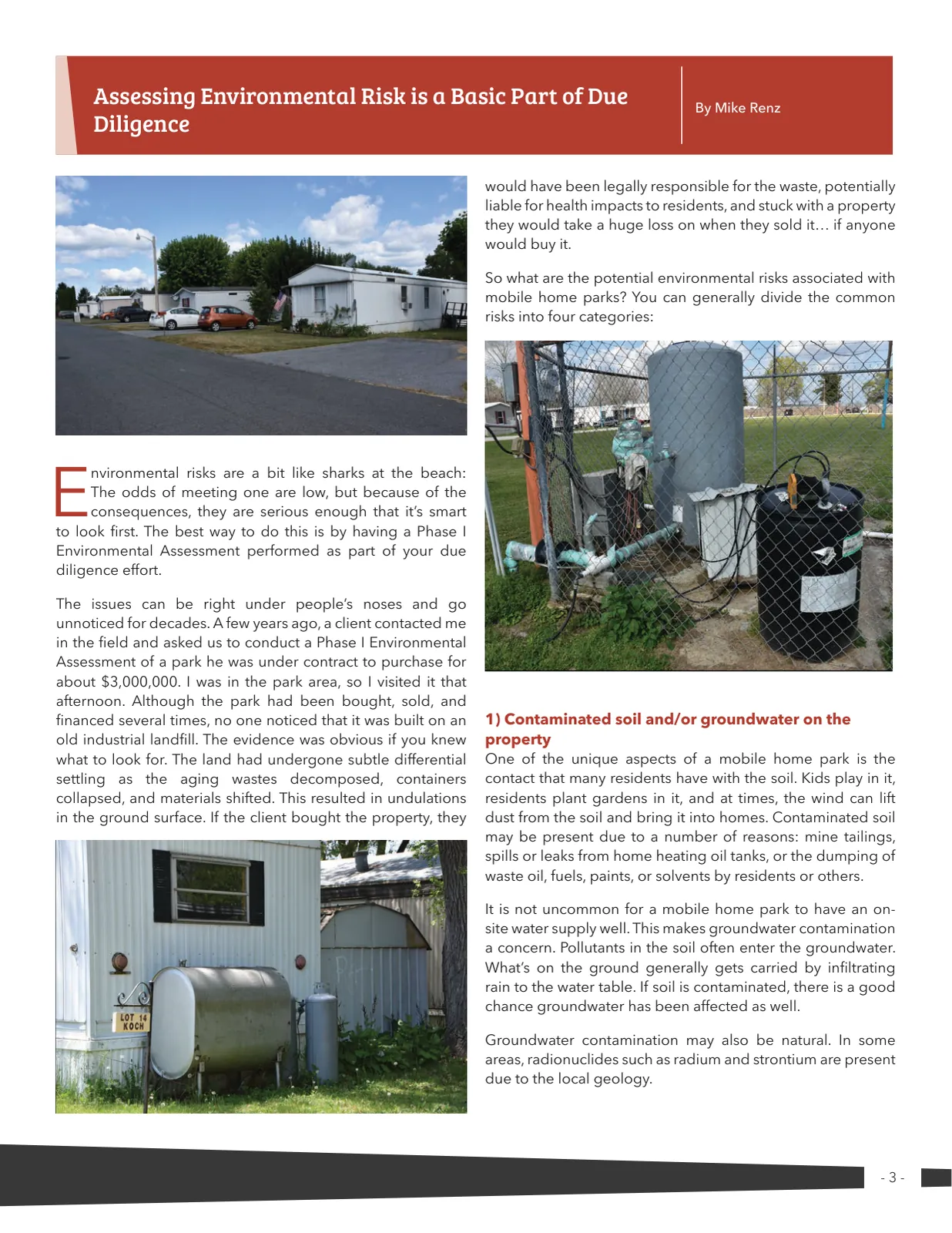
The issues can be right under people’s noses and go unnoticed for decades. A few years ago, a client contacted me in the field and asked us to conduct a Phase I Environmental Assessment of a park he was under contract to purchase for about $3,000,000. I was in the park area, so I visited it that afternoon. Although the park had been bought, sold, and financed several times, no one noticed that it was built on an old industrial landfill. The evidence was obvious if you knew what to look for. The land had undergone subtle differential settling as the aging wastes decomposed, containers collapsed, and materials shifted. This resulted in undulations in the ground surface. If the client bought the property, they would have been legally responsible for the waste, potentially liable for health impacts to residents, and stuck with a property they would take a huge loss on when they sold it… if anyone would buy it.
So what are the potential environmental risks associated with mobile home parks? You can generally divide the common risks into four categories:
1) Contaminated soil and/or groundwater on the property
One of the unique aspects of a mobile home park is the contact that many residents have with the soil. Kids play in it, residents plant gardens in it, and at times, the wind can lift dust from the soil and bring it into homes. Contaminated soil may be present due to a number of reasons: mine tailings, spills or leaks from home heating oil tanks, or the dumping of waste oil, fuels, paints, or solvents by residents or others.
It is not uncommon for a mobile home park to have an on-site water supply well. This makes groundwater contamination a concern. Pollutants in the soil often enter the groundwater. What’s on the ground generally gets carried by infiltrating rain to the water table. If soil is contaminated, there is a good chance groundwater has been affected as well.
Groundwater contamination may also be natural. In some areas, radionuclides such as radium and strontium are present due to the local geology.
2) Off-site sources of soil and/or groundwater contamination
Contamination can move underground and migrate into a park from an adjoining property or even a more distant source.
We have seen mobile home parks impacted by contaminants migrating from airfields, military installations, factories, gas stations, farmers’ cooperatives, dry cleaners, and landfills. Additionally, contaminants in the form of vapors also move around through soils and cross property lines.
3) Operational Units
Functional parts of a park, such as water supply wells, wastewater treatment plants, and home heating oil tanks, pose risks in more than one way. When these types of units fail, they can pollute soil and/or groundwater. Additionally, they are regulated. Failing to meet current regulatory standards can result in significant financial losses.
4) Legacy Wastes
Owners and residents often collect hazardous waste. These are left behind when the park is sold or a resident moves out. The materials can range from waste oil, paints, and fuels to pesticides, solvents, and unidentified materials. Improper disposal or mishandling can result in legal and financial burdens for the new owners.
Know what you are buying
Environmental risk is not always apparent, but often serious. Mobile home parks are highly valuable and typically highly productive investments. However, environmental liabilities can range from diminishing a park’s value to regulatory entanglements and toxic tort lawsuits. Environmental assessments are as much a part of due diligence as financial audits, engineering evaluations of on-site wastewater treatment plants, land surveys, and property condition evaluations.
The Risk of Employing Humans: Sexual Abuse and Molestation Danger
Any Manufactured Home Community (MHC) owner recently seeking to finance or refinance a property is well-versed in Sexual Abuse and Molestation (SAM) risk, SAM insurance coverage, and costs. While these claims remain rare in for MHC operators, they are a stealth nuclear bomb of liability that has financially crippled businesses, schools, and non-profits.
During a visit with a rare underwriter that writes SAM coverage, I asked him what worried them the most. Here’s his answers and my risk reduction recommendations for each:
Workers in remote or unsupervised locations
Employ and Contract Workers in a business entity (LLC etc.) that’s separate from the entity that owns your valuable real estate and assets. Manage, employ, and contract via a separate business entity.
Place cameras in work areas. Advise employees the cameras are there to protect them and the company.
Have virtual office software for all company computers. Here, workers stay logged in all day. Management can see who’s at their desk and virtually enter their offices any time. Examples are Gather.town and Sococo.com
Workers entering tenant occupied residences
All workers who enter rental homes must be screened for prior sexual offenses.
Workers must never enter homes occupied by children when no adult is present.
Use and follow all the protocols noted on Mobile’s Performance Agreement for Rental Home Contractors found at MobileAgency.com / Forms Tab.
Avoid Day Care, After School Programs and Short Term Rentals
If these are truly necessary for your residents, have them owned and operated by insured third parties. Short term rentals are often where unapprovable tenants congregate.
Kurt Kelley is the President of Mobile Insurance, an agency specializing in insurance for manufactured home communities and retailers. Named top commercial insurance agency by American Modern Insurance Group. Member of numerous insurance companies’ policy development and advisory teams. One of largest manufactured home specialty agencies in the country. Founder and Publisher of the Manufactured Housing Review. Inductee into the MH Hall of Fame. [email protected]
Top Mistakes of First-Time Manufactured Home Community Owner-Operators
Owning and operating a manufactured housing community (MHC) requires a broad understanding of property management, legal compliance, and community relations. First-time and newer owner-operators often encounter avoidable pitfalls that can lead to costly disputes, legal problems, and operational headaches. The following are some of the most common mistakes a new MHC owner-operator may make both before and after an acquisition and how to avoid them.
Conducting Inadequate Due Diligence
Before purchasing an MHC, conduct thorough due diligence, particularly regarding land use and zoning. Many manufactured housing communities were established before modern zoning ordinances and are therefore categorized as non-conforming uses. While the law generally permits an owner-operator to continue a lawful non-conforming use, an owner-operator typically cannot expand or change that use. Before buying an MHC, a purchaser should confirm whether the community is a non-conforming use and understand the city or county’s position on key issues regarding MHCs, such as whether the city or county permits home replacements or lot expansions. Obtaining an ALTA survey and speaking with local authorities early in the process can save significant time and money and provide an owner-operator with greater clarity prior to closing. If a city or county does not honor the non-conforming use rights, the owner-operator may need to hire an attorney to enforce them, potentially through litigation, which is costly.
Failing to Understand State and Local Laws During the Due Diligence Period & Beyond
New owner-operators must understand the applicable state and local laws governing MHCs, including general landlord-tenant law.
Purchasers should retain an experienced MHC attorney to review all existing leases during the due diligence period prior to closing. An owner-operator must understand the basic economic terms and legal structure of the existing leases. In many states, a landlord can be held liable simply for having unlawful provisions in a lease, even without enforcing such provision. Reviewing the leases and making any necessary amendments to conform with state law before or immediately following closing sets an owner-operator up for success from day one.
Additionally, every state, and sometimes every city or county, has different requirements regarding rent increase/rent control, maximum late fees, and the required duties of landlords and tenants. Some jurisdictions even impose specific obligations of MHC owner-operators and landlords at the time of acquisition. For example, Iowa Code Section 562A.12(5) requires that tenants receive notice of a transfer of their rental deposit and the name and address of the transferee of such rental deposits. Failing to comply with requirements like these can expose an owner-operator to liability from the very start. An experienced MHC attorney can help an owner-operator understand their duties and obligations both during the acquisition process and upon ownership.
Neglecting to Build Strong Relationships
Successful MHC ownership depends on strong relationships both inside and outside of the MHC community. New owner-operators should get involved in the MHC community to learn best practices and create connections with MHC-specific vendors and suppliers. A new owner-operator can create a strong community in the following ways:
First, have a capable local property manager trained in the applicable state and local laws and skilled in customer service in place from day one. A good manager is the face of the community and essential to smooth day-to-day operations.
Second, build connections with local government officials. Developing relationships with city and county inspectors, city council members, and state representatives can prove invaluable when navigating regulatory issues or seeking support for community improvements.
Third, become a member of your statewide MHC association. These organizations offer access to local resources, networking opportunities with colleagues, and connections to vendors who specialize in the manufactured housing industry. The relationships and knowledge gained through association membership can provide a significant competitive advantage, and ultimately a better experience for your tenants.
By avoiding these common mistakes, first-time and newer MHC owner-operators can position themselves for long-term success in the MHC industry.
If you have questions regarding this article, please contact Jodie McDougal at 515.242.8971 or [email protected].
THIS ARTICLE DOES NOT PROVIDE LEGAL ADVICE. The materials in this article have been prepared by Fredrikson & Byron, P.A. and its consulting subsidiaries for informational purposes only. For more information, visit www.fredlaw.com/disclaimer.
Changes Are Coming for Texas Cities in Fall 2026
Significant changes are coming for many Texas cities regarding manufactured housing. On September 1, 2026, a new law takes effect through S.B. 785, which was passed during the 2025 Texas Legislative Session as TMHA’s top legislative priority.
Texas Cities Impacted
The new law will affect Texas cities that currently ban manufactured homes, do not provide actual locations on their zoning maps for the by-right placement of new manufactured homes, or require a special use permit process that applies only to manufactured homes. TMHA estimates that more than one-third of Texas’s 1,200-plus cities will need to update their zoning ordinances and maps to comply.
Anticipated and Recommended Action
As cities become aware of the coming legal mandate, many are likely to begin drafting new ordinances and revising zoning maps in the months leading up to September 2026. Others may not fully recognize the impact until the new law is directly brought to their attention.
This creates a unique opportunity for the manufactured housing industry. Between now and September 2026, industry professionals can engage locally as a positive force for practical change, advocating for reasonable updates that allow new manufactured homes in areas where they were previously prohibited. But that effort will not happen on its own. It will require local stakeholders to step forward, engage with city leaders, and advocate for their businesses, customers, and communities. If the goal is to open new areas and expand the market, the responsibility to help drive that change starts at the local level.
TMHA’s Help for You
TMHA helped pass the law that begins this process, but implementation at the local level now depends on industry engagement across Texas.
To further support this effort, TMHA has created several resources for members and stakeholders. These include a concise summary of what the new law requires, a frequently asked questions guide, and more than two dozen links to summaries, legal analysis, ordinance tracking, advocacy articles, data, useful statistics, and related resources. These materials are available through the SB 785 Resource Center (www.texasmha.com/sb785).
TMHA is also launching multiple awareness efforts across various platforms and publications. In addition, with support from Champion Homes, TMHA will bring a home to the 2026 Texas Municipal League Annual Conference, where thousands of attendees — including city staff, land-use officials, planners, and elected leaders — will have the opportunity to tour a modern manufactured home firsthand.
A Rare Opportunity to Open New Markets
We stand at the beginning of a real opportunity. The law TMHA helped pass can spark the conversations and local policy changes needed to open new markets and expand housing opportunities. It is a chance to bring today’s modern manufactured homes into areas where they have long been excluded and, in the process, begin changing outdated and often negative perceptions. Few things change minds faster than showing skeptics what our industry is building today.
This law should be the catalyst for thoughtful local conversations about how specific home types, price points, sizes, and elevations can fit appropriately within specific parts of a city. These are the same cities where we live, work, raise families, attend church, shop, and stand alongside our neighbors, and fellow Texans.
Now is the time for action and engagement. Now is the time for reasonable cooperation, practical solutions, and constructive advocacy that addresses concerns while disproving misconceptions. This opportunity should not be squandered. Just as importantly, it should not be approached carelessly. The industry must avoid trying to place homes under the new law that are not a good fit for the community and could set progress back for years.
Instead, we must be thoughtful, honest, and reasonable. We must place homes under this new law that we are proud to stand in front of with city leaders, neighborhood residents, and, most importantly, the families who will call them home.
We take pride in what we build. Our buyers take pride in the homes they choose. Now it is time to share that pride, build on it, expand our markets, and bring more housing opportunities to Texans.
Pendleton has worked for the Texas Manufactured Housing Association (TMHA) for nearly 20 years. He became the Executive Director in 2008, the position he still holds today. TMHA is an industry member trade association primarily focused on state level legislative advocacy on behalf of the manufactured housing industry. Over the last 20 years, and eight Texas Legislative Sessions, TMHA has successfully advocated and helped pass more than 25 bills, while defending against hundreds more on behalf of the industry. Pendleton is licensed to practice law in Texas. He’s education background: undergraduate and master’s degrees in accounting from Texas A&M University, and a juris doctorate law degree from Baylor Law School.
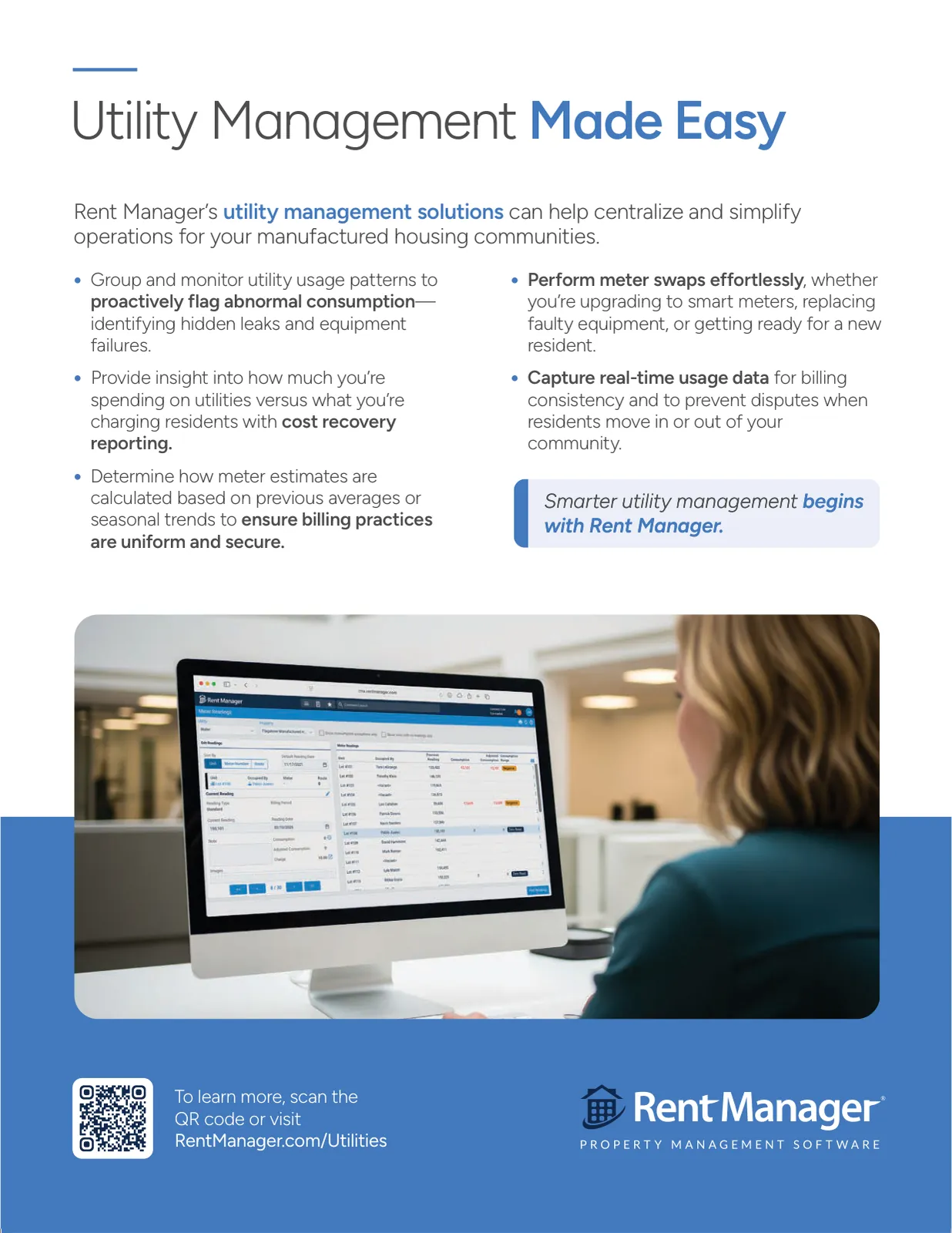
Utility Management Made Easy
Rent Manager’s utility management solutions can help centralize and simplify operations for your manufactured housing communities.
• Group and monitor utility usage patterns to proactively flag abnormal consumption— identifying hidden leaks and equipment failures.
• Provide insight into how much you’re spending on utilities versus what you’re charging residents with cost recovery reporting.
• Determine how meter estimates are calculated based on previous averages or seasonal trends to ensure billing practices are uniform and secure.
To learn more, scan the QR code or visit RentManager.com/Utilities
• Perform meter swaps effortlessly, whether you’re upgrading to smart meters, replacing faulty equipment, or getting ready for a new resident.
• Capture real-time usage data for billing consistency and to prevent disputes when residents move in or out of your community.
Smarter utility management begins with Rent Manager.
Note Sales: The Next Frontier in Mobile Home & RV Park Transactions
For decades, the mobile home and RV park business has mostly been about dirt.
Who owns the land?
What is the lot rent?
How many pads are occupied?
What is the cap rate?
What is the upside?
And all of that still matters. At the end of the day, this is still a real estate business.
But as the industry matures, the next wave of opportunity may not just come from understanding the real estate. It may come from understanding the paper behind it.
I’m talking about note sales.
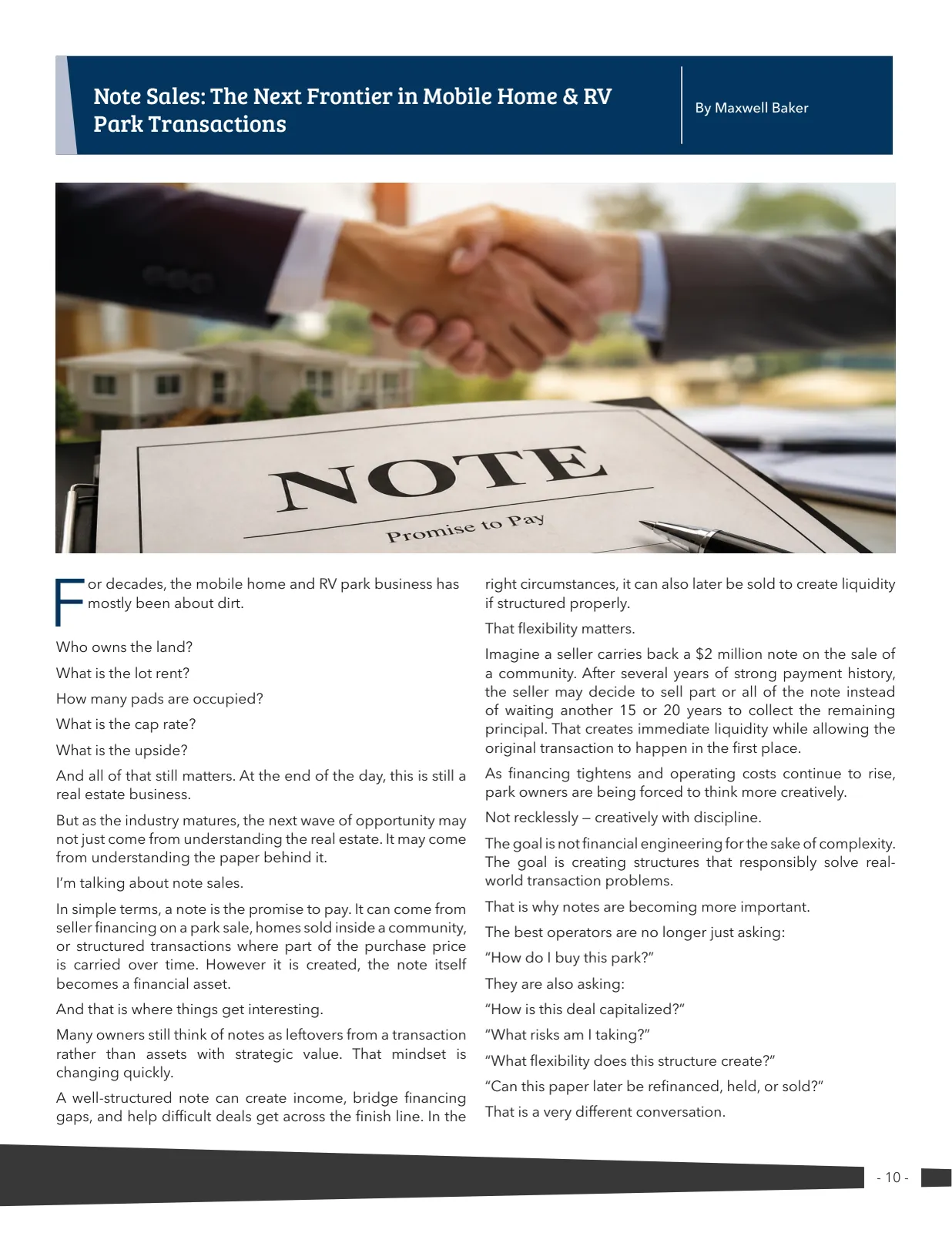
In simple terms, a note is the promise to pay. It can come from seller financing on a park sale, homes sold inside a community, or structured transactions where part of the purchase price is carried over time. However it is created, the note itself becomes a financial asset.
And that is where things get interesting.
Many owners still think of notes as leftovers from a transaction rather than assets with strategic value. That mindset is changing quickly.
A well-structured note can create income, bridge financing gaps, and help difficult deals get across the finish line. In the right circumstances, it can also later be sold to create liquidity if structured properly.
That flexibility matters.
Imagine a seller carries back a $2 million note on the sale of a community. After several years of strong payment history, the seller may decide to sell part or all of the note instead of waiting another 15 or 20 years to collect the remaining principal. That creates immediate liquidity while allowing the original transaction to happen in the first place.
As financing tightens and operating costs continue to rise, park owners are being forced to think more creatively.
Not recklessly — creatively with discipline.
The goal is not financial engineering for the sake of complexity. The goal is creating structures that responsibly solve real-world transaction problems.
That is why notes are becoming more important.
The best operators are no longer just asking:
“How do I buy this park?”
They are also asking:
“How is this deal capitalized?”
“What risks am I taking?”
“What flexibility does this structure create?”
“Can this paper later be refinanced, held, or sold?”
That is a very different conversation.
Notes also force better deal structure from day one. If a note may eventually be sold, documentation, collateral quality, servicing, borrower strength, and payment history suddenly matter a lot more.
A sloppy note limits future options.
A clean note creates them.
Of course, not all paper is good paper. Weak underwriting, poor documentation, or unrealistic leverage can quickly turn a note into a problem instead of an asset. Like any financial instrument, discipline matters.
That is one reason why note knowledge increasingly separates sophisticated operators from casual investors.
Anybody can talk about cap rates. Far fewer people understand how paper is priced, how risk is discounted, or how note buyers evaluate opportunities.
That knowledge is becoming more valuable as the industry evolves.
This is not about turning every park owner into a Wall Street bond trader. The point is simply that value can exist in more than one place.
It can exist in the land.
It can exist in the operations.
And it can exist in the paper itself.
The operators who understand all three will have more tools available to them — more ways to structure deals, create liquidity, bridge valuation gaps, and think strategically about exits.
The dirt still matters. It always will.
But the next era of mobile home and RV park dealmaking may belong to the people who understand both the real estate and the paper attached to it.
Maxwell Baker is the President of The MHP Broker, a specialty Real Estate brokerage focusing Manufactured Home and RV Parks. You can reach Max at [email protected].
Unlock potential in every property.
For 25 years, we’ve remained the only property management software partnering exclusively with manufactured housing.
Learn More
Finance Your Community Purchase Utilizing Advocates and the Winning Method
Now that you have found the perfect mobile home community to buy, you are going to need to procure financing. The financing process is not hard, but there are many steps involved which take time, and you need to know how to navigate the process.
The highest likelihood of success in financing your community will be by utilizing my WINNING METHOD. This technique involves finding and using an Advocate who will guide you through the process for your commercial loan request.
Why You Need An Advocate
You need an Advocate who know the loan approval process and can guide you through it.
The Advocate knows the players, the culture, and personalities of those people approving your loan. He is an insider who knows the inner workings of the bank.
Every bank has a credit culture. A credit culture is a bank’s rules, procedures, and emotional criteria for making decisions on what loans it approves. The culture is typically established by an significant person inside the bank, such as the owner, president, or the chairman of the board. The significant person is the Lynchpin. You likely have very little idea who the Lynchpin is, and won’t get an opportunity to speak to him or her. The Lynchpin will be part of the process of approving or denying your loan. Only your Advocate can win over the Lynchpin. The Lynchpin will likely have a credit committee, which is a group of people inside the bank which will discuss, analyze, and approve or deny your loan.
What The Advocate Does
The Advocate needs to be able to
1. Understand your deal
2. Be an expert on your deal
3. Explain it to the Lynchpin
How To Succeed Using Your Advocate
In order to employ the Winning Method, you need to be completely upfront with your Advocate. Don’t sugarcoat your deal. Explain the good details, which led to your placing it under contract, but also explain the risk points. The risk points are going to come out at some point anyway, so it is better to explain it upfront. That way, the Advocate can decide how to deal with it. Don’t try to hide anything. Again, it will all come out through appraisals, environmental reports, inspections, and public records search. If you found out about it, the bank will too.
Being upfront also allows you to control the narrative. For example, let’s suppose you are purchasing a great community that just happens to sit at the end of the main runway of a major airport. When the credit committee looks at the location map of your community (and they will), they are going to give a thumbs down on the location, because none of them could fathom living next to a runway.
However, you are going to tell your advocate why being next to the runway is a good thing:
“Yes, it’s right next to the runway where planes take off every 45 seconds, but that airport is the largest employer in town, and a huge number of our residents work there. They love the location and being able to get home from work in under five minutes.”
You just turned a negative into a positive.
Mitigate The Weaknesses
Another key point is to mitigate any weaknesses of the deal. Every mobile home park has a weakness. The blue suits at the bank love to point out all the bad things about your property, and the worst things that could happen (“what if that airport shuts down??? You’ll be ruined!. What if a plane crashed into the mobile home park! He won’t re-pay the loan!).
Once I when I was young and naïve, I was presenting a loan request to the credit committee for a business near Fort Bragg. The Chairman (Lynchpin) pointed out, “that business will be ruined if they close down that military base at Fort Bragg!” Unfortunately, I had not done enough homework, and I failed to realize that my customer’s property was located NOT near the biggest U.S. Army base in Fort Bragg, North Carolina, but near the beach community of Fort Bragg, California (known for its beautiful beaches filled with sea glass). I almost blew that one, but thankfully the loan still went through.
A big weakness that is hard to get over is the first time buyer. Experience is a hard thing to make up for. I have financed first time community buyers, but they need to demonstrate why they can still make the business plan work. Things that can help are: other real estate investing experience, being a real estate broker, having attended Mobile Home University (www.mobilehomeuniversity.com), and having been an investor with other experienced MHC investors.
Have A Good Story
When you tell your Advocate about your park, you had better lead off with a great story. A boring story fails to stir the hearts of men. The credit committee sees hundreds of loan request a year. Yours needs to stand out and be interesting. For example, you might have a intriguing story about how you found the opportunity: you scoured the public records for owners of mobile home parks on your nights and weekends. Then you tracked down the owner using reverse lookup, you cold-called until you got a hold of them. Then you spent every Sunday playing shuffleboard with them until they agreed to sell to you.
Credit committee members love to live vicariously through their borrowers. The better the story, the more likelihood of success. You want them to fell like they wish they had found the opportunity. And make sure you explain why it is an opportunity. Any fool can find a mobile home park for sale. Explain why yours is a “special situation.”
Here are some detailed points that you should be able to present to your advocate (who will present to the Credit Committee).
1. How did you find the opportunity? (you cold called 1,200 community owners, you stopped by and spoke with the owner every Sunday afternoon for three years, etc.)
2. What do you like about it? (the rents have not been raised in 10 years, there is zero delinquency, there is a new factory being built in town)
3. Why do you think you will become rich off of it (You’ve done this before, and I can implement my business plan with my eyes shut)
4. Why the opportunity is exciting to you (You own a park ten miles away, and have been enormously successful).
SUBSCRIBE!
Be An Expert
You must be able to answer every question that the Advocate, underwriter, credit officer, or credit committee may ask. You must also be able to answer the questions that they don’t ask but they might ask. Be prepared. Know everything about your community (and your other communities). If your other communities aren’t doing well, that could be a red flag in the eyes of the credit committee.
Find And Pick Your Advocate
How do you find your advocate? Just like anything in life, you will get out what you put into it. Similar to how you spent significant time finding and analyzing your MHC deal, you will need to spend time finding your Advocate.
This will be a long-term relationship. Hopefully you will be doing multiple deals together, so you will need to make a commitment. You will be in a relationship for the length of the loan term, at the very least.
Your ideal advocate is a Vice President or above at a bank, and has been there at least a few years. The longer the better. Your second option is a loan broker that comes highly recommended from some other MHC operator. They must have experience in the asset class you are trying to purchase. Don’t use a hotel loan broker to place your MHC deal.
Your financing should go smoothly by understanding the loan approval process and utilizing an Advocate.
R. Scott MacNeil has been in commercial lending for over twenty years. He has attended hundreds of loan committee meetings, and approved loans for such interesting things as casinos, cattle, martial arts studios, planes, a 1927 Boeing Stearman, tax certificates, mosques, synagogues, churches, pianos, and of course mobile home parks. Scott is currently the Chief Executive Officer at PEPlending.com, a direct lender for mobile home parks and other things.
Manufactured Housing Review Magazine
www.manufacturedhousingreview.com [email protected]
Know Your Other Partner: Why MHC Owners Can’t Ignore the Statehouse
Consider this: as a manufactured housing community (MHC) owner-operator, who truly sets the rules for your community? While the immediate answer may be you, the reality is you have an unchosen partner with a significant voice in your organization’s operations: state and local government.
While national media and public interest centers on the federal government—President, Congress, and the U.S. Supreme Court—MHC owner-operators must maintain a critical focus on state and local authorities. In many ways, these local and state bodies hold the decisive power over critical business issues: how and when lot rent can be adjusted, the process for initiating real estate transactions without burdensome regulation, and the ability to address problematic residents.
You would never ignore a business partner who holds such control. The same communication imperative applies to state and local government officials, including both elected leaders and professional staff.
Since 2019, state governments have taken aggressive regulatory actions against MHC owner-operators. Several Democrat-led states have enacted rent control measures, and others now permit residents to inject themselves into the community sales process, aiming to slow transactions or stop them entirely.
While these developments are troubling, this assault on free enterprise is a predictable move by certain political actors. More concerning, however, is the growing number of free market-oriented state legislators across America who now believe the industry requires more regulation to protect residents from community owners.
Community owners must proactively engage to safeguard their organizations against adverse legislative actions. The following steps are crucial for effective government relations:
1. Get Organized through your State MHA: There is an unbelievable network of state manufactured housing associations around the country. They are your first line of defense against government overreach that could negatively affect your investments. Join the association. Get invited in the association, and gain a firm understanding of the political environment in your state capitol.
2. Develop and Cultivate Direct Relationships with Lawmakers and Staff: Proactive engagement and relationship-building with both elected officials and professional staff are essential to ensuring the industry’s concerns are heard. This includes being willing to participate in meetings with legislative leaders and the governor’s team to discuss the real-world policy impacts on our industry. The vast majority of MHC owner-operators are good actors providing much needed affordable housing opportunities in their states. We should not be afraid to tell our stories.
3. Provide Data and Educate Local Officials to Help them Understand your Business: The vast majority of state legislators are considered citizen legislators, meaning they are not professional politicians. They may not have experience in the multi-residential or manufactured housing space. Support advocacy efforts by gathering and sharing practical information, such as operational estimates of what percentage of your lot rent goes toward property tax burden, which has been shown to be around 10–11 percent in some cases. This proprietary data is vital for countering misinformation and educating policymakers about the manufactured housing industry’s financial realities and misconceptions.
4. Fund Dedicated Advocacy Through the PAC:
Contribute consistently to the industry’s Political Action Committee (PAC). These funds are critical for engaging with policymakers and influencing legislation at the highest levels, enabling the industry to advocate for favorable regulations and fight against harmful policies.
5. Understand and Shine a Light on the Other Side: While some of those advocating for reforms in manufactured housing are well-intentioned residents, financial and institutional support often comes from organizations outside the industry who want to penalize entrepreneurs and business interests for their success. Policymakers need to know that those who often advocate for manufactured housing reforms are often doing so as part of a larger agenda to counter to free enterprise and a strong business environment.
Advocacy, like partnership, is not a spectator sport. The most important thing any MHC owner-operator can do to influence public policy is to get involved in the process.
When Wastewater Becomes a Growth Strategy for Manufactured Housing Communities
Manufactured housing communities across the United States are facing a familiar challenge: demand for affordable housing continues to grow, but infrastructure limitations often stand in the way of expansion.
While conversations about community growth typically focus on land acquisition, occupancy rates, financing, and zoning, one critical piece of infrastructure is frequently underestimated until it becomes a problem: wastewater treatment capacity.
For many community owners and operators, wastewater is no longer just a utility concern. It has become a strategic factor in determining whether a property can expand, improve profitability, or remain compliant in an increasingly regulated environment.
According to the Manufactured Housing Institute, there are approximately 43,000 manufactured housing communities nationwide. An estimated 20 to 30 percent are not connected to municipal sewer systems and instead rely on onsite wastewater treatment solutions. In many rural or developing areas, municipal sewer access is either unavailable, prohibitively expensive to extend, or limited by aging infrastructure that lacks the capacity for additional connections.
As a result, onsite wastewater systems are becoming increasingly important to the future growth of manufactured housing communities.
Expansion Starts with Infrastructure
Today’s manufactured housing market is largely acquisition-driven. Operators are purchasing adjacent land, filling vacant pads, redeveloping aging communities, and looking for opportunities to increase density where possible.
But before expansion plans move forward, owners need to understand whether their existing wastewater infrastructure can support growth.
Too often, wastewater systems are evaluated late in the process, after land has already been acquired or development plans are underway. That approach can create expensive surprises, delays in permitting, or limitations on occupancy.
Instead, successful projects begin with infrastructure due diligence early in the planning process.
That starts by assembling the right team. A strong project team may include a local engineer, system operator, soil or geotechnical specialist, regulatory officials, and a wastewater treatment manufacturer familiar with community-scale systems.
The goal is not simply to install a treatment system. The goal is to develop a long-term infrastructure strategy that supports both current operations and future expansion.
Planning for Scalable Growth
One of the most important considerations in wastewater planning is scalability.
Many manufactured housing communities do not expand all at once. Growth often happens in phases as additional homesites are developed or occupied over time. Wastewater infrastructure should be designed with that reality in mind.
A scalable system allows owners to add treatment capacity as the community grows, reducing upfront costs while minimizing future disruption to residents and operations.
Understanding projected flow rates is also essential. Existing water usage records can help estimate current demand, while local regulations typically establish design flow requirements on a per-home basis.
Site conditions matter as well. Soil characteristics, groundwater levels, topography, and available land area all influence what type of treatment solution is most appropriate.
The right design balances performance, regulatory compliance, operational simplicity, and long-term cost efficiency.
Choosing the Right Treatment Approach
There is no universal solution for every manufactured housing community. The best treatment approach depends on site conditions, community size, discharge requirements, and long-term operational goals.
Traditional septic and cluster systems may work well in locations with favorable soils and lower density. However, larger communities or properties with tighter footprints often require more advanced treatment solutions.
In many cases, advanced onsite systems can achieve discharge standards that support water reuse applications such as irrigation or landscaping, helping communities improve sustainability while reducing environmental impact.
Maintenance Matters More Than Technology
Even the best-designed treatment system will fail without proper maintenance and operational oversight.
Community owners should prioritize systems that are both reliable and manageable over the long term. Routine
inspections, scheduled pumping, monitoring equipment, and emergency planning all play an important role in protecting system performance.
With proper planning and the right technology, onsite wastewater infrastructure can support sustainable growth, improve property value, and create opportunities for community expansion in areas where municipal sewer access is limited.
Operator requirements and compliance obligations should also be clearly understood before selecting a treatment approach. Some systems require licensed operators or ongoing sampling to meet local and state regulations.
Reliable wastewater treatment also directly contributes to resident satisfaction by supporting a clean, safe, and well-managed living environment.
Low-maintenance systems that simplify operations while maintaining compliance can significantly reduce risk and operating costs over time.
As demand for affordable housing continues to increase, communities that proactively invest in resilient infrastructure will be better positioned for long-term success.
Wastewater as a Long-Term Asset
For years, onsite wastewater systems were often viewed as obstacles to development. Today, they are increasingly becoming part of the solution.
More questions, please contact: · [email protected] or 443 871 8449 · www.anua-us.com
Special INSURANCE PROGRAMS with Industry Leading Value
Manufactured Home Retailers Manufactured Home Community Owners
INSURANCE MOBILE
800-458-4320 800-458-4320
Call or email today for a free consultation
Protect your Investments
• Retailers • Communities • Developers • Transporters • Installers
800-458-4320 [email protected]
Kurt Kelley - President
Forget About the Federal Reserve. The Future Of Mortgage Rates Rests with Scott Bessent and the Treasury
There’s nothing more frustrating than the ex-Jerome Powell’s Federal Reserve – or as impotent when it comes to reducing interest rates. Once an important group, it became nothing but a quagmire of Trump Derangement Syndrome and infighting among bureaucrats with zero real-world experience.
But don’t despair if you are hoping for lower mobile home park mortgage rates, as the future of lower rates is all about Trump ally Scott Bessent and the U.S. Treasury. And his power to reduce rates dwarfs the Federal Reserve’s potential.
Here’s what AI has to say about it:
While setting the benchmark federal funds rate is strictly the job of the Federal Reserve, the U.S. Treasury Department can take several powerful, independent actions to lower market interest rates and bond yields.
Rather than altering monetary policy, the Treasury achieves this by changing the supply and demand of its debt issuance, directly shifting market liquidity.
1. Shift Debt Issuance to Short-Term Bills (“Billnanza”)
The Treasury controls the maturity mix of the national debt. If it wants to lower long-term interest rates (like the 10-year Treasury yield, which heavily dictates mortgage and auto loan rates), it can reduce the issuance of long-term bonds and increase the issuance of short-term Treasury bills (T-bills).
How it lowers rates: Decreasing the supply of long-term bonds makes them scarcer. Higher demand for fewer bonds drives their prices up and forces their yields (interest rates) down.
2. Utilize the Treasury Buyback Program
The Treasury conducts an official Buyback Program. This allows the department to use its cash balances to buy back older, less-liquid, or undervalued government debt directly from the market.
How it lowers rates: By actively steping in as a major buyer of its own debt, the Treasury injects cash back into financial markets and applies downward pressure on bond yields, mimicking a localized version of Quantitative Easing (QE).
3. Drain the Treasury General Account (TGA)
The TGA is the Treasury’s operational cash account held at the Federal Reserve. Instead of issuing new debt to pay for government spending, the Treasury can choose to deliberately draw down the cash balance in the TGA.
How it lowers rates: Spending cash directly out of the TGA pushes massive amounts of liquidity into the private banking system. This surge in bank reserves lowers short-term lending stress and puts downward pressure on broader market interest rates.
4. Direct Visual: Treasury Action vs. The Yield Curve
By changing its debt issuance behavior, the Treasury can selectively lower interest rates at different parts of the maturity spectrum (known as flattening or shifting the yield curve): [1, 2]
5. Push for Regulatory and Capital Rule Relief
The Treasury Secretary chairs the Financial Stability Oversight Council (FSOC) and maintains massive influence over banking regulators. The Treasury can advocate for modifying banking rules—such as exempting U.S. Treasuries from the Supplementary Leverage Ratio (SLR).
How it lowers rates: If banks aren’t penalized with heavy capital requirements for holding government debt, commercial banks will buy far more Treasuries. This massive influx of private institutional demand forces interest rates lower.
Those looking to the Fed to lower rates are not looking in the right direction. Trump knows that there are not enough votes to lower rates among the Fed members and has given up on that option. Watch for Scott Bessent to make his move after the midterms are over (or beforehand if necessary).
The late Sam Zell always said “when everyone is looking left, look right”. Here’s yet another example of that – courtesy of MHU.com.
Frank Rolfe has been an investor in mobile home parks for over three decades, and has owned and operated hundreds of mobile home parks during that time. He has ranked, with his partner Dave Reynolds, as high as the 5th largest mobile home park owner in the U.S., with over $1 billion worth of mobile home parks. Along the way, Frank began writing about the industry, and his books and educational programs on community acquisition and management became among the best-selling in the business. To learn more about Frank’s insights and expertise, visit www.MobileHomeUniversity.com.
Statutory Rights of First Refusal (New York Real Property Law Section 233-A)
A seller contemplating the sale of its property should always consider whether a right of first refusal may impact the sale and determine how it needs to be addressed at the outset, particularly as statutory rights of first refusal become more prevalent in certain jurisdictions.
Under New York Real Property Law Section 233-a, for example, homeowners in New York’s manufactured home parks now have a statutory right of first refusal when a park is offered for sale, marketed, or a bona fide third-party offer is received that the park owner intends to accept or counter. Sellers and prospective purchasers of manufactured home parks in New York must anticipate a resident-led purchase effort that can impact a potential deal.
Every purchase agreement for a manufactured home park in New York is automatically subject to this right of first refusal, and sellers must disclose that any acceptance or counteroffer is contingent on the homeowners’ or their association’s ability to match the deal. In addition, the statute imposes notice requirements to New York State and homeowners, requiring disclosure of key sale terms and residents’ rights, while affording homeowners the opportunity to organize and form an association or cooperative to pursue the purchase of the park.
Under New York law, a park owner cannot finalize a sale until the homeowners have been given the opportunity to evaluate the proposed transaction and determine whether they want to exercise their right of first refusal within the time afforded under the statute. If homeowners elect to purchase the park through a qualifying association, the owner is required to sell the property to them rather than the third-party buyer. If the homeowners fail to timely notify and deliver a matching offer to the owner, then the owner is permitted to proceed with the sale to its third party buyer unless the owner later modifies the terms of the sale.
While the statute has broad and sweeping implications for mobile home park transactions in New York, it does contain a few key exclusions for transfers incidental to park financing or to eminent domain. Financing-driven restructurings may avoid the right, but they must be substantively tied to financing rather than a sale in disguise.
Given the statute’s broad effect, detailed timing requirements, and procedural mechanics, park owners should consult with legal counsel early in the sale process to ensure compliance and avoid unnecessary delays or complications. Some of the practical considerations for park owners relative to NYRPL §233(a) are:
Build deal calendars that incorporate the statutory notice and election periods, and draft third-party contracts with flexible closing conditions, resident-rights covenants, break-out rights, and price allocations (especially if an owner is contemplating a portfolio sale).
Prepare an offer notice package that fully tracks statutory disclosures, because defects can derail timelines and financing.
In equity or recapitalization strategies, document non-avoidance business purposes, align lender expectations, and evaluate whether the transaction could be characterized as a financing that fits the statutory exclusion.
When revising price or key terms after residents do not match, expect renewed matching rights and plan communications accordingly.
It is critical for parties to stay informed of additional legal updates and the impact that changes in legislation can have on deal terms and timelines. This article addresses New York law and manufactured home park sales. However, it’s important to always consider, in any jurisdiction, whether a sale or purchase of a manufactured home park (or any other commercial property) might be impacted by a statutory or a contractual right of first refusal; And to consult with counsel as early as possible in the process.
David C. DiMarco is a partner in the Real Estate and Finance Department at Woods Oviatt Gilman LLP. He can be reached at [email protected].
The Importance of Financial Reporting and Documentation for a Community Bank Loan
It was not that long ago that quality manufactured housing community (MHC) purchase opportunities could be found at comparatively low prices and high cap rates. If an MHC was purchased and managed properly, owners could confidently project revenue growth and increasing property values.
At that time, underwriting a community bank loan request was relatively straightforward — essentially simple math. Loan amounts were low compared to the actual value of the MHC, providing lenders with a substantial cushion to mitigate risk. In addition, historically low lot rents made it reasonable to project future rent increases and rising annual revenues, creating even more comfort for lenders.
A good story and a firm handshake could often go a long way toward securing financing. Perhaps not quite that simple, but financing was often available with a credit profile not much different from that used for a home equity loan.
However, in a relatively short period of time, MHC prices have increased dramatically. A quality 50-lot MHC that may once have sold for less than $1 million could easily command more than $3 million today — and potentially exceed $4 million in the near future.
Naturally, the loan amounts required to purchase these properties have increased as well. But the value and cap rate cushions that once protected lenders are largely gone. Cash flows are now more heavily stretched and increasingly vulnerable to ongoing economic and world events that are completely outside the borrower’s control.
And this leads to the central point of this article: larger loans are far more likely to be reviewed by bank auditors, independent loan review teams, and bank examiners — collectively referred to here as “Loan Examiners.”
When Loan Examiners review a loan file, they are not interested in simply hearing a good story from the loan officer. They want to see current financial reporting and proper documentation that verifies the borrower’s performance and supports the lender’s underwriting assumptions.
When current financial statements are missing, Loan Examiners do not assume that everything is fine. In many cases, they take the position that there is insufficient evidence the borrower is performing as expected, and the loan may be downgraded. If a borrower goes several quarters — or even years — without providing updated financials, a downgrade becomes almost inevitable.
Banks do not like downgraded loans.
For the lender, a downgraded loan can negatively impact performance reviews and standing within the bank. For the bank itself, downgraded loans can affect profitability, capital positions, regulatory relationships, and access to capital markets.
Beyond general safety and soundness concerns, Loan Examiners are also evaluating whether the bank is complying with banking laws and regulations and whether lending and collection decisions are being made fairly and consistently.
Simply operating in today’s business environment creates enough risk for loans to occasionally underperform expectations. A loan that becomes downgraded solely because a borrower failed to provide current financials and documentation is especially frustrating for banks.
As a result, banks will often choose not to renew a downgraded loan at maturity, instead requiring the borrower to either pay off the loan or refinance with another lender. Ironically, in order to refinance elsewhere, the borrower must ultimately provide the same accurate financial statements and documentation that had previously been neglected.
With all of this in mind, a borrower’s ability to produce timely and accurate financial statements and supporting documentation has become paramount in both the initial loan decision and the ongoing management of the loan.
From the very beginning of the loan request, loan officers are evaluating whether the borrower has the skills — or the third-party bookkeeping support — necessary to produce accurate historical financial statements and realistic projections. They are also considering whether the borrower understands and respects the importance of providing ongoing, timely financial reporting in the future.
The answers to those questions are now almost as important as the quality of the MHC itself.
Storytelling still has its place, but it is no longer the most important factor in either loan approval or ongoing loan management. “Trust, but verify” has become a guiding principle throughout today’s business environment.
A borrower may not have entered the business world because of a passion for bookkeeping, but they must recognize the importance of maintaining accurate records, filing tax returns and reports on time, and responding promptly when the bank
requests information. Loan amounts today are simply too large for sloppy recordkeeping.
Accordingly, it is in every borrower’s best interest to strengthen their bookkeeping capabilities — whether by investing in accounting software and learning to use it properly, or by hiring an accountant or outside bookkeeping professional to maintain accurate records and prepare reliable tax filings.
A good storyteller may make for enjoyable company at lunch or on the golf course, but ultimately, it is an accurate and reliable set of financial statements that will determine whether you are approved for a loan — and whether you are able to keep that loan for as long as you own your MHC.
Important Legal Update: Emergency Proclamation Triggers Penal Code §396
We want to make you aware that Governor Gavin Newsom has proclaimed a State of Emergency for Orange County following the recent chemical incident in the City of Garden Grove involving the release of hazardous fumes from a chemical storage tank. The proclamation was issued on May 23, 2026, and references evacuations impacting approximately 50,000 residents throughout the surrounding area.
A copy of the Governor’s Proclamation is available below for your review. As a reminder, whenever a State of Emergency is declared in California, certain consumer protection laws are automatically triggered, including California’s restrictions on price gouging and rent increases.
California Penal Code section 396 generally prohibits increasing the price of housing, lodging, food, emergency supplies, gasoline, and other essential goods and services by more than 10% following the declaration of a state of emergency. This law also applies to rental housing, including mobilehome spaces and related housing accommodations.
Specifically relating to rental housing, Penal Code section 396(e) provides in relevant part:
“It is unlawful for any person, business, or other entity, to increase the rental price, as defined in paragraph (11) of subdivision (j), advertised, offered, or charged for housing, to an existing or prospective tenant, by more than 10 percent.”
Violations of Penal Code section 396 may subject a party to criminal penalties, civil enforcement, and other remedies.
Additionally, park owners and managers should remain mindful of any local rent stabilization ordinances, rules governing utility pass throughs, and operational considerations that may arise during emergency conditions, including temporary displacement issues and communications with residents.
We encourage all community operators and managers to exercise caution before implementing any rent increases, fees, or pricing adjustments that could potentially fall within the scope of California’s anti-price gouging laws during the declared emergency period.
If you have questions regarding the State of Emergency, compliance obligations, or how these restrictions may apply to your community, please contact our office.
John Pentecost, is a Shareholder and Managing Partner of Hart Kienle and Pentecost, a California based law firm with a specialty focus on serving MHC owners and Operators. You can reach John and his team at [email protected]
And There Endeth The Park Pit Bull Parade
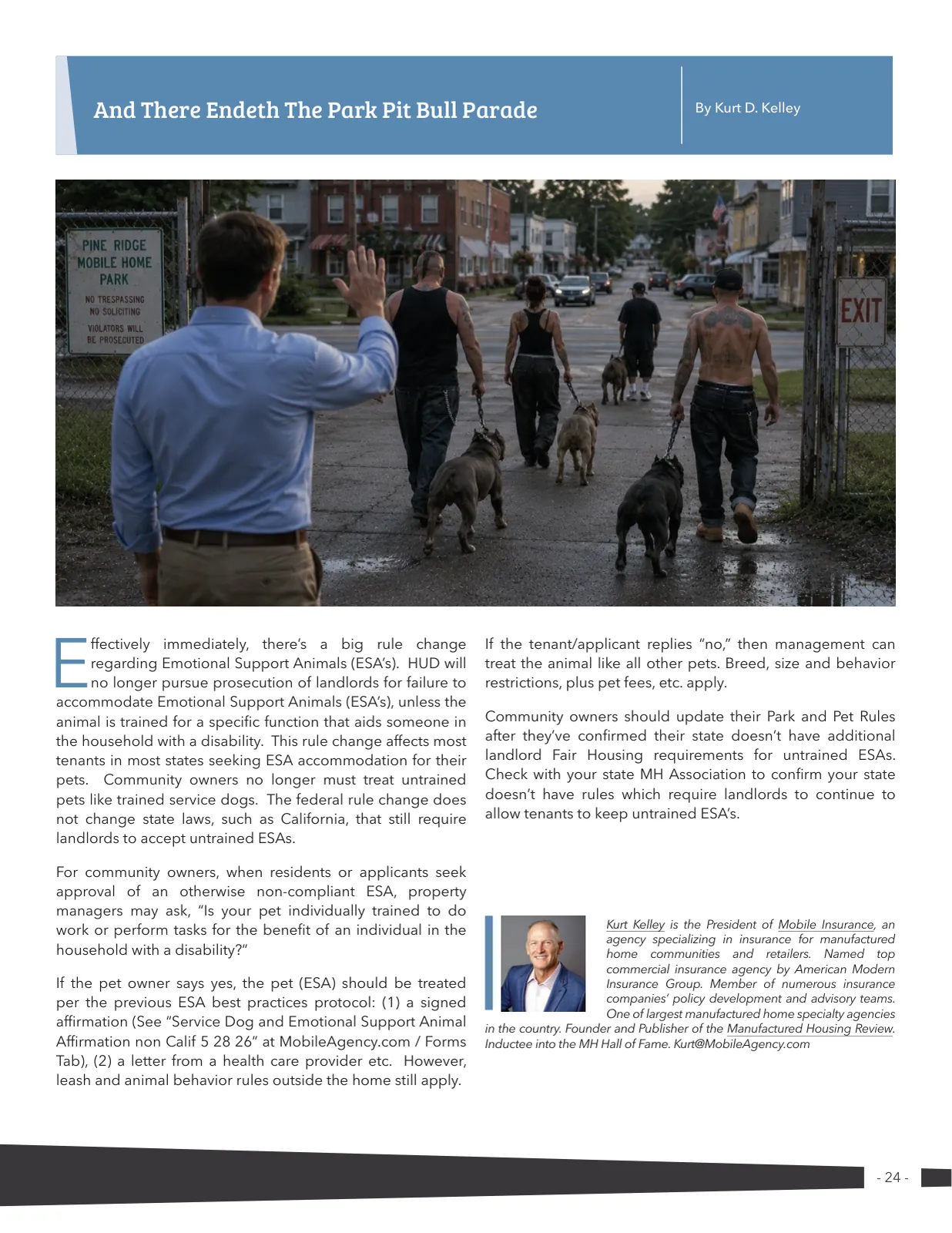
Effectively immediately, there’s a big rule change regarding Emotional Support Animals (ESA’s). HUD will no longer pursue prosecution of landlords for failure to accommodate Emotional Support Animals (ESA’s), unless the animal is trained for a specific function that aids someone in the household with a disability. This rule change affects most tenants in most states seeking ESA accommodation for their pets. Community owners no longer must treat untrained pets like trained service dogs. The federal rule change does not change state laws, such as California, that still require landlords to accept untrained ESAs.
For community owners, when residents or applicants seek approval of an otherwise non-compliant ESA, property managers may ask, “Is your pet individually trained to do work or perform tasks for the benefit of an individual in the household with a disability?”
If the pet owner says yes, the pet (ESA) should be treated per the previous ESA best practices protocol: (1) a signed affirmation (See “Service Dog and Emotional Support Animal Affirmation non Calif 5 28 26” at MobileAgency.com / Forms Tab), (2) a letter from a health care provider etc. However, leash and animal behavior rules outside the home still apply.
If the tenant/applicant replies “no,” then management can treat the animal like all other pets. Breed, size and behavior restrictions, plus pet fees, etc. apply.
Community owners should update their Park and Pet Rules after they’ve confirmed their state doesn’t have additional landlord Fair Housing requirements for untrained ESAs. Check with your state MH Association to confirm your state doesn’t have rules which require landlords to continue to allow tenants to keep untrained ESA’s.
Kurt Kelley is the President of Mobile Insurance, an agency specializing in insurance for manufactured home communities and retailers. Named top commercial insurance agency by American Modern Insurance Group. Member of numerous insurance companies’ policy development and advisory teams. One of largest manufactured home specialty agencies in the country. Founder and Publisher of the Manufactured Housing Review. Inductee into the MH Hall of Fame. [email protected]
Giving You Guidance.
Empowering you with the rental industry resources & education you need.
JOIN AAOA FOR FREE
SERVING YOU
139K
19YRS
MEMBERS
11K
REVIEWS
3M
UNITS MANAGED
Find Quality Tenants Learn
Reliable credit/background checks Option for landlord or tenant pay LeaseGuarantee to protect your rental income
Download Legal Forms
150+ Premium state-specific forms 20 Free landlord forms Attorney reviewed & customizable
Unlimited recorded & live webinars AAOA Today e-newsletter Free access to RENT Magazine
Grow Your Portfolio
Exclusive off-market listings Financing for your investments Vendor directory & discounts
AAOA.com 866.579.2262 [email protected]
MHR Event Calendar
December 1, 2026
October 21-22, 2026
2026 MHISC Winter Meeting
Arkansas Manufactured Housing Association’s
Hyatt Regency Greenville
October 21-22, 2026
Greenville, SC
Annual Meeting & Convention
https://mhisc.com/winter-2026/
Oaklawn Casino Resort
Hot Springs, Arkansas
Contact: J.D. Harper
(501) 663-8444 [email protected] [email protected]
Unlocking the Mystery of European Mobile Home Communities
News of YES Communities’ sale of its United Kingdom portfolio—approximately 50 holiday parks—to Aermont Capital for roughly $1 billion was announced in late May, shortly before my wife and I departed for a vacation in Ireland.
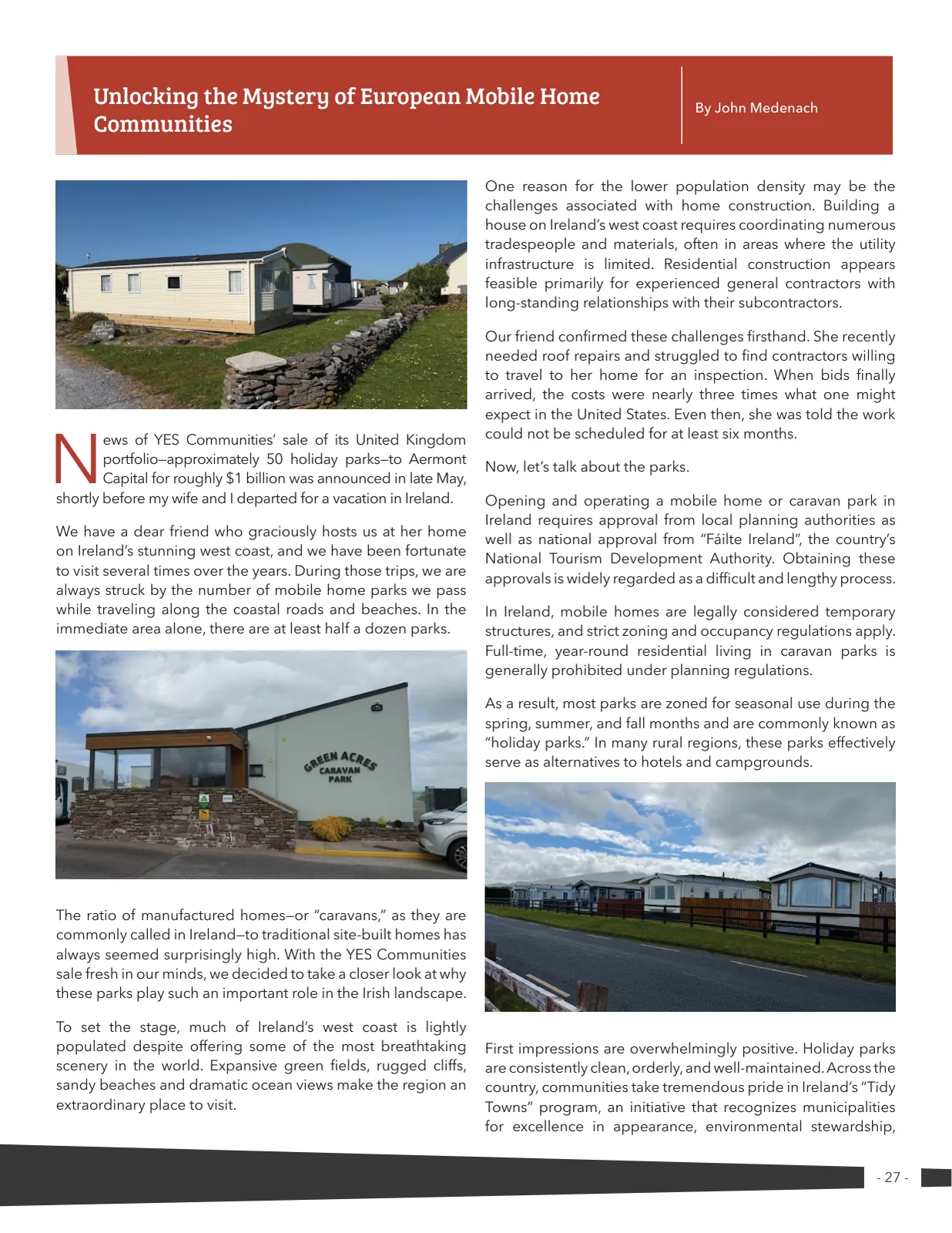
We have a dear friend who graciously hosts us at her home on Ireland’s stunning west coast, and we have been fortunate to visit several times over the years. During those trips, we are always struck by the number of mobile home parks we pass while traveling along the coastal roads and beaches. In the immediate area alone, there are at least half a dozen parks.
The ratio of manufactured homes—or “caravans,” as they are commonly called in Ireland—to traditional site-built homes has always seemed surprisingly high. With the YES Communities sale fresh in our minds, we decided to take a closer look at why these parks play such an important role in the Irish landscape.
To set the stage, much of Ireland’s west coast is lightly populated despite offering some of the most breathtaking scenery in the world. Expansive green fields, rugged cliffs, sandy beaches and dramatic ocean views make the region an extraordinary place to visit.
One reason for the lower population density may be the challenges associated with home construction. Building a house on Ireland’s west coast requires coordinating numerous tradespeople and materials, often in areas where the utility infrastructure is limited. Residential construction appears feasible primarily for experienced general contractors with long-standing relationships with their subcontractors.
Our friend confirmed these challenges firsthand. She recently needed roof repairs and struggled to find contractors willing to travel to her home for an inspection. When bids finally arrived, the costs were nearly three times what one might expect in the United States. Even then, she was told the work could not be scheduled for at least six months.
Now, let’s talk about the parks.
Opening and operating a mobile home or caravan park in Ireland requires approval from local planning authorities as well as national approval from “Fáilte Ireland”, the country’s National Tourism Development Authority. Obtaining these approvals is widely regarded as a difficult and lengthy process.
In Ireland, mobile homes are legally considered temporary structures, and strict zoning and occupancy regulations apply. Full-time, year-round residential living in caravan parks is generally prohibited under planning regulations.
As a result, most parks are zoned for seasonal use during the spring, summer, and fall months and are commonly known as “holiday parks.” In many rural regions, these parks effectively serve as alternatives to hotels and campgrounds.
First impressions are overwhelmingly positive. Holiday parks are consistently clean, orderly, and well-maintained. Across the country, communities take tremendous pride in Ireland’s “Tidy Towns” program, an initiative that recognizes municipalities for excellence in appearance, environmental stewardship,
and community pride. Towns proudly display their awards at entrances and throughout their villages.
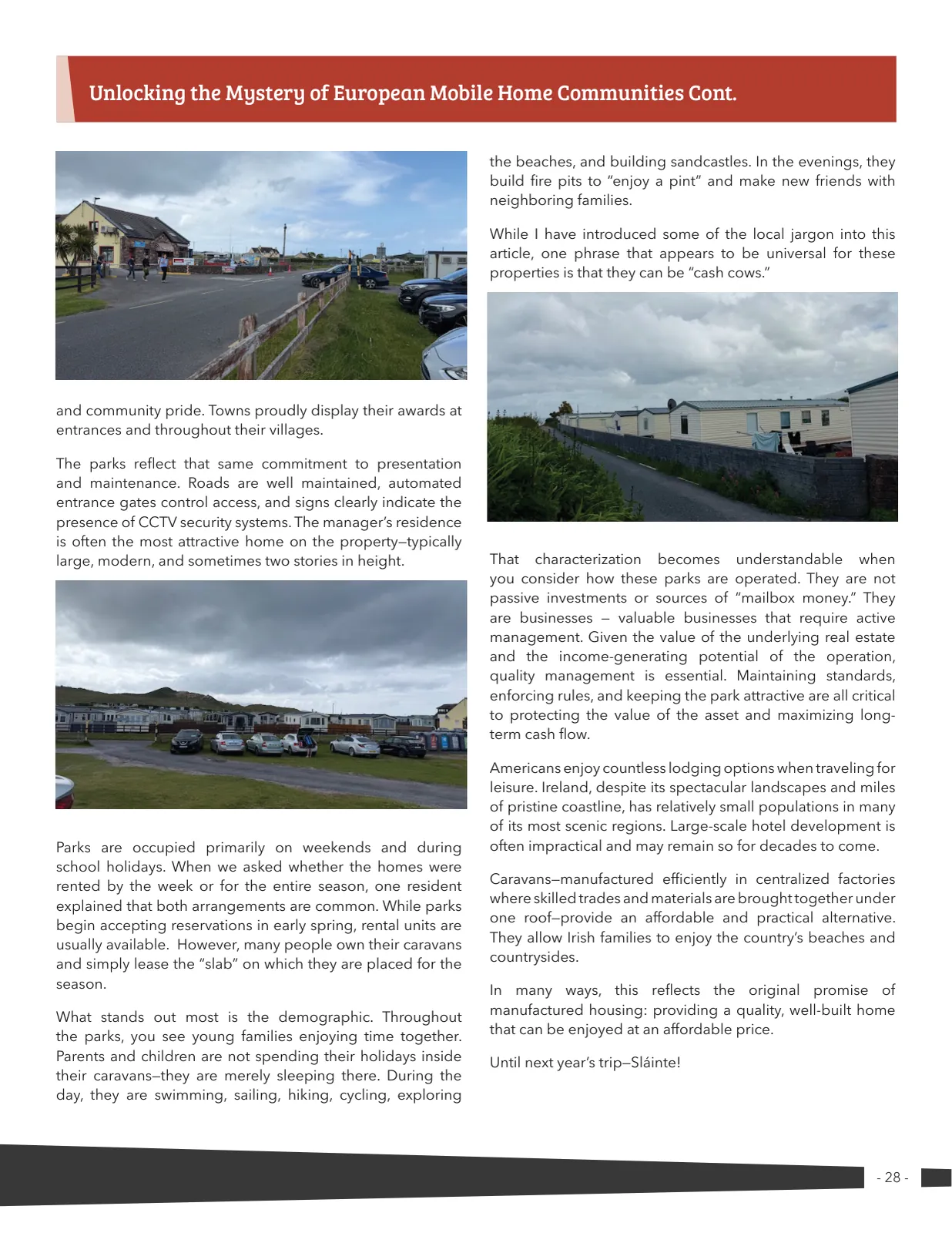
The parks reflect that same commitment to presentation and maintenance. Roads are well maintained, automated entrance gates control access, and signs clearly indicate the presence of CCTV security systems. The manager’s residence is often the most attractive home on the property—typically large, modern, and sometimes two stories in height.
Parks are occupied primarily on weekends and during school holidays. When we asked whether the homes were rented by the week or for the entire season, one resident explained that both arrangements are common. While parks begin accepting reservations in early spring, rental units are usually available. However, many people own their caravans and simply lease the “slab” on which they are placed for the season.
What stands out most is the demographic. Throughout the parks, you see young families enjoying time together. Parents and children are not spending their holidays inside their caravans—they are merely sleeping there. During the day, they are swimming, sailing, hiking, cycling, exploring the beaches, and building sandcastles. In the evenings, they build fire pits to “enjoy a pint” and make new friends with neighboring families.
While I have introduced some of the local jargon into this article, one phrase that appears to be universal for these properties is that they can be “cash cows.”
That characterization becomes understandable when you consider how these parks are operated. They are not passive investments or sources of “mailbox money.” They are businesses — valuable businesses that require active management. Given the value of the underlying real estate and the income-generating potential of the operation, quality management is essential. Maintaining standards, enforcing rules, and keeping the park attractive are all critical to protecting the value of the asset and maximizing long-term cash flow.
Americans enjoy countless lodging options when traveling for leisure. Ireland, despite its spectacular landscapes and miles of pristine coastline, has relatively small populations in many of its most scenic regions. Large-scale hotel development is often impractical and may remain so for decades to come.
Caravans—manufactured efficiently in centralized factories where skilled trades and materials are brought together under one roof—provide an affordable and practical alternative. They allow Irish families to enjoy the country’s beaches and countrysides.
In many ways, this reflects the original promise of manufactured housing: providing a quality, well-built home that can be enjoyed at an affordable price.
Until next year’s trip—Sláinte!
We are an electronically delivered quarterly magazine focused on the Manufactured Housing Industry. From Manufactured Home Community Managers, to Retailers, to Manufacturers, and all those that supply and service them, we supply news and educational articles that help them run their businesses.
ManufacturedHousingReview.com
Have something to contribute or advertise?
Email us at [email protected]
Communications regarding any alleged offending, inappropriate, inaccurate or infringing content should be directed immediately to [email protected] along with the communicator’s contact information.