












Text version of this issue
Grandfathered to Death: Why It’s Nearly Impossible to Maintain the Communities We Say We Want to Preserve
An empty site is remarkably easy to approve. It requires no permit, no variance and no public hearing at which six people explain that they strongly support affordable housing before describing, in considerable detail, why this particular affordable housing should be located somewhere else. An empty site can sit for a decade collecting weeds, a tire and a shopping cart nobody remembers stealing, and no one will ever ask whether it is adequately serving working families. It has never been accused of changing the character of the neighborhood. In the language of the ordinance, it is in full compliance.
Put a home back on it, however, and the site develops a criminal record.
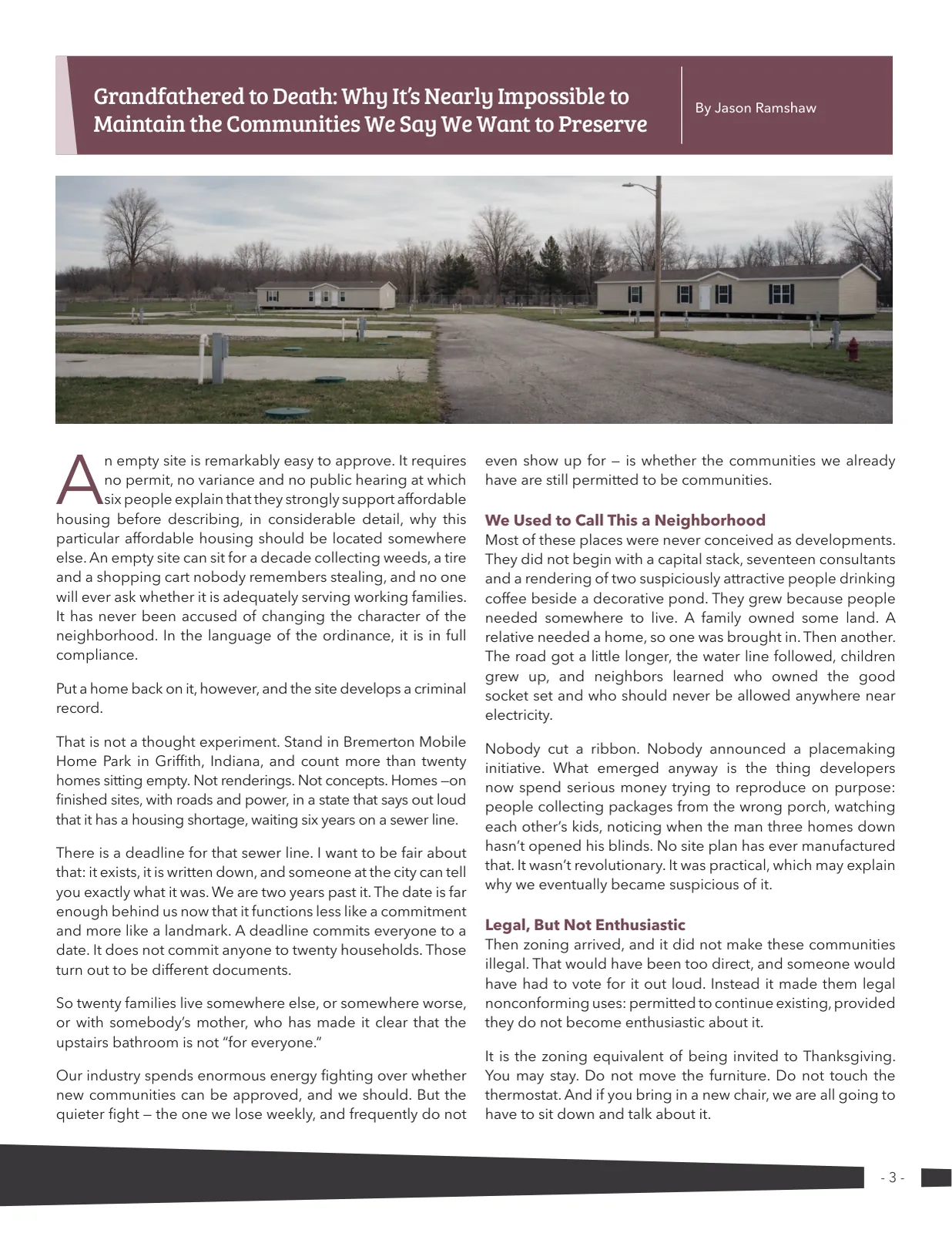
That is not a thought experiment. Stand in Bremerton Mobile Home Park in Griffith, Indiana, and count more than twenty homes sitting empty. Not renderings. Not concepts. Homes —on finished sites, with roads and power, in a state that says out loud that it has a housing shortage, waiting six years on a sewer line.
There is a deadline for that sewer line. I want to be fair about that: it exists, it is written down, and someone at the city can tell you exactly what it was. We are two years past it. The date is far enough behind us now that it functions less like a commitment and more like a landmark. A deadline commits everyone to a date. It does not commit anyone to twenty households. Those turn out to be different documents.
So twenty families live somewhere else, or somewhere worse, or with somebody’s mother, who has made it clear that the upstairs bathroom is not “for everyone.”
Our industry spends enormous energy fighting over whether new communities can be approved, and we should. But the quieter fight — the one we lose weekly, and frequently do not even show up for — is whether the communities we already have are still permitted to be communities.
We Used to Call This a Neighborhood
Most of these places were never conceived as developments. They did not begin with a capital stack, seventeen consultants and a rendering of two suspiciously attractive people drinking coffee beside a decorative pond. They grew because people needed somewhere to live. A family owned some land. A relative needed a home, so one was brought in. Then another. The road got a little longer, the water line followed, children grew up, and neighbors learned who owned the good socket set and who should never be allowed anywhere near electricity.
Nobody cut a ribbon. Nobody announced a placemaking initiative. What emerged anyway is the thing developers now spend serious money trying to reproduce on purpose: people collecting packages from the wrong porch, watching each other’s kids, noticing when the man three homes down hasn’t opened his blinds. No site plan has ever manufactured that. It wasn’t revolutionary. It was practical, which may explain why we eventually became suspicious of it.
Legal, But Not Enthusiastic
Then zoning arrived, and it did not make these communities illegal. That would have been too direct, and someone would have had to vote for it out loud. Instead it made them legal nonconforming uses: permitted to continue existing, provided they do not become enthusiastic about it.
It is the zoning equivalent of being invited to Thanksgiving. You may stay. Do not move the furniture. Do not touch the thermostat. And if you bring in a new chair, we are all going to have to sit down and talk about it.
That works beautifully for a use that never changes. Housing changes. Homes age, storms come, residents move away, and something has to go back on the site.
So an owner replaces a worn-out 1974 home with a new HUD-code home — safer, better insulated, better for the resident, better for the neighborhood, and better for everyone who has ever said the words “housing quality” into a microphone. Then the permit counter explains that putting a home where a home has stood since Nixon may not be maintenance. It may be an expansion of a nonconforming use.
Expansion. Of a use that just got smaller.
Expansion requires a variance. A variance requires a hearing. And while everyone deliberates, a second clock is running, because many ordinances hold that a site left unused for six months, or a year, forfeits the right entirely. Two clocks now: the approval process, and the penalty for waiting on the approval process. That is not preservation. That is a magic trick in which the housing disappears and everyone insists they never touched it.
One Sensible Brick at a Time
Zoning restrictions. Density minimums. Infrastructure standards written for five-hundred-unit subdivisions. Entitlement timelines measured in quarters. Each is defensible standing alone, which is precisely why the whole is impossible to argue with. One department wants a wider road. Another wants larger lots. Another needs one more study. Everybody brings a single sensible brick, and eventually somebody looks up and discovers a wall, with the affordable housing everyone keeps saying we need sitting on the other side of it.
Then financing joins the meeting, because the meeting was not long enough. A vacant site is worth something only if it can be filled, so the appraiser discounts it, the lender declines to fund it, and it stays empty — which confirms the appraisal. Nobody designed that loop. That is how you know it’s real.
And this is what makes the problem so durable: no villain is required. The planner may be doing exactly what the ordinance requires. The engineer may have a legitimate concern. The neighbor may sincerely worry about traffic. Everyone involved can be entirely reasonable, and twenty homes can still sit empty for six years.
The Vacancy Nobody Photographs
The resident across the street has not read the nonconforming use section of the ordinance. He knows a home has been empty since before the pandemic, and he draws the obvious conclusion: somebody stopped caring. He is looking at the same empty home I am. His explanation is shorter, and from the sidewalk, it is the better one.
That is the part of the housing shortage nobody can photograph. We can photograph an apartment building coming down, interview displaced residents, stand beside the rubble and understand exactly what was lost. Nobody photographs the family that never moved into the home that was already sitting there, on a finished site, waiting on a signature. There is no moving truck, no eviction notice, no crying child on the evening news. There is only a lot where people used to live, a file containing the very responsible reasons they no longer do, and a site in perfect compliance.
Fix Bad Owners. Don’t Outlaw the House.
Sometimes the neighbor is right. Some communities are badly run. Infrastructure gets deferred, rents rise with no corresponding improvement, and some owners know every number on the rent roll while remaining mysteriously unfamiliar with almost everyone who lives there. That is bad ownership. Call it bad ownership and fix it.
But we make a remarkable leap from “some operators behave badly” to “therefore this form of housing should be extraordinarily difficult to maintain.” When an apartment building has a terrible landlord, we do not ban apartments. When a restaurant poisons its customers we close the restaurant; we generally resist zoning out lunch. Yet the system blames operators for deterioration and then requires a variance to reverse it. It demands reinvestment and then penalizes it. It says preserve the community, provided preservation looks exactly like neglect.
I’ll grant the counterargument its due, and it has been made in these pages: restrictive zoning does keep a competitor from building across the road. Scarcity is good for the rent roll. It is a moat — wonderful right up until the day you need a drawbridge and discover you’re on the wrong side of it, standing with your residents. Fewer communities mean fewer choices, and fewer choices have never once produced better prices, however compassionate the hearing sounded while creating them. Good intentions matter. They are not a housing unit.
Never Only an Asset Class
In this business we reduce neighborhoods to wonderfully efficient language: occupied site, lot rent, past-due balance, home type, year built. I do it in every offering memorandum I touch. The spreadsheet isn’t wrong. It’s incomplete.
Somewhere between those columns is a family that finally found a housing payment it could manage, a retiree who drinks his coffee on the same porch every morning, and a kid who knows which streetlight means it’s time to ride home. Someone planted tomatoes beside a home that somebody else, in a hearing, called temporary.
It is not temporary. It is where the dog sleeps, where the Christmas decorations are stored badly, and where everyone knows which floorboard makes noise. It is one of the last places in America where a family gets a detached home, a yard, some privacy and neighbors who know their kids’ names, without a mortgage the size of a small municipal bond. That inventory is being retired one empty site at a time, quietly, with everyone’s paperwork in order.
Permission
None of this is an argument against standards. Safe utilities and responsible infrastructure matter, and nobody serious misses the era when the utility department consisted of a gentleman named Earl, one wrench and a filing system based on vibes. It is an argument about proportion.
Treat home replacement as maintenance, because that is what it is. Let existing communities refill their existing vacant sites by right. Stop the abandonment clock when the delay is administrative, so a city cannot create a delay and then let the delay erase the housing.
And stop treating “no” like weather. Most operators never lose these fights; they never have them. They hear “no” from a planner and accept it the way you accept a forecast. It isn’t weather. Somebody decided it, and decisions come with procedure — appeals, zoning boards, variance standards, deadlines shorter than anyone expects. A legal nonconforming use is a property right, not a favor. Quite often the answer at the counter is an opinion delivered in the tone of a statute.
New communities matter, and we should keep fighting for them. But preservation cannot become a polite way of supervising the disappearance of the product. Protect these communities in principle while making them impossible to maintain in practice, and in twenty years we will have a beautifully preserved shortage. That isn’t a housing strategy. It’s curation.
We keep waiting for the affordable housing breakthrough to be an invention. Maybe AI. Maybe 3D printing. Maybe a federal program with an acronym so encouraging that we briefly forget it requires a seventy-four-page application. But the cheapest affordable housing in America is the housing already standing, on land already zoned, on sites already served. It doesn’t need a new idea. It needs permission to work the way it always has — and owners willing to insist on that permission in writing, with a citation.
Until then, everyone involved remains fully compliant.
So do twenty homes at Bremerton, still waiting on a sewer line that had, I’m told, a deadline.
Jason Ramshaw is an affordable housing advocate and founder of Rhino Communities, a manufactured housing-focused brokerage and advisory firm specializing in MHC sales, acquisitions, and strategic consulting nationwide. He spends much of his time somewhere between rent rolls, utility systems, zoning maps and the recurring American mystery of why housing everybody agrees we desperately need becomes a problem the moment somebody tries to build it. He is also partnered with Equity Consultants Real Estate, where he helps structure, underwrite and execute transactions across the Rhino platform with an emphasis on disciplined, financeable deals and housing that works in the real world.
Unlock potential in every property.
For 25 years, we’ve remained the only property management software partnering exclusively with manufactured housing.
Learn More
Aurora Trailer Sales
Aurora is the second largest city in Illinois. Its first eastern settlers claimed land along the Fox River in 1835. From there, the river flows into the Illinois River and eventually the Mississippi, linking Aurora to a much larger world.
The area received a huge boost in 1850 when the railroad was extended to Aurora, making the city the western terminus of the line from Chicago. Overnight, Aurora was connected to the nation, opening the door to commerce, industry, and growth.
By the turn of the 20th century, Aurora had become home to numerous international manufacturing companies and a destination for immigrants looking to work for the American Dream. So, when America’s first transcontinental highway—the Lincoln Highway—was established in 1915, it was only natural that the route would pass through Aurora.
And that is where our story begins.
Years earlier, an Aurora mayor had donated land that eventually grew to more than 320 acres, creating the city’s premier southeast-side park. The Lincoln Highway (today’s U.S. Route 30) bordered the park along its eastern edge, making it an ideal stopping place for travelers.
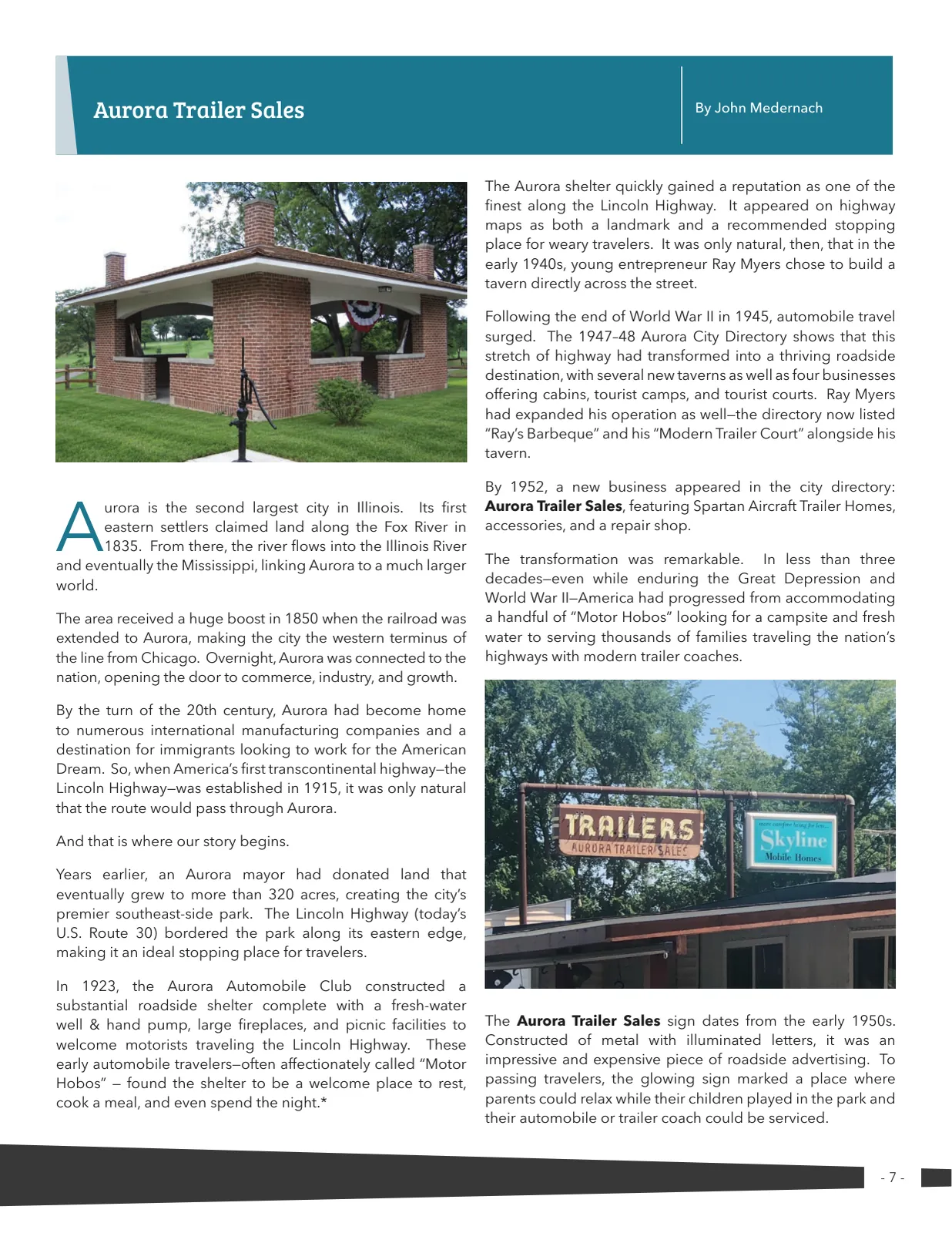
In 1923, the Aurora Automobile Club constructed a substantial roadside shelter complete with a fresh-water well & hand pump, large fireplaces, and picnic facilities to welcome motorists traveling the Lincoln Highway. These early automobile travelers—often affectionately called “Motor Hobos” — found the shelter to be a welcome place to rest, cook a meal, and even spend the night.*
The Aurora shelter quickly gained a reputation as one of the finest along the Lincoln Highway. It appeared on highway maps as both a landmark and a recommended stopping place for weary travelers. It was only natural, then, that in the early 1940s, young entrepreneur Ray Myers chose to build a tavern directly across the street.
Following the end of World War II in 1945, automobile travel surged. The 1947–48 Aurora City Directory shows that this stretch of highway had transformed into a thriving roadside destination, with several new taverns as well as four businesses offering cabins, tourist camps, and tourist courts. Ray Myers had expanded his operation as well—the directory now listed “Ray’s Barbeque” and his “Modern Trailer Court” alongside his tavern.
By 1952, a new business appeared in the city directory: Aurora Trailer Sales, featuring Spartan Aircraft Trailer Homes, accessories, and a repair shop.
The transformation was remarkable. In less than three decades—even while enduring the Great Depression and World War II—America had progressed from accommodating a handful of “Motor Hobos” looking for a campsite and fresh water to serving thousands of families traveling the nation’s highways with modern trailer coaches.
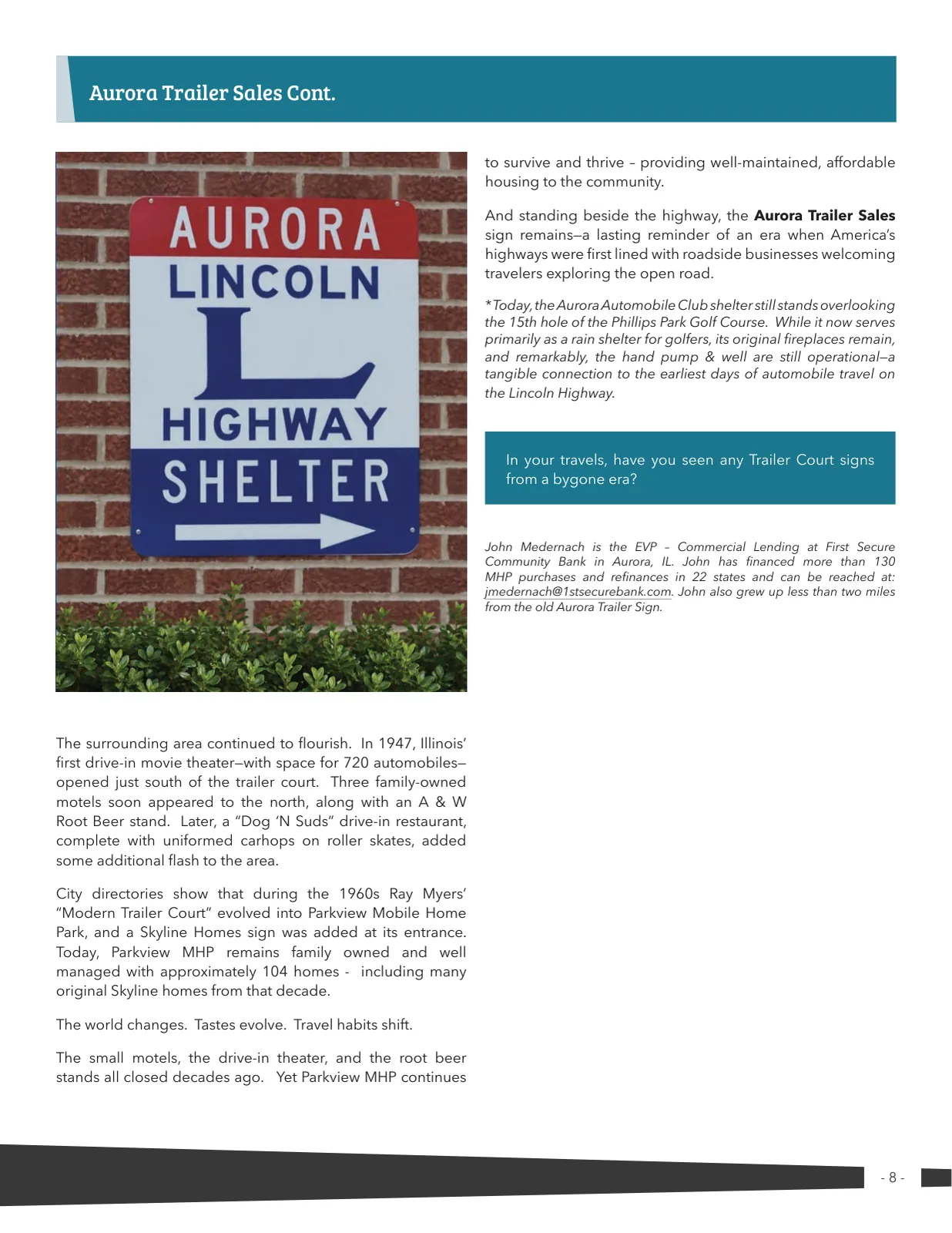
The Aurora Trailer Sales sign dates from the early 1950s. Constructed of metal with illuminated letters, it was an impressive and expensive piece of roadside advertising. To passing travelers, the glowing sign marked a place where parents could relax while their children played in the park and their automobile or trailer coach could be serviced.
The surrounding area continued to flourish. In 1947, Illinois’ first drive-in movie theater—with space for 720 automobiles—opened just south of the trailer court. Three family-owned motels soon appeared to the north, along with an A & W Root Beer stand. Later, a “Dog ‘N Suds” drive-in restaurant, complete with uniformed carhops on roller skates, added some additional flash to the area.
City directories show that during the 1960s Ray Myers’ “Modern Trailer Court” evolved into Parkview Mobile Home Park, and a Skyline Homes sign was added at its entrance. Today, Parkview MHP remains family owned and well managed with approximately 104 homes - including many original Skyline homes from that decade.
The world changes. Tastes evolve. Travel habits shift.
The small motels, the drive-in theater, and the root beer stands all closed decades ago. Yet Parkview MHP continues to survive and thrive – providing well-maintained, affordable housing to the community.
And standing beside the highway, the Aurora Trailer Sales sign remains—a lasting reminder of an era when America’s highways were first lined with roadside businesses welcoming travelers exploring the open road.
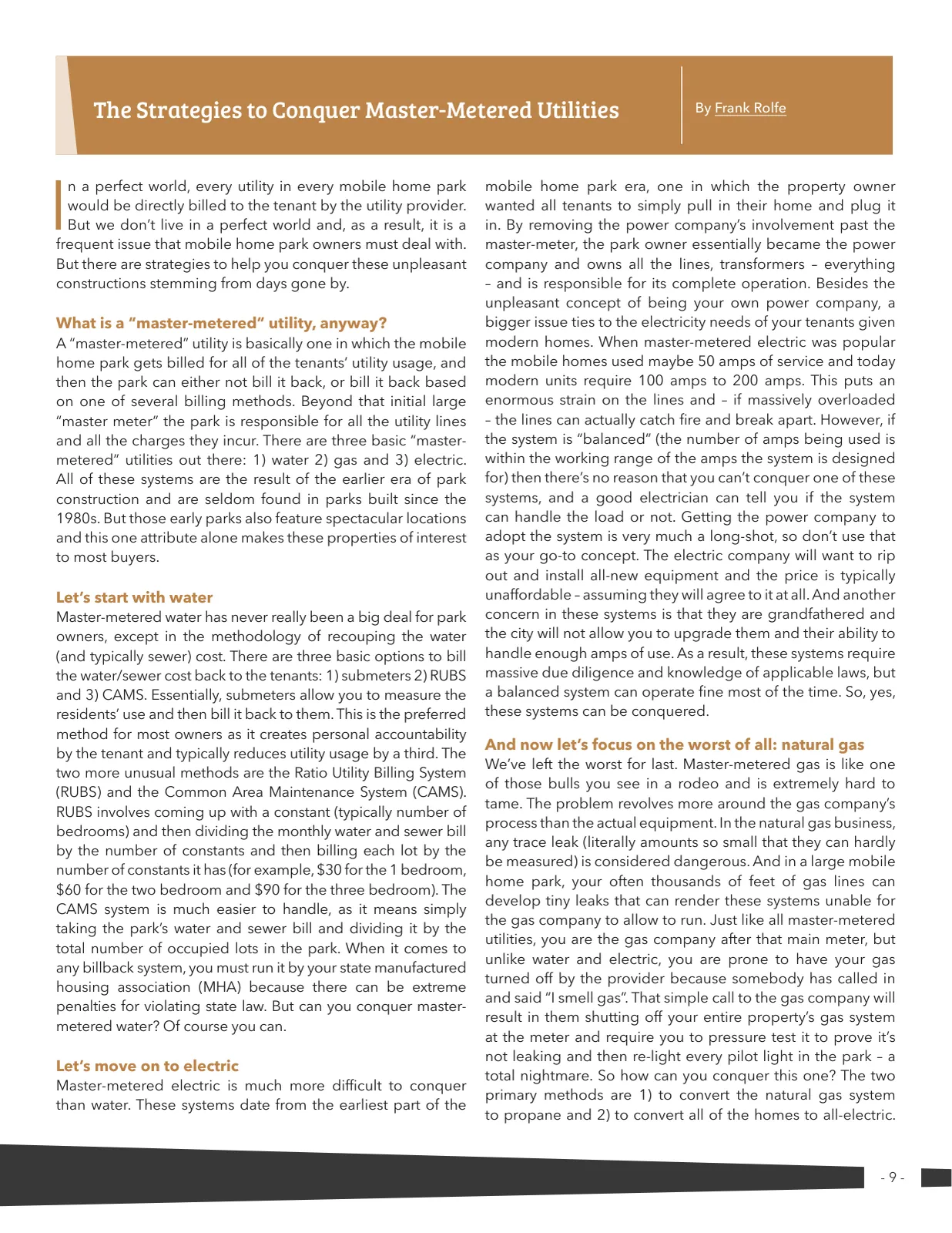
* Today, the Aurora Automobile Club shelter still stands overlooking the 15th hole of the Phillips Park Golf Course. While it now serves primarily as a rain shelter for golfers, its original fireplaces remain, and remarkably, the hand pump & well are still operational—a tangible connection to the earliest days of automobile travel on the Lincoln Highway.
In your travels, have you seen any Trailer Court signs from a bygone era?
John Medernach is the EVP – Commercial Lending at First Secure Community Bank in Aurora, IL. John has financed more than 130 MHP purchases and refinances in 22 states and can be reached at: [email protected]. John also grew up less than two miles from the old Aurora Trailer Sign.
The Strategies to Conquer Master-Metered Utilities
In a perfect world, every utility in every mobile home park would be directly billed to the tenant by the utility provider. But we don’t live in a perfect world and, as a result, it is a frequent issue that mobile home park owners must deal with. But there are strategies to help you conquer these unpleasant constructions stemming from days gone by.
What is a “master-metered” utility, anyway?
A “master-metered” utility is basically one in which the mobile home park gets billed for all of the tenants’ utility usage, and then the park can either not bill it back, or bill it back based on one of several billing methods. Beyond that initial large “master meter” the park is responsible for all the utility lines and all the charges they incur. There are three basic “master-metered” utilities out there: 1) water 2) gas and 3) electric. All of these systems are the result of the earlier era of park construction and are seldom found in parks built since the 1980s. But those early parks also feature spectacular locations and this one attribute alone makes these properties of interest to most buyers.
Let’s start with water
Master-metered water has never really been a big deal for park owners, except in the methodology of recouping the water (and typically sewer) cost. There are three basic options to bill the water/sewer cost back to the tenants: 1) submeters 2) RUBS and 3) CAMS. Essentially, submeters allow you to measure the residents’ use and then bill it back to them. This is the preferred method for most owners as it creates personal accountability by the tenant and typically reduces utility usage by a third. The two more unusual methods are the Ratio Utility Billing System (RUBS) and the Common Area Maintenance System (CAMS). RUBS involves coming up with a constant (typically number of bedrooms) and then dividing the monthly water and sewer bill by the number of constants and then billing each lot by the number of constants it has (for example, $30 for the 1 bedroom, $60 for the two bedroom and $90 for the three bedroom). The CAMS system is much easier to handle, as it means simply taking the park’s water and sewer bill and dividing it by the total number of occupied lots in the park. When it comes to any billback system, you must run it by your state manufactured housing association (MHA) because there can be extreme penalties for violating state law. But can you conquer master-metered water? Of course you can.
Let’s move on to electric
Master-metered electric is much more difficult to conquer than water. These systems date from the earliest part of the mobile home park era, one in which the property owner wanted all tenants to simply pull in their home and plug it in. By removing the power company’s involvement past the master-meter, the park owner essentially became the power company and owns all the lines, transformers – everything – and is responsible for its complete operation. Besides the unpleasant concept of being your own power company, a bigger issue ties to the electricity needs of your tenants given modern homes. When master-metered electric was popular the mobile homes used maybe 50 amps of service and today modern units require 100 amps to 200 amps. This puts an enormous strain on the lines and – if massively overloaded – the lines can actually catch fire and break apart. However, if the system is “balanced” (the number of amps being used is within the working range of the amps the system is designed for) then there’s no reason that you can’t conquer one of these systems, and a good electrician can tell you if the system can handle the load or not. Getting the power company to adopt the system is very much a long-shot, so don’t use that as your go-to concept. The electric company will want to rip out and install all-new equipment and the price is typically unaffordable – assuming they will agree to it at all. And another concern in these systems is that they are grandfathered and the city will not allow you to upgrade them and their ability to handle enough amps of use. As a result, these systems require massive due diligence and knowledge of applicable laws, but a balanced system can operate fine most of the time. So, yes, these systems can be conquered.
And now let’s focus on the worst of all: natural gas
We’ve left the worst for last. Master-metered gas is like one of those bulls you see in a rodeo and is extremely hard to tame. The problem revolves more around the gas company’s process than the actual equipment. In the natural gas business, any trace leak (literally amounts so small that they can hardly be measured) is considered dangerous. And in a large mobile home park, your often thousands of feet of gas lines can develop tiny leaks that can render these systems unable for the gas company to allow to run. Just like all master-metered utilities, you are the gas company after that main meter, but unlike water and electric, you are prone to have your gas turned off by the provider because somebody has called in and said “I smell gas”. That simple call to the gas company will result in them shutting off your entire property’s gas system at the meter and require you to pressure test it to prove it’s not leaking and then re-light every pilot light in the park – a total nightmare. So how can you conquer this one? The two primary methods are 1) to convert the natural gas system to propane and 2) to convert all of the homes to all-electric.
Of these options, the preferred one is propane conversion. Virtually all natural gas-powered homes have the ability to run on propane gas with the correct change to the appliance and furnace apertures. In addition, the propane tanks are owned by the propane company and the customers have to directly pay the propane company to get their tanks re-filled, so the park is no longer in the gas business at all (except for the tiny amount of pipe that runs from the propane tank to the home and has an expected life of decades). All-electric is a more expensive option, of course, because you literally have to replace every appliance and furnace that is gas powered with an electrical substitute. But either option results in your having no further “master-metered gas” worries. Of course, you will have to figure out the laws regarding propane conversion in your area, as well as the cost of electrical conversion and if the homes are capable of such a change. You will also have to weigh whether or not you feel the risk warrants conversion or not.
Conclusion
There are many great mobile home parks with master-metered utilities. They are not “deal-killers” necessarily but need significant due diligence to overcome the risks and to conquer your fears. Some of the most valuable parks in the U.S. are master-metered, such as those on Pacific Coast Highway in California, but those owners have spent a great amount of time learning how to successfully co-exist with these type of utility challenges. You, too, can conquer master-metered utilities when the other attributes are winners and you should never fear these to the point of avoidance.
Frank Rolfe has been an investor in mobile home parks for over three decades, and has owned and operated hundreds of mobile home parks during that time. He has ranked, with his partner Dave Reynolds, as high as the 5th largest mobile home park owner in the U.S., with over $1 billion worth of mobile home parks. Along the way, Frank began writing about the industry, and his books and educational programs on community acquisition and management became among the best-selling in the business. To learn more about Frank’s insights and expertise, visit www.MobileHomeUniversity.com.
What’s the Matter with Maine?
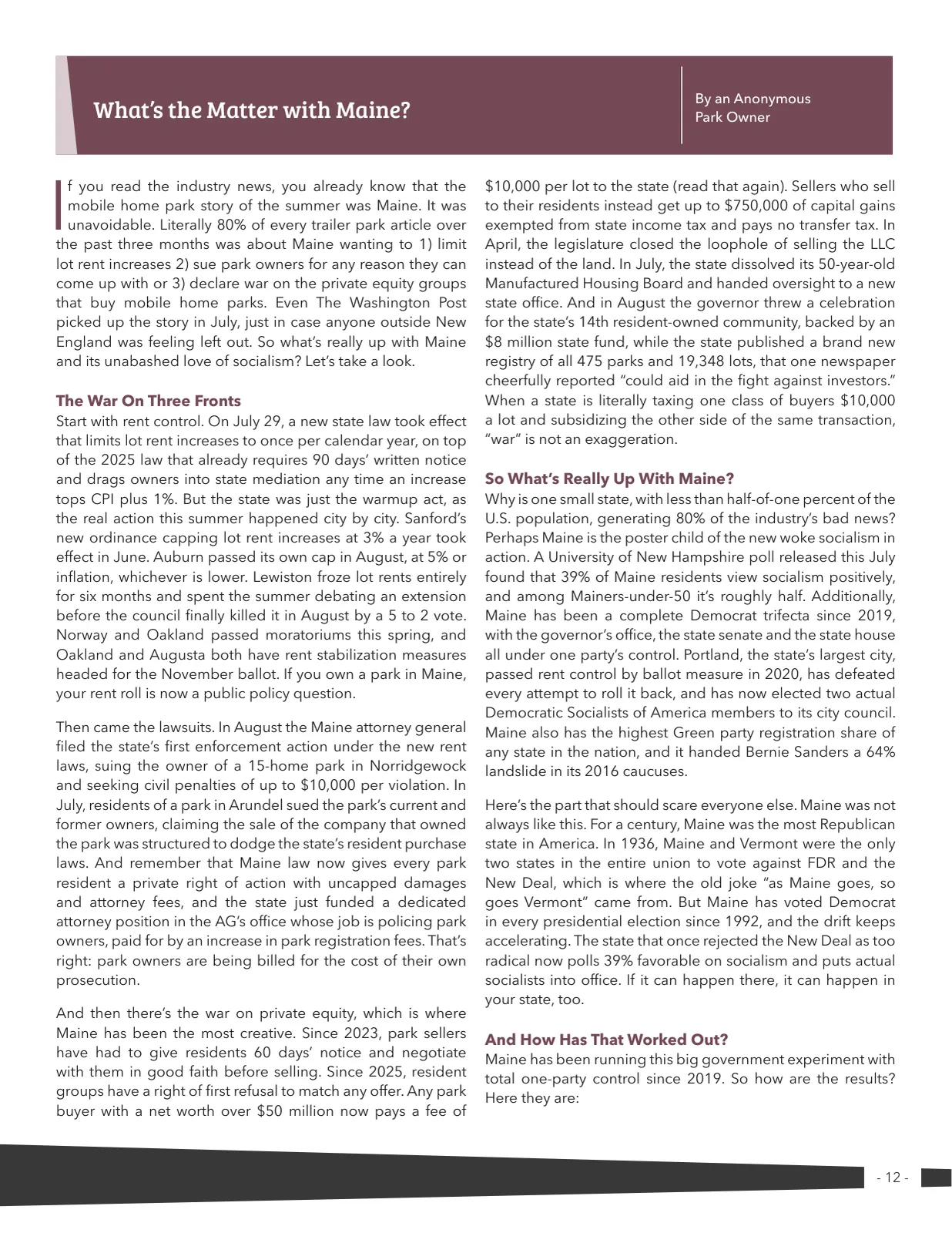
If you read the industry news, you already know that the mobile home park story of the summer was Maine. It was unavoidable. Literally 80% of every trailer park article over the past three months was about Maine wanting to 1) limit lot rent increases 2) sue park owners for any reason they can come up with or 3) declare war on the private equity groups that buy mobile home parks. Even The Washington Post picked up the story in July, just in case anyone outside New England was feeling left out. So what’s really up with Maine and its unabashed love of socialism? Let’s take a look.
The War On Three Fronts
Start with rent control. On July 29, a new state law took effect that limits lot rent increases to once per calendar year, on top of the 2025 law that already requires 90 days’ written notice and drags owners into state mediation any time an increase tops CPI plus 1%. But the state was just the warmup act, as the real action this summer happened city by city. Sanford’s new ordinance capping lot rent increases at 3% a year took effect in June. Auburn passed its own cap in August, at 5% or inflation, whichever is lower. Lewiston froze lot rents entirely for six months and spent the summer debating an extension before the council finally killed it in August by a 5 to 2 vote. Norway and Oakland passed moratoriums this spring, and Oakland and Augusta both have rent stabilization measures headed for the November ballot. If you own a park in Maine, your rent roll is now a public policy question.
Then came the lawsuits. In August the Maine attorney general filed the state’s first enforcement action under the new rent laws, suing the owner of a 15-home park in Norridgewock and seeking civil penalties of up to $10,000 per violation. In July, residents of a park in Arundel sued the park’s current and former owners, claiming the sale of the company that owned the park was structured to dodge the state’s resident purchase laws. And remember that Maine law now gives every park resident a private right of action with uncapped damages and attorney fees, and the state just funded a dedicated attorney position in the AG’s office whose job is policing park owners, paid for by an increase in park registration fees. That’s right: park owners are being billed for the cost of their own prosecution.
And then there’s the war on private equity, which is where Maine has been the most creative. Since 2023, park sellers have had to give residents 60 days’ notice and negotiate with them in good faith before selling. Since 2025, resident groups have a right of first refusal to match any offer. Any park buyer with a net worth over $50 million now pays a fee of $10,000 per lot to the state (read that again). Sellers who sell to their residents instead get up to $750,000 of capital gains exempted from state income tax and pays no transfer tax. In April, the legislature closed the loophole of selling the LLC instead of the land. In July, the state dissolved its 50-year-old Manufactured Housing Board and handed oversight to a new state office. And in August the governor threw a celebration for the state’s 14th resident-owned community, backed by an $8 million state fund, while the state published a brand new registry of all 475 parks and 19,348 lots, that one newspaper cheerfully reported “could aid in the fight against investors.” When a state is literally taxing one class of buyers $10,000 a lot and subsidizing the other side of the same transaction, “war” is not an exaggeration.
So What’s Really Up With Maine?
Why is one small state, with less than half-of-one percent of the U.S. population, generating 80% of the industry’s bad news? Perhaps Maine is the poster child of the new woke socialism in action. A University of New Hampshire poll released this July found that 39% of Maine residents view socialism positively, and among Mainers-under-50 it’s roughly half. Additionally, Maine has been a complete Democrat trifecta since 2019, with the governor’s office, the state senate and the state house all under one party’s control. Portland, the state’s largest city, passed rent control by ballot measure in 2020, has defeated every attempt to roll it back, and has now elected two actual Democratic Socialists of America members to its city council. Maine also has the highest Green party registration share of any state in the nation, and it handed Bernie Sanders a 64% landslide in its 2016 caucuses.
Here’s the part that should scare everyone else. Maine was not always like this. For a century, Maine was the most Republican state in America. In 1936, Maine and Vermont were the only two states in the entire union to vote against FDR and the New Deal, which is where the old joke “as Maine goes, so goes Vermont” came from. But Maine has voted Democrat in every presidential election since 1992, and the drift keeps accelerating. The state that once rejected the New Deal as too radical now polls 39% favorable on socialism and puts actual socialists into office. If it can happen there, it can happen in your state, too.
And How Has That Worked Out?
Maine has been running this big government experiment with total one-party control since 2019. So how are the results? Here they are:
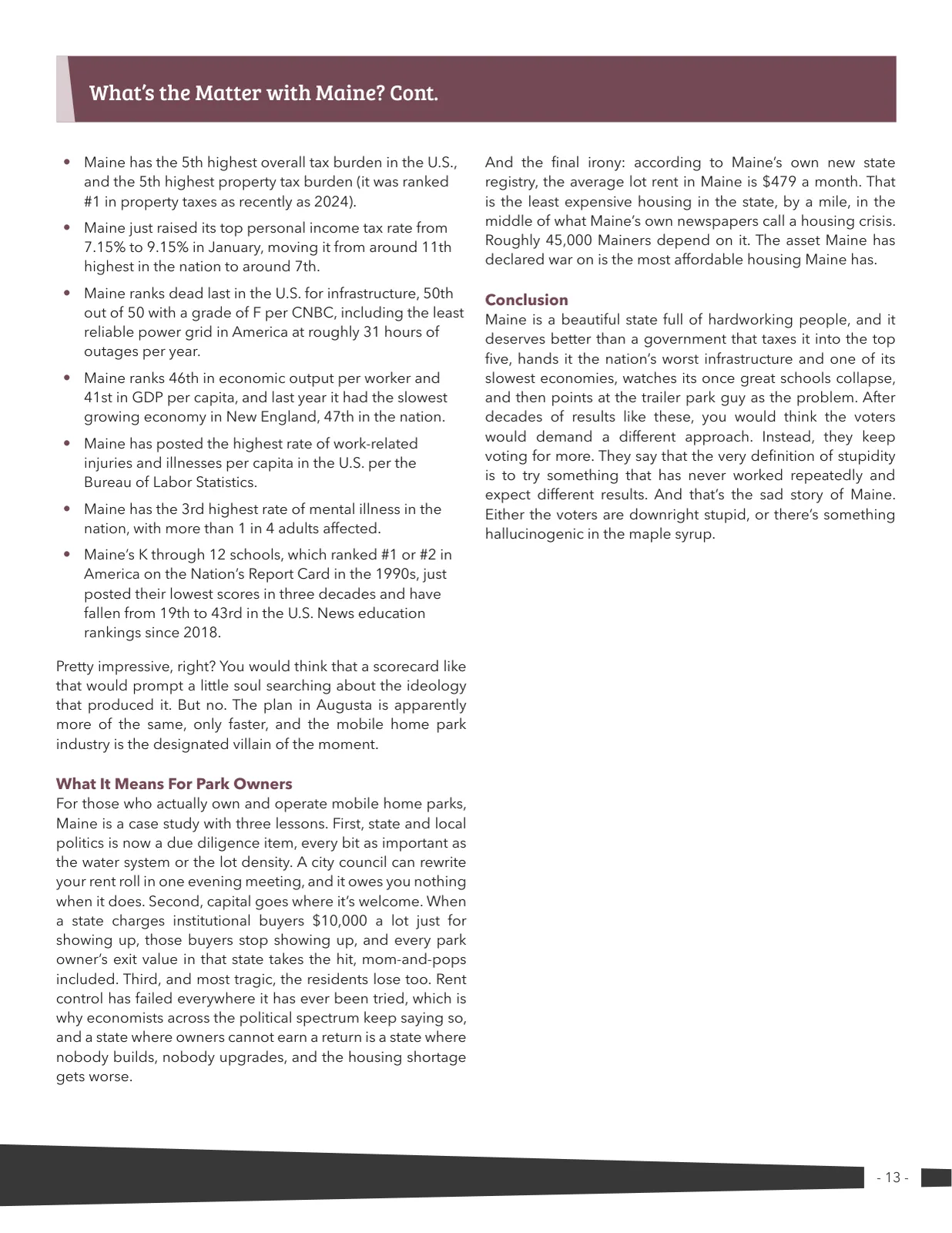
• Maine has the 5th highest overall tax burden in the U.S., and the 5th highest property tax burden (it was ranked #1 in property taxes as recently as 2024).
• Maine just raised its top personal income tax rate from 7.15% to 9.15% in January, moving it from around 11th highest in the nation to around 7th.
• Maine ranks dead last in the U.S. for infrastructure, 50th out of 50 with a grade of F per CNBC, including the least reliable power grid in America at roughly 31 hours of outages per year.
• Maine ranks 46th in economic output per worker and 41st in GDP per capita, and last year it had the slowest growing economy in New England, 47th in the nation.
• Maine has posted the highest rate of work-related injuries and illnesses per capita in the U.S. per the Bureau of Labor Statistics.
• Maine has the 3rd highest rate of mental illness in the nation, with more than 1 in 4 adults affected.
• Maine’s K through 12 schools, which ranked #1 or #2 in America on the Nation’s Report Card in the 1990s, just posted their lowest scores in three decades and have fallen from 19th to 43rd in the U.S. News education rankings since 2018.
Pretty impressive, right? You would think that a scorecard like that would prompt a little soul searching about the ideology that produced it. But no. The plan in Augusta is apparently more of the same, only faster, and the mobile home park industry is the designated villain of the moment.
What It Means For Park Owners
For those who actually own and operate mobile home parks, Maine is a case study with three lessons. First, state and local politics is now a due diligence item, every bit as important as the water system or the lot density. A city council can rewrite your rent roll in one evening meeting, and it owes you nothing when it does. Second, capital goes where it’s welcome. When a state charges institutional buyers $10,000 a lot just for showing up, those buyers stop showing up, and every park owner’s exit value in that state takes the hit, mom-and-pops included. Third, and most tragic, the residents lose too. Rent control has failed everywhere it has ever been tried, which is why economists across the political spectrum keep saying so, and a state where owners cannot earn a return is a state where nobody builds, nobody upgrades, and the housing shortage gets worse.
And the final irony: according to Maine’s own new state registry, the average lot rent in Maine is $479 a month. That is the least expensive housing in the state, by a mile, in the middle of what Maine’s own newspapers call a housing crisis. Roughly 45,000 Mainers depend on it. The asset Maine has declared war on is the most affordable housing Maine has.
Conclusion
Maine is a beautiful state full of hardworking people, and it deserves better than a government that taxes it into the top five, hands it the nation’s worst infrastructure and one of its slowest economies, watches its once great schools collapse, and then points at the trailer park guy as the problem. After decades of results like these, you would think the voters would demand a different approach. Instead, they keep voting for more. They say that the very definition of stupidity is to try something that has never worked repeatedly and expect different results. And that’s the sad story of Maine. Either the voters are downright stupid, or there’s something hallucinogenic in the maple syrup.
How To Combat Application Fraud With Tenant Screening
Rental fraud is quietly costing landlords millions, and even thorough background checks aren’t always enough to catch it. Within minutes, landlords can view a rental applicant’s credit and background history, but deceptive applications are becoming harder to spot.
The 2023-24 Pulse Survey conducted by the National Multifamily Housing Council (NMHC) found that over 70% of major apartment landlords reported an increase in fraudulent activity in the past year. They also reported that application fraud has nearly doubled since before the pandemic.
Adding to the challenge, it’s becoming harder for landlords to learn about an applicant’s criminal or eviction history. In 2023, Alameda County in California became the first in the United States to ban criminal background checks for renters, kickstarting a national trend to restrict access to criminal records.
What’s more, since 2017, the three major credit bureaus have removed civil judgments and state and federal tax liens from credit reports. That means a renter with an eviction record may still have a strong credit score, unless a landlord has won a monetary judgment and reported it through a collection agency.
With access to data diminishing and applicant fraud increasing, there are some precautions landlords should be taking to ensure they rent to good tenants.
Rental fraud takes many forms
According to NMHC, “the rise in false rental housing applications is exacerbating rental costs, fueling the housing affordability challenges facing communities across the country, and undermining the credibility of eviction data.”
As with most crime, rental fraud takes many shapes while it continues to evolve; 84.3% of the survey respondents reported seeing applicants falsifying or fabricating pay stubs, employment references, or other income documentation.
The following are the most common application frauds at this time:
• Identity theft: Scammers steal personal information, including Social Security numbers, to create false identities to apply for a lease.
• Providing fake credit reports: Applicants provide a falsified credit report with a high score and an exaggerated record of on-time payments. Property owners should always conduct their own credit and background checks through a reputable reporting company.
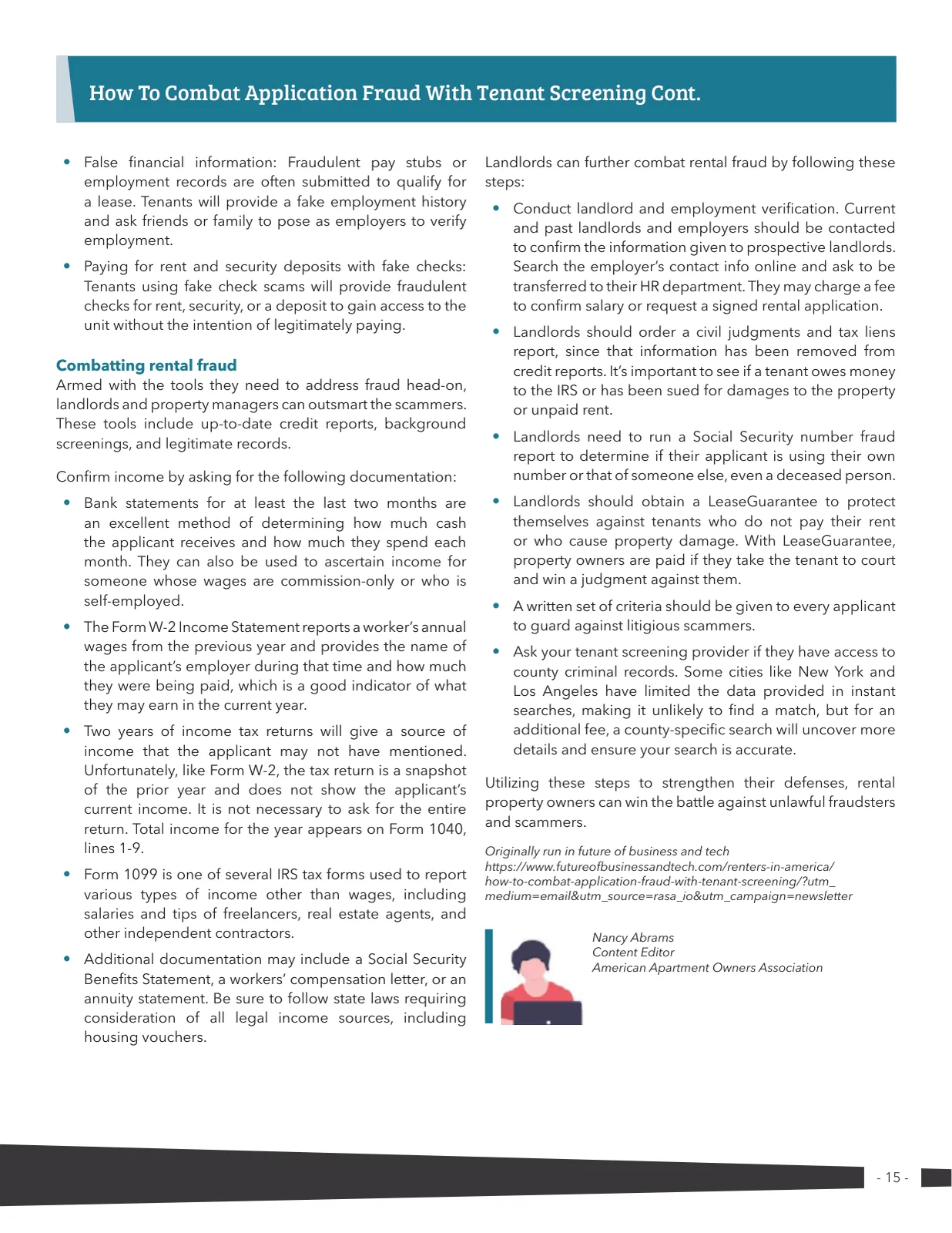
• False financial information: Fraudulent pay stubs or employment records are often submitted to qualify for a lease. Tenants will provide a fake employment history and ask friends or family to pose as employers to verify employment.
• Paying for rent and security deposits with fake checks: Tenants using fake check scams will provide fraudulent checks for rent, security, or a deposit to gain access to the unit without the intention of legitimately paying.
Combatting rental fraud
Armed with the tools they need to address fraud head-on, landlords and property managers can outsmart the scammers. These tools include up-to-date credit reports, background screenings, and legitimate records.
Confirm income by asking for the following documentation:
• Bank statements for at least the last two months are an excellent method of determining how much cash the applicant receives and how much they spend each month. They can also be used to ascertain income for someone whose wages are commission-only or who is self-employed.
• The Form W-2 Income Statement reports a worker’s annual wages from the previous year and provides the name of the applicant’s employer during that time and how much they were being paid, which is a good indicator of what they may earn in the current year.
• Two years of income tax returns will give a source of income that the applicant may not have mentioned. Unfortunately, like Form W-2, the tax return is a snapshot of the prior year and does not show the applicant’s current income. It is not necessary to ask for the entire return. Total income for the year appears on Form 1040, lines 1-9.
• Form 1099 is one of several IRS tax forms used to report various types of income other than wages, including salaries and tips of freelancers, real estate agents, and other independent contractors.
• Additional documentation may include a Social Security Benefits Statement, a workers’ compensation letter, or an annuity statement. Be sure to follow state laws requiring consideration of all legal income sources, including housing vouchers.
Landlords can further combat rental fraud by following these steps:
• Conduct landlord and employment verification. Current and past landlords and employers should be contacted to confirm the information given to prospective landlords. Search the employer’s contact info online and ask to be transferred to their HR department. They may charge a fee to confirm salary or request a signed rental application.
• Landlords should order a civil judgments and tax liens report, since that information has been removed from credit reports. It’s important to see if a tenant owes money to the IRS or has been sued for damages to the property or unpaid rent.
• Landlords need to run a Social Security number fraud report to determine if their applicant is using their own number or that of someone else, even a deceased person.
• Landlords should obtain a LeaseGuarantee to protect themselves against tenants who do not pay their rent or who cause property damage. With LeaseGuarantee, property owners are paid if they take the tenant to court and win a judgment against them.
• A written set of criteria should be given to every applicant to guard against litigious scammers.
• Ask your tenant screening provider if they have access to county criminal records. Some cities like New York and Los Angeles have limited the data provided in instant searches, making it unlikely to find a match, but for an additional fee, a county-specific search will uncover more details and ensure your search is accurate.
Utilizing these steps to strengthen their defenses, rental property owners can win the battle against unlawful fraudsters and scammers.
Originally run in future of business and tech https://www.futureofbusinessandtech.com/renters-in-america/how-to-combat-application-fraud-with-tenant-screening/?utm_ medium=email&utm_source=rasa_io&utm_campaign=newsletter
Nancy Abrams Content Editor American Apartment Owners Association
Utility Management Made Easy
Rent Manager’s utility management solutions can help centralize and simplify operations for your manufactured housing communities.
• Group and monitor utility usage patterns to proactively flag abnormal consumption— identifying hidden leaks and equipment failures.
• Provide insight into how much you’re spending on utilities versus what you’re charging residents with cost recovery reporting.
• Determine how meter estimates are calculated based on previous averages or seasonal trends to ensure billing practices are uniform and secure.
To learn more, scan the QR code or visit RentManager.com/Utilities
• Perform meter swaps effortlessly, whether you’re upgrading to smart meters, replacing faulty equipment, or getting ready for a new resident.
• Capture real-time usage data for billing consistency and to prevent disputes when residents move in or out of your community.
Smarter utility management begins with Rent Manager.
Manufactured Housing Expense Analysis
Manufactured Housing Expense Analysis
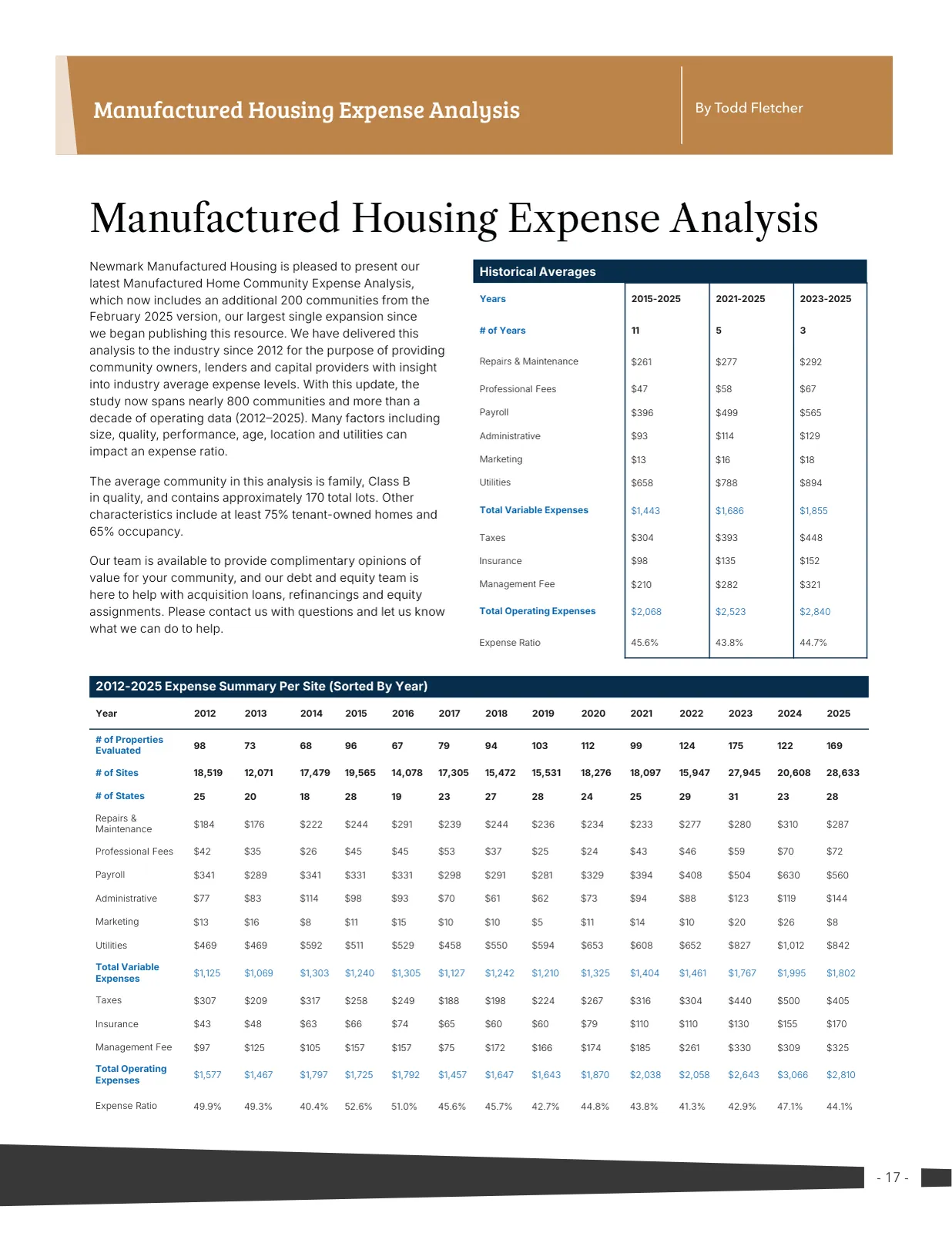
Newmark Manufactured Housing is pleased to present our latest Manufactured Home Community Expense Analysis, which now includes an additional 200 communities from the February 2025 version, our largest single expansion since we began publishing this resource. We have delivered this analysis to the industry since 2012 for the purpose of providing community owners, lenders and capital providers with insight into industry average expense levels. With this update, the study now spans nearly 800 communities and more than a decade of operating data (2012–2025). Many factors including size, quality, performance, age, location and utilities can impact an expense ratio.
The average community in this analysis is family, Class B in quality, and contains approximately 170 total lots. Other characteristics include at least 75% tenant-owned homes and 65% occupancy.
Our team is available to provide complimentary opinions of value for your community, and our debt and equity team is here to help with acquisition loans, refinancings and equity assignments. Please contact us with questions and let us know what we can do to help.
2012-2025 Expense Summary Per Site (Sorted By Year)
Historical Averages
Years 2015-2025 2021-2025 2023-2025
# of Years 11 5 3
Repairs & Maintenance $261 $277 $292
Professional Fees $47 $58 $67
Payroll $396 $499 $565
Administrative $93 $114 $129
Marketing $13 $16 $18
Utilities $658 $788 $894
Total Variable Expenses $1,443 $1,686 $1,855
Taxes $304 $393 $448
Insurance $98 $135 $152
Management Fee $210 $282 $321
Total Operating Expenses $2,068 $2,523 $2,840
Expense Ratio 45.6% 43.8% 44.7%
Year 2012 2013 2014 2015 2016 2017 2018 2019 2020 2021 2022 2023 2024 2025
# of Properties Evaluated 98 73 68 96 67 79 94 103 112 99 124 175 122 169
# of Sites 18,519 12,071 17,479 19,565 14,078 17,305 15,472 15,531 18,276 18,097 15,947 27,945 20,608 28,633
# of States 25 20 18 28 19 23 27 28 24 25 29 31 23 28
Repairs & Maintenance $184 $176 $222 $244 $291 $239 $244 $236 $234 $233 $277 $280 $310 $287
Professional Fees $42 $35 $26 $45 $45 $53 $37 $25 $24 $43 $46 $59 $70 $72
Payroll $341 $289 $341 $331 $331 $298 $291 $281 $329 $394 $408 $504 $630 $560
Administrative $77 $83 $114 $98 $93 $70 $61 $62 $73 $94 $88 $123 $119 $144
Marketing $13 $16 $8 $11 $15 $10 $10 $5 $11 $14 $10 $20 $26 $8
Utilities $469 $469 $592 $511 $529 $458 $550 $594 $653 $608 $652 $827 $1,012 $842
Total Variable Expenses $1,125 $1,069 $1,303 $1,240 $1,305 $1,127 $1,242 $1,210 $1,325 $1,404 $1,461 $1,767 $1,995 $1,802
Taxes $307 $209 $317 $258 $249 $188 $198 $224 $267 $316 $304 $440 $500 $405
Insurance $43 $48 $63 $66 $74 $65 $60 $60 $79 $110 $110 $130 $155 $170
Management Fee $97 $125 $105 $157 $157 $75 $172 $166 $174 $185 $261 $330 $309 $325
Total Operating Expenses $1,577 $1,467 $1,797 $1,725 $1,792 $1,457 $1,647 $1,643 $1,870 $2,038 $2,058 $2,643 $3,066 $2,810
Expense Ratio 49.9% 49.3% 40.4% 52.6% 51.0% 45.6% 45.7% 42.7% 44.8% 43.8% 41.3% 42.9% 47.1% 44.1%
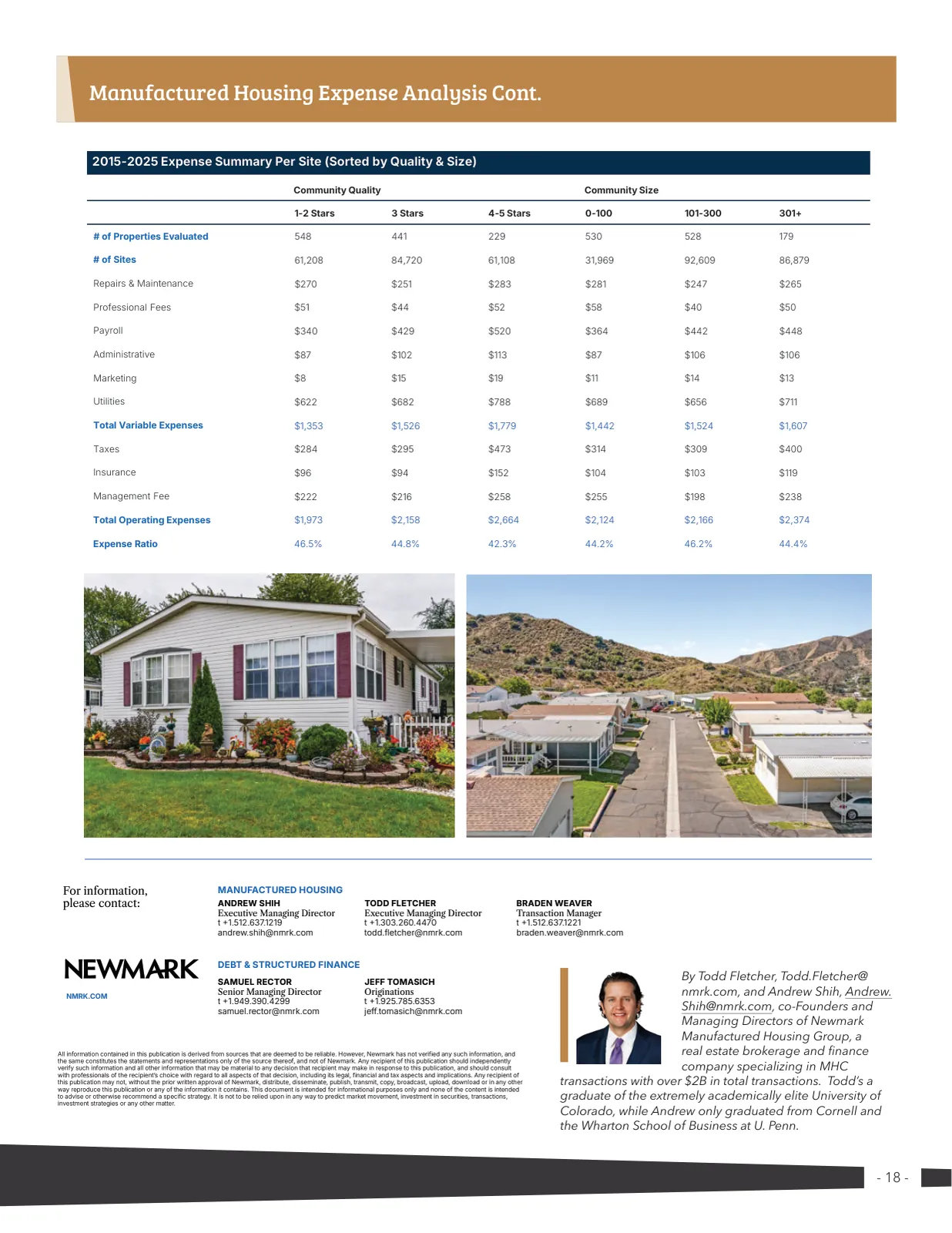
2015-2025 Expense Summary Per Site (Sorted by Quality & Size)
Community Quality Community Size
1-2 Stars 3 Stars 4-5 Stars 0-100 101-300 301+
# of Properties Evaluated 548 441 229 530 528 179
# of Sites 61,208 84,720 61,108 31,969 92,609 86,879
Repairs & Maintenance $270 $251 $283 $281 $247 $265
Professional Fees $51 $44 $52 $58 $40 $50
Payroll $340 $429 $520 $364 $442 $448
Administrative $87 $102 $113 $87 $106 $106
Marketing $8 $15 $19 $11 $14 $13
Utilities $622 $682 $788 $689 $656 $711
Total Variable Expenses $1,353 $1,526 $1,779 $1,442 $1,524 $1,607
Taxes $284 $295 $473 $314 $309 $400
Insurance $96 $94 $152 $104 $103 $119
Management Fee $222 $216 $258 $255 $198 $238
Total Operating Expenses $1,973 $2,158 $2,664 $2,124 $2,166 $2,374
Expense Ratio 46.5% 44.8% 42.3% 44.2% 46.2% 44.4%
MANUFACTURED HOUSING
For information, please contact: ANDREW SHIH Executive Managing Director t +1.512.637.1219 [email protected]
TODD FLETCHER Executive Managing Director t +1.303.260.4470 [email protected]
DEBT & STRUCTURED FINANCE
SAMUEL RECTOR Senior Managing Director t +1.949.390.4299 [email protected]
JEFF TOMASICH Originations t +1.925.785.6353 [email protected]
NMRK.COM
All information contained in this publication is derived from sources that are deemed to be reliable. However, Newmark has not verified any such information, and the same constitutes the statements and representations only of the source thereof, and not of Newmark. Any recipient of this publication should independently verify such information and all other information that may be material to any decision that recipient may make in response to this publication, and should consult with professionals of the recipient’s choice with regard to all aspects of that decision, including its legal, financial and tax aspects and implications. Any recipient of this publication may not, without the prior written approval of Newmark, distribute, disseminate, publish, transmit, copy, broadcast, upload, download or in any other way reproduce this publication or any of the information it contains. This document is intended for informational purposes only and none of the content is intended to advise or otherwise recommend a specific strategy. It is not to be relied upon in any way to predict market movement, investment in securities, transactions, investment strategies or any other matter.
BRADEN WEAVER Transaction Manager t +1.512.637.1221 [email protected]
King Insurance Joins the Mobile Insurance Team
On September 1, the King Insurance team joined Mobile Insurance, bringing together two agencies with a long history of serving the manufactured housing industry. Both agencies have been members of the American Insurance Alliance since its inception in 2001. The Alliance is a group of insurance agencies working together to expand insurance provider and coverage options for manufactured home retailers and community operators.
The combination of King Insurance and Mobile Insurance will provide clients with expanded insurance options, additional loss-control expertise, and greater operating efficiencies, while allowing the combined team to devote more time and resources to serving clients.
King Insurance was founded by MH and RV Hall of Fame inductee Dick King and is headquartered in Omaha, Nebraska. “This is a positive change for our employees and clients. Our agents will have more back-office support, more insurance options, and more time to provide clients with the best coverage advice and valuable resources available,” said Rick King.
“Rick and I have worked together to generate better insurance coverage options for our clients for more than 25 years. The claims experience and insights we have gained through years of serving clients and working together have taught us new ways to guide our clients toward safer and more profitable business operations. This is a good marriage of company cultures, teams, and access to the best insurance values available,” said Kurt Kelley, President of Mobile and King Insurance.
Special INSURANCE PROGRAMS with Industry Leading Value
Manufactured Home Retailers Manufactured Home Community Owners
Protect your Investments
• Retailers
• Communities
• Developers
• Transporters
• Installers
INSURANCE MOBILE
800-458-4320 800-458-4320
800-458-4320 [email protected]
Call or email today for a free consultation
Kurt Kelley - President
Midterm Trump 2.0 Verdict for Industry – Continuing Failure
In January 2025, with the start of President Donald Trump’s second term fast approaching, MHARR published an Issues and Perspectives (IP) article entitled “Trump 2.0 – The Industry’s Second Chance.” Noting that President Trump first came into office in January 2017 with a domestic policy agenda focused on cutting unnecessary, costly and burdensome federal regulation – particularly on small businesses -- the IP detailed the broader industry’s near-total failure to capitalize on that agenda during the four years of President Trump initial term (despite aggressive initiatives by MHARR), in order to ease federal regulatory burdens on manufactured housing producers as well as the post-production sector of the industry and consumers. The IP then recounted various “performative” actions by the Manufactured Housing Institute (MHI) which failed to achieve significant substantive results.
More importantly, though, the article stressed the continuing, urgent need for reform of the HUD program during President Trump’s second term and, most particularly, the crucial need for targeted, effective, broader industry action to address and eliminate the three principal regulatory bottlenecks which have suppressed the industry’s growth and expansion during the 21st Century, specifically:
1. Widespread discriminatory zoning exclusion of HUD-regulated manufactured homes;
2. Lack of Fannie Mae/Freddie Mac support for manufactured home personal property loans pursuant to the statutory “Duty to Serve” (DTS) mandate; and
3. Impending draconian and discriminatory manufactured home “energy conservation” standards.
Accordingly, the January 2025 IP concluded that:
“[T]he start of a second Trump presidential term provides the industry with a remarkable second chance. A second chance to clear away unnecessary and debilitating [energy] regulation. A second chance to eliminate (or significantly reduce) the discriminatory and exclusionary zoning edicts that have wrongly restricted [the] availability [of manufactured housing], and a second chance to demand – and push through to fruition – much-needed federal secondary market and securitization support for the vast bulk of manufactured home consumer chattel loans in accordance with DTS.”
So, with the midway point of President Trump’s second term only a few months away, and the November 2026 midterm elections threatening the possibility of a significant upheaval in the balance of political power in Washington, D.C., where does the industry stand on these three key priorities? And what, if anything, has been accomplished, for the industry as a whole (as contrasted with its largest corporate conglomerates), by – as MHI routinely presents itself – “the only national trade association that represents every segment of the factory-built housing industry?” The short answer, unfortunately, is:
(1) Not much that could not have been accomplished 40 years ago (before MHI – at that time -- withdrew its support, see, below); and
(2) virtually nothing on the three principal bottlenecks suppressing industry production.
This despite more than a million dollars in reported political contributions paid by MHI’s Political Action Committee (i.e., not including direct political contributions by MHI-connected individuals) between 2023 and 2026 according to public records.
For almost all of President Trump’s second term, to date, MHI’s main focus and main priority – from a public-facing perspective – seems to have been the enactment of legislation ultimately designated the “21st Century ROAD to Housing Act” (ROAD Act). That law, enacted on July 11, 2026 without President Trump’s signature, had two principal “takeaways” for manufactured housing. First, the Act finally repealed the 1974 federal requirement that manufactured homes be built on a “permanent chassis.” Second, the Act -- sort of – transferred (or, more accurately, restored) primary jurisdiction over manufactured home “energy” standards to HUD (although it did not, per se, repeal section 413 of the Energy Independence and Security Act of 2007 – EISA -- which directed the U.S. Department of Energy to establish manufactured housing energy conservation standards).
MHI, naturally, has touted the ROAD Act as a “major win” for the industry. But the significance of that alleged victory – or whether it is a “victory” at all – is, at a minimum, open to debate and has been the subject of ample misleading commentary. On the issue of optional/removable chassis, the concept of amending the 1974 law to delete the “permanent chassis” mandate was first broached some 40 years ago. Although agreement had been reached on that matter between MHARR, MHI and relevant members of Congress, MHI withdrew its support at a crucial juncture and that amendment – as well as other changes to the 1974 federal manufactured housing law -- ultimately failed. So, while the “permanent chassis” change is positive – and was supported by MHARR – it is not a new concept, and its ultimate impact on the industry and consumers will take years to determine, even after the molasses-like HUD regulatory process brings forth the necessary standards and regulations, which itself, will likely take years.
Beyond the singular optional chassis provision, however, the ROAD Act fails to address or rectify in any meaningful way, the principal bottlenecks that have stymied industry production. First, the ROAD Act has no mandatory provision(s) to prevent the zoning exclusion of HUD Code homes. While MHARR submitted a proposed amendment that would have strengthened the existing enhanced federal preemption of the Manufactured Housing Improvement Act of 2000 (2000 Reform Law) to expressly reach such discriminatory and exclusionary mandates, that amendment was not publicly supported by MHI. Second, the ROAD Act does not address the failure of the Government Sponsored Enterprises (GSEs) to provide secondary market or securitization support for the manufactured home consumer chattel loans which constitute nearly 80% of the entire market. Again, while MHARR submitted a proposed amendment to remedy this failure, that amendment was not publicly supported by MHI. And third, while the ROAD Act purports to make HUD the primary regulatory authority for manufactured housing energy conservation standards, the language utilized in the law does not strip the U.S. Department of Energy (DOE) of its regulatory authority under EISA and also contains other weaknesses that could (and likely will) be exploited by future administrations to again try to saddle the industry and its consumers with draconian, unnecessary, discriminatory and excessively-costly energy standards.
Worse yet, on energy regulation, the ROAD Act affirmatively requires new HUD manufactured housing “energy” standards, with continuing updates “not less frequently than once every three years” thereafter. In imposing this mandate, the ROAD Act itself contains no safeguards or guardrails to ensure that any (and all) such standards are both objectively necessary – and more importantly – specifically cost-justified. And, just to illustrate the immediate danger of this baseless mandate, the HUD-manipulated Manufactured Housing Consensus Committee (MHCC) -- just days after this directive was enacted – recommended new HUD manufactured housing “energy” standards based on proposals developed by the Committee in 2022, under the gun of the then-looming draconian DOE energy standards, with: (1) absolutely no reconsideration of their merit -- or lack thereof; and (2) no specific consideration of the likely current-day cost or market (i.e., consumer) impacts of those now four-year-old recommendations, in direct violation of the 2000 Reform Law. (See, MHARR July 27, 2026 Report – “MHI / ROAD Act Snatch Defeat from Jaws of Victory Regarding Manufactured Housing Energy Standards”).
The ROAD Act, then, essentially leaves intact – without any significant remedy – the three regulatory bottlenecks with the greatest negative impacts on the industry, its production levels, the placement, financing, sales and marketing of manufactured homes, and the overall availability of affordable, mainstream manufactured homes for Americans.
Meanwhile, as MHARR recently communicated to HUD Secretary Scott Turner, the HUD manufactured housing program – under its current leadership -- has been steadily regressing back to the abuses, mismanagement and discrimination against smaller industry businesses that characterized the program prior to President Trump’s first term and during the Biden Administration. As MHARR extensively detailed in that August 12, 2026 communication, these abuses primarily fall into four areas of paramount concern:
(1) “Corrupt manipulation of the Manufactured Housing Consensus Committee (MHCC) and its processes as established by the [Manufactured Housing Improvement Act of 2000];
(2) The imposition of (or pending imposition of) needless additional and further regulatory mandates that disproportionately impact and harm smaller industry businesses and consumers;
(3) Continued operation with the same personnel, same regulatory “contractor,” same regulatory excesses, same anti-small business agenda, perspective and biases, and same lack of transparency (e.g., failure to respond to multiple time-sensitive Freedom of Information Act requests – for years …) as it did prior to the Trump Administration; and
(4) Failing to take any action, whatsoever, to fully and properly implement remaining reform provisions of the 2000 Reform Law including, most importantly, the implementation of its enhanced federal preemption authority to invalidate discriminatory state and local zoning mandates which exclude HUD-regulated manufactured housing.”
(Emphasis added). MHARR’s communication subsequently details each of these areas with specific documents, facts and evidence.
Ultimately, beyond calling for specific concrete action by HUD Secretary Turner to address and correct each of these (steadily worsening) key program failures – with particular emphasis on urgent action to federally preempt cases of discriminatory zoning exclusion of HUD-regulated manufactured homes -- MHARR’s August 12, 2026 communication and supporting document package calls on the Secretary to “either … correc[t] or elevat[e] [the HUD manufactured housing program] to a position under [the Secretary’s] direct supervision, with an appointed Deputy Assistant Secretary.” (Emphasis added).
Based on this key takeaway and fundamental request to Secretary Turner, MHARR was gratified to learn – on August 24, 2026, some 12 days after MHARR’s communication to Secretary Turner – that the Secretary has appointed Mr.
Christopher Patterson, a HUD veteran from the first Trump Administration, to serve as Deputy Assistant Secretary of the HUD Office of Manufactured Housing Programs (OMHP). As MHARR noted contemporaneously with this appointment, while the jury will be out on Mr. Patterson until he begins to actively take control of the HUD program, and MHARR, will, therefore, withhold judgment on him and his appointment, the designation and selection of new leadership for the federal program so close in time to MHARR’s highly-critical communication detailing its extreme mismanagement, is encouraging and potentially significant.
As MHARR’s August 12, 2026 communication makes clear, however, the federal manufactured housing program at HUD has regressed significantly since the end of the first Trump Administration in January 2021. The industry – and most particularly its post-production sector (including, among other things, retailers, communities, consumer financing providers, insurers and developers) – cannot afford performative displays by MHI during the remaining 2+ years of the Trump Administration. Instead, the entire industry must address and finally correct the principal regulatory bottlenecks that continue to threaten its prosperity, its consumers and its very existence going forward.
Mark Weiss is the President and CEO of the Manufactured Housing Association for Regulatory Reform (MHARR) in Washington, D.C. He has served in that position since January 2015 and, prior to that, served as MHARR’s Senior Vice President and General Counsel.
MHARR is a Washington, D.C.-based national trade association representing the views and interests of independent producers of federally-regulated manufactured housing.
“MHARR-Issues and Perspectives” is available for re-publication in full (i.e., without alteration or substantive modification) without further permission and with proper attribution to MHARR.
Manufactured Housing Association for Regulatory Reform (MHARR) 1331 Pennsylvania Ave N.W., Suite 512, Washington D.C. 20004 Phone: 202/783-4087 | Fax: 202/783-4075 [email protected]
Notable Women in Manufactured Housing
First North American Rights for this Allen Legacy column, Is granted to MHInsider magazine on 5 May 2026
‘Pioneers Past, Present Day Leaders, Future Stars’
For most of the past half century, manufactured housing has been ‘a man’s world’ – well almost. Among the nearly 500 RV/MH Hall of Fame members inducted between 1972 and 2025, only 30 have been women; specifically, 12 in the MH industry, 12 from the RV industry, and three couples to date.
Furthermore; of the dozen or so published autobiographies archived in the RV/MH Hall of Fame library, all have been penned by male industry pioneers and leaders – but, hopefully, that too may be changing. A few RV and MH industry women are reportedly authoring memoirs, desiring to share their career and business success lessons learned, with young women beginning their careers.
And there is history relative to notable women in manufactured housing! During the early 1990s, a dozen women, mostly spouses of MH entrepreneurs, regional property managers, and several supplier reps, started meeting together during annual MH Congress sessions in Las Vegas, and Networking Roundtables across the U.S. During the few years they met and interacted, this informal group was known as Manufactured Housing Executive Women or ‘MHEW’. That group, however, faded after a few years.
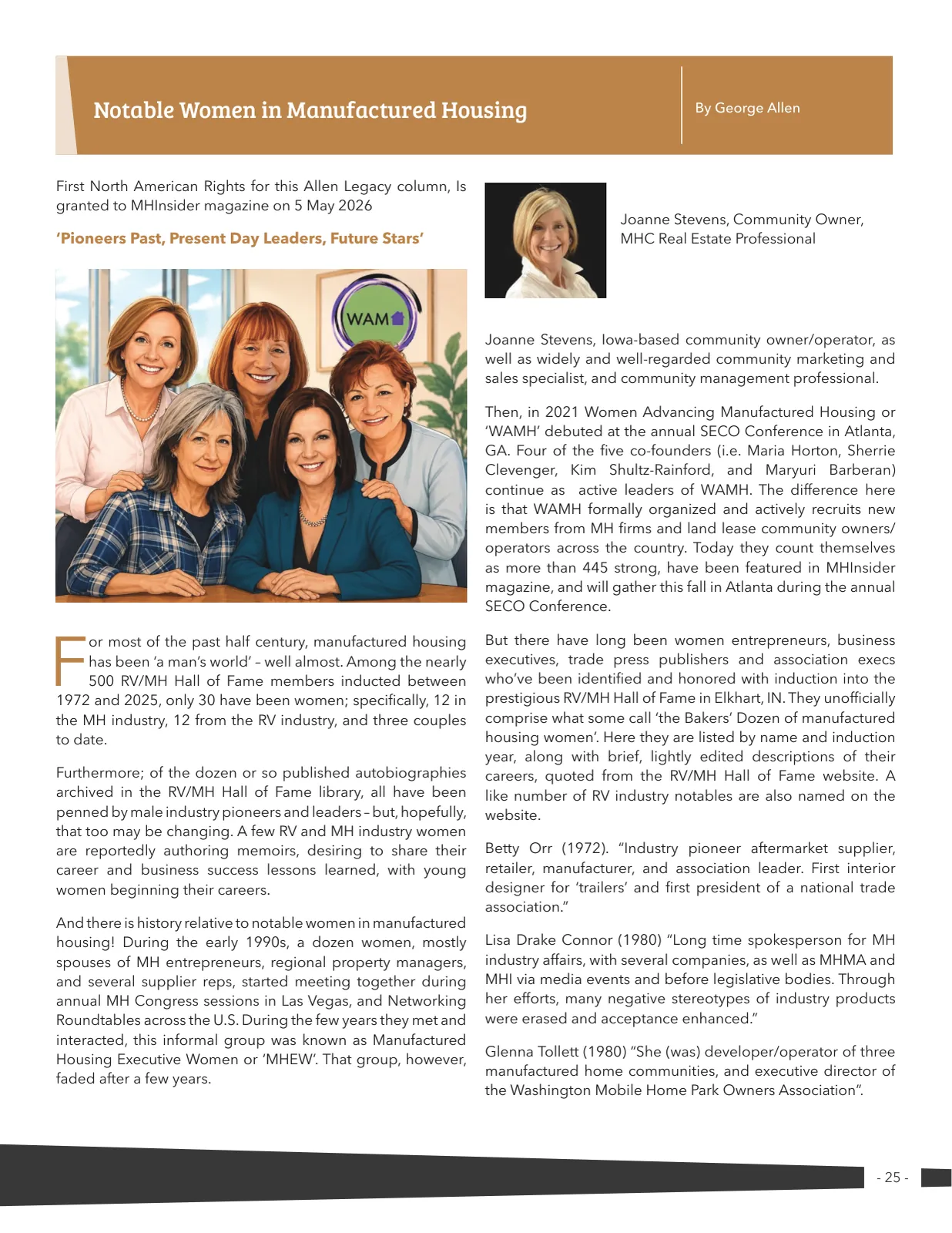
Joanne Stevens, Community Owner, MHC Real Estate Professional
Joanne Stevens, Iowa-based community owner/operator, as well as widely and well-regarded community marketing and sales specialist, and community management professional.
Then, in 2021 Women Advancing Manufactured Housing or ‘WAMH’ debuted at the annual SECO Conference in Atlanta, GA. Four of the five co-founders (i.e. Maria Horton, Sherrie Clevenger, Kim Shultz-Rainford, and Maryuri Barberan) continue as active leaders of WAMH. The difference here is that WAMH formally organized and actively recruits new members from MH firms and land lease community owners/operators across the country. Today they count themselves as more than 445 strong, have been featured in MHInsider magazine, and will gather this fall in Atlanta during the annual SECO Conference.
But there have long been women entrepreneurs, business executives, trade press publishers and association execs who’ve been identified and honored with induction into the prestigious RV/MH Hall of Fame in Elkhart, IN. They unofficially comprise what some call ‘the Bakers’ Dozen of manufactured housing women’. Here they are listed by name and induction year, along with brief, lightly edited descriptions of their careers, quoted from the RV/MH Hall of Fame website. A like number of RV industry notables are also named on the website.
Betty Orr (1972). “Industry pioneer aftermarket supplier, retailer, manufacturer, and association leader. First interior designer for ‘trailers’ and first president of a national trade association.”
Lisa Drake Connor (1980) “Long time spokesperson for MH industry affairs, with several companies, as well as MHMA and MHI via media events and before legislative bodies. Through her efforts, many negative stereotypes of industry products were erased and acceptance enhanced.”
Glenna Tollett (1980) “She (was) developer/operator of three manufactured home communities, and executive director of the Washington Mobile Home Park Owners Association”.
Ruth Kaseman (1983) “An industry leader since 1944, as cofounder and executive director of the Arizona Mobile Home Association. Also a co-founder of the RV/MH Hall of Fame.”
Doris Woodward (1985) “Editor of Trailer Life magazine in the 40s & 50s. And western representative for Trailer Dealer Magazine, Northwest Trailer News, and Jenkins Publishing Co.”
Maggie Stephenson (2003) “…Established a brokerage of new and pre-owned manufactured homes in the late 1970s, and is a 20 year IMHA board member and past state president.” Also served on the RV/MH Heritage Foundation Board of Directors, and developed a large land lease community in Indiana.
Mary Irene Younkin (2012) “A 60+ year veteran of the RV and housing industry. serving the Ohio MH association for more than 30 years.” She joined her late husband and son as members of the RV/MH Hall of Fame.
Theresa M. Desfosses (2014) “Since 1968 she has led her company in retail sales of HUD-Code and modular homes, and the development/management of land lease communities, with more than 600 home sites, in Maine and New Hampshire.”
Patricia Fiederer (2015) “Since 1972, Patricia has worked at Latham Homes of Oneonta, New York, and now serves as president. She has also developed several land lease communities, and has been an active member of the New York Housing Association for 40 years.”
Christine Lindsey (2017) “Lindsey began her career with UMH Properties, Inc., in 1979, and is currently their Vice President of Sales & Finance.” Also is a professional regional property manager of the firm’s land lease communities.
Debra (Dee) Pizer (2021). “She helped change the perception of this being an ‘exclusively male dominated’ industry, and has been essential to the growth and success of Zeman Home, as well as contributing to the continued success of the community industry as a whole.”
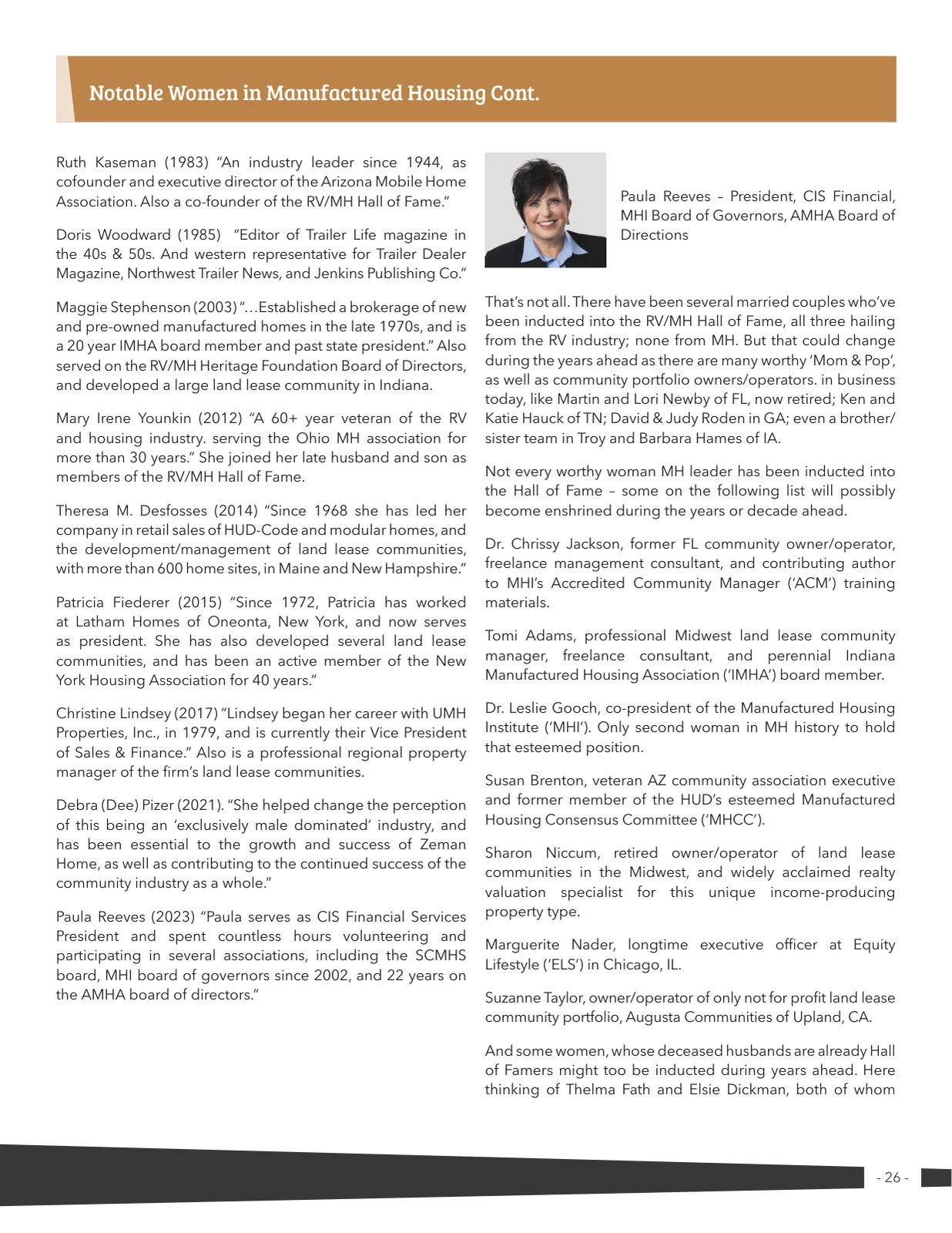
Paula Reeves (2023) “Paula serves as CIS Financial Services President and spent countless hours volunteering and participating in several associations, including the SCMHS board, MHI board of governors since 2002, and 22 years on the AMHA board of directors.”
Paula Reeves – President, CIS Financial, MHI Board of Governors, AMHA Board of Directions
That’s not all. There have been several married couples who’ve been inducted into the RV/MH Hall of Fame, all three hailing from the RV industry; none from MH. But that could change during the years ahead as there are many worthy ‘Mom & Pop’, as well as community portfolio owners/operators. in business today, like Martin and Lori Newby of FL, now retired; Ken and Katie Hauck of TN; David & Judy Roden in GA; even a brother/sister team in Troy and Barbara Hames of IA.
Not every worthy woman MH leader has been inducted into the Hall of Fame – some on the following list will possibly become enshrined during the years or decade ahead.
Dr. Chrissy Jackson, former FL community owner/operator, freelance management consultant, and contributing author to MHI’s Accredited Community Manager (‘ACM’) training materials.
Tomi Adams, professional Midwest land lease community manager, freelance consultant, and perennial Indiana Manufactured Housing Association (‘IMHA’) board member.
Dr. Leslie Gooch, co-president of the Manufactured Housing Institute (‘MHI’). Only second woman in MH history to hold that esteemed position.
Susan Brenton, veteran AZ community association executive and former member of the HUD’s esteemed Manufactured Housing Consensus Committee (‘MHCC’).
Sharon Niccum, retired owner/operator of land lease communities in the Midwest, and widely acclaimed realty valuation specialist for this unique income-producing property type.
Marguerite Nader, longtime executive officer at Equity Lifestyle (‘ELS’) in Chicago, IL.
Suzanne Taylor, owner/operator of only not for profit land lease community portfolio, Augusta Communities of Upland, CA.
And some women, whose deceased husbands are already Hall of Famers might too be inducted during years ahead. Here thinking of Thelma Fath and Elsie Dickman, both of whom
closely assisted their husbands Mel and Burt, respectively, develop their land lease communities.
And, there are simply too many women association executives, who’ve already distinguished themselves, to list here. However, two executives in particular, retired New York Housing Association (‘NYHA’) exec Nancy Geer, and 35 years Wisconsin Housing Alliance (‘WHA’) executive Ami Bliss.
Yes, many notable women entrepreneurs, property managers, and association executives have left their indelible marks on manufactured housing during the past 50+ years. And as you can readily see, there are many more now making their mark on the industry and among land lease community owners/operators. So, long live the RV/MH Hall of Fame and Women Advancing Manufactured Housing (‘WAMH’)! If you’re reading this and are a woman, plan now to attend the RV/MH Hall of Fame induction banquet in Elkhart, IN., on 17 August, then the annual SECO Conference in Atlanta, GA., on 6-8 October 2026. See you there! GFA
By George Allen - Lt. Col. Allen is a community owner, a Certified Property Manager, member of the RV/MH Heritage Hall of Fame, Member Emeritus of the Manufactured Housing Institute, the publisher of multiple MH Industry publications including the “Allen Report” and the “Allen Letter,” the author of multiple books including “Land Lease Community Management” now on its 7th edition, the host of the International Networking Roundtable, and a Lt. Colonel in the U.S. Marine Corp (retired) as well as a decorated Vietnam combat veteran.
Wire and Bank Fraud Reaching Record Levels
Recently, I emailed a request to my long-time banker to wire funds. I had previously met with my banking representative in person to discuss the upcoming transaction in detail. After our conversation, I followed up with an email confirming my wire instructions. The bank sent me the response below:
“With ever increasing cyber fraud, the Bank is taking additional steps to inform our customers of risks related to certain banking activities. We received your wire transfer email request. Email is not considered a secure delivery channel for sensitive data. Email traffic is highly susceptible to interception by third parties who could then use the account information, both yours and the recipient of the wire, to perpetrate fraud.
We strongly discourage this delivery method. Acceptable delivery channels include:
• Bank Internet Cash Management (preferred method for all commercial customers)
• Fax (Land lines only... Voice over IP systems are internet based)
• Hand delivery and Mail”
Banks are confronting increasingly sophisticated attempts to steal their customers’ funds. Financial institutions routinely warn customers about ongoing fraud attempts. These warnings, along with strict and sometimes cumbersome transaction procedures, are to protect account holders and prevent financial theft.
Here are four key bank account safety measures every organization must instigate to survive in today’s AI-enhanced fraud environment:
1. Regularly train and test all employees for phone and online theft attempts. Even employees with no banking authority can inadvertently provide thieves with company information that can be used to perpetrate fraud. Employees must be on guard for unsolicited and unexpected communications.
2. Institute strict electronic wire protocols and approvals, both internally and with your bank. This should include very limited company authority to instigate wires filed internally and with your bank.
3. Utilize your bank’s payment confirmation offerings that require approval of all payment requests presented to your account
4. Have Cyber Crime insurance protection. Confirm with your insurance agent you have funds protection. This has gone from a business option to a necessity.
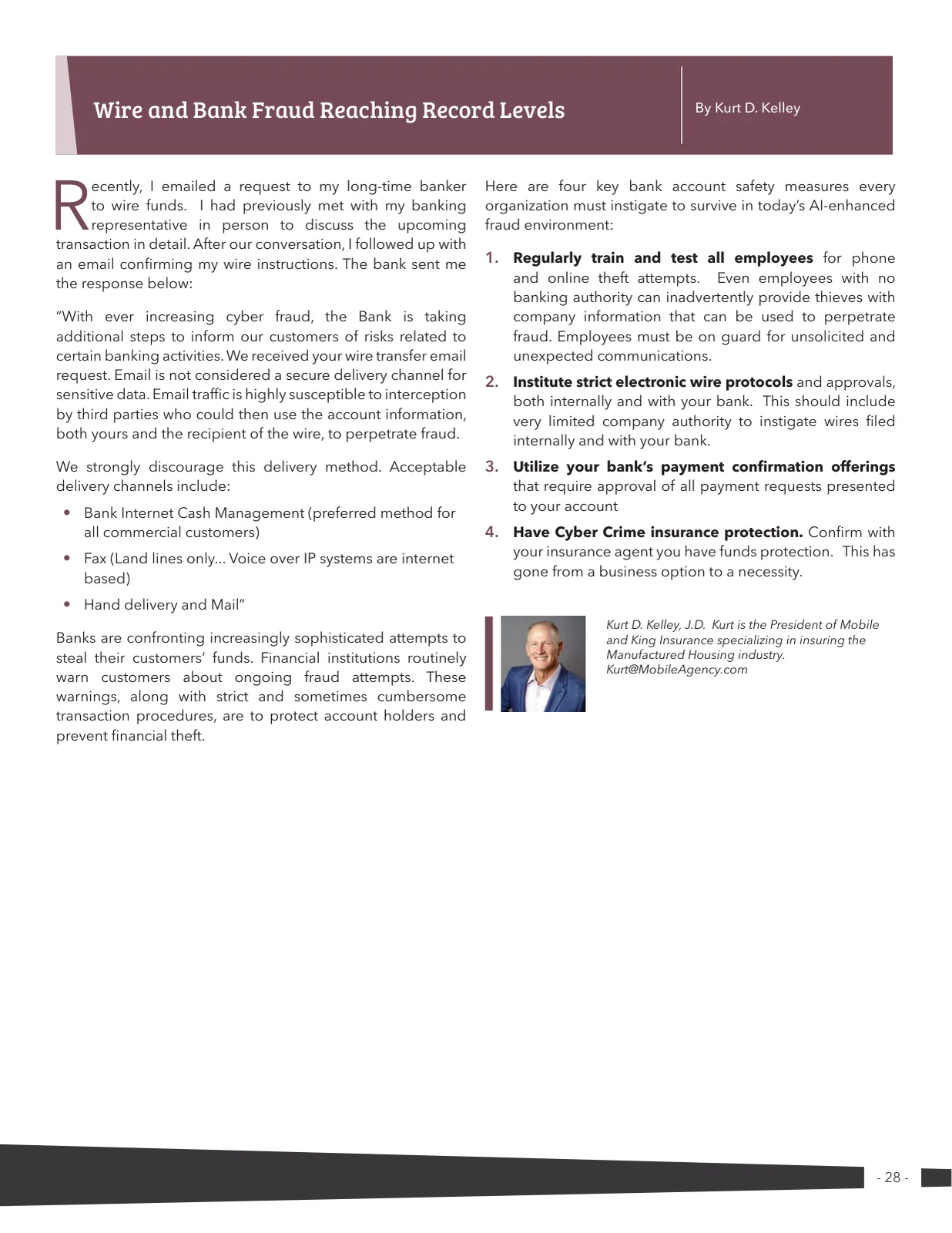
Kurt D. Kelley, J.D. Kurt is the President of Mobile and King Insurance specializing in insuring the Manufactured Housing industry. [email protected]
The Timing Trap: When Routine Rule Enforcement Starts Looking Like Retaliation
A resident has been violating a community rule for months. There has been thorough documentation, staff has issued reminders, and management is finally ready to escalate. Then the resident files a fair housing complaint or requests a reasonable accommodation.
Now what?
The underlying violation did not disappear. The lease did not suddenly become unenforceable. But the context surrounding the next management decision has changed. This is where retaliation risk becomes complicated. A perfectly ordinary lease violation notice, non-renewal, or other enforcement action can attract very different scrutiny when it closely follows a resident exercising a fair housing right.
The challenge is not simply whether you can enforce the rule, but how you demonstrate why you are enforcing it, why you are doing so now, and whether you would have made the same decision if the protected activity had never occurred.
The Rule May Be the Same. The Risk Is Not.
Under federal fair housing regulations, housing providers may not retaliate against someone because that person made a fair housing complaint, participated in a Fair Housing Act proceeding, or reported a discriminatory housing practice. More broadly, the Fair Housing Act protects people from interference related to exercising their fair housing rights.
That does not mean a resident who raises a fair housing concern becomes exempt from community rules.
Housing providers still need to address legitimate issues such as excessive noise, property damage, unauthorized occupants, safety concerns, or other lease violations. The distinction here is clear: legitimate, nondiscriminatory rule enforcement can continue, provided the housing provider can demonstrate that the action is genuinely connected to the violation rather than the resident’s protected activity.
The complication is timing. Imagine that management has tolerated or informally handled a particular violation for six months. A resident then makes a fair housing complaint. Two weeks later, management suddenly moves to formal enforcement. There may be a completely legitimate explanation. But now there is also an obvious question:
What changed?
That is the question your documentation should be able to answer.
The Timeline Is Part of the File
Property managers naturally focus on documenting the violation itself. What happened? When did it happen? Who witnessed it? Are there photographs, emails, incident reports, or other records? Those details matter. But when protected activity has recently occurred, another type of documentation becomes equally important: the decision timeline.
A strong file should make it possible to understand how management reached the decision without having to rely on someone saying, “Trust us, the complaint had nothing to do with it.”
For example, perhaps the resident received three previous notices before requesting an accommodation. Maybe the escalation was already scheduled. Perhaps management recently adopted a community-wide enforcement initiative that affected several residents at the same time. Those facts help tell the story.
On the other hand, if enforcement becomes dramatically faster, harsher, or more aggressive immediately after a resident raises a fair housing concern, the timing can create questions even when a legitimate lease violation exists. Timing alone does not automatically establish retaliation. But it can make the reasoning behind a decision much more important.
Consistency Helps, But It Is Not a Magic Word
“Be consistent” is among the most common pieces of advice in fair housing training. And for good reason. If five residents receive the same notice for the same violation under comparable circumstances, that history can help demonstrate that the action was part of normal property operations rather than a reaction to one resident’s complaint.
But consistency should mean more than having the same rule written in everyone’s lease. Look at the entire enforcement process:
• Are similar violations normally given a warning first?
• How much time are residents typically given to correct the problem?
• Who normally approves a non-renewal?
• Does this resident’s situation suddenly involve more inspections, more notices, or faster escalation than comparable situations?
The issue is not merely whether everyone is technically subject to the same policy. The issue is whether the policy is being applied through a reasonably consistent process, and that distinction matters.
Separate the Two Tracks
One of the safest operational habits is also one of the simplest: keep the resident’s protected activity and the unrelated lease issue on separate tracks. This can sound convoluted at first, so let’s go over a practical scenario. Suppose a resident requests a reasonable accommodation while management is addressing an ongoing noise problem. To best keep the request and the complaint separate, you can:
• Ensure the accommodation request moves through the accommodation process.
• Follow the normal lease-enforcement process regarding the noise issue.
• When following your documentation policies, make sure to record the request and the issue separately.
Documentation surrounding the lease violation should focus on the lease violation, not the resident’s complaint history, the amount of staff time they have consumed, or frustration surrounding their accommodation request. The more clearly the two issues can stand independently, the easier it becomes to explain the business reason behind management’s decision.
Give High-Risk Decisions a Second Set of Eyes
What is one of the most practical things you can do as a property manager faced with a high-risk decision-type situation? Follow the “second set of eyes” review when an adverse action closely follows a fair housing complaint, accusation, or request. This is more than a compliance suggestion; it is a management control.
Before issuing a significant notice, non-renewal, termination, or other adverse action, someone who was not directly involved in the resident interaction should review the file. A regional manager, compliance professional, supervisor, or legal counsel can ask questions that the site team may be too close to the situation to see:
Is the business reason clearly documented?
Have comparable situations been handled similarly?
Was this enforcement process already underway?
Has anything about management’s response changed since the protected activity occurred?
Does the written communication contain unnecessary references to the complaint or accommodation?
Would the file make sense to someone reviewing it six months from now with no knowledge of the personalities involved?
That last question is particularly useful. Because eventually, the person reviewing the decision may not be someone who knows the property at all.
Make the File Tell the Story
Retaliation prevention does not mean property managers have to stop enforcing legitimate rules when a resident exercises a fair housing right. It means recognizing that timing, consistency, documentation, and communication all become more important when protected activity and enforcement overlap.
By keeping accommodation or complaint processes separate from unrelated lease issues, documenting the reason and timeline behind decisions, using objective language, and adding a second level of review when appropriate, housing providers can continue managing their communities while reducing unnecessary risk. Clear policies and consistent enforcement still matter, but the strongest position is one where the entire record shows that the decision was based on legitimate business reasons—not the resident’s fair housing activity.
Source: Fair Housing Institute
https://american-apartment-owners-association.org/property-management/the-timing-trap-when-routine-rule-enforcement-starts-looking-like-retaliation/?utm_medium=email&utm_source=rasa_io&utm_ campaign=newsletter
Homeowners: Appraising a Manufactured Home for an Insurance Policy
Most manufactured home owners set their insurance coverage once, at the time of purchase, and never revisit it. The number on the policy usually comes from the sales price, a lender’s minimum requirement, or a quick estimate from the agent. None of those figures are the same as an appraised value, and the gap between them is where owners get hurt when a claim actually comes in.
Why an Independent Appraisal Matters for Manufactured Home Insurance
An insurance policy is only as good as the number it’s built on. If the insured value is too low, a total loss leaves the owner covering the difference between the payout and the actual cost to replace the home. If it’s set too high, the owner pays premiums on coverage they’ll never collect in full.
An independent appraisal solves that problem. Rather than relying on a purchase price that may be years old or a generic online calculator, an appraiser documents the home’s actual construction, condition, and local rebuilding costs, giving the owner, the agent, and the carrier a defensible number everyone can work from.
Insured Value Isn’t the Same as Market Value
One of the most common misunderstandings owners run into is treating the home’s market value and its insured value as interchangeable. Market value reflects what a buyer would pay for the home as it sits, land, location, and all. Insured value reflects what it would cost to rebuild the structure itself if it were destroyed.
Those two numbers can diverge significantly: older homes in desirable locations, where the land carries much of the sale price, or newer homes with high-end finishes that would be expensive to replace at current construction costs. An appraisal prepared specifically for insurance purposes is scoped to answer the replacement question, not the resale question. Owners who confuse the two are the ones most likely to end up with the wrong coverage amount.
What to Expect From the Appraisal Process
A manufactured home appraisal for insurance purposes generally involves a site visit or detailed documentation of the home’s construction and condition, followed by a written report that states the appraiser’s conclusion of value and
the basis for it. Appraisers working in this space typically prepare reports in accordance with the Uniform Standards of Professional Appraisal Practice (USPAP), the framework maintained by The Appraisal Foundation, which gives carriers and adjusters a consistent standard to evaluate the report against.
Owners who work with mobile home appraisal services as part of setting or reviewing their coverage get a documented, standards-based number instead of a guess, which is exactly what an insurer wants to see if a claim is ever questioned.
Questions Worth Asking Before You Rely on Any Number
Before an owner accepts whatever figure ends up on the policy, a short round of questions can catch a lot of problems:
• Is this number based on an appraisal, or an estimate the agent or carrier generated automatically?
• Does the policy pay replacement cost or actual cash value, and does the insured figure match that basis?
• Were recent additions or upgrades factored into the current value?
• When was the insured value last reviewed, and has anything changed since then?
A manufactured home is a significant asset, and the insurance built around it is only useful if the number behind it actually reflects what the home would cost to replace. An appraisal is the most direct way to get that number right, and to have something documented to stand behind if it’s ever challenged.
Joe Kattan, Founder, Mobile Home Mavens Mobile Home Mavens provides manufactured home appraisals for owners, lenders, and insurers nationwide. mobilehomeappraisal.co (929) 610-8244 [email protected]
Giving You Guidance.
Empowering you with the rental industry resources & education you need.
JOIN AAOA FOR FREE
SERVING YOU
139K
19YRS
MEMBERS
11K
REVIEWS
3M
UNITS MANAGED
Find Quality Tenants Learn
Reliable credit/background checks Option for landlord or tenant pay LeaseGuarantee to protect your rental income
Download Legal Forms
150+ Premium state-specific forms 20 Free landlord forms Attorney reviewed & customizable
Unlimited recorded & live webinars AAOA Today e-newsletter Free access to RENT Magazine
Grow Your Portfolio
Exclusive off-market listings Financing for your investments Vendor directory & discounts
AAOA.com 866.579.2262 [email protected]
When the Leasing Office Becomes a Lifeline
Mental Health, Loneliness and the Changing Role of Property Management
For those who work in multifamily housing, the job has always been about more than buildings. Property managers and onsite teams create communities, solve problems, navigate conflict and often become trusted faces in residents’ everyday lives.
Increasingly, that human side of property management includes encountering residents—and sometimes coworkers—who are struggling with their mental health.
According to The State of Mental Health in America 2025, 23.4% of U.S. adults experienced a mental illness in the previous year—more than 60 million people—and 17.7% experienced a substance use disorder—more than 46 million people. Anxiety and mood disorders are the top two disorders that people are living with impacting more than 73 million people.
Those statistics inevitably show up in our communities: a resident who suddenly stops caring for their home, someone behaving differently in a common area, a neighbor experiencing an obvious crisis, or someone who begins stopping by the office more frequently because they need someone to talk to.
When “I Have a Question” Really Means “I Need Connection”
Loneliness can be easy to overlook because it doesn’t always look like a mental health crisis.
For residents who live alone or have limited social connections, the leasing office may be one of the few places where someone recognizes them. A maintenance technician may be one of the few people who regularly knocks on their door. A community event may offer an important opportunity to interact with others.
Sometimes the resident lingering at the front desk after their question has been answered isn’t really there because of the package, parking permit or work order. They may simply need connection.
That does not mean property management professionals should become counselors. We are not there to diagnose mental illness or fix another person’s problems.
We can, however, notice. We can listen. We can connect people with appropriate resources. And we can create communities where people feel seen.
The People Helping Residents Are Under Pressure, Too
Our industry also cannot ignore the mental health of property management professionals themselves.
Swift Bunny’s 2025 Mental Health Study surveyed 1,631 respondents from companies representing 7,851 employees. On its 100-point scale, the overall score was 67—within the study’s “warning” range. Twenty-three percent of site team members and 66% of regional team members reported working 50 or more hours per week, while five of six stress-related scores fell into the “red flag” range below 60.
Consider someone onsite handling staffing shortages, resident concerns, delinquency, maintenance emergencies and everyday operational demands, then finding themselves face-to-face with someone experiencing a mental health challenge or even crisis.
Supporting others is difficult when your own tank is empty, and sometimes counterproductive.
There is encouraging news, however. Team relationships were among Swift Bunny’s stronger results, including relationships with coworkers and supervisors, access to company mental health resources and respectful treatment.
That suggests something important: relationships can be part of the solution.
You Don’t Have to Fix It to Help
When someone appears to be struggling, many people hesitate because they fear saying the wrong thing or stepping outside their role.
The answer isn’t to become a therapist. It’s to become a human being willing to engage—even when it feels awkward.
I created the MILES: Motivate, Inspire, Listen, Engage/Evaluate and Support framework as a simple way to think about interacting with someone showing signs of a mental health or substance-use challenge. It is not a clinical process or rigid sequence.
Motivate — Connect rather than diagnose. Ask whether the person has someone they can call or has considered talking with a professional. Employees should know their organization’s Employee Assistance Program and available benefits to facilitate their connection with capable professionals.
Inspire — Encourage self-care. Help others identify strategies that support their wellbeing, whether exercise, sleep, relationships, hobbies, nature or healthier boundaries. Small, intentional steps can help people manage stress and build resilience.
Listen — Listen more than you speak. Active, nonjudgmental listening builds trust. Leave room for silence, pay attention and resist the impulse to immediately solve the problem.
Engage/Evaluate — Be willing to start the conversation, stand still in the awkward, and know when concern becomes a safety issue. A simple expression of concern can open a door. Teams should also understand company emergency procedures and when professional crisis responders or emergency services are necessary. Supporting someone does not mean an onsite employee must personally manage a dangerous situation.
Support — Offer reassurance, useful information and a steady presence. Ask, “What can I do to help?” or “Who or what has helped you through something like this before?” The goal isn’t to fix the situation, but to help someone feel heard and connected to appropriate resources. Management companies should consider providing their communities with resources to offer residents.
And importantly, maintain boundaries. Caring about someone does not mean assuming responsibility for that person’s mental health.
Building Communities That Make Connection Easier
The loneliness component gives multifamily housing a unique opportunity.
We can’t cure loneliness with a resident event calendar, but we can intentionally create opportunities for connection through welcoming common spaces, activities, volunteer opportunities, neighbor introductions and everyday interactions that communicate, “You belong here.”
The same principle applies to our teams. Organizations have a role, too. Research indicates that 85% of workers believe actions taken by employers could positively affect their mental health. That can mean training managers, communicating benefits, addressing unreasonable workloads and giving employees opportunities to be heard. It may also mean sharing the message that self-care is not selfish and offering information about it. Less than a third of adults are engaging in daily self-care, which means we should talk about it more and evaluating the different domains of self-care: physical, mental, emotional, social and even spiritual. Exploring these areas with our colleagues would be a wonderful place to start the wellness conversation.
For property management leaders, the question isn’t whether mental health belongs in our industry conversation. It already does.
The question is whether our teams are prepared for conversations already happening at the leasing desk, in the maintenance shop, in the hallway and behind residents’ front doors.
We don’t need property managers to become mental health professionals. We need them to know their boundaries, know their resources and have the confidence to recognize when someone may need help—and to Motivate, Inspire, Listen, Engage/Evaluate and Support (MILES).
Sometimes the most valuable thing we can offer is remarkably simple: notice the person, listen without judgment and help connect them to the next right resource—while creating communities where residents and team members know they don’t have to navigate difficult moments alone.
Victoria Cowart, CPM, NAAEI Faculty, Vice President of Education at PetScreening, is a nationally recognized multifamily leader whose decades of industry impact span property management, education, advocacy, and leadership—including serving as president of both the Charleston Apartment Association and South Carolina Apartment Association and as an NAA regional vice president. A South Carolina Apartment Association Hall of Fame inductee, Victoria is a passionate champion for industry education, pets, and assistance animals, bringing nationally recognized expertise in fair housing, human resources, and professional development to every stage she takes.
We are an electronically delivered quarterly magazine focused on the Manufactured Housing Industry. From Manufactured Home Community Managers, to Retailers, to Manufacturers, and all those that supply and service them, we supply news and educational articles that help them run their businesses.
ManufacturedHousingReview.com
Have something to contribute or advertise?
Email us at [email protected]
Communications regarding any alleged offending, inappropriate, inaccurate or infringing content should be directed immediately to [email protected] along with the communicator’s contact information.